
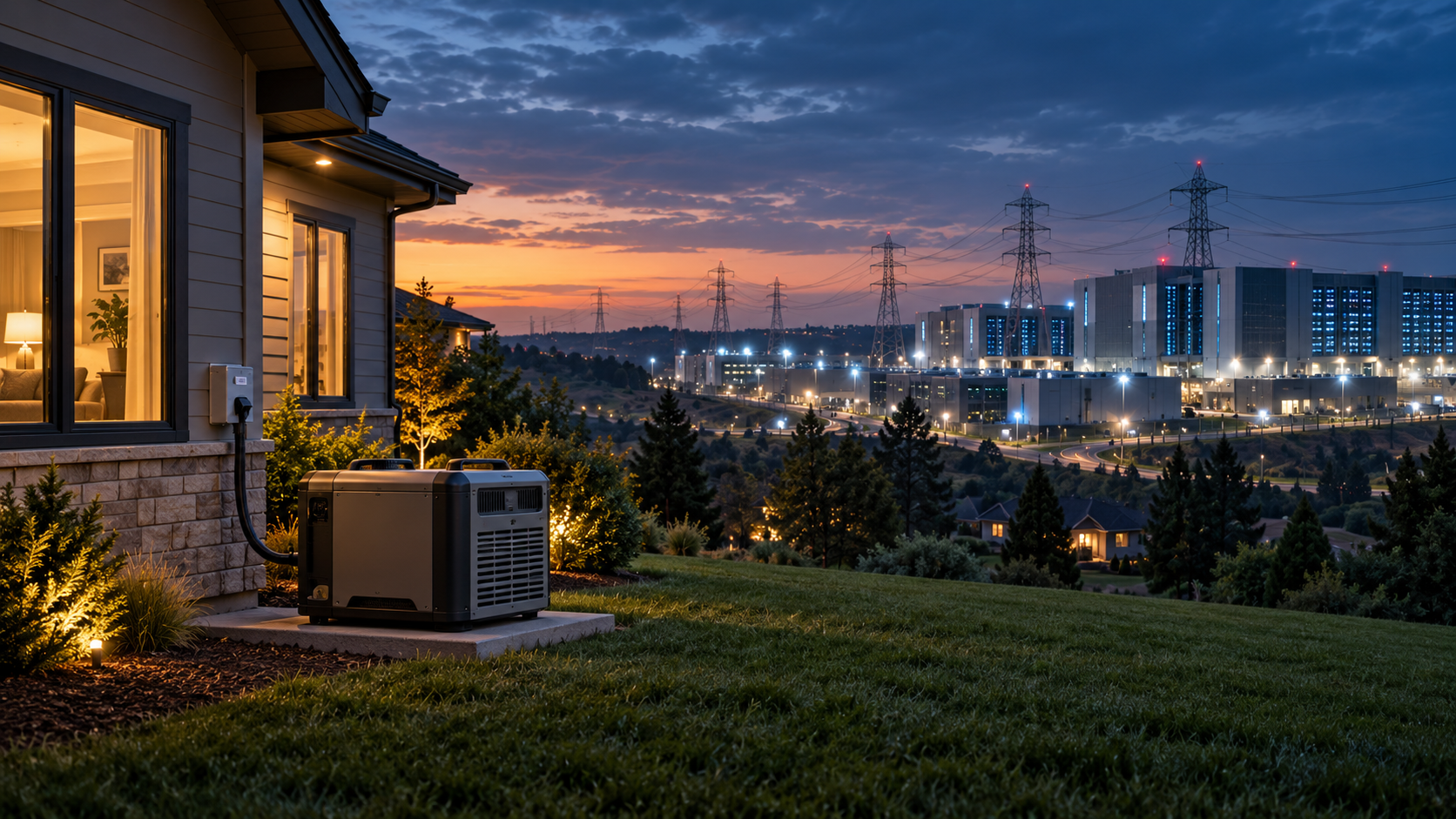
Artificial intelligence may feel like something that happens entirely inside a computer, but the infrastructure behind it is very physical.
AI models run in data centers filled with servers, networking equipment, cooling systems, backup power equipment, and other hardware that requires enormous amounts of electricity. As companies race to build larger AI systems and expand cloud computing capacity, equally enormous data centers are being proposed throughout the United States.
For homeowners, that raises two practical questions:
Could all of this new electricity demand raise your power bill? And could it make the electrical grid less reliable?
The short answer is yes, both are possible, but the situation is more complicated than saying data centers automatically cause higher bills or blackouts.
Quick answer: AI data centers are driving unusually fast growth in U.S. electricity demand. If new generation, transmission, and grid infrastructure do not expand quickly enough, that growth can contribute to higher electricity costs and smaller reliability margins. It does not mean utilities are automatically shutting off homes to keep data centers online, and regulators are already developing rules intended to prevent that outcome.
Electricity demand from data centers is growing extraordinarily quickly. In some regions, including the PJM grid that serves Pennsylvania and much of the Mid-Atlantic, new demand is arriving faster than new generation can be built.
For homeowners, the sensible response is not panic. It is understanding what is changing and deciding how dependent your household is on uninterrupted grid power.
How Much Electricity Do AI Data Centers Actually Use?
The numbers are enormous, and they are increasing quickly.
In June 2026, Lawrence Berkeley National Laboratory released an updated national data-center energy-use report estimating that data centers could consume approximately 649 terawatt-hours of electricity per year by 2030 in its reference scenario.
That would equal approximately 11.8% of total U.S. electricity consumption.
Because future AI growth is difficult to predict, researchers modeled several scenarios. The resulting range was approximately 9.5% to 15.3% of all U.S. electricity consumption by 2030.
You can read the Lawrence Berkeley National Laboratory data-center energy update here.
For perspective, this is not merely ordinary population growth spread evenly across millions of homes.
A large data center may represent hundreds of megawatts of concentrated electrical demand at a single location. Multiple facilities can also cluster in the same geographic area because developers are attracted to locations with fiber connectivity, available land, favorable tax policies, access to electricity, and existing data-center infrastructure.
That concentration matters because the electrical grid is not one gigantic pool capable of sending unlimited electricity anywhere in the country.
Electricity has to move through specific transmission lines, substations, transformers, and regional networks, all of which have physical capacity limits.
A community can therefore face significant new electricity demand even when the country as a whole generates plenty of power.
Why AI Has Changed Electricity Forecasts So Quickly
For many years, U.S. electricity demand grew relatively slowly. Utilities and regional grid operators developed long-term plans around that assumption.
AI and other large new electrical loads have changed the forecast dramatically.
PJM Interconnection operates the wholesale electrical grid serving all or portions of 13 states and the District of Columbia, including Pennsylvania, New Jersey, Maryland, Virginia, Ohio, and West Virginia.
PJM’s 2026 forecast projects summer peak electrical demand growing approximately 3.6% annually over the following decade.
Its forecast shows summer peak demand increasing by more than 65,000 megawatts between 2026 and 2036.
The complete figures are available in PJM’s 2026 Load Forecast Report.
PJM has also been unusually direct about what is driving the change.
It has identified data centers as the primary source of recent load growth and warned that electricity demand is growing faster than new generating capacity is being built.
PJM has estimated that new data centers may be developed two to three times faster than many of the generating resources required to support them.
That mismatch matters.
A data center can go from proposal to consuming hundreds of megawatts faster than a new power plant, transmission project, or major grid upgrade can necessarily be planned, permitted, financed, built, and connected.
Can Data Centers Raise Residential Electricity Bills?
They can.
The exact effect depends heavily on where you live, how your utility is regulated, how electricity is generated in your region, and who is required to pay for new infrastructure.
There are several ways rapidly growing electricity demand can affect consumer costs.
Higher wholesale electricity demand
Electricity prices are influenced by supply and demand just like prices in many other markets.
When demand increases, additional generating resources may need to operate. During periods of high demand, those additional resources can be more expensive than the generators that would otherwise be sufficient.
That can increase wholesale electricity costs.
Higher capacity costs
Some electricity markets, including PJM, also have what is called a capacity market.
Capacity payments compensate generators and other resources for committing to be available when the grid needs them in the future.
Think of it as paying not only for firefighters currently putting out fires, but also for maintaining enough firefighters and equipment to respond if several fires happen at once.
As forecast electricity demand increases, grid operators need to secure more capacity.
The Federal Energy Regulatory Commission explains that capacity costs paid by utilities and electricity suppliers can ultimately be reflected in consumer electricity bills. You can read FERC’s explanation of wholesale capacity markets here.
Recent PJM capacity auctions demonstrate how quickly those costs have changed.
PJM capacity prices increased dramatically between the 2024/2025 delivery year and subsequent auctions. The 2028/2029 auction reached the temporary regulatory price cap while still procuring approximately 6.8 gigawatts less capacity than PJM’s reliability requirement.
Data centers are not the only reason electricity costs change.
Power-plant retirements, transmission constraints, fuel prices, regulatory policy, construction delays, weather, and the design of electricity markets all matter.
But PJM itself identifies rapidly growing data-center demand as the primary source of its current load growth.
New power plants and grid infrastructure
Serving a large data center can require much more than simply generating additional electricity.
Possible infrastructure includes:
- New substations
- Larger transformers
- Transmission upgrades
- Distribution-system upgrades
- New power plants
- Battery storage
- Backup generation
- Additional reliability infrastructure
The important question for an existing homeowner is:
Who pays for all of that?
If a utility constructs expensive infrastructure specifically because a large data center requires it, homeowners understandably do not want those costs quietly distributed across millions of ordinary electricity bills.
That question has become significant enough that federal and state regulators are actively developing new rules governing how large electrical loads connect to the grid and who bears the resulting costs.
Could Data Centers Increase the Risk of Power Outages?
Potentially, but it is important to describe the risk accurately.
A data center does not simply switch on and cause neighboring houses to black out.
Grid reliability depends on having enough generation, transmission capacity, reserves, and operational flexibility to meet electricity demand under both normal and abnormal conditions.
Problems arise when the margin between available electricity supply and demand becomes too small.
Imagine a regional grid can reliably provide 100 units of electricity during extreme conditions while customers may demand 90 units.
There is a useful reserve margin.
If new loads increase demand toward 100 while available generation remains roughly unchanged, the system has less protection against:
- An unexpected power-plant outage
- A transmission failure
- Extreme heat
- Extreme cold
- Fuel-supply problems
- Lower-than-expected renewable generation
- Equipment failures
- Higher-than-expected electricity demand
This is why rapid load growth matters even when it never directly causes an outage.
Reliability Agencies Are Already Watching the Risk
The North American Electric Reliability Corporation, or NERC, oversees bulk-power-system reliability across the United States and Canada.
NERC has identified data centers, electrification, and manufacturing as major drivers of unusually rapid electricity-demand growth.
Its long-term assessments have warned that several regions could face shrinking reserve margins if electricity demand grows faster than new generation and transmission capacity.
You can review NERC’s current long-term reliability assessments here.
That does not mean widespread blackouts are inevitable.
The grid is not standing still.
New natural-gas generation, solar, wind, battery storage, transmission projects, demand-response programs, and other resources are also being built.
The real question is whether those resources can be developed quickly enough to keep pace with demand.
Will Utilities Prioritize Data Centers Over Homes During an Electricity Shortage?
This is one of the most understandable concerns surrounding large data centers.
A single facility may consume as much electricity as a substantial residential community, so homeowners reasonably wonder what happens if there is not enough electricity to serve everyone.
There is currently no general U.S. policy saying utilities should keep data centers powered while disconnecting residential customers.
In Pennsylvania, policymakers are now explicitly pursuing the opposite approach.
On August 18, 2026, Pennsylvania Governor Josh Shapiro signed an executive order establishing new requirements for data-center development in the Commonwealth.
Among other measures, Pennsylvania’s Special Counsel for Energy Affordability is directed to work with the Pennsylvania Public Utility Commission on protocols intended to ensure that data centers lose electricity service before other customers when the grid is stressed.
The state is also pursuing procedures intended to make data centers pay costs associated with infrastructure and new generating resources needed specifically to serve their demand rather than shifting those costs to ordinary households and businesses.
You can read the Pennsylvania data-center executive-order announcement here.
This distinction is important.
Reasonable concern: Large data centers can increase grid demand and create difficult questions about reliability, infrastructure costs, and emergency electricity shortages.
Unsupported conclusion: Utilities are already planning to shut off ordinary houses specifically so AI data centers can keep operating.
There is strong evidence supporting the first concern. There is not currently evidence that the second is standard practice.
Can the Power Company “Throttle” Electricity to Your House?
Sort of, but not in the way the word is sometimes used online.
Your utility generally does not decide that your individual house may use only 60% or 70% of its normal electricity because another customer needs more.
Grid operators instead have several escalating tools available during a severe shortage.
These can include:
- Conservation requests
- Demand-response programs
- Dispatching additional generators
- Importing electricity from neighboring regions
- Voltage reductions
- Interrupting participating large loads
- Rotating customer outages as a last resort
Voltage reduction
During a severe capacity shortage, PJM can order utilities to reduce distribution-system voltage.
Its emergency procedures include a 5% voltage reduction under certain circumstances.
This slightly reduces system-wide electricity consumption and can relieve a significant amount of demand. Many residential customers may not notice the change.
This is probably the closest real-world equivalent to what people sometimes mean when they describe household electricity being “throttled.”
Demand response
Large commercial and industrial customers can participate in programs that require or compensate them for reducing electrical consumption when the grid becomes stressed.
That concept could become particularly important for data centers.
Instead of building enough generating capacity for every data center to operate at maximum demand under every possible emergency condition, some facilities may eventually reduce or shift computing workloads during severe grid stress.
Rotating outages
If other emergency measures are insufficient, grid operators can ultimately order utilities to shed electrical load.
PJM describes rotating customer outages as a last-resort measure intended to prevent a larger failure of the interconnected electrical system.
The entire point of reserve capacity and emergency procedures is to avoid reaching that stage.
Why Can’t Utilities Just Build More Power Plants?
They can, and more generating capacity is being built.
The problem is time.
A large data center may sometimes be developed much faster than the power plants and transmission infrastructure required to support it.
New generation projects can face:
- Permitting requirements
- Environmental reviews
- Transmission interconnection studies
- Equipment lead times
- Financing requirements
- Local approval
- Supply-chain constraints
- Multi-year construction schedules
Transmission projects can take even longer.
This creates an unusual planning challenge.
Utilities may know that enormous amounts of electricity could eventually be required without knowing exactly which proposed data centers will actually be built, when they will begin operating, or how much electricity they will ultimately consume.
What Is “Ghost Demand” From Data Centers?
Utilities and grid operators also have to distinguish real projects from speculative ones.
A developer may request hundreds of megawatts of future electrical capacity before a project has been fully financed, permitted, or committed.
Another developer may submit similar requests to multiple utilities while considering several possible sites.
If every request is treated as guaranteed future demand, utilities could build billions of dollars of infrastructure for projects that never appear.
If they assume too many projects will disappear, however, they could end up without enough power for the projects that actually get built.
This phenomenon is sometimes called ghost demand.
It is one reason regulators increasingly want data-center developers to provide stronger financial commitments before utilities make major infrastructure investments around their projected loads.
Are Data Centers Bad for the Electrical Grid?
Not necessarily.
Rapid data-center growth creates legitimate challenges, but data centers can also contribute to grid development.
Large customers can provide long-term electricity demand that helps justify construction of new generating capacity and transmission infrastructure.
Some developers are also investing in:
- Onsite generation
- Solar power
- Battery storage
- Advanced nuclear generation
- Natural-gas generation
- Demand response
- Flexible computing loads
Data centers also support cloud computing, communications, scientific research, artificial intelligence, businesses, government systems, and much of the digital infrastructure modern society already depends on.
The useful question is therefore not simply whether the United States should have data centers.
It is whether generation and grid infrastructure can expand quickly enough to support them without compromising reliability or unfairly increasing costs for existing customers.
Electricity Is Not the Only Local Concern
Communities considering large data-center developments may also have questions about:
- Water consumption
- Wastewater
- Noise
- Land development
- Backup diesel generators
- Air emissions
- Transmission lines
- Tax incentives
- Local road and infrastructure impacts
Water use in particular varies enormously by facility.
Some data centers rely heavily on evaporative cooling systems and can consume substantial amounts of water.
Other facilities use closed-loop liquid cooling, air cooling, reclaimed water, or other designs that can dramatically reduce direct freshwater consumption.
This is why statements such as “data centers use millions of gallons of water” may be accurate for one facility and misleading for another.
When evaluating a proposed local project, look for facility-specific information including:
- Maximum electrical demand
- Average electrical demand
- Water source
- Maximum daily water use
- Average water consumption
- Cooling technology
- Wastewater handling
- Backup-generator configuration
- Transmission and substation requirements
- Who pays for required infrastructure
What Should Homeowners Do About Growing Grid Demand?
You cannot personally control how many data centers are constructed in your region.
You can control how dependent your household is on uninterrupted utility power.
That does not mean everyone needs a massive whole-home backup system.
Start by identifying the loads that would actually matter during an outage.
For many homes, essential loads include:
- Refrigerator
- Freezer
- Well pump
- Sump pump
- Furnace controls or heating equipment
- Medical equipment
- Internet modem and router
- Phones
- Basic lighting
- Selected cooking equipment
- Fans or limited air conditioning
Once you identify those loads, determine how much electricity they actually consume.
A basic plug-in electricity monitor can help with ordinary 120V appliances. The P3 Kill A Watt electricity monitor on Amazon is a simple example that can measure watts and cumulative kilowatt-hour consumption.
It cannot measure every household circuit or safely test hardwired 240V equipment, but it is useful for refrigerators, electronics, televisions, routers, and other plug-connected equipment.
You can then use the Home Power Matrix Battery Runtime Calculator to estimate how long a battery system could operate those loads.
If you are considering a generator, remember that motors and compressors can require substantially more electricity while starting than they use once running. Our guide to starting watts vs. running watts explains how to account for those short startup surges.
Four Ways to Build More Grid Independence
Different backup-power technologies solve different problems.
There is no single system that makes sense for every household.
1. Portable generator
A gasoline, propane, dual-fuel, or tri-fuel generator can provide a large amount of electrical output for a relatively modest equipment cost.
Generators become particularly valuable during extended outages because additional stored fuel can provide additional runtime.
A tri-fuel generator also gives homeowners several fuel options.
For example, the Champion 201438 can operate on gasoline, propane, or natural gas. Champion rates it for:
- Gasoline: 12,500 starting watts / 10,000 running watts
- Propane: 11,250 starting watts / 9,000 running watts
- Natural gas: 10,000 starting watts / 8,000 running watts
Homeowners looking at this class of generator can view the Champion 201438 Tri-Fuel Generator on Amazon.
Gasoline generally provides the greatest maximum output in this example, while natural gas provides less output but may offer a major convenience advantage because a properly installed household gas supply does not require repeatedly filling a portable fuel tank.
Generator disadvantages include:
- Engine maintenance
- Noise
- Fuel storage
- Refueling
- Exhaust
- Carbon-monoxide risk
Portable generators must never be operated inside a house, garage, basement, shed, or other enclosed area.
A working carbon-monoxide alarm is particularly important in any household using combustion equipment during an outage. One straightforward option is the Kidde battery-powered carbon-monoxide detector on Amazon.
A proper transfer switch, listed interlock arrangement, or other approved connection method should also be used when supplying household circuits. Never attempt to energize a house by backfeeding power through a receptacle.
2. Portable power station
A portable power station stores electricity in a rechargeable battery and supplies AC or DC power without combustion.
These systems are quiet, require very little routine maintenance, and can generally be used indoors according to manufacturer instructions.
They are particularly convenient for:
- Refrigerators
- Freezers
- Internet equipment
- Computers
- Lighting
- CPAP machines
- Phones
- Other moderate electrical loads
A good example of the 2kWh class is the Jackery Explorer 2000 v2.
It provides approximately 2,042Wh of battery capacity and 2,200W of continuous AC output, making it much larger than a basic camping power station without moving all the way into semi-permanent whole-home equipment.
You can view the Jackery Explorer 2000 v2 on Amazon.
The main limitation of any battery system is stored energy.
A 2,200W inverter tells you approximately how much load the unit can operate at once.
The battery’s watt-hour rating tells you how long it may operate those loads.
Those are different specifications.
Our guide to what a 2,000-watt portable power station can run explains the difference and provides realistic appliance examples.
3. Larger home-backup battery systems
Larger portable or semi-permanent battery systems can handle substantially more of a home’s electrical demand.
Two useful examples are the Anker SOLIX F3800 and EcoFlow DELTA Pro 3.
The Anker SOLIX F3800 combines approximately 3.84kWh of battery capacity with up to 6,000W of AC output and supports both 120V and 240V loads.
It can also be expanded with additional battery modules, making it substantially more capable than a conventional portable power station.
Homeowners considering this size of system can view the Anker SOLIX F3800 on Amazon.
The EcoFlow DELTA Pro 3 is another large expandable option, with approximately 4,096Wh of battery capacity and 4,000W of continuous AC output.
You can view the EcoFlow DELTA Pro 3 on Amazon.
These are not inexpensive products, but they demonstrate how far consumer battery backup has progressed.
A homeowner can now buy expandable systems capable of operating refrigerators, pumps, furnaces, communications equipment, and selected larger household appliances without running a combustion engine continuously.
Our guide to home battery backup systems compares the advantages and limitations of larger battery platforms in more detail.
4. Solar plus battery storage
Solar becomes particularly valuable during a long outage because it provides a way to replenish stored battery energy without consuming fuel.
A battery by itself is finite.
A battery combined with an appropriately sized solar array can potentially support essential loads for much longer, provided:
- The array receives adequate sunlight
- The panels are large enough
- The battery accepts enough solar input
- Weather cooperates
- Household consumption stays within the available energy budget
For homeowners interested in greater energy independence, combining grid electricity, batteries, solar, and potentially generator charging can provide much greater resilience than relying on any one technology alone.
We cover that hybrid approach separately because there is considerably more to building a reliable system than attaching several solar panels and declaring your house an independent nation.
You Do Not Have to Back Up Your Entire House
One of the most expensive mistakes in backup-power planning is assuming an outage system has to reproduce normal life perfectly.
It usually does not.
Keeping a refrigerator, internet connection, several lights, phones, medical equipment, a sump pump, and selected other essentials operating requires dramatically less electricity than simultaneously running:
- Central air conditioning
- An electric clothes dryer
- An electric range
- An electric water heater
- Resistance heating
- Pool equipment
- Every household appliance
Prioritizing loads can dramatically reduce the size and cost of a backup system.
Our Outage Planning 101 guide explains how to identify essential circuits and create a practical outage plan.
The goal is not necessarily to become completely independent from the electrical grid.
The goal is to ensure that a temporary grid problem does not automatically become a household emergency.
Should You Buy Backup Power Because of Data Centers?
Data centers alone are probably not a reason to rush out and spend thousands of dollars.
They are one additional reason to think about household energy resilience.
Power outages already occur because of:
- Thunderstorms
- Hurricanes
- Ice storms
- High winds
- Fallen trees
- Vehicle crashes
- Equipment failures
- Transmission problems
- Extreme heat
- Extreme cold
Rapidly growing electrical demand simply adds another variable.
If your household can tolerate six or twelve hours without electricity, a modest backup system may be sufficient.
If you depend on a well pump, sump pump, refrigeration, medical equipment, heating systems, or other essential electrical loads, the consequences of an extended outage may be considerably greater.
That is where backup planning becomes less about convenience and more about resilience.
The Bottom Line
AI data centers are not an imaginary future electricity issue.
Their effect on electricity demand is already large enough that Lawrence Berkeley National Laboratory, NERC, PJM, FERC, state utility regulators, governors, utilities, and power companies are changing forecasts, market rules, infrastructure plans, and consumer protections around them.
Data centers could account for approximately 11.8% of total U.S. electricity consumption by 2030 under Berkeley Lab’s current reference scenario.
In PJM, rapidly growing data-center demand is arriving faster than new generating capacity, contributing to concerns about capacity prices, infrastructure costs, and long-term reliability.
That does not mean data centers will inevitably cause blackouts.
It also does not mean utilities are secretly preparing to sacrifice residential customers so AI servers can remain online.
The grid can adapt.
New power plants, solar generation, energy storage, transmission infrastructure, demand response, onsite generation, flexible data-center operations, and better market rules can all reduce the risk.
But adaptation takes time.
For homeowners, that makes basic energy resilience increasingly sensible even if the lights never go out because of a data center.
You do not have to fear the grid.
You also do not have to be completely dependent on it.
Frequently Asked Questions
Do AI data centers increase electricity prices?
They can. Large data centers increase electricity demand and may require additional generation, transmission, substations, and other infrastructure. In regions with capacity markets, higher forecast demand can also increase the cost of securing enough future generating capacity. Those costs may eventually affect consumers, although data centers are not the only factor influencing electricity prices.
Can data centers cause power outages?
Data centers do not automatically cause outages. The reliability concern arises when electricity demand grows faster than available generation and transmission capacity. Smaller reserve margins can leave the grid more vulnerable during extreme weather, power-plant failures, transmission problems, or unexpectedly high demand.
Will utilities shut off homes to keep data centers running?
There is currently no general U.S. policy requiring residential customers to be disconnected so data centers can remain powered. Pennsylvania announced in August 2026 that state officials will pursue protocols intended to make data centers lose electricity service before other customers during severe grid stress.
What does it mean when electricity is “throttled”?
Utilities generally do not individually limit each home’s electricity allowance. During grid emergencies, operators may request conservation, activate demand-response resources, dispatch additional generation, reduce distribution-system voltage, or ultimately order rotating outages.
How much electricity will U.S. data centers use?
Lawrence Berkeley National Laboratory’s June 2026 reference scenario estimates approximately 649 terawatt-hours of annual data-center electricity consumption by 2030, equivalent to about 11.8% of total U.S. electricity use. Its modeled scenarios range from approximately 9.5% to 15.3%.
Why do data centers use so much electricity?
Data centers contain large numbers of servers, networking equipment, storage systems, cooling equipment, power-conversion equipment, and other infrastructure that may operate continuously. AI training and inference can require particularly dense concentrations of computing hardware.
Should I buy a generator because of data centers?
Not necessarily. Your decision should be based on your household’s outage risk, essential electrical loads, budget, fuel availability, medical requirements, and desired runtime. Generators, portable power stations, home batteries, solar systems, or combinations of these technologies may all be appropriate depending on the household.
Is a home battery enough for an extended blackout?
It depends on battery capacity, household consumption, and how the battery can be recharged. A battery without a charging source eventually runs out. Solar charging or periodic generator charging can dramatically extend useful runtime during a long outage.
Can solar panels keep batteries charged during a blackout?
Potentially. The system must be specifically designed to operate during grid outages, and actual solar production depends on array size, weather, season, shading, panel orientation, and battery-charging limits. Standard grid-tied solar systems may shut down during an outage unless appropriate backup equipment is installed.
Should homeowners be worried about data centers?
Homeowners should be informed rather than alarmed. Data centers are creating real electricity-demand, infrastructure, affordability, and environmental challenges, but regulators and grid operators are actively developing solutions. Preparing your home for outages is useful regardless of whether a future outage has anything to do with a data center.