

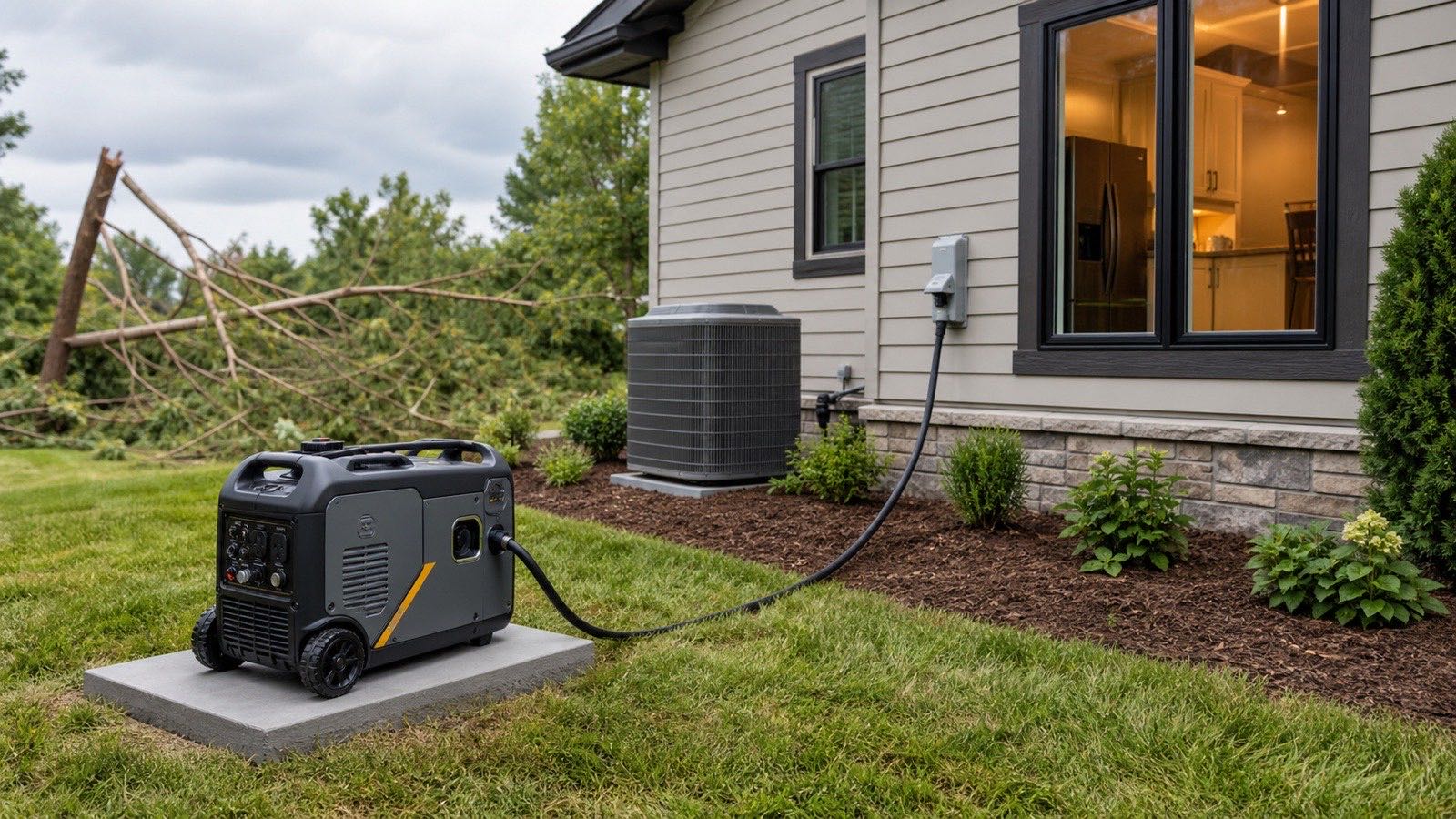
You add up everything you want to run during an outage and get 4,500 watts. The generator can supply 5,000 running watts, so the math appears comfortable. Then the refrigerator compressor, sump pump, or central air conditioner starts and the generator bogs down, trips an overload, or fails to start the equipment.
The missing piece is starting watts.
Quick answer: Running watts are the continuous power an appliance needs after it is operating normally. Starting watts, which are also commonly called surge watts, are the brief higher demand created when certain motors and compressors start. A generator or portable power station must have enough continuous capacity for everything already running and enough temporary surge capacity for the equipment starting.
This guide explains how starting/surge watts differ from running watts, why the larger number is not added on top of a generator’s rating, how overlapping compressor starts change the math, and how much electrical breathing room to leave when sizing backup power.
Starting Watts vs. Running Watts at a Glance
| Term | What it means | How long it matters | Typical example |
|---|---|---|---|
| Running watts | Normal continuous electrical demand | As long as the equipment operates | Refrigerator after its compressor starts |
| Starting watts | Total temporary demand while a motor or compressor starts | Usually fractions of a second to a few seconds | Sump-pump motor starting |
| Surge watts | Usually another name for starting or temporary peak demand/capacity | Briefly | Generator or power-station specification |
| Peak or maximum watts | Highest short-term output advertised by a manufacturer | Manufacturer-dependent | Temporary inverter output |
Champion Power Equipment defines running watts as power a generator can supply continuously and starting watts as power it can supply momentarily to start a motor. That is the practical distinction to carry through every sizing calculation.
Starting Watts and Surge Watts Are Essentially the Same Thing
For generators and portable power stations, starting watts and surge watts generally describe the same concept: the brief increase in power required by equipment—or temporarily available from the power source—when a motor or compressor starts.
You may see several labels:
- Starting watts
- Surge watts
- Startup watts
- Peak watts
- Maximum watts
In everyday backup-power planning, starting watts and surge watts can usually be treated as interchangeable. Generac, for example, describes a generator’s temporary output as “starting (or surge) power” in its own product guidance.
The caveat is that manufacturers do not always define peak or maximum output identically. One inverter may sustain elevated output for several seconds; another may tolerate its headline peak only for a very short transient. Compare the continuous rating, surge rating, surge duration, voltage, and overload behavior in the actual manual—not just the largest number on the box.
If a refrigerator normally draws 300 watts while its compressor runs but briefly needs 900 watts to start, its running demand is about 300W and its starting—or surge—demand is about 900W.
Appliance surge watts vs. generator surge watts
The same terminology works from opposite sides of the equation:
- Appliance: 300W running demand → 900W starting/surge demand
- Generator: 5,000W running capacity → 6,250W starting/surge capacity
The appliance is temporarily asking for more power. The generator’s surge rating tells you how much temporary power it can provide. Successful startup requires the power source to satisfy the appliance’s brief demand without exceeding its own temporary limit.
Why Motors and Compressors Need More Power When They Start
Motors draw elevated current while accelerating from a stop. Compressor motors in refrigerators, freezers, air conditioners, and heat pumps must also begin moving refrigerant against system pressure. Once the motor reaches operating speed, current and power settle toward their normal running values.
The U.S. Department of Energy’s MotorMaster+ manual defines locked-rotor or startup amps as the maximum current expected during the first few seconds of motor startup. The exact ratio varies by motor design, load, supply voltage, temperature, and equipment condition, which is why a generic “multiply running watts by three” rule should be treated only as a rough estimate.
Equipment commonly associated with meaningful starting demand includes:
- Central and window air conditioners
- Refrigerators and freezers
- Sump pumps and well pumps
- Furnace and air-handler blowers
- Air compressors
- Garage-door openers and motor-driven power tools
Primarily resistive loads—such as electric heating elements, kettles, toasters, and many space heaters—normally do not create the same compressor-style startup spike. They can still be punishing loads because their continuous demand is high. Our guide to running an electric furnace from a generator shows why enormous steady heating demand can be a bigger problem than surge.
Starting Watts Are Not Added on Top of a Generator’s Rating
Suppose a generator is labeled:
7,500 running watts / 9,500 starting watts
That does not mean it can produce 7,500 + 9,500 = 17,000 watts. It means the generator can supply approximately:
- 7,500 watts continuously, and
- 9,500 watts total for a short startup event.
Its temporary headroom above the continuous rating is therefore about 2,000 watts. The higher number is a temporary ceiling, not a second bucket of power stacked onto the first.
Appliance tables create similar confusion because “starting watts” may mean either total watts during startup or additional watts above the running load. Check the column heading. Generac’s home-generator sizing worksheet, for example, labels its column “additional starting watts” and adds the largest value to the total running load.
How to Calculate the Generator Capacity You Need
For a basic plan in which only one major motor starts at a time, use two tests.
Test 1: Continuous capacity
Total the running watts of every load that may operate at the same time.
That total must remain below the generator’s running-watt rating. If the connected equipment needs 6,000W continuously, a 5,000-running-watt generator is undersized no matter how impressive its surge number looks.
Test 2: Temporary starting capacity
For each motor-driven load, calculate:
Additional startup demand = total starting watts − running watts
Then estimate:
Required temporary output = total running load + largest additional startup demand
That result must remain below the generator’s starting/surge rating. This is the method used in Champion’s generator-selection worksheet and Generac’s sizing worksheet.
Our generator size calculator gives you a faster starting point, but equipment labels and manufacturer documentation should replace generic estimates whenever available.
What Happens When Two Appliances Start at the Same Time?
The “total running load + largest startup difference” method assumes the largest motor starts while the other selected equipment continues running. It does not assume that every compressor and pump reaches locked rotor at the same instant, which would often oversize the generator dramatically.
Real households, however, do not schedule their cycling loads. A refrigerator does not ask the sump pump for permission before starting. Central AC, a chest freezer, a well pump, and a furnace blower can overlap—especially after power is restored and several thermostatic loads call at once.
If you have multiple substantial cycling loads, test plausible overlaps:
Total running load + startup difference A + startup difference B
You do not necessarily need to size for every theoretical worst case. Load management can prevent certain circuits from operating together. But if a sump pump must remain available while central AC runs, dismissing overlap is bad planning with excellent timing for a flooded basement.
The same issue matters when backing up a sump pump during an outage or operating multiple cold-storage appliances. Starting demand is why the inverter rating matters even when the battery has ample energy capacity.
A Worked Whole-Home Example
The figures below are illustrative planning numbers, not universal appliance specifications. Replace them with the labels and manuals for your equipment.
| Load | Running watts | Total starting watts | Additional startup demand |
|---|---|---|---|
| Refrigerator | 200W | 800W | 600W |
| Chest freezer | 150W | 600W | 450W |
| Lights, router, and electronics | 250W | 250W | 0W |
| Gas-furnace blower | 600W | 1,800W | 1,200W |
| Sump pump | 900W | 2,700W | 1,800W |
| Central AC with a soft starter | 3,500W | 5,500W | 2,000W |
| Total running load | 5,600W | — | — |
Now compare the load with a hypothetical generator rated for 7,500 running watts and 9,500 starting watts.
- Normal operation: 5,600W remains below the 7,500W continuous rating.
- AC starts: 5,600W + 2,000W = 7,600W, below the 9,500W surge rating.
- Sump pump starts: 5,600W + 1,800W = 7,400W, also below the surge rating.
- AC and freezer overlap: 5,600W + 2,000W + 450W = 8,050W, still below 9,500W.
This plan passes both constraints. It has enough continuous capacity for the steady load and enough temporary capacity for the tested startup events. It does not prove that every 7,500/9,500W generator will behave identically; transient response, fuel, altitude, temperature, voltage regulation, and surge duration still matter.
How a Soft Start Changes the Surge-Watt Equation
Central AC compressors can have a very large starting current relative to their normal operating demand. The system may run comfortably once started yet overwhelm a generator or inverter during the first moment of compressor operation.
A properly matched soft starter controls how current is applied during startup. Micro-Air says its EasyStart FLEX can reduce startup current by up to 75%. That is a manufacturer maximum, not a guaranteed result for every compressor, installation, voltage condition, or generator.
The crucial distinction is that a soft starter primarily reduces startup demand. It does not turn a 3,500W air conditioner into a 1,500W appliance while the compressor is running. The generator still needs enough continuous capacity for the AC and every other active load.
Reducing the AC’s startup spike leaves more of the generator’s temporary surge capacity available for a refrigerator, freezer, blower, or pump that happens to start nearby. It can sometimes allow a smaller generator to start an air conditioner that would otherwise require a larger unit, but it cannot compensate for inadequate running watts.
Our full guide to the benefits of an air-conditioner soft start covers compatibility, hard-start kits, installation, and product selection. Homeowners comparing equipment can also review the Micro-Air EasyStart FLEX 398 on Amazon or the AIRGO 16–32A soft starter on Amazon, but an HVAC professional should confirm compressor type, voltage, RLA, existing start components, and product sizing before installation.
Generator Surge Watts vs. Portable Power Station Surge Watts
The same two constraints apply to battery power stations:
- Continuous inverter output limits the loads the unit can operate normally.
- Surge or peak output limits the brief startup demand it can tolerate.
A power station labeled 2,000W continuous / 4,000W surge is not a 4,000W power station for ordinary use. The larger number exists for short transients, and the manual may impose a time limit or shut output down when voltage, current, temperature, or battery conditions leave the permitted range.
Battery capacity in watt-hours creates a third constraint: runtime. A power station might successfully start a 1,500W appliance yet have too little stored energy to run it for long. What Can a 2,000-Watt Portable Power Station Run? separates inverter output from battery capacity and gives realistic appliance-runtime examples.
Common Appliances and Their Startup Behavior
| Appliance type | Typical startup behavior | What to verify |
|---|---|---|
| LED lights, router, chargers | Little relevant motor surge | Normal running watts |
| Space heater, kettle, toaster | Usually little startup surge; high steady demand | Continuous wattage and circuit limits |
| Refrigerator or freezer | Compressor startup surge | Nameplate, documentation, and measured startup |
| Furnace blower | Motor startup surge | Motor data and control requirements |
| Sump or well pump | Often substantial pump-motor surge | Horsepower, voltage, running amps, and starting data |
| Central AC | Potentially very high compressor inrush | RLA, LRA, voltage, and soft-start measurements |
| Inverter-driven HVAC | May ramp more gradually | Manufacturer backup-power requirements |
Champion’s current generator wattage chart is useful for preliminary ranges, but it also tells readers to consult the specific tool or appliance for actual consumption. Equipment data beats a generic internet table every time.
How to Find the Starting Watts of Your Equipment
Use the best information available, in this order:
- Manufacturer manual or data sheet. Look for starting watts, surge watts, inrush current, LRA, or generator requirements.
- Equipment nameplate. Voltage and current provide useful boundaries, but the label may list only running information.
- Motor or compressor data. LRA means locked-rotor amps and relates to the high current present when the rotor is not yet turning.
- Measured demand. A qualified electrician or HVAC technician can capture startup current with suitable equipment.
- Manufacturer wattage charts. Use them as planning estimates when equipment-specific figures are unavailable.
A basic plug-in energy monitor is useful for learning the running demand of ordinary 120V appliances. The P3 Kill A Watt monitor on Amazon is one familiar example. However, a slow display or ordinary energy meter may miss a very fast startup peak; do not assume its highest visible number is a complete inrush measurement.
Never open electrical equipment or place a meter around conductors unless you have the training and correctly rated test equipment to do it safely. Central AC condensers and other 240V equipment are not casual DIY measurement projects.
How Much Generator Headroom Should You Leave?
There is no universal rule requiring every generator to operate at one exact percentage. Manufacturer limits, duty cycle, altitude, temperature, fuel type, transient response, and connected load profile all matter.
For conservative home-backup planning, keeping ordinary demand around 50–70% of available continuous output can leave useful room for startup events, load variation, and an appliance you forgot to count. Treat that range as a planning target—not an electrical commandment.
More headroom is especially useful when the plan includes several independently cycling compressors or pumps. A mostly resistive load profile is more predictable, although it may still consume enormous continuous power. If you use load management to prevent large loads from overlapping, you may be able to choose a smaller generator without designing the system against its ceiling.
Start with the essential circuits worth backing up first, then compare the result with our guide to choosing the right home generator. Do not forget power quality when sensitive electronics are involved; generator THD is a separate specification from running and surge capacity.
Ways to Reduce Startup Problems Without Buying the Biggest Generator
- Stagger large loads. Start the largest motor first, allow the generator to stabilize, and add other equipment gradually when the manufacturer permits it.
- Use load management. Prevent nonessential high-demand circuits from operating when AC, pumps, or electric heat need capacity.
- Install an appropriate AC soft starter. Reduce compressor startup demand without pretending it eliminates running load.
- Prioritize essential circuits. A refrigerator, sump pump, lights, and communications usually deserve capacity before electric cooking or resistance heat.
- Correct voltage, wiring, and maintenance problems. Undersized cords, poor connections, stale fuel, altitude, and neglected equipment can make marginal startup performance worse.
- Choose the right power source. A generator and power station solve different problems; our generator-versus-power-station comparison explains the tradeoffs.
Whatever size you choose, operate portable generators safely. The U.S. Consumer Product Safety Commission says to use them outdoors only, at least 20 feet from the home, with exhaust facing away, and to maintain working carbon-monoxide alarms. A proper transfer switch or listed inlet arrangement is not optional decoration; never backfeed a house through a receptacle.
The Sizing Rule Worth Remembering
Running watts determine whether your backup system can continuously carry the selected loads. Starting—or surge—watts determine whether it can survive the brief spikes created when motors and compressors start. Pass both tests, then leave enough headroom for a real household where pumps, freezers, blowers, and air conditioners do not politely take turns.
Use the Home Power Matrix generator size calculator to build an initial load list, verify the important numbers against your equipment, and test realistic overlap scenarios before shopping.
Frequently Asked Questions
Are starting watts and surge watts the same?
Yes, in most generator and portable-power-station discussions, starting watts and surge watts describe essentially the same temporary increase in power. Peak or maximum wattage may also refer to temporary output, but manufacturers can define its duration differently.
What are running watts?
Running watts are the continuous power an appliance requires after startup or the continuous output a generator or inverter can supply. Add the running watts of all equipment that may operate at the same time.
Do you add starting watts to running watts?
Add only the additional startup demand to the total running load. If a device uses 300W while running and 900W total while starting, its additional startup demand is 600W—not another 900W.
How many starting watts does my generator need?
A common planning method is total running watts plus the largest additional startup demand. If two large cycling loads could realistically start together, test that overlap as well and compare it with the generator’s temporary surge rating.
How long do starting watts last?
Starting demand commonly lasts for fractions of a second to a few seconds while a motor accelerates. The required duration varies by equipment, and a power source’s advertised peak duration is manufacturer-dependent.
Which appliances have high starting watts?
Central air conditioners, refrigerators, freezers, sump pumps, well pumps, furnace blowers, air compressors, and some power tools can have meaningful motor or compressor startup demand.
Does an AC soft starter reduce running watts?
A soft starter primarily reduces compressor startup current. It does not substantially eliminate the air conditioner’s normal running demand, so the generator still needs enough continuous capacity for the AC and other active loads.
Can two appliances surge at the same time?
Yes. Independently cycling loads such as an air conditioner, freezer, refrigerator, sump pump, and well pump can start close together. Test plausible overlaps or use load management to prevent them.
Are peak watts always the same as surge watts?
Peak watts often refer to temporary surge capacity, but the permitted duration and overload behavior can vary by manufacturer. Compare the actual product manual instead of treating every peak rating as equivalent.
Do portable power stations have starting watts?
Portable power stations usually list continuous inverter output and a higher surge or peak output. The surge rating helps start motors and compressors, while battery watt-hours determine how long the connected load can run.