

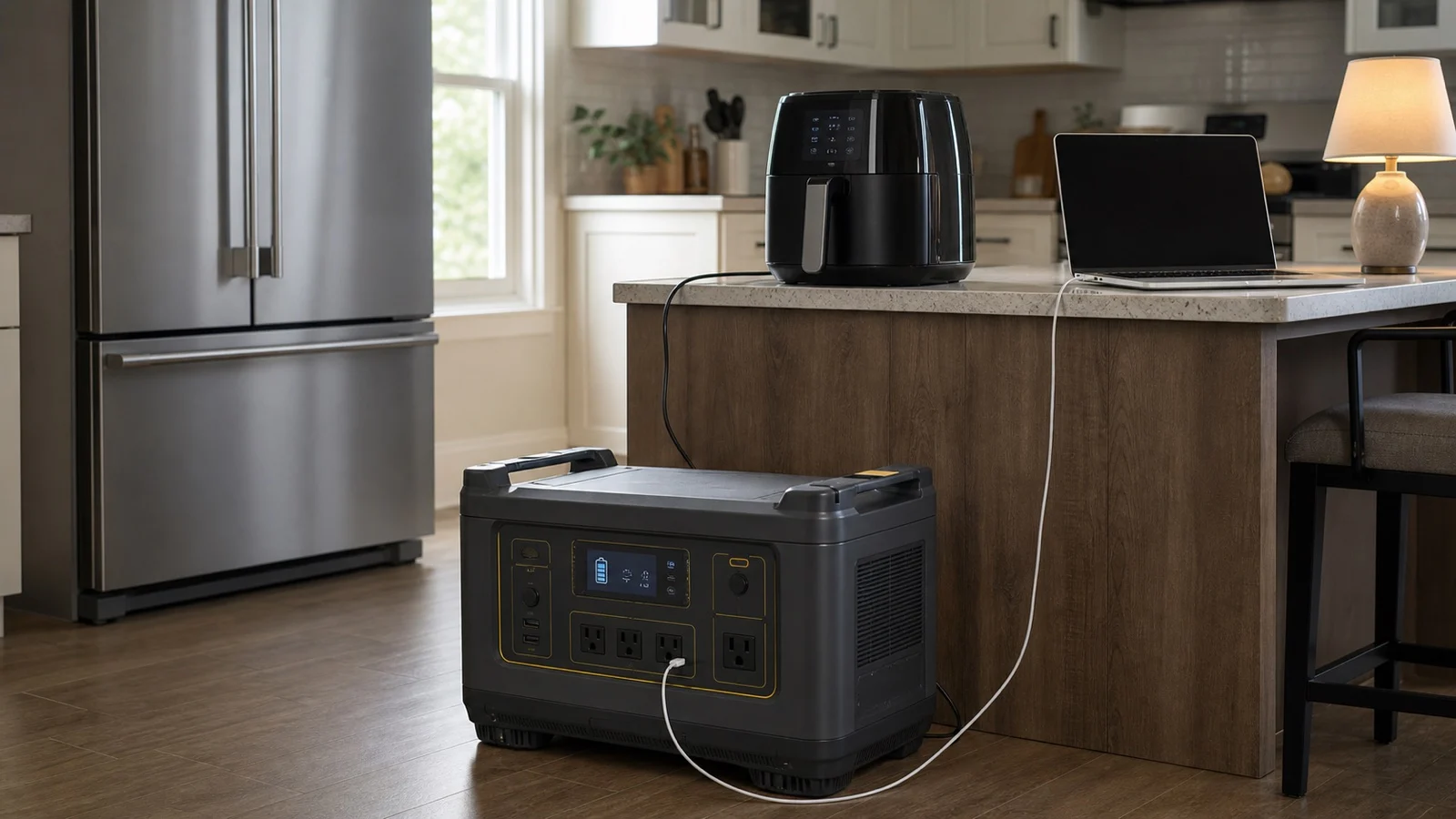
A 2,000-watt portable power station can run most ordinary 120-volt household appliances one at a time, including a refrigerator, freezer, microwave, coffee maker, air fryer, television, computers, and many sump pumps. The harder question is not whether the appliance will turn on. It is whether the battery stores enough energy to run that appliance for a useful amount of time.
That distinction is where product names become spectacularly unhelpful. “2,000-watt” may describe inverter output, while “2,000Wh” describes battery capacity. Some products offer both numbers in roughly the same range. Others absolutely do not.
Quick answer: A portable power station with 2,000W of continuous AC output and approximately 2,000Wh of battery capacity can usually run a refrigerator for about 20 to 35 hours, a 1,500W air fryer for roughly one hour of total heating time, a 1,200W microwave for about 80 to 90 minutes of total cooking time, or a 100W group of electronics for roughly 17 hours. Those are planning estimates based on 85% usable AC energy. Actual runtime changes with appliance cycling, inverter losses, startup surge, temperature, battery age, and the power station’s own idle consumption.
This guide separates output from capacity, works through realistic appliance examples, and shows which loads make sense during an outage—and which technically work but devour the battery like it insulted their family.
First: 2,000 Watts Is Not the Same as 2,000 Watt-Hours
The two numbers answer different questions.
Watts determine what the power station can run
Continuous AC output is measured in watts. It tells you how much power the inverter can supply at one time. A power station rated for 2,000W continuous output should be able to support a 1,500W air fryer or space heater, provided no other connected devices push the total above the inverter limit.
Surge or peak watts describe a brief higher output available for motor and compressor startup. Refrigerators, freezers, sump pumps, and some power tools may need this temporary burst even though their normal running draw is much lower.
Watt-hours determine how long it runs
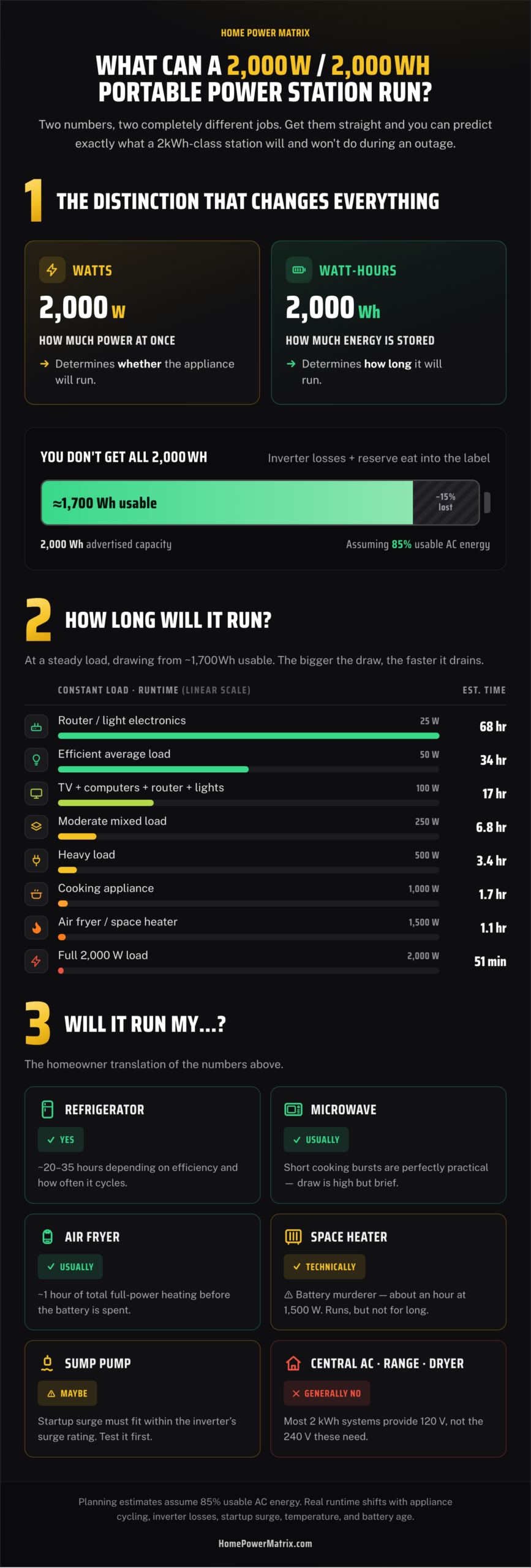
Battery capacity is measured in watt-hours. A 2,000Wh battery theoretically stores enough energy to provide 2,000 watts for one hour, 200 watts for ten hours, or 100 watts for twenty hours.
Real AC runtime is lower. The inverter uses energy, wiring creates losses, the battery-management system maintains reserves, and some power stations consume a meaningful amount simply by leaving AC output active. Using 85% of advertised capacity is a reasonable middle-of-the-road planning assumption—not a promise for every product.
For a 2,000Wh battery:
2,000Wh × 0.85 = approximately 1,700Wh of usable AC energy
Our battery runtime guide explains usable capacity and inverter losses in more detail, while the Home Power Matrix battery runtime calculator lets you enter your own load and efficiency assumptions.
Infographic: What devices you can run and for how long on a 2,000W power station
Do Not Trust the Model Name
A product with “2000” in its name may refer to capacity, inverter output, product generation, or something known only to a marketing department operating without adult supervision.
For example, the Anker SOLIX S2000 specifications list 2,010Wh of capacity but 1,500W of AC output. That makes it a 2kWh-class battery, not a 2,000W power station. It can provide long runtime for moderate loads but may not operate an appliance that truly demands 1,800W.
By contrast, the Anker SOLIX C2000 Gen 2 combines 2,048Wh of capacity with 2,400W of continuous AC output. Always compare the separate capacity, continuous-output, and surge specifications rather than assuming the product name defines all three.
2,000Wh Portable Power Station Runtime Table
The following table assumes a 2,000Wh battery with 85% usable AC energy, leaving approximately 1,700Wh for connected devices. It shows continuous-load equivalents. Cycling appliances may run for more elapsed time because they do not draw their full wattage continuously.
| Average load | Estimated runtime | Example use |
|---|---|---|
| 25W | About 68 hours | Router, modem, or very light electronics |
| 50W | About 34 hours | Efficient cycling refrigerator average or small electronics setup |
| 75W | About 22.7 hours | Larger refrigerator average or laptop workstation |
| 100W | About 17 hours | Television, computers, router, and lighting |
| 250W | About 6.8 hours | Multiple electronics or a moderate intermittent load |
| 500W | About 3.4 hours | Tools, larger workstation, or several appliances |
| 1,000W | About 1.7 hours | Coffee maker, microwave, or cooking appliance while actively heating |
| 1,500W | About 1.1 hours | Air fryer, hair dryer, or space heater |
| 2,000W | About 51 minutes | Near the inverter’s continuous-output limit |
These figures are intentionally simple. A refrigerator cycles, a coffee maker stops heating after brewing, an air fryer regulates temperature, and a sump pump may run for less than a minute per cycle. Use average energy over time for runtime, but still verify the appliance’s highest instantaneous demand for inverter compatibility.
Can a 2,000-Watt Power Station Run a Refrigerator?
Yes. A true 2,000W inverter has considerably more continuous capacity than most household refrigerators require. The compressor’s startup surge is the number to verify, while average daily energy use determines runtime.
The refrigerator’s EnergyGuide label is more useful for runtime than its maximum nameplate wattage. The U.S. Department of Energy notes that the label provides estimated annual electricity consumption in kilowatt-hours. Divide that annual figure by 365 to estimate daily energy use.
For example, a refrigerator rated at 500kWh per year uses an estimated:
500 × 1,000 ÷ 365 = approximately 1,370Wh per day
A 2,000Wh battery delivering about 1,700Wh to AC loads could theoretically cover roughly 30 hours at that daily consumption. Hot weather, door openings, defrost cycles, inverter idle draw, and battery temperature can shorten the result.
Our dedicated guide to sizing a portable power station for a refrigerator includes more detailed refrigerator tables and startup guidance. During a long outage, also follow the food-safety practices in Keep Your Fridge and Freezer Safe During Outages instead of trusting the battery percentage alone.
Can a 2,000-Watt Power Station Run an Air Fryer?
Usually. Many full-size air fryers draw approximately 1,200 to 1,800 watts while the heating element is active. Check the appliance label because large dual-basket and oven-style models may approach or exceed the power station’s continuous limit.
Air fryers do not usually require the dramatic startup surge associated with refrigerator compressors or pumps. Their challenge is sustained resistance heating. A 1,500W air fryer operating at full power for 20 minutes uses:
1,500W × 0.333 hours = approximately 500Wh
That means a 2,000Wh power station with around 1,700Wh of usable AC energy could theoretically supply about three 20-minute full-power sessions. Real air fryers cycle their heating elements after reaching temperature, so some cooking sessions consume less. Preheating, temperature, food volume, and the specific appliance change the result.
The practical rule is simple: pause other large loads while cooking. Running a 1,500W air fryer while a refrigerator compressor, battery charger, and coffee maker all become ambitious can overload a nominal 2,000W inverter.
For travelers using high-draw cooking appliances away from shore power, the same load-management principles apply to the system discussed in our RV and camper-van generator sizing guide.
Can It Run a Microwave?
Usually, but use the microwave’s electrical input rating—not the cooking-power number printed dramatically across the door.
A “1,000-watt microwave” may draw 1,400 watts or more from the outlet. If the input label shows 1,400W, a 2,000W power station can generally handle it by itself, but simultaneous loads reduce the available headroom.
At a 1,400W input, ten minutes of cooking consumes approximately:
1,400W × 0.167 hours = approximately 234Wh
Short microwave use is therefore feasible even though the instantaneous load is high. Leaving a 1,500W heater on for an hour is a much larger energy decision than using a microwave for six minutes.
Can It Run a Coffee Maker, Toaster, or Electric Kettle?
Most single countertop appliances fit within 2,000W, but many of them use resistance heating:
- Drip coffee maker: commonly around 800–1,200W while brewing.
- Toaster: commonly around 800–1,500W.
- Electric kettle: commonly around 1,200–1,800W.
- Induction burner: often adjustable from a few hundred watts to 1,800W.
Their short duty cycles make them more reasonable than continuous electric heat. Still, do not operate several simultaneously unless their combined measured draw remains below the power station’s continuous rating.
Can It Run a Sump Pump?
Possibly. Battery capacity is usually adequate for many intermittent pump cycles, but motor-starting surge is the deciding specification.
A sump pump might use several hundred to more than 1,000 running watts and briefly demand substantially more at startup. A product’s “2,000W” continuous rating does not guarantee adequate surge performance, and some marketing peak ratings last too briefly to start a difficult motor.
Check the pump label and power-station manual, test the exact combination under controlled conditions, and keep water away from the battery, plugs, and connections. Our guide to keeping a sump pump running during an outage compares portable power stations with dedicated battery systems and generators.
Can It Run a Space Heater?
Technically, yes. Strategically, usually not for long.
Many portable electric heaters draw 1,500W on high. At that rate, approximately 1,700Wh of usable battery energy lasts only about 68 minutes—and less once cold-weather battery performance and inverter overhead are considered.
This is a perfect example of the difference between power and energy. The inverter can support the heater, but the battery cannot supply many hours of heat. If electric resistance heating is central to the plan, our guide to backing up an electric furnace shows how quickly heating demand escalates beyond portable-battery territory.
Electronics, Internet Equipment, and 3D Printers
Low and moderate loads are where a 2kWh power station becomes genuinely impressive. A combined 100W load could run for roughly 17 hours under the 85% assumption. That might include a router, modem, laptop, monitor, LED lamp, and device charging, depending on the equipment.
A 3D printer is more variable. Its bed and hot end draw more while heating, then cycle to maintain temperature. Printer size, bed temperature, enclosure heat, material, and print duration all matter. Measure a representative job instead of multiplying the printer’s maximum power-supply rating by the print time.
A plug-in meter such as the P3 Kill A Watt electricity monitor on Amazon can measure cumulative kilowatt-hours for ordinary 120V plug-in devices. It will not capture every split-second surge accurately, but it is far more useful for runtime planning than guessing from internet charts.
Can You Run Several Appliances at Once?
Yes, provided the combined demand remains within the continuous-output rating and the power station can handle any overlapping startup surges.
Consider this example:
| Connected load | Example operating draw |
|---|---|
| Refrigerator while compressor runs | 180W |
| Router and modem | 25W |
| Laptop and monitor | 100W |
| LED lighting | 30W |
| Combined ordinary load | 335W |
That combination leaves substantial output headroom and may average less when the refrigerator compressor stops. Adding a 1,500W air fryer produces an estimated 1,835W load while everything is operating—technically within a 2,000W rating, but with little room for startup variation. The safer choice is to pause the high-draw appliance or temporarily reduce other loads.
Automatic equipment does not coordinate itself around your cooking schedule. Load management is not glamorous, but neither is walking into a dark kitchen because the inverter tripped at the exact moment the toast became important.
Smart Standby and Eco Modes Can Extend Runtime
AC inverters consume energy whenever they remain active, even when the connected appliance is temporarily drawing little or nothing. That overhead matters with cycling refrigerators and very small loads.
The Anker SOLIX S2000, for example, publishes 6W active idle power and 2W system standby power. Anker’s OptiSave system is designed to reduce standby consumption for loads such as refrigerators. Over a full day, saving even several watts can preserve meaningful battery energy.
Eco modes are not automatically safe for every load. Some power stations turn off AC output when consumption stays below a threshold for a specified time. That can create problems for a refrigerator between compressor cycles, a router, low-speed fan, medical device, aquarium equipment, security system, or anything else that must remain ready even while drawing very little.
Before relying on an energy-saving mode:
- Read the power station’s shutdown threshold and delay.
- Confirm whether it can recognize and restart for a cycling appliance.
- Test the exact appliance through several complete cycles.
- Check whether an app or firmware update changes the behavior.
- Disable automatic shutdown for equipment that must remain continuously powered unless the manufacturer explicitly supports that use.
This is also why two 2,000Wh products may deliver different real refrigerator runtimes even when their advertised capacity is nearly identical.
Three 2kWh-Class Power Stations to Compare
These examples all store approximately 2kWh, but their output, weight, ports, expansion options, charging limits, and software differ. Product specifications and Amazon sellers can change, so compare the current listing with the linked manufacturer page before buying.
Anker SOLIX C2000 Gen 2
The C2000 Gen 2 pairs 2,048Wh of capacity with 2,400W of continuous 120V AC output, a 4,000W peak rating, LFP batteries, a 10ms UPS specification, an RV-style TT-30 outlet, and expansion-battery support. It is a stronger high-wattage-appliance fit than the S2000 despite the confusingly similar names.
Homeowners who want that combination can check the specific Anker SOLIX C2000 Gen 2 on Amazon and confirm it against Anker’s current specifications. Our broader guide to the Anker SOLIX ecosystem explains where its batteries and home-backup options fit.
Jackery Explorer 2000 v2
Jackery rates the Explorer 2000 v2 at 2,042Wh with 2,200W of total pure-sine-wave AC output. At roughly 39.5 pounds, it emphasizes portability within the 2kWh class, although its 400W solar-input limit is lower than some heavier competitors.
For buyers prioritizing a lighter unit, the Jackery Explorer 2000 v2 on Amazon can be compared with Jackery’s current technical information.
BLUETTI AC200L
The BLUETTI AC200L provides 2,048Wh of capacity, 2,400W of pure-sine-wave output, a 4,800W surge rating, up to 1,200W of solar input, a TT-30 outlet, and multiple expansion-battery options. Its roughly 62-pound weight makes it substantially less casual to carry than the Jackery.
Buyers who value solar input, RV connectivity, and expansion can check the specific BLUETTI AC200L on Amazon while verifying the configuration against BLUETTI’s published AC200L specifications.
How to Estimate Your Own Runtime
Use this planning formula for a continuous AC load:
Battery capacity × expected efficiency ÷ average load = estimated runtime
For a 2,048Wh power station at 85% efficiency running a measured 180W load:
2,048 × 0.85 ÷ 180 = approximately 9.7 hours
For cycling appliances, measure kilowatt-hours over several representative hours—or preferably a full day—and calculate from total energy instead of the highest wattage seen on the display.
Build in reserve. Battery percentage estimates can drift, appliances may consume more in hot or cold conditions, and an outage rarely asks permission before lasting longer than expected. The planning approach in Outage Planning 101 helps prioritize the loads that protect health, food, water, and the home before optional conveniences consume the battery.
What a 2,000-Watt Power Station Should Not Be Expected to Run
Most portable 2kWh units provide 120V output only. They generally cannot directly operate ordinary 240V appliances such as a central air conditioner, electric range, clothes dryer, well pump configured for 240V, or conventional electric water heater.
Even some 120V loads are poor battery choices:
- Space heaters used continuously
- Portable air conditioners for many hours
- Large shop tools near the inverter limit
- Multiple cooking appliances at once
- Any motor whose startup demand exceeds the surge rating
- Equipment requiring a grounding, neutral, waveform, or UPS configuration the power station does not provide
When the priority list grows beyond one battery’s output or energy capacity, compare a larger expandable system, a fuel generator, or a hybrid approach. Our guide to portable power stations versus generators explains the practical tradeoffs, and The Essential Circuits Worth Backing Up First helps keep the plan from becoming an attempt to recreate the entire grid in one box.
Frequently Asked Questions
What can a 2,000-watt portable power station run?
A 2,000W portable power station can typically run most individual 120V household appliances, including refrigerators, freezers, air fryers, microwaves, coffee makers, televisions, computers, and many sump pumps. Motor startup surge and the combined demand of simultaneous appliances must remain within the power station’s limits.
How long will a 2,000Wh portable power station last?
A 2,000Wh battery may provide approximately 1,600 to 1,800Wh to AC appliances after losses. That equals roughly 17 hours at a 100W average load, 3.4 hours at 500W, 1.7 hours at 1,000W, or slightly more than one hour at 1,500W.
What is the difference between 2,000W and 2,000Wh?
Two thousand watts describes how much power the inverter can supply at one time. Two thousand watt-hours describes how much energy the battery stores. Watts determine whether an appliance can operate; watt-hours largely determine how long it can operate.
Can a 2,000-watt power station run a refrigerator?
Yes, provided its surge output can start the compressor. Runtime depends on the refrigerator’s daily energy consumption, temperature, door openings, defrost cycles, inverter overhead, and usable battery capacity. A 2,000Wh battery may provide roughly 20 to 35 hours for many refrigerators.
Can a 2,000-watt power station run an air fryer?
Usually. Many air fryers draw between approximately 1,200 and 1,800 watts while heating. Verify the appliance label and avoid operating other high-draw equipment simultaneously. A 1,500W air fryer uses about 500Wh during 20 minutes of continuous full-power heating.
Can a 2,000-watt power station run a microwave?
Usually, but check the microwave’s electrical input rather than its advertised cooking output. A microwave marketed as 1,000 watts may draw 1,400 watts or more from the outlet. Short cooking periods use far less battery energy than operating a comparable load continuously.
Can a 2,000-watt power station run a space heater?
It can usually operate a typical 1,500W space heater, but a 2,000Wh battery may last only about one hour at that load. Electric resistance heat is technically compatible but generally an inefficient use of limited stored energy.
Can a 2,000-watt power station run a sump pump?
Possibly. The power station must handle the pump’s brief startup surge as well as its normal running wattage. Check both manuals and test the exact combination safely before relying on it during a storm.
Can I run several appliances from a 2,000-watt power station?
Yes, as long as their combined running demand and any overlapping startup surges stay within the inverter ratings. Pause air fryers, microwaves, heaters, and other high-draw loads when necessary to preserve output headroom and battery runtime.
Does eco mode make a portable power station last longer?
It can reduce inverter and standby losses, especially with cycling or low-draw appliances. However, automatic shutdown thresholds may turn off equipment that must remain ready while drawing very little. Test the exact appliance and settings through complete operating cycles before relying on eco mode.