

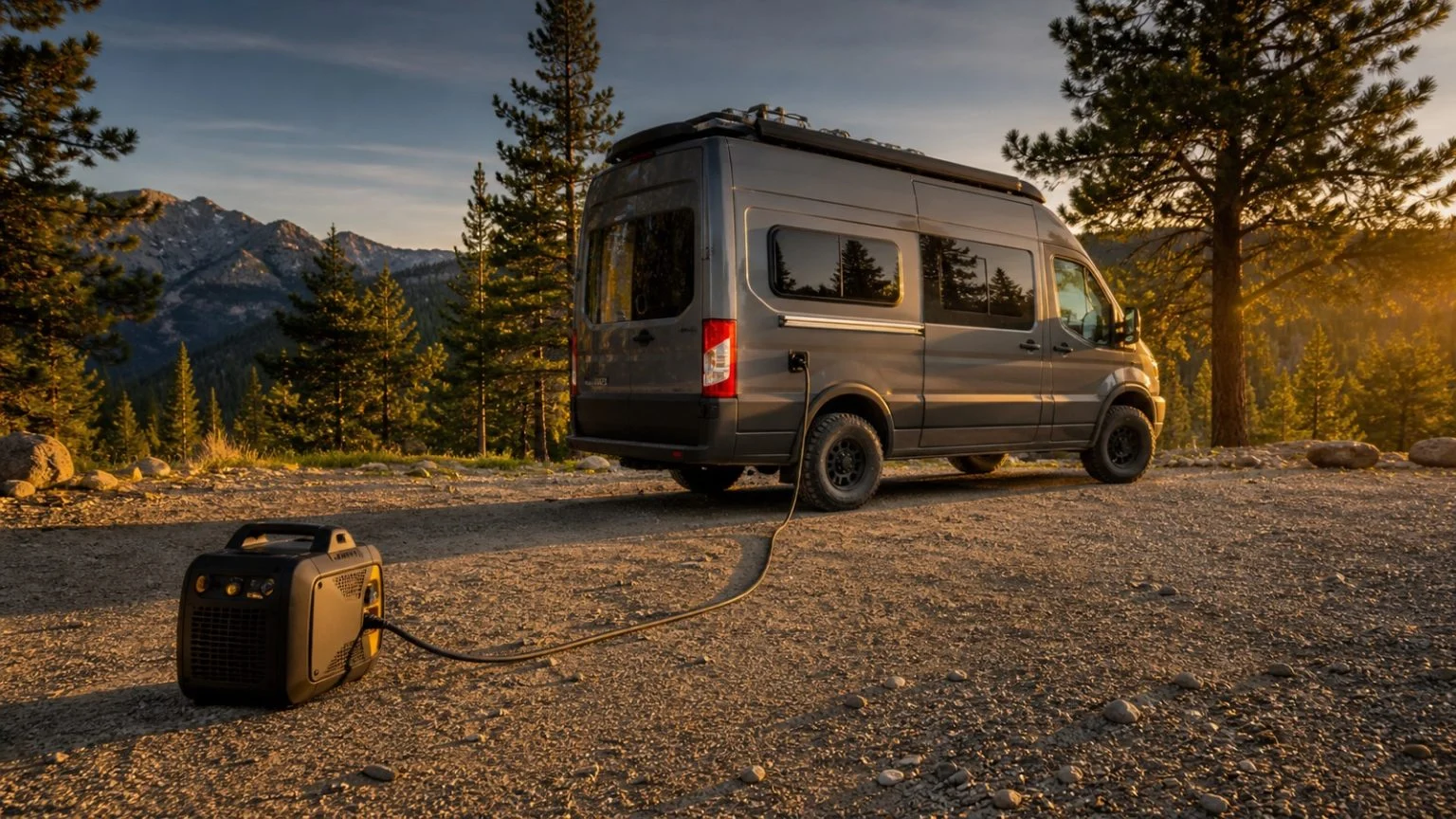
A generator for van life or RV travel has to do more than produce enough watts. It has to fit in limited storage, tolerate travel, supply the right receptacle, stay reasonably quiet, and operate safely at a campsite where your bedroom is only a few steps away.
That makes the “best” generator less about one winning model and more about matching the generator to your actual travel style. A van that needs laptop charging and a refrigerator is a very different electrical problem from a 30-amp travel trailer running rooftop air conditioning—or a 50-amp fifth wheel trying to imitate full-hookup living.
Quick answer: A 2,000-watt inverter generator is often enough for a camper van or small RV without air conditioning. For an RV with one rooftop air conditioner, roughly 2,500 to 4,000 watts is a more practical range, depending on the AC startup demand and other loads. A 30-amp RV can use up to 3,600 watts from shore power, while matching the full capacity of a 50-amp RV connection requires 12,000 watts—but most travelers do not need to reproduce their rig’s entire shore-power capacity from a portable generator.
The right answer begins with what you will run at the same time, not the amperage printed on the shore cord.
What Size Generator Do You Need for an RV or Camper Van?
These ranges are useful starting points, not substitutes for checking your equipment:
| Travel setup | Practical generator range | Typical use |
|---|---|---|
| Camper van without electric air conditioning | 1,500–2,200 running watts | Battery charging, refrigerator, laptops, lights, and occasional small appliances |
| Van or small trailer with occasional AC use | 2,000–3,000 running watts | One modest air conditioner with careful load management |
| Typical 30-amp RV | 2,800–4,000 running watts | One rooftop AC plus selected appliances |
| Larger RV with heavier simultaneous loads | 4,500–7,000+ running watts | AC, microwave, converter, and additional appliances with less manual juggling |
| Full 50-amp shore-power equivalent | Up to 12,000 watts | Approaching the rig’s complete electrical capacity rather than normal camping needs |
Do not size around the generator’s large “starting watts” number alone. The smaller rated or running-watt figure tells you what it can continuously supply. Our generator size calculator can total the loads, but use the labels or manuals for your actual RV appliances whenever possible.
Start With Your Travel Style, Not Your Shore-Power Plug
Two rigs with the same 30-amp connection can need completely different generators.
Full-time van life
For a full-time van dweller, storage space, weight, noise, and fuel handling matter every day. The generator may spend more time recharging a house battery than directly powering appliances. A compact inverter generator in the 1,800-running-watt class can be enough when cooking and climate control use propane, diesel, or another non-electric source.
This is also where a generator-and-battery hybrid makes the most sense. Run the generator during an allowed daytime window to recharge the battery bank, then use silent stored power for the refrigerator, fan, lights, internet equipment, and laptop overnight.
Weekend camper-van travel
A weekend traveler may accept stricter load management in exchange for a smaller machine. If the generator only needs to recharge batteries and cover an occasional coffee maker or induction cooktop, 2,000 watts may be plenty. Just do not run the high-draw appliance while the battery charger is already pulling hard.
Travel trailers and motorhomes
RV owners are more likely to expect rooftop air conditioning, a microwave, a converter/charger, and multiple receptacles. One AC unit often pushes the practical choice toward a 2,800- to 4,000-watt generator. Larger generators reduce the appliance shuffle, but they also add weight, fuel use, noise, and a machine that may require two people to move.
Build an RV Load List Before Shopping
Write down the running watts and starting demand for everything you might operate. Common loads include:
- Rooftop or window air conditioner
- RV converter and battery charger
- 12-volt refrigerator or residential refrigerator
- Microwave
- Induction cooktop, toaster, or coffee maker
- Electric water heater element
- Space heater
- Laptops, monitors, cameras, and internet equipment
- Water pump and ventilation fans
- Medical equipment
Some “12-volt” devices still affect generator sizing indirectly because the RV converter draws AC power while recharging the battery. A high-capacity lithium battery bank with a powerful charger can become one of the largest loads in the rig unless its charge rate is adjustable.
Add the running watts of everything you want on simultaneously, then add the largest additional motor-starting surge. The same method is explained in more detail in our guide to choosing the right generator.
Can a 2,000-Watt Generator Run an RV Air Conditioner?
Sometimes—but “it ran once in the driveway” is not a robust power plan.
Cummins’ RV generator sizing guidance estimates that a 7,000-BTU air conditioner may use about 600 running watts and 1,700 starting watts, while a 15,000-BTU unit may use about 1,500 running watts and 3,500 starting watts. The actual demand depends on the AC, temperature, elevation, voltage, and condition of the equipment.
A 2,000-watt generator might run a smaller efficient AC if little else is operating, but it may not have enough surge capacity for a larger rooftop unit. The converter, refrigerator, or microwave can also push the total over the edge at exactly the wrong moment.
An air-conditioner soft starter can reduce compressor startup demand on compatible equipment. It does not reduce the AC’s normal running watts, create extra generator capacity, or guarantee that every 2,000-watt generator can start every RV air conditioner.
What Size Generator for a 30-Amp RV?
A 30-amp RV connection supplies 120 volts, so its maximum shore-power capacity is:
120 volts × 30 amps = 3,600 watts
A 3,600-running-watt generator can roughly match that maximum, and Cummins notes that 4,000 watts can provide additional motor-starting room. It also identifies approximately 2,500 to 2,800 watts as a common minimum range for a 30-amp RV with air conditioning.
You do not need all 3,600 watts merely because the RV has a TT-30 plug. A couple using propane for water heating and cooking may comfortably manage a smaller generator. Someone running a 15,000-BTU AC, microwave, and aggressive battery charger will want more room—or a clear routine for turning loads off before another one starts.
If the generator lacks a TT-30R receptacle, a correctly rated adapter may provide physical compatibility, but it cannot create additional amperage. A 15-amp generator outlet remains limited by the generator and circuit even when connected to a 30-amp RV cord.
What Size Generator for a 50-Amp RV?
A typical 50-amp RV service supplies two 120-volt, 50-amp legs. That provides as much as 12,000 watts total—far more than a 30-amp connection.
That does not mean every 50-amp RV owner needs a 12,000-watt portable generator. It means 12,000 watts would be required to approach the shore connection’s full theoretical capacity. Many travelers select a smaller generator and deliberately limit simultaneous loads.
Before using an adapter, understand which legs and circuits it energizes, whether the generator supplies 120 volts only or 120/240 volts, and what the RV manufacturer permits. An adapter changes the plug arrangement; it does not turn a small 120-volt generator into full 50-amp service.
Why an Inverter Generator Usually Fits RV Travel Better
For most vans and RVs, an enclosed inverter generator is the strongest default. Its engine can slow under lighter loads, which generally reduces fuel use and noise compared with a conventional generator running at a fixed speed. Quality inverter models also provide low-distortion output that is friendlier to chargers, computers, and other electronics.
Our guide to generator total harmonic distortion explains why the label “inverter” is useful but not a substitute for checking the manufacturer’s actual specifications.
Open-frame generators still make sense when maximum watts per dollar matter more than weight and campground manners. For travel, though, the cheapest large generator can become a loud, heavy box you hate moving long before you admire the money saved.
Gasoline, Propane, or Dual Fuel?
Gasoline
Gasoline commonly produces the generator’s highest rated output and is widely available. Its disadvantages are the smell, shorter storage life, carburetor problems caused by neglected fuel, and the need to carry a volatile liquid safely.
Propane
Propane stores longer without going stale and avoids leaving gasoline in a carburetor. Many RV travelers already carry cylinders for cooking or heat. The tradeoff is that a generator often produces fewer running watts on propane, which matters when the machine is already close to the AC’s requirement.
Dual fuel
A dual-fuel generator gives travelers options. Propane can handle ordinary use and storage, while gasoline can provide additional output or a more accessible fuel during a long trip. Compare both fuel ratings; the number printed most prominently on the box is often the gasoline starting output.
For longer storage and transport planning, review our guide to generator fuel storage safety rather than improvising with a questionable container inside your living space.
Three Generator Sizes and Products Worth Comparing
These are examples that represent three useful size classes, not universal winners. Availability, sellers, model revisions, and included accessories can change, so verify the current listing against the manufacturer’s specifications before buying.
Honda EU2200i: premium compact option for light loads
Honda rates the EU2200i at 2,200 maximum watts and 1,800 rated watts. It weighs 47.4 pounds, supports parallel operation, and is rated at 48 dBA at one-quarter load and 57 dBA at rated load. Those specifications make it a strong fit for battery charging, electronics, refrigeration, and carefully managed small-RV loads—not full 30-amp service.
Travelers prioritizing portability, dealer support, and proven compact-generator design can check the Honda EU2200i on Amazon, then confirm the exact model and seller against Honda’s current EU2200i specifications.
Champion 201122: lightweight dual-fuel flexibility
Champion’s model 201122 produces 1,850 running watts on gasoline and 1,665 on propane. It weighs 39 pounds, is rated at 53 dBA from 23 feet, offers parallel capability, and includes an automatic CO shutoff system. It is attractive for vans and small trailers that value fuel choice more than maximum AC capacity.
The exact model is easy to confuse with several similar Champion units, so use the model number when you find the Champion 201122 on Amazon and compare the listing with Champion’s published ratings.
WEN 56360iX: more room for a 30-amp RV
The WEN 56360iX is rated for 3,600 surge watts and 2,900 running watts. It includes an RV-ready TT-30R receptacle, parallel capability, and automatic CO shutdown. That additional continuous output makes it more plausible for one rooftop AC plus selected loads, although it still does not reproduce a full 3,600-watt 30-amp shore connection.
RV owners who want that middle size can look for the specific WEN 56360iX on Amazon while checking the listing against WEN’s official product page.
Generator vs. Portable Power Station for Van Life
A fuel generator offers high sustained output as long as fuel is available. A portable power station offers silent indoor power, no exhaust, instant startup, and much less maintenance—but its stored energy is finite.
For many van-life setups, choosing only one is an artificial restriction. The practical system is often:
- A house battery or portable power station for daily and overnight loads.
- Solar charging when the weather cooperates.
- A compact inverter generator for fast backup charging during cloudy stretches or heavy demand.
This lets the generator run for a shorter daytime charging session instead of idling beside the sleeping area all night. Use our battery runtime calculator to estimate stored-energy needs, then compare the tradeoffs in portable power stations versus generators.
Confirm that the power station accepts the generator’s voltage, frequency, neutral configuration, and power quality. Some chargers reduce input or reject unstable generator power.
Campground Generator Rules Can Defeat a Generator-Only Plan
Generator hours vary by campground, and some loops prohibit generators entirely. For example, Bryce Canyon National Park’s campground rules currently limit use to 8–10 a.m. and 6–8 p.m. in designated loops. Glacier National Park publishes different operating windows and lists several generator-free campground areas.
Rules can change, so check the specific campground before arrival. A generator that technically powers your air conditioner is not useful when its operating hours exclude the hottest part of the day. Battery capacity, ventilation, shade, and non-electric cooling strategies still matter.
Noise specifications also deserve skepticism. Manufacturers may measure at different distances and loads. Compare like with like, and remember that a small change on paper can feel much larger—or much less impressive—once neighboring campsites are involved.
Portable Generator Safety Is Even More Important Beside a Van
A van or RV is an occupied sleeping space, not a protective barrier against exhaust. Never operate a portable generator inside a van, RV, garage, storage compartment, under an awning, or in another enclosed or partly enclosed area.
The U.S. Consumer Product Safety Commission says portable generators should be used outside at least 20 feet from a home, with exhaust directed away. Apply the same separation to an occupied RV or van, and also consider neighboring rigs, tents, doors, windows, roof vents, and wind direction.
- Use working battery-powered carbon-monoxide alarms inside the rig.
- Keep the generator outdoors, dry, and well ventilated without enclosing it.
- Point exhaust away from every occupied space, not just your own.
- Shut the generator down and allow it to cool before refueling or transport.
- Use approved fuel containers and secure the generator and fuel for travel.
- Use outdoor-rated cords sized for the current and distance.
- Never defeat a CO shutoff system or treat it as permission to operate closer.
This is the fatal flaw in the idea of running a portable generator beside a sleeping van all night. Use battery power overnight and reserve engine-driven charging for times when safe placement, supervision, and campground rules all cooperate.
How to Choose Without Buying the Wrong Generator
Before ordering, answer these questions:
- What must run at the same time?
- Which load has the largest startup surge?
- Will you run rooftop air conditioning?
- What are the generator’s running watts on your preferred fuel?
- Does it have the correct RV receptacle, or will you need a properly rated adapter?
- Can you lift and safely secure its actual weight?
- Where will the generator and fuel travel without entering the living space improperly?
- Can it operate at least 20 feet from the rig with exhaust directed away?
- Do your destinations permit generator use when you need it?
- Would a smaller generator plus battery storage cover more real-world situations?
The last question is the one most shopping guides skip. For van life, the best generator is often not the machine that runs everything continuously. It is the smallest reliable generator that covers the hard loads or recharges the battery system without consuming half the storage bay.
Frequently Asked Questions
What size generator do I need for a 30-amp RV?
A 30-amp RV can receive up to 3,600 watts from a 120-volt shore connection. A 3,600-running-watt generator can approximately match that capacity, while 2,500 to 2,800 watts is often treated as a practical minimum for a 30-amp RV with one air conditioner. Your actual loads and AC startup demand determine the answer.
Do I need a 12,000-watt generator for a 50-amp RV?
No, unless you intend to approach the full capacity of the 50-amp shore connection. A typical 50-amp RV can accept up to 12,000 watts across two 120-volt legs, but many owners use a smaller generator and manage which appliances operate together.
Can a 2,000-watt generator run an RV air conditioner?
It may run a small or efficient RV air conditioner if the generator can handle the compressor’s startup surge and other loads are minimized. Larger rooftop units may need substantially more starting capacity. Check the AC ratings and do not assume running watts tell the entire story.
Is an inverter generator better for a camper van?
Usually. Enclosed inverter generators are generally quieter, more efficient at light loads, easier to transport, and better suited to sensitive electronics than conventional open-frame models. The tradeoff is a higher purchase price per watt.
Is propane or gasoline better for an RV generator?
Gasoline usually provides more output, while propane stores longer and avoids stale fuel in the carburetor. A dual-fuel generator provides flexibility, but always size from the lower propane running-watt rating if propane will be your normal fuel.
Can I run a portable generator while sleeping in my RV?
Running a portable generator beside an occupied RV or van creates carbon-monoxide and fire risks, and campground quiet hours may prohibit it. A safer plan is to operate the generator outdoors with proper separation while awake, charge a battery system, and use silent battery power overnight.
Can I carry a portable generator inside my van?
Never operate one inside. Transport also requires careful control of fuel, fumes, hot surfaces, and movement. Follow the generator and vehicle manufacturers’ instructions, let the unit cool, close fuel controls, secure it upright, and keep fuel out of the living space in approved storage appropriate to local rules.
Is a portable power station better than a generator for van life?
A power station is better for silent indoor and overnight power, while a generator is better for sustained output when fuel is available. Many full-time travelers benefit from combining solar and battery power with a small inverter generator used only for backup charging.
Can a small generator charge my RV batteries?
Yes, usually through the RV’s converter/charger or a compatible standalone charger. The charging rate depends on the charger’s input demand, battery chemistry, wiring, and settings. Make sure the generator can supply the charger continuously and that both devices accept the electrical configuration.
Can I use a generator in a national park campground?
Sometimes, but rules vary by park, campground, loop, and time of day. Some locations limit generators to short operating windows, while others designate generator-free areas. Check the current rules for each destination before relying on a generator for climate control or medical equipment.