

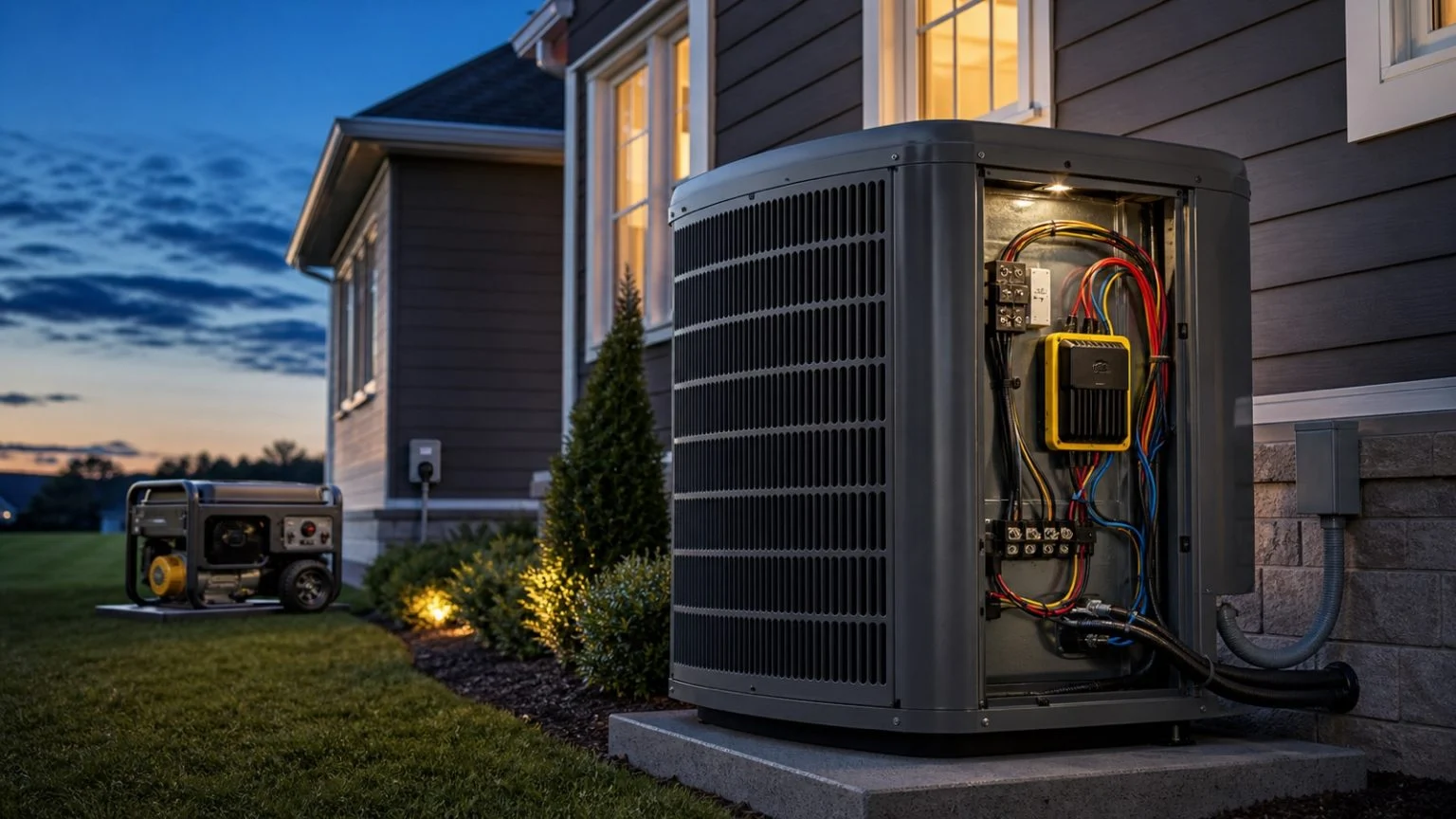
When a central air conditioner starts, its compressor can demand several times more current than it needs once it is running. That brief surge may dim the lights, trip a limited backup source, or make a generator that looks large enough on paper stumble at the exact moment cooling begins.
An air-conditioner soft starter is designed to make that startup less abrupt. It can be especially useful when central air needs to operate from a portable generator, standby generator, solar inverter, or home battery—but it is not an energy-saving miracle or a repair for failing HVAC equipment.
Quick answer: An AC soft starter reduces the brief inrush current required when the compressor starts. The main benefits are easier startup on generators and battery inverters, less light dimming and voltage sag, quieter compressor starts, and lower electrical and mechanical stress during startup. It does not significantly reduce the air conditioner’s normal running wattage or monthly energy use.
The real value depends on the air conditioner, the backup source, and the problem you are trying to solve. Before buying anything, identify the compressor type and electrical ratings rather than choosing a device by tonnage alone.
What Does a Soft Start Do for an Air Conditioner?
A conventional single-stage air-conditioning compressor starts from a complete stop. For a fraction of a second, the motor can draw a high level of current while it builds enough torque to begin turning. The nameplate often identifies this potential starting demand as locked-rotor amps, or LRA.
Once the compressor reaches operating speed, its current falls toward its normal running level. That operating figure may appear as rated-load amps, or RLA. The difference between LRA and RLA explains why a generator or inverter can have enough continuous power to run an air conditioner yet still fail to start it.
A soft starter electronically manages the startup sequence rather than applying the compressor’s full starting demand all at once. Depending on the product and equipment, it may learn the compressor over several starts and adjust how current is applied to the start and run windings.
Manufacturers publish different reduction claims. Micro-Air says its EasyStart FLEX can reduce startup current by up to 75%, while ICM Controls advertises reductions of up to 70% for the ICM870 family. Those are manufacturer maximums, not guarantees for every installation. The useful number is the starting current measured on your own equipment before and after installation. See the Micro-Air EasyStart FLEX specifications and ICM870 fact sheet for the manufacturers’ descriptions.
Seven Benefits of an AC Soft Starter
1. It Reduces Compressor Startup Current
Reducing startup current is the central benefit from which most of the others follow. Lower inrush demand can make the compressor easier on the electrical supply and less likely to overwhelm a generator or inverter during the first moments of a cooling cycle.
This does not mean the compressor’s normal demand disappears. If the complete system needs 5,000 watts after it starts, the backup source must still deliver approximately that much continuous power. The soft starter addresses the short surge—not the sustained load.
2. It Can Make Central Air Easier to Run From a Generator
Central air is one of the most difficult household loads for a generator because it combines a motor-starting surge with substantial continuous demand. A soft starter can narrow the gap between those two requirements, sometimes allowing an otherwise adequate generator to start the compressor reliably.
But it cannot make every generator compatible with every air conditioner. The generator still needs the correct voltage, enough continuous output for the compressor, condenser fan, and indoor blower, and additional capacity for other active circuits. Micro-Air’s generator-selection guidance specifically warns that its estimates assume no other significant household loads are running when the compressor starts.
Use the Home Power Matrix generator size calculator to total the loads you plan to operate, then compare the result with the generator’s continuous rating—not only the large starting-watt number on the box. Our guide to choosing the right home generator explains voltage, starting watts, fuel derating, transfer equipment, and load management in more detail.
3. It Improves Compatibility With Home Batteries and Solar Inverters
A battery system has two separate limits: how much power its inverter can deliver at one time and how much energy the batteries can store. A large battery capacity does not help if the inverter trips when the AC compressor starts.
Reducing inrush current may bring startup within the inverter’s surge capability. The battery must still have enough continuous output to run the full cooling system and enough usable kilowatt-hours to keep it operating for a meaningful period.
That distinction matters when planning a home battery backup system. Central air may become electrically startable after a soft starter is installed while still consuming the stored energy much faster than refrigerators, lighting, internet equipment, or other essential circuits.
Solar presents the same two-part problem. The system needs compatible islanding equipment and sufficient inverter output, while the panels and batteries must supply enough energy over time. The guide to using solar panels during an outage explains why ordinary grid-tied panels shut down and how storage changes the equation.
4. It May Reduce Light Dimming and Voltage Sag
If household lights briefly dim whenever the outdoor unit starts, compressor inrush may be contributing to a short voltage drop. A successful soft-start installation can reduce that disturbance by lowering the sudden demand on the electrical system.
Persistent or severe dimming deserves professional investigation. A soft starter will not correct a loose neutral, damaged connection, undersized conductor, weak utility supply, failing capacitor, or inadequate electrical service. Treat it as startup management, not a substitute for diagnosis.
5. It Can Produce a Smoother, Quieter Startup
Homeowners sometimes notice a sharp clunk or thump when a conventional compressor starts. A soft starter can make that transition less abrupt and reduce the momentary strain heard or felt during startup.
It will not silence the condenser fan, compressor, refrigerant flow, ductwork, or indoor blower while the system is operating. If an air conditioner begins making new grinding, rattling, buzzing, or repeated clicking noises, have the equipment inspected rather than assuming a soft starter will solve the cause.
6. It Reduces Abrupt Startup Stress
Compressor startup is electrically and mechanically demanding. Managing the transition more gradually can reduce the torque shock and current spike associated with an across-the-line start.
That does not justify promises that a soft starter will add a specific number of years to an air conditioner. Compressor life also depends on proper equipment sizing, refrigerant charge, airflow, voltage quality, cycling frequency, installation, weather exposure, and routine maintenance. Reduced startup stress is a reasonable benefit; a guaranteed lifespan extension is marketing astrology.
7. It May Avoid Oversizing Backup Power Solely for the Startup Surge
A homeowner can end up shopping for a much larger generator or battery inverter because the air conditioner’s starting demand is dramatically higher than its running demand. Reducing that surge may allow a smaller backup source to operate the system, provided its continuous capacity remains adequate.
This can affect equipment cost, fuel consumption, installation complexity, and load-management strategy. It is not permission to size at the ragged edge. A backup source needs headroom for hot-weather performance, elevation, alternate-fuel derating, and automatic loads that may start at inconvenient times.
What an AC Soft Starter Will Not Do
Soft starters are useful enough without assigning them superpowers. An AC soft starter generally will not:
- Meaningfully reduce normal compressor running watts.
- Create large monthly electricity savings.
- Repair a failing compressor, weak capacitor, or burned connection.
- Correct undersized wiring or poor utility voltage.
- Add continuous watts to a generator or inverter.
- Make an undersized backup source capable of running any central AC system.
- Make every variable-speed or inverter-driven compressor compatible.
The startup event is short, so reducing its peak does not usually make a meaningful dent in monthly kilowatt-hour consumption. Cooling cost is driven primarily by how much power the system uses while running and how long it operates.
Soft Start vs. Hard-Start Kit
The names sound similar, but the devices solve different electrical problems. A hard-start kit adds starting torque so a compressor can reach operating speed more decisively. A soft starter reduces the peak demand placed on the power source while still providing the torque needed to start.
| Question | Soft starter | Hard-start kit |
|---|---|---|
| Primary purpose | Reduce startup demand | Increase starting torque |
| Best backup-power use | Generators, batteries, and limited inverters | Not primarily intended to reduce source capacity |
| Typical complexity | Electronic control with compatibility requirements | Capacitor and relay or electronic start assist |
| Relative product cost | Usually higher | Usually lower |
| Failing compressor | Not a repair | May assist certain difficult starts after proper diagnosis |
HVAC School’s technical discussion of hard starts and soft starts provides a useful explanation of their different effects on the compressor circuit.
Do not stack a soft starter onto an existing hard-start device without checking the instructions. Some manufacturers require the existing start capacitor or start-assist components to be removed or disabled. The correct approach depends on the compressor and the selected soft starter.
Can Your Air Conditioner Use a Soft Starter?
Compatibility is determined by more than the air conditioner’s tonnage. Record the outdoor-unit model number and check its label for voltage, phase, LRA, RLA, and compressor configuration. Then compare those specifications with the soft-starter manufacturer’s instructions.
Single-Stage Air Conditioners
Conventional single-stage, single-phase compressors are the most common candidates. They have an obvious on-or-off startup event for the soft starter to manage.
Two-Stage Systems
Some soft starters can work with two-stage compressors, but the learning procedure and wiring requirements matter. A system with two separate compressors may need one soft starter for each compressor. ICM’s current guidance states that two-compressor, two-stage equipment requires an ICM870 on each compressor.
Heat Pumps
Many compatible heat-pump compressors can use a soft starter for both cooling and heating operation. This does not reduce the load from electric auxiliary heat strips. Those strips are large resistance loads, much like the equipment discussed in our guide to backing up an electric furnace.
Variable-Speed and Inverter-Driven Systems
Variable-speed and inverter-driven compressors already use electronic controls to manage motor speed and startup. An external soft starter may be unnecessary or incompatible. Micro-Air states that EasyStart should not be installed on inverter-driven variable-speed compressors. Check the HVAC manufacturer’s documentation before adding any aftermarket starting device.
How Much Generator Do You Need With a Soft Start?
There is no universal “soft start equals 5,000 watts” rule. A practical calculation includes every component required for cooling:
- Find the compressor’s voltage and RLA on the condenser nameplate.
- Add the condenser-fan current.
- Add the indoor blower or air-handler demand.
- Add every other circuit expected to operate simultaneously.
- Measure actual startup current after the soft starter completes its learning cycles.
- Allow operating headroom for weather, altitude, fuel, and load changes.
Micro-Air’s worked generator-sizing example adds the compressor, condenser fan, and circulation fan before adjusting for elevation. That is much more useful than sizing from AC tonnage alone.
Also confirm voltage. Most central condensers require 208 or 240 volts, while many smaller portable generators provide only 120 volts. A soft starter reduces startup demand; it does not create the missing voltage or provide a safe connection to the home’s wiring.
AC Soft Starter Products to Consider
These are examples of established product types, not universal prescriptions. A qualified HVAC technician or electrician should verify the compressor configuration, RLA, existing start components, warranty requirements, and mounting location before a model is selected.
Micro-Air EasyStart FLEX 398
The EasyStart FLEX is designed for many single-phase residential and light-commercial air conditioners up to six tons. It includes Bluetooth access for learned startup data, faults, settings, and support information. Homeowners who value those diagnostics can compare the Micro-Air EasyStart FLEX 398 on Amazon, while confirming that the seller, included installation kit, and current model match Micro-Air’s specifications.
AIRGO 16–32A Soft Starter
AIRGO offers amperage-specific soft starters for air conditioners and heat pumps. The AIRGO 16–32A soft starter on Amazon is one product homeowners may encounter, but the compressor’s actual electrical rating—not a guess based on tonnage—must fall within the selected model’s requirements.
ICM Controls ICM870
The ICM870 family includes 9A, 16A, and 32A models. ICM tells buyers to use actual compressor RLA, noting that equipment near a sizing boundary may not follow a simple tonnage chart. Because the required variant differs by system, homeowners can compare ICM870 soft-starter models on Amazon only after identifying the correct amperage range.
AC Soft Starter Cost and Installation
Quality residential soft starters commonly cost several hundred dollars before installation. The final project cost varies with the product, condenser layout, existing start components, local labor rates, weatherproofing needs, and whether electrical problems must be corrected first.
Professional installation adds cost, but central AC equipment commonly operates at 208 or 240 volts and contains capacitors that can retain hazardous energy. The ICM870 installation instructions specify installation by a certified HVAC technician or licensed electrician, require power to be disconnected at the main service panel, and call for compliance with applicable electrical codes.
Before approving the work, ask the installer to:
- Confirm that the compressor type is compatible.
- Document LRA, RLA, voltage, and existing start components.
- Check the run capacitor and electrical connections.
- Verify whether the HVAC warranty permits the device.
- Record startup current before and after installation.
- Test both utility and backup operation where applicable.
If a portable generator will supply the home, use listed transfer equipment and proper outdoor placement. The U.S. Consumer Product Safety Commission says portable generators should be operated outside at least 20 feet from the house with exhaust directed away from the home. Never improvise a connection or backfeed through a receptacle.
Who Benefits Most From an AC Soft Starter?
A soft starter is most compelling when:
- A generator has enough continuous output but struggles when the compressor starts.
- A home battery or solar inverter trips on AC startup surge.
- Lights noticeably dim during otherwise normal compressor starts.
- A homeowner wants to reduce abrupt startup noise and stress.
- Backup-power sizing is being driven primarily by compressor LRA.
It may offer less value when the system already has a variable-speed inverter compressor, the backup source cannot meet continuous cooling demand, or the compressor is showing symptoms that require diagnosis. In those cases, spending money on a soft starter before understanding the equipment is how a useful upgrade becomes an expensive side quest.
Is an AC Soft Starter Worth It?
An AC soft starter is usually worth considering when compressor startup—not continuous running power—is preventing a properly sized generator, battery, or inverter from operating the cooling system. It can also reduce light dimming, soften startup noise, and reduce the abrupt electrical and mechanical demand placed on the system.
It is less persuasive as a general energy-saving purchase. The device does not materially change how much electricity the air conditioner consumes during hours of normal operation, and it cannot repair unhealthy equipment. The strongest case begins with measurements: verify the compressor type, compare starting and running current, identify the backup source’s limits, and confirm what the soft starter actually changes after installation.
Frequently Asked Questions
What does a soft start do for an air conditioner?
An AC soft starter electronically manages compressor startup to reduce the brief inrush current demanded from the electrical source. It does not significantly change the power the air conditioner requires after the compressor reaches normal operating speed.
Does an AC soft starter save electricity?
Usually not in a meaningful way. A soft starter reduces a very brief startup peak, while the air conditioner’s energy consumption is dominated by its running wattage and total operating time. It should be purchased for startup management rather than promised monthly utility savings.
Can a soft start help a generator run central air?
Yes, when compressor inrush is the limiting factor. The generator must still provide the correct voltage and enough continuous output for the compressor, condenser fan, indoor blower, and other active loads. A soft starter cannot compensate for inadequate running capacity.
What is the difference between a soft start and a hard-start kit?
A soft starter is primarily intended to reduce the demand placed on the electrical source during compressor startup. A hard-start kit supplies additional starting torque to help certain compressors start more decisively. They are not interchangeable solutions, and existing start components may need to be removed when a soft starter is installed.
Can a soft starter damage an air conditioner?
An incompatible, incorrectly sized, or improperly installed soft starter can cause operational problems or conflict with existing controls. Verify the compressor type, manufacturer instructions, amperage range, existing start components, and warranty requirements before installation.
Do variable-speed air conditioners need a soft start?
Usually not. Variable-speed and inverter-driven compressors already use electronic controls to manage motor startup and speed. Some aftermarket soft starters are specifically incompatible with them, so consult the HVAC manufacturer rather than assuming another device should be added.
How much does an AC soft starter cost?
Residential soft starters commonly cost several hundred dollars for the device, with professional installation adding to the total. Actual cost depends on the product, compressor configuration, mounting requirements, local labor, and whether existing electrical issues need correction.
Can I install an AC soft start myself?
Central air-conditioning equipment commonly uses hazardous 208- or 240-volt power and contains capacitors that may retain energy. Some manufacturers explicitly require installation by a certified HVAC technician or licensed electrician. Follow the product instructions, equipment warranty, electrical code, and local licensing requirements.