

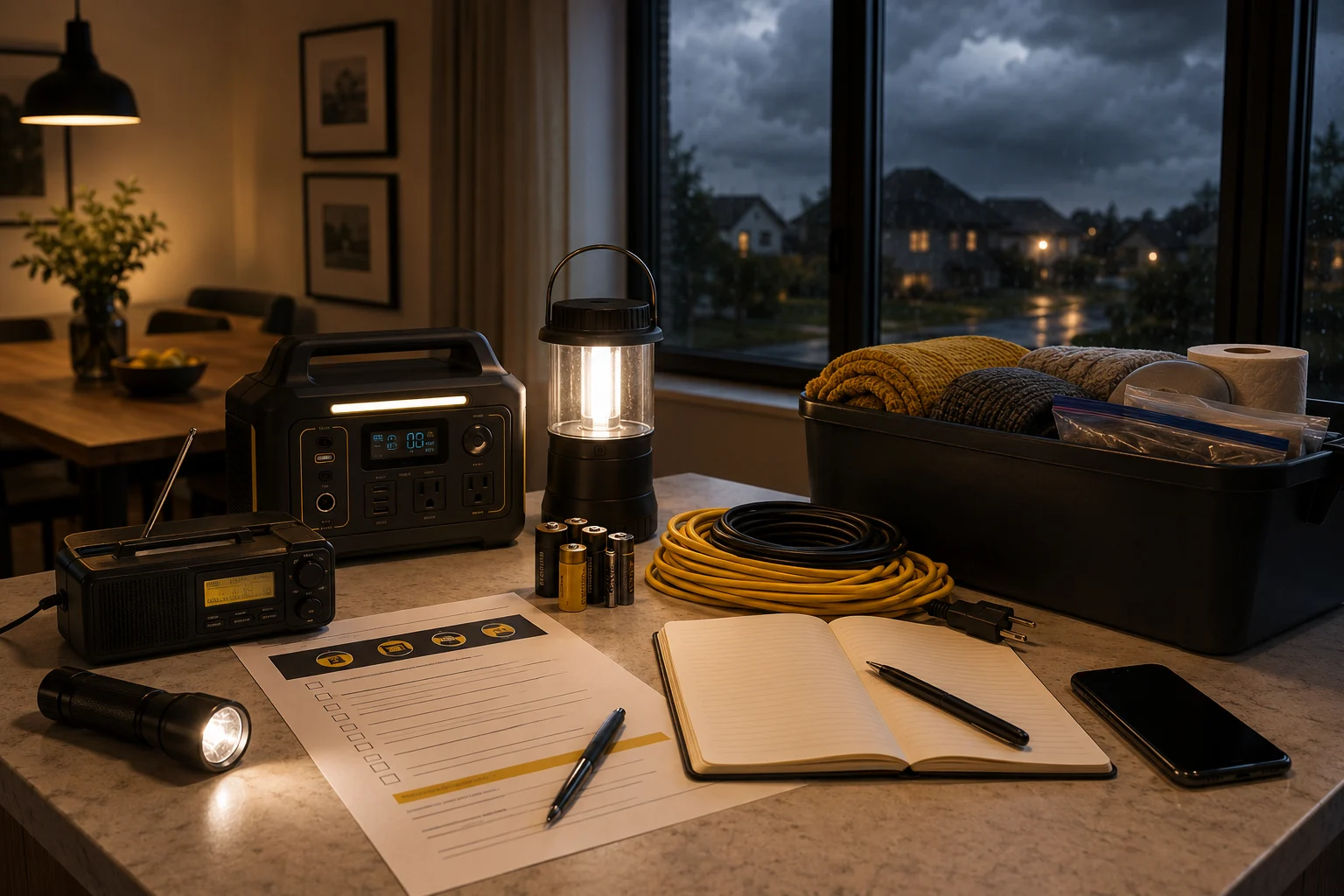
Power outages are inevitable. The good news is that they do not have to become household emergencies. A little planning can keep the lights on, protect refrigerated food, maintain essential communications, and prevent your family from scrambling through drawers for half-dead flashlights while the weather performs its latest act of violence outside.
This guide walks through the basic steps of creating a practical outage plan for your home, whether your budget covers a few rechargeable lights or a complete generator, battery, and solar setup.
The goal is not to power everything exactly as you would on a normal day. The goal is to identify what matters most and build a system that keeps those essentials running safely.
Know Your Outage Risks
Every home has different vulnerabilities. A household in a cold northern climate may be most concerned about heating, while a home with a sump pump may face water damage within hours of losing power. If that is one of your risks, plan specifically for keeping the sump pump running during an outage rather than treating it like an ordinary appliance.
Start by identifying the most likely reasons your power could fail.
Common causes of household power outages
- Severe thunderstorms
- High winds and fallen trees
- Snow and ice accumulation
- Hurricanes or tropical storms
- Wildfires and public-safety shutoffs
- Grid overload
- Utility equipment failure
- Vehicle accidents involving power lines
- Planned maintenance
- Local transformer failure
Consider both the frequency and duration of past outages in your area. A neighborhood that loses power for two hours several times a year requires a different plan than one that occasionally experiences a three-day winter outage.
Questions to ask about your home
- How often does the power go out?
- How long do outages usually last?
- Do outages happen more often during summer or winter?
- Does the home rely on electric heat, a furnace blower, a well pump, or a sewage pump?
- Is anyone in the household dependent on powered medical equipment?
- Are there pets, children, or older adults with additional needs?
- How quickly would the basement flood if the sump pump stopped?
- How much food is typically stored in the refrigerator and freezer?
Key takeaway: Preparedness begins with identifying the essential circuits and systems your household cannot afford to lose.
Decide What You Actually Need to Power
Most households do not need to run every appliance during an outage. Trying to recreate normal grid service can dramatically increase the cost and complexity of a backup system.
Instead, divide your devices into three categories.
Essential loads
These are the systems that protect health, safety, or the home itself.
- Refrigerator and freezer
- Sump pump
- Well pump
- Furnace blower or boiler controls
- Medical equipment
- Basic lighting
- Phones and communication devices
- Internet equipment
- Security systems
- Sewage or grinder pump
Useful loads
These improve comfort but may not need to run continuously.
- Television
- Computers
- Fans
- Coffee maker
- Microwave
- Garage-door opener
- Small kitchen appliances
- Washing machine
- Portable air conditioner
Optional loads
These are usually the first items to remove when reducing power demand.
- Clothes dryer
- Electric oven
- Hot tub
- Pool equipment
- Central air conditioning
- Electric water heater
- Decorative lighting
- Multiple televisions or gaming systems
A simple priority list might look like this:
- Keep the sump pump operating.
- Maintain refrigeration.
- Power the furnace and basic lighting.
- Keep phones, internet, and radios charged.
- Add comfort devices only when capacity permits.
Understand Watts, Watt-Hours, and Starting Power
You do not need an electrical-engineering degree to plan backup power, but three basic concepts matter.
Running watts
Running watts describe how much power a device uses while operating normally.
A refrigerator, for example, may use a relatively modest amount of power once its compressor is running.
Starting watts
Some appliances need a brief surge of extra power when motors or compressors start.
Common high-surge devices include:
- Refrigerators
- Freezers
- Sump pumps
- Well pumps
- Furnace blowers
- Air conditioners
- Power tools
Your generator or battery inverter must be able to handle that temporary surge. The generator size calculator can help estimate both running and startup requirements.
Watt-hours
Watt-hours measure energy capacity over time and are especially important when comparing portable power stations. Use the battery runtime calculator to turn that capacity into a practical estimate.
For example:
- A 100-watt device running for one hour uses approximately 100 watt-hours.
- The same device running for five hours uses approximately 500 watt-hours.
- A 1,000Wh power station will not usually provide the entire rated capacity through its AC outlets because some energy is lost through the inverter and internal electronics.
Pro tip: Generator sizing is primarily about how much power you need at one time. Battery sizing is also about how long you need that power to last.
Build a Basic Household Load List
Create a simple inventory of the appliances and devices you may want to use.
| Device | Running Watts | Starting Watts | Hours Per Day | Priority |
|---|---|---|---|---|
| Refrigerator | 150 | 900 | Cycles | Essential |
| Sump pump | 800 | 2,000 | Intermittent | Essential |
| Furnace blower | 600 | 1,200 | 6 | Essential |
| Router and modem | 25 | 25 | 24 | Useful |
| LED lights | 40 | 40 | 6 | Essential |
| Television | 120 | 120 | 3 | Optional |
Exact consumption varies by appliance. Use the product label, owner’s manual, or a plug-in watt meter whenever possible.
Add the loads in the right order
- Add the running watts of devices that may operate simultaneously.
- Identify the appliance with the largest startup surge.
- Add a reasonable safety margin.
- Decide whether some appliances can be used separately.
- Calculate the energy required over the expected outage period.
Load management can reduce the system size you need. You might run the microwave only after confirming that the sump pump and furnace are not starting at the same moment.
Choose a Backup-Power Strategy
There is no universal best solution. The right system depends on your budget, fuel access, noise tolerance, outage length, and the appliances you need to support.
Option 1: Rechargeable lights and small USB batteries
This is the most affordable starting point.
A basic setup may include:
- Rechargeable LED lanterns
- USB battery banks
- Battery-powered radio
- Rechargeable flashlights
- Spare charging cables
- Small solar charger
This will not run a refrigerator, but it can keep phones charged, eliminate the need for candles, and provide safe lighting during short outages.
Option 2: Compact portable power station
A small power station can support:
- Phones and tablets
- Internet equipment
- Lights
- Laptops
- Television
- CPAP equipment, depending on capacity
- Small fans
These systems are quiet and can be used indoors, although recharge time and limited capacity must be considered.
Option 3: Large expandable power station
Larger battery systems may support refrigeration, pumps, heating equipment, or selected household circuits.
Advantages include:
- Quiet operation
- Indoor use
- No exhaust
- Solar-charging compatibility
- Low maintenance
- Automatic or near-automatic operation with some systems
The primary limitations are initial cost and finite stored energy.
Option 4: Portable generator
Portable generators offer substantial power at a lower upfront cost than many large battery systems.
Common fuel options include:
- Gasoline
- Propane
- Natural gas
- Dual-fuel configurations
- Tri-fuel configurations
Generators are well suited for longer outages when fuel is available, but they create noise, require maintenance, and must be operated outdoors at a safe distance from doors, windows, and vents.
Option 5: Generator and battery hybrid
A hybrid system uses a generator during the day to run major loads and recharge a power station. The battery then supplies quiet power overnight.
This approach can:
- Reduce nighttime noise
- Lower generator runtime
- Conserve fuel
- Provide indoor power without extension cords running continuously
- Maintain phones, refrigeration, lights, and internet while the generator is off
Recommended approach: For many households, a generator-plus-battery system offers the best balance of runtime, quiet operation, fuel efficiency, and flexibility.
Create a Daytime and Nighttime Operating Plan
Backup equipment works better when you decide in advance how it will be used.
Sample daytime plan
- Run the generator from 8:00 a.m. to noon.
- Power the refrigerator, freezer, sump pump, and furnace.
- Recharge portable power stations and USB batteries.
- Use high-demand kitchen appliances while the generator is running.
- Refill water containers and complete necessary household tasks.
Sample nighttime plan
- Shut down and secure the generator.
- Use the portable power station for lights and internet.
- Keep phones and medical devices charged.
- Run refrigeration only if needed and supported by available capacity.
- Use battery-powered motion lights in hallways and bathrooms.
A planned schedule prevents unnecessary fuel consumption and reduces the temptation to leave equipment running without a clear purpose.
Store Fuel Safely and Realistically
Fuel planning is often the weakest part of a generator setup.
A generator is only useful for as long as you can safely supply it.
Fuel-planning checklist
- Determine the generator’s consumption at several load levels.
- Estimate daily operating hours.
- Calculate fuel needed for one, three, and seven days.
- Store fuel only in approved containers.
- Follow local regulations and manufacturer guidance.
- Rotate gasoline before it degrades.
- Keep propane cylinders upright and protected.
- Never refuel a hot or running generator.
Questions to answer before an outage
- Where will fuel be stored?
- How much can be stored safely and legally?
- Where is the nearest functioning fuel source during a regional outage?
- Can the generator operate on more than one fuel type?
- Who in the household knows how to start, shut down, and refuel it?
8. Prepare for Outages Without Backup Power
Equipment is helpful, but planning should also assume that your backup system may fail, run out of fuel, or be temporarily unavailable.
Keep basic supplies available
- Drinking water
- Shelf-stable food
- Manual can opener
- Blankets
- Battery radio
- First-aid supplies
- Prescription medications
- Pet food
- Cash
- Printed contact information
- Fire extinguisher
- Carbon-monoxide alarms
- Spare batteries
- Basic tools
Reduce unnecessary energy use
During an outage:
- Keep refrigerator and freezer doors closed.
- Use one occupied room rather than lighting the entire house.
- Charge devices while the generator is already running.
- Lower screen brightness.
- Use LED lighting.
- Avoid unnecessary heating or cooling loads.
- Turn off equipment before starting or stopping a generator.
Write the Plan Down
A plan trapped inside one person’s head is not much of a household plan.
Create a short written document that includes:
- Emergency contact information
- Utility company outage-reporting information
- Generator startup and shutdown instructions
- Fuel locations
- Extension-cord and connection instructions
- The order in which appliances should be powered
- Medical or accessibility needs
- Pet procedures
- Evacuation triggers
- The location of flashlights, radios, and emergency supplies
Store one printed copy with your emergency supplies and another near the backup-power equipment.
Callout: Your plan should be simple enough that another adult can follow it without calling you six times while standing next to a beeping machine in the dark.
Test Everything Before You Need It
The middle of a storm is a terrible time to discover that your generator will not start, your extension cord is too short, or your power station was quietly sitting at 14% charge.
Monthly quick test
- Check battery charge levels.
- Test flashlights and lanterns.
- Confirm that charging cables are present.
- Start the generator.
- Inspect fuel and oil.
- Test carbon-monoxide alarms.
- Review stored water and food.
Seasonal full test
- Simulate a power outage.
- Disconnect or avoid normal grid power where safe.
- Start the backup equipment.
- Connect essential appliances.
- Confirm startup surges can be handled.
- Measure approximate runtime.
- Practice the transition from generator power to battery power.
- Note any missing equipment or confusing steps.
- Update the written plan.
Testing turns a collection of products into a working system.
A Simple Outage Plan for Different Budgets
Under $100
Focus on communication and lighting.
- Two rechargeable lanterns
- USB battery banks
- Battery radio
- Charging cables
- Spare batteries
- Basic water and food storage
Under $500
Add limited device and appliance support.
- Larger USB batteries or compact power station
- Rechargeable fans
- LED room lighting
- Small solar panel
- Plug-in watt meter
- Heavy-duty extension cords
Under $1,500
Build a more capable short-outage system.
- Mid-sized power station or portable generator
- Fuel storage
- Refrigerator support
- Internet and lighting support
- Sump-pump capability where practical
- Carbon-monoxide alarms and safety accessories
Larger whole-home budget
A comprehensive setup may include:
- Standby or high-output portable generator
- Transfer switch or interlock installed by a qualified professional
- Expandable battery storage
- Rooftop or portable solar panels
- Smart load management
- Multiple fuel options
- Whole-home surge protection
The most expensive system is not automatically the best. A carefully planned smaller system can outperform a larger one that has no fuel strategy, no load priorities, and no one who remembers how to turn it on.
Final Outage Planning Checklist
Before calling your plan complete, confirm that you have:
- Identified your most likely outage risks
- Listed essential household loads
- Recorded running and starting watts
- Selected an appropriate backup-power system
- Planned fuel or recharge requirements
- Created daytime and nighttime operating schedules
- Stored basic food and water
- Written clear operating instructions
- Installed working carbon-monoxide alarms
- Tested the complete system under realistic conditions
Final thought: The purpose of outage planning is not to prepare for every possible catastrophe. It is to make the next ordinary disruption safer, cheaper, quieter, and considerably less annoying.