

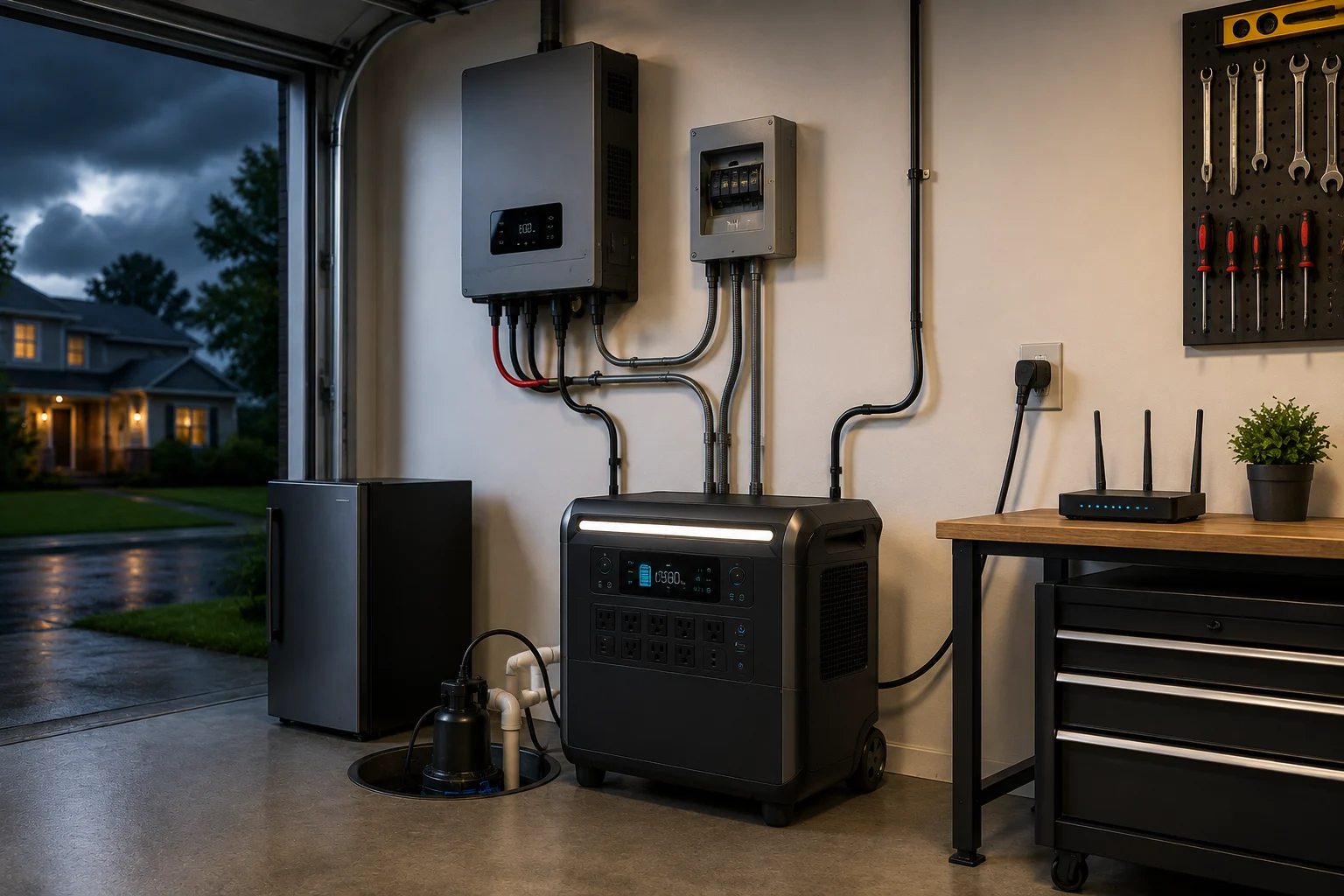
A home battery backup system can keep your refrigerator cold, internet connection active, lights running, medical equipment operating, and essential electronics charged when the electrical grid goes down.
Unlike a traditional gas generator, a battery backup does not burn fuel while it is operating. It produces no exhaust at the point of use, requires no engine maintenance, and can usually be operated safely inside the home when installed and used according to the manufacturer’s instructions.
Modern battery systems also cover a much wider range of needs than the small emergency power packs many homeowners remember. A compact portable power station may be enough to run a router, laptop, television, lights, and CPAP machine. Larger expandable systems can power refrigerators, sump pumps, freezers, well pumps, window air conditioners, and selected household circuits. Some premium systems can even provide 120-volt and 240-volt output for major appliances or integrate with a home electrical panel.
That versatility is one reason home battery backup systems have become so popular. They provide a quieter and simpler alternative to generators, but they also come with meaningful limitations. Batteries store a finite amount of energy, large systems can be expensive, and powering an entire home for several days requires considerably more capacity than many first-time buyers expect.
This guide explains the pros and cons of home battery backup systems, how to compare capacity and output, and what distinguishes major brands including Anker SOLIX, EcoFlow, BLUETTI, Jackery, and Goal Zero.
Quick answer: Home battery backup systems provide quiet, indoor-safe emergency power without gasoline or engine maintenance. They are well suited to refrigerators, internet equipment, lights, medical devices, and selected home circuits, but they cost more per stored kilowatt-hour than generators and must be recharged once their stored energy is used.
Affiliate disclosure: Home Power Matrix may earn a commission from qualifying purchases made through links on this page. This does not affect the price you pay.
What Is a Home Battery Backup System?
A home battery backup system stores electricity so you can use it later.
At its simplest, it consists of:
- A rechargeable battery
- An inverter that converts stored DC power into household AC power
- Charging electronics
- AC outlets, USB ports, or other output connections
- A battery management system that monitors temperature, voltage, and charging conditions
Most portable home backup systems are sold as self-contained units commonly called portable power stations. You charge the unit in advance, plug appliances directly into it, and recharge it from a wall outlet, solar panels, a vehicle, or another supported source.
Larger systems may also support expansion batteries, high-voltage appliances, transfer switches, or smart electrical panels. These products blur the line between a portable power station and a permanently installed whole-home battery.
The important distinction is that a battery backup stores energy. It does not create energy by itself. Once its stored capacity has been used, it must be recharged.
The Advantages of Home Battery Backup Systems
Batteries Can Be Used Indoors
A battery backup does not produce carbon monoxide during normal operation because it does not burn gasoline, propane, or natural gas.
That means a portable power station can usually be placed inside the home, provided it remains dry, adequately ventilated, and within the manufacturer’s recommended operating-temperature range.
This is one of the greatest practical advantages of a battery system. You can keep it near the appliances it powers instead of running extension cords through a window to an outdoor generator.
A battery should still be treated as a substantial electrical device. Do not block its cooling vents, expose it to water, place it beside a furnace, or use damaged charging cables. Manufacturer safety instructions always take priority.
Battery Systems Are Quiet
Portable power stations make little noise compared with combustion generators. You may hear cooling fans when the system is charging quickly or supplying a heavy load, but there is no continuously running engine.
Quiet operation makes batteries particularly useful:
- Overnight
- In apartments and townhouses
- In neighborhoods with noise restrictions
- Around children and pets
- For powering CPAP machines
- When you do not want to advertise that your home has backup power
Many homeowners use a hybrid strategy during extended outages: operate a generator during the day to power appliances and recharge batteries, then shut the generator down and use battery power overnight.
They Require Very Little Routine Maintenance
A gas generator requires fuel management, oil changes, periodic test runs, spark-plug inspections, and attention to carburetor or fuel-system problems.
A battery power station requires much less routine work. You generally need to:
- Keep it charged
- Store it within the recommended temperature range
- Inspect the unit and cables periodically
- Install firmware or app updates when applicable
- Recharge it according to the manufacturer’s storage recommendations
There is no oil to change, stale gasoline to drain, or engine to troubleshoot at two o’clock in the morning while your basement fills with water. A charming little nightmare avoided.
They Deliver Clean, Stable Power
Reputable modern power stations generally use inverter technology to provide regulated AC output suitable for common household electronics.
This makes them a convenient option for:
- Computers
- Televisions
- Routers and modems
- Game consoles
- CPAP machines
- Audio equipment
- Phone and tablet chargers
Buyers should still verify that a particular unit provides a pure sine wave output, especially when powering sensitive electronics, variable-speed motors, medical devices, or equipment with specialized power requirements.
Batteries Can Be Recharged in Several Ways
Most portable power stations can be charged from a household wall outlet. Depending on the model, they may also support:
- Portable solar panels
- Rooftop or ground-mounted solar arrays
- Vehicle charging
- Alternator chargers
- Gas or propane generators
- Electric vehicle charging equipment
- Multiple charging sources at the same time
Charging flexibility becomes especially important during a long outage. A battery that can only be recharged from the unavailable electrical grid has a limited emergency window. A battery that can accept substantial solar input or generator charging can remain useful much longer.
Some Systems Are Expandable
Expandable battery systems allow you to purchase a base unit and add battery modules later.
This can make the initial purchase more manageable. A homeowner might begin with enough capacity for a refrigerator, internet equipment, lights, and electronics, then add storage later for a sump pump, freezer, heating system, or additional circuits.
Expansion limits vary dramatically. Some portable systems accept only one or two additional batteries. Larger platforms can scale from a few kilowatt-hours to several dozen.
Batteries Can Provide Automatic Backup
Selected power stations include an uninterruptible power supply or emergency power supply function. When the power station is connected between the wall and a supported device, it can automatically switch to battery power when grid power fails.
Transfer time varies by product. A fast switching time may be suitable for computers, networking equipment, or storage devices, but buyers should not assume that every power station functions like a true online UPS.
For broader household protection, larger systems can be connected to compatible transfer equipment or smart home panels. This allows selected circuits to switch to battery power without moving extension cords around the house.
Electrical-panel integration should use equipment approved for the system and should be completed by a qualified professional where required.
The Disadvantages of Home Battery Backup Systems
Stored Energy Is Limited
The biggest limitation is simple: a battery eventually runs out.
A 2,000-watt-hour battery does not mean it can run a 2,000-watt appliance for exactly one hour. Some energy is lost through the inverter, internal electronics, temperature, and wiring. The power station itself also consumes energy while operating.
A rough planning formula is:
Estimated runtime = usable battery capacity ÷ average appliance wattage
If a 2,048Wh battery provides approximately 1,740Wh of usable AC energy after losses, a constant 200-watt load might run for about 8.7 hours.
Real appliances complicate the calculation. Refrigerators, freezers, pumps, and air conditioners cycle on and off rather than drawing their rated wattage continuously. Motor-driven appliances may also require a brief surge of power when they start.
Large Systems Are Expensive
A small battery backup can be purchased for a few hundred dollars. A serious expandable home system can cost several thousand dollars before adding solar panels, expansion batteries, transfer equipment, or installation.
Batteries are often less economical than generators when the sole goal is producing large amounts of emergency energy for many consecutive days.
Their value is strongest when quiet operation, indoor use, automatic backup, minimal maintenance, solar compatibility, or everyday energy management matters to the buyer.
Recharging Can Be Difficult During Long Outages
Solar charging sounds wonderfully self-sufficient, but actual solar production depends on:
- Panel wattage
- Available sunlight
- Weather
- Season
- Shade
- Panel angle
- Solar-input limits
- Charging losses
A 400-watt solar panel will not necessarily produce 400 watts throughout the day. Clouds, heat, shade, and poor positioning can reduce output substantially.
For dependable extended-outage planning, calculate how much energy you expect to use each day and whether your charging setup can realistically replace that energy.
High-Capacity Units Are Heavy
The word “portable” becomes increasingly philosophical once a power station weighs more than 100 pounds.
Small systems can be carried with one hand. Larger home-backup systems may require wheels, ramps, or two people. Expansion batteries add additional weight and floor space.
Before buying, consider where the system will be stored and whether it must be moved across stairs, gravel, thresholds, or carpeting.
Not Every Battery Can Run Every Appliance
Battery capacity and output power are separate specifications.
Capacity, measured in watt-hours or kilowatt-hours, tells you approximately how much energy the battery stores.
Output, measured in watts or kilowatts, tells you how much power the inverter can deliver at one time.
A battery may store enough energy to operate an appliance for several hours but still be unable to start it because the appliance’s startup surge exceeds the inverter rating.
You must check:
- Continuous output
- Surge output
- 120V or 240V requirements
- Appliance startup demand
- Outlet type
- Maximum output from each individual port
- Whether high-power boost modes alter voltage
Do not assume that a marketing claim such as “powers 99% of appliances” guarantees compatibility with your particular equipment.
LiFePO4 Batteries Explained
Many newer premium power stations use lithium iron phosphate, commonly abbreviated as LiFePO₄ or LFP.
LFP has become popular in home backup products because it generally offers a long cycle life, good thermal stability, and strong durability compared with older lithium-ion chemistries commonly used in portable electronics.
A cycle represents the equivalent of using and replacing the battery’s full capacity. Using 50% one day and 50% the next is approximately one full cycle.
Manufacturers frequently advertise several thousand cycles before an LFP battery declines to a specified percentage of its original capacity. That does not mean the battery suddenly dies at the end of its rated cycle life. It means the battery is expected to retain less energy than it did when new.
Cycle-life claims are not directly comparable unless the manufacturers use the same testing conditions and remaining-capacity threshold. Temperature, charging rate, discharge rate, storage habits, and depth of discharge all affect real battery aging.
For most buyers planning to keep a power station for many years, LFP is the preferred chemistry unless lower weight or another specialized requirement takes priority.
How Much Battery Capacity Do You Need?
There is no single correct battery size for every household.
Start by identifying the appliances that genuinely matter during an outage. Then record each appliance’s running wattage, estimated daily operating time, and startup surge where applicable.
A small 500Wh to 1,000Wh system may be suitable for:
- Phones
- Tablets
- Laptops
- LED lights
- Internet equipment
- A television
- A CPAP machine, depending on its settings and accessories
A 1,000Wh to 3,000Wh system may support a combination of:
- Refrigerator
- Freezer
- Internet equipment
- Computers
- Television
- Lights
- Small kitchen appliances
- Medical equipment
- Limited sump-pump operation, depending on pump size and frequency
A 3,000Wh to 10,000Wh expandable system may support several major appliances or selected home circuits for a more meaningful period.
Capacity beyond 10kWh becomes increasingly relevant for:
- Longer outages
- Well pumps
- Heating equipment
- Window or mini-split air conditioning
- Multiple refrigerators and freezers
- Larger household loads
- 240V appliances
- Whole-home or near-whole-home backup
A battery-runtime calculator can help estimate individual loads, but always leave a reserve. Designing a system that works only under perfect mathematical conditions is how you end up choosing between the refrigerator and the sump pump during a thunderstorm.
Home Battery Backup Brands Compared
The five brands below all sell power stations that can be used for home backup, but their product ranges and strongest use cases differ.
Individual models change regularly, so buyers should compare the exact specifications of the current product rather than relying on brand reputation alone.
| Brand | Best For | Key Strengths | Main Drawbacks | Expansion Potential | 240V / Home Integration | Ease of Use |
|---|---|---|---|---|---|---|
| Anker SOLIX | Premium expandable home backup | Strong build quality, fast charging, LFP batteries, polished app, high-capacity systems | Premium pricing, heavy equipment, accessories increase total cost | Excellent | Strong on larger systems | Very good |
| EcoFlow | Smart home integration and fast charging | Broad ecosystem, strong app controls, rapid AC charging, smart panels, extensive accessories | Product lineup can be confusing, proprietary accessories, expensive at scale | Excellent | Excellent | Good |
| BLUETTI | Buyers focused on capacity and value | Wide range of battery sizes, LFP chemistry, competitive specifications, frequent bundles | Complex product lineup, compatibility varies, less intuitive model naming | Very good | Available on selected systems | Moderate |
| Jackery | Beginners and buyers who value simplicity | Easy controls, strong brand recognition, portable designs, straightforward solar bundles | Older models vary in battery chemistry, fewer advanced energy-management tools | Good | Available on larger systems | Excellent |
| Goal Zero | Portable solar, camping, mobile work, and emergency backup | Established portable-power brand, user-friendly products, strong outdoor focus | Smaller ecosystem, fewer whole-home options, sometimes higher cost per watt-hour | Moderate | Limited compared with larger competitors | Very good |
Compare current home battery backup systems: Check battery capacity, output, charging speed, expandability, warranty coverage, and accessory compatibility before purchasing.
Anker SOLIX
Anker SOLIX offers products ranging from compact portable power stations to expandable 120V/240V home-backup platforms.
At the larger end, the SOLIX F3800 platform starts with 3.84kWh of storage and supports 120V and 240V output. Anker also offers configurations with expansion batteries, transfer equipment, substantial solar input, and capacity extending well beyond a basic portable system.
Anker SOLIX Pros
- Strong selection of portable and home-oriented systems
- LFP batteries across many current models
- Fast wall charging on selected units
- Expandable premium systems
- App-based monitoring and control
- 120V and 240V options
- Direct connections for RV or EV applications on selected products
- Attractive choice for generator-and-battery hybrid setups
Anker SOLIX Cons
- Larger systems carry premium pricing
- Expansion batteries and home-integration accessories add significant cost
- High-capacity units are extremely heavy
- Similar product names and bundles can make comparison confusing
- Buyers must verify compatibility between base units, batteries, panels, and home-backup accessories
Who Should Consider Anker SOLIX?
Anker SOLIX is especially compelling for homeowners who want to begin with portable backup but retain a path toward an expandable home system.
The F3800 family is designed for buyers considering substantial capacity, 240V output, solar charging, RV connections, or direct EV charging. If vehicle charging is part of your backup plan, see what is realistically possible when charging an EV with a portable power station. Smaller SOLIX models are better suited to essential-appliance backup and portable use.
EcoFlow
EcoFlow has one of the broadest product ecosystems in the portable power industry. Its DELTA products range from compact 1kWh units to modular systems intended for extensive home backup.
The company’s current lineup includes portable models with app control and fast AC charging, along with larger products supporting 120V/240V output, smart-panel integration, and capacities that can expand into whole-home territory.
For example, the DELTA 3 Classic combines 1,024Wh of capacity, 1,800W output, app management, and a 10-millisecond automatic switching specification. At the other end of the range, EcoFlow’s larger DELTA Pro platforms can be expanded for far more demanding household loads.
EcoFlow Pros
- Extensive product range
- Strong app and energy-management features
- Very fast AC charging on many models
- Expandable batteries
- Smart home panel options
- 120V and 240V solutions
- High solar-input capability on selected systems
- Good ecosystem for home, RV, vehicle, and portable use
EcoFlow Cons
- Large number of products can overwhelm first-time buyers
- Some features depend on proprietary accessories
- Product generations and compatibility must be checked carefully
- Complete home systems become expensive quickly
- Advanced app features may be unnecessary for buyers who want simple emergency power
Who Should Consider EcoFlow?
EcoFlow is well suited to buyers who value fast charging, detailed app control, expansion options, and the ability to build a more automated backup system over time.
It is also a logical choice for homeowners who want to integrate portable storage with solar panels, an alternator charger, or a smart home panel.
BLUETTI
BLUETTI sells a wide variety of portable power stations, expansion batteries, solar panels, and larger home-energy products.
Its lineup covers entry-level units, 1kWh and 2kWh portable systems, and higher-capacity modular products. The current Elite 100 V2, for example, combines 1,024Wh of capacity with 1,800W output and an advertised cycle rating exceeding 4,000 cycles.
BLUETTI Pros
- Broad range of battery sizes
- LFP chemistry used across many models
- Competitive capacity and output specifications
- Expansion support on selected systems
- Frequent product bundles and promotions
- Wide range of solar-panel options
- Products available for both portable and home-backup use
BLUETTI Cons
- The product lineup can be difficult to navigate
- Model names do not always make the hierarchy obvious
- Expansion compatibility varies by product
- App and interface experiences can differ across generations
- Buyers should verify warranty terms for the exact model and sales channel
Who Should Consider BLUETTI?
BLUETTI is worth considering for buyers focused on capacity, LFP longevity, and modular expansion.
The brand often appeals to shoppers who enjoy comparing specifications and assembling a system around a particular capacity target. Less technically inclined buyers should spend extra time confirming which batteries, cables, panels, and accessories work together.
Jackery
Jackery is one of the most recognizable portable power station brands. Its products have historically emphasized straightforward operation, portability, and bundled solar-generator kits.
The company now offers LFP models ranging from small portable units to expandable home systems. Current examples include the 1,070Wh Explorer 1000 v2, the 2,042Wh Explorer 2000 v2, and the much larger Explorer 5000 Plus with 5,040Wh capacity and 120V/240V output.
Jackery Pros
- Generally simple controls
- Strong brand recognition
- Wide availability
- Portable designs across much of the range
- Solar-generator bundles are easy to understand
- Newer models use LFP batteries
- Large home-backup options are now available
- Good fit for buyers who prefer a relatively straightforward ecosystem
Jackery Cons
- Some older models use different battery chemistry than newer LFP units
- Buyers must compare generations carefully
- Expansion options vary substantially by model
- Some products prioritize simplicity over advanced energy-management features
- Large systems remain expensive and heavy
Who Should Consider Jackery?
Jackery is a strong option for buyers who prioritize ease of use and do not want to spend their outage studying an electrical-engineering flowchart.
Its smaller Explorer products work well for portable and essential-device backup. Newer HomePower and Explorer Plus systems target buyers who need more capacity, expansion, or household-circuit support.
Goal Zero
Goal Zero has a long history in portable solar and battery power. Its Yeti series is designed for camping, professional work, off-grid applications, and emergency home use.
The company describes its portable systems as scalable emergency backup options for renters and homeowners who want power that can move between rooms or travel outside the home. Goal Zero’s newer Yeti 1500 uses an LFP battery and a 2,000W inverter, reflecting the company’s movement toward the longer-lived battery chemistry now common in premium competitors.
Goal Zero Pros
- Established portable-power brand
- Strong connection to portable solar
- Straightforward emergency-backup positioning
- Useful options for camping, vans, work sites, and home use
- Newer LFP products improve long-term durability
- Portable products are generally approachable for nontechnical users
Goal Zero Cons
- Product selection may be smaller than some major competitors
- Older Yeti models may use different battery chemistry
- Buyers should confirm whether a listed product is current or discontinued
- Expansion and home-integration options may be less extensive than the largest EcoFlow, Anker, or Jackery platforms
- Pricing may not always be the lowest per watt-hour
Who Should Consider Goal Zero?
Goal Zero makes the most sense for buyers who want a portable system that can serve multiple roles, including emergency backup, camping, overlanding, mobile work, or van use.
It may be less attractive for someone planning a highly expandable, automated whole-home system, but its newer LFP models deserve consideration for portable and essential-appliance backup.
Which Home Battery Backup Brand Is Best?
There is no universal winner because the right brand depends on the type of system you are building.
Consider Anker SOLIX when you want a polished expandable platform, strong high-capacity options, and the possibility of 240V, RV, EV, or home-panel use.
Consider EcoFlow when fast charging, app control, smart-home integration, and a broad ecosystem are high priorities.
Consider BLUETTI when you want a wide selection of capacities and are comfortable carefully comparing technical specifications and expansion compatibility.
Consider Jackery when simple operation, portability, recognizable products, and straightforward solar bundles matter most.
Consider Goal Zero when you want an established portable-solar brand and a system that can move easily between emergency backup, outdoor use, and mobile work.
The exact product matters more than the logo. Compare individual models based on your appliances, runtime target, charging plan, warranty, and expansion needs.
Home Battery Backup Buyer’s Checklist
Before purchasing a system, verify the following:
- Battery capacity in watt-hours or kilowatt-hours
- Expected usable capacity after conversion losses
- Continuous AC output
- Surge output
- 120V or 240V support
- Battery chemistry
- Cycle-life rating and remaining-capacity threshold
- Wall-charging time
- Maximum solar input
- Expansion-battery compatibility
- Automatic switching capability
- Transfer-switch or smart-panel compatibility
- Product weight and dimensions
- Operating and storage temperature range
- Warranty length
- App requirements
- Replacement-cable and accessory availability
Most importantly, calculate the actual loads you intend to run. Buying based only on battery capacity is one of the most common mistakes first-time shoppers make.
Calculate your backup power needs first. Estimate how long a battery system may run your essential appliances before choosing a capacity.
Frequently Asked Questions
Can a battery backup run a refrigerator?
Yes, many medium and large portable power stations can run a refrigerator.
You must verify both the refrigerator’s normal running wattage and its startup surge. Runtime depends on battery capacity, room temperature, refrigerator efficiency, door openings, and how frequently the compressor runs.
Can a battery backup run a sump pump?
Potentially, but sump pumps can require a substantial startup surge. This guide explains how to keep a sump pump running during an outage and how the main backup options compare.
Check the pump’s amperage, voltage, running wattage, and startup requirement. A small portable power station may shut down even when its stored capacity appears sufficient.
Can a battery power an entire house?
Large expandable systems can power many household circuits and, in some configurations, nearly an entire home.
However, whole-home operation depends on system output, storage capacity, electrical-panel integration, and the appliances being used. Central air conditioning, electric furnaces, electric water heaters, ovens, dryers, and well pumps can consume enormous amounts of energy.
How long will a home battery last during an outage?
Runtime depends on usable battery capacity and the total energy consumed by connected appliances.
A battery may run low-power electronics for days but operate a space heater for only a short period. Heating and cooling loads generally consume far more energy than lighting, communications equipment, or refrigeration.
Can I recharge a battery backup with a generator?
Many systems can be recharged from a generator, but the generator must provide voltage and frequency within the battery charger’s acceptable range.
Inverter generators are often a good match because they typically provide stable electrical output. Always follow both manufacturers’ instructions and never operate a combustion generator indoors or near doors, windows, or vents.
Safety warning: Never operate a gasoline, propane, or natural-gas generator inside a home, garage, basement, shed, or near doors, windows, or vents. Carbon monoxide can build up quickly and can be fatal.
Can I use third-party solar panels?
Sometimes.
You must match the panel array’s voltage, current, connector type, polarity, and total wattage to the power station’s solar-input requirements. Exceeding the maximum voltage can damage equipment.
Can a home battery save money on electricity?
Some larger systems can store energy when electricity is inexpensive and use it when rates are higher. This is most useful in areas with time-of-use pricing, demand charges, or favorable solar policies.
Savings depend heavily on local utility rates, battery efficiency, installation cost, and how frequently the battery cycles. A portable power station purchased primarily for emergencies may never recover its cost through energy arbitrage alone.
Are portable power stations safe?
Reputable systems include battery management and electrical protection features, but no large battery is risk-free.
Purchase from an established manufacturer, follow charging and storage instructions, avoid damaged or recalled equipment, and do not use incompatible cables or improvised electrical connections.
Should I leave my power station plugged in?
Some products are specifically designed to remain connected for automatic backup. Others have different long-term charging recommendations.
Follow the instructions for the exact model. Do not assume that storage guidance for one brand applies to another.
Do I need an electrician?
You generally do not need an electrician when plugging appliances directly into a portable power station.
You may need a qualified electrician when connecting a battery system to household circuits, installing a transfer switch, adding an inlet, modifying a panel, or integrating a smart home energy system.
Is a battery better than a generator?
A battery is better for quiet indoor power, low maintenance, automatic backup, and running modest loads.
A generator is often better for producing large amounts of energy over a long outage, provided fuel remains available.
Many homeowners benefit most from owning both.
Final Thoughts
Home battery backup systems have evolved from oversized phone chargers into legitimate household emergency-power tools.
Their greatest strengths are quiet operation, indoor usability, low maintenance, clean inverter power, and flexible charging. Their greatest weaknesses are limited stored energy, high cost, substantial weight, and the need for a realistic recharging plan.
A small power station may be perfect for communication, lighting, and medical equipment. A 2kWh system may cover a refrigerator and household essentials. A larger expandable platform can support major appliances, selected circuits, and 240V equipment.
The right system is not necessarily the largest one you can afford. It is the one that can start your essential appliances, run them for the required period, and be recharged under the conditions you are likely to face.
Calculate your loads first. Compare current products second. Then choose the battery platform that gives you enough capacity, output, charging flexibility, and room to expand without paying for an elaborate whole-home system you do not actually need.