

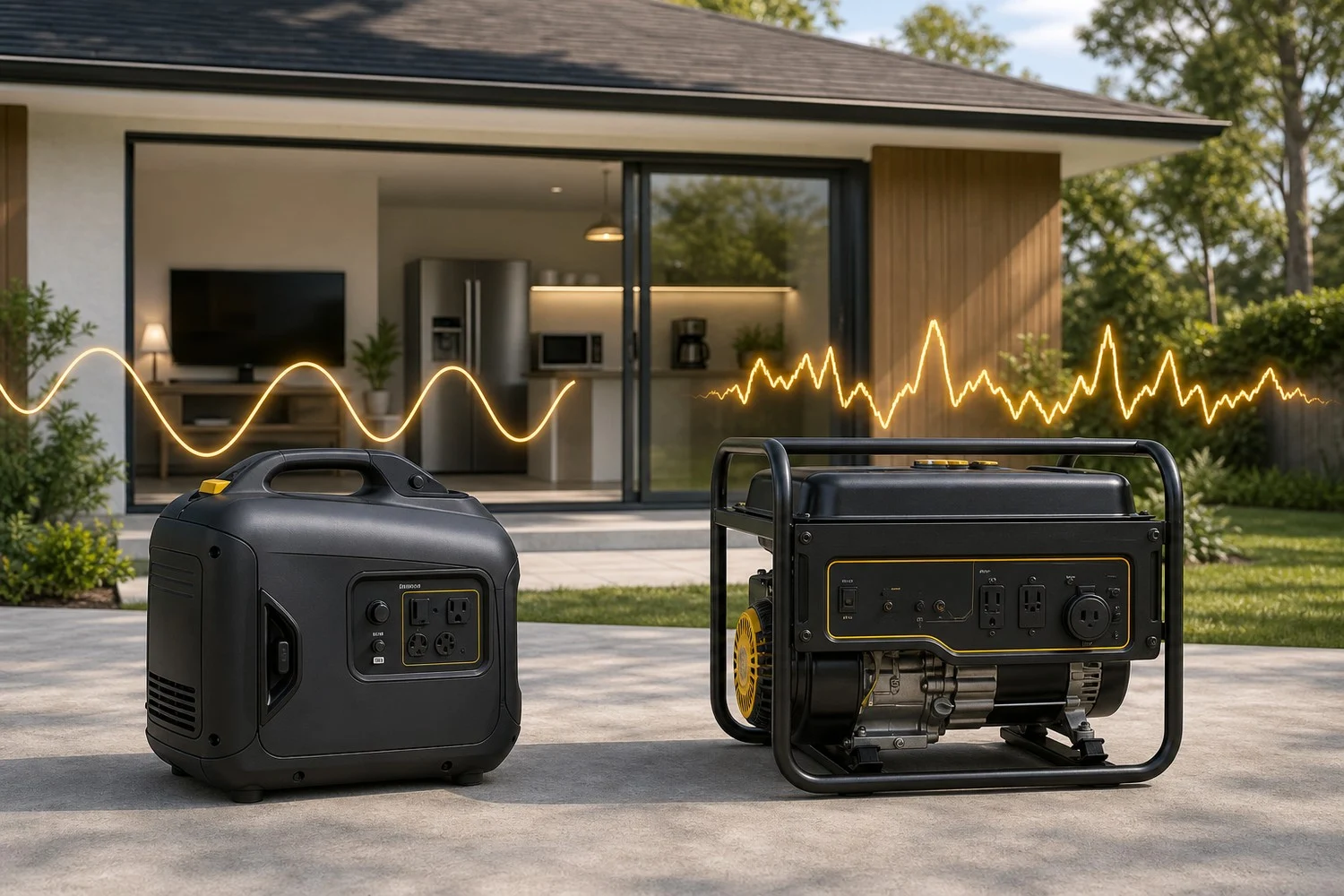
THD describes the quality of the electricity a generator produces. It does not tell you how much power the generator can supply. Instead, it helps describe how closely that electricity resembles the smooth alternating-current waveform that household equipment is designed to receive.
That distinction matters because a generator can produce the correct voltage, run at approximately 60 hertz, and have more than enough wattage while still delivering a distorted electrical waveform. Many basic loads will operate normally on that power. Other equipment may run hotter, make unusual noises, refuse to charge, switch repeatedly between power sources, or shut itself down.
You do not need an electrical-engineering degree to choose a generator, but understanding THD can help you avoid buying a very large machine that is poorly suited to the electronics you actually want to operate.
Quick answer
Generator THD measures how distorted its electrical waveform is. For sensitive electronics, battery power stations, UPS systems, and modern appliances, look for a generator rated below 6% THD. Under 3% is excellent and common among inverter generators.
What Is Total Harmonic Distortion?
Utility power in a North American home alternates direction 60 times per second, producing a waveform known as a sine wave. On a graph, ideal AC electricity appears as a smooth, repeating curve rather than a jagged line, flattened staircase, or irregular series of spikes.
Real-world electricity is never perfectly shaped. Motors, electronic power supplies, generator windings, voltage regulators, nonlinear loads, and other electrical components can introduce additional frequencies called harmonics. These harmonics alter the shape of the original 60-hertz waveform.
Total Harmonic Distortion expresses the combined strength of those unwanted harmonics as a percentage of the fundamental waveform. Lower THD generally means that the power more closely resembles a clean sine wave. Higher THD means that the waveform has been altered more substantially.
Generac describes THD as a measurement of how much an electrical signal has been distorted from its original shape. The company uses less than 6% THD as its threshold for products marketed with its TruePower clean-power technology.
For a homeowner, the important takeaway is simpler:
Wattage tells you how much power is available. THD helps describe the quality of that power.
A generator may have enough wattage to start a refrigerator, charge a portable power station, and run a computer simultaneously. That does not automatically mean every connected device will be happy with the waveform it receives.
What Does a THD Percentage Actually Mean?
A THD rating is not a percentage of “bad electricity,” nor does 10% THD mean that 10% of the generator’s output is unusable. It is a mathematical comparison between the energy in the harmonic frequencies and the energy in the fundamental 60-hertz frequency.
For generator shopping, the exact formula is less important than the general ranges:
| Published THD | Practical Interpretation |
|---|---|
| Under 3% | Excellent power quality and a strong choice for sensitive electronics |
| 3% to 5% | Very clean power suitable for nearly all normal residential loads |
| 5% to 6% | Commonly treated by manufacturers as clean or electronics-safe power |
| 6% to 10% | Often usable, but compatibility becomes more equipment-dependent |
| 10% to 15% | Increasing potential for noise, heat, charging problems, or equipment rejection |
| Above 15% | Better reserved for tolerant loads unless the equipment manufacturer says otherwise |
These are practical shopping ranges, not universal laws. There is no single percentage at which every electronic device suddenly fails. One computer power supply may operate normally on a waveform that causes a particular UPS to click repeatedly or reject the input. Likewise, a generator that produces 12% THD under one load condition may perform better or worse as the connected load changes.
When a manufacturer publishes a THD number, check whether it states that the rating applies at full load, under 25% load, across the entire load range, or only under unspecified test conditions. A conveniently vague “low THD” claim is less useful than an actual percentage.
Why Generator THD Changes Under Load
A generator does not necessarily produce one fixed THD percentage at all times. Its power quality can change as appliances turn on and off, as the engine responds to load, and as the generator approaches its rated output.
A refrigerator compressor, well pump, sump pump, air conditioner, or power tool may draw several times its normal running current for a brief period when starting. During that event, generator voltage and engine speed can dip. The alternator and voltage-regulation system then attempt to recover. The resulting waveform may look worse during the transition than it does while the load is running steadily.
Nonlinear electronic loads can also distort the waveform. Computers, LED lighting, battery chargers, televisions, and variable-speed appliances do not always draw current smoothly throughout the AC cycle. Connecting many of these loads can affect the generator’s output differently than connecting a simple resistance heater with the same wattage.
This is one reason generator performance cannot be judged by watching the front-panel voltage display while nothing is connected. A generator may produce a beautifully stable 120 volts at no load and behave very differently when a large compressor starts or a portable power station begins charging at 1,500 watts.
For the cleanest and most stable operation, avoid routinely running a generator at its absolute maximum output. Leave room for starting surges and changing loads rather than sizing the generator so tightly that every appliance startup becomes an electrical hostage situation.
Our generator sizing guide explains how running watts and starting watts fit into that calculation.
THD Is Not the Same as Voltage or Frequency
THD is only one part of power quality. A generator should also maintain appropriate voltage and frequency.
In the United States, most plug-in household equipment expects approximately:
- 120 volts for standard receptacles
- 240 volts for larger appliances and circuits
- 60-hertz frequency
A generator can show 120 volts on its display and still have high THD. Conversely, a generator can produce a relatively clean waveform while its voltage is too high, too low, or unstable.
Frequency is closely related to engine speed in a conventional generator. If the engine slows significantly under load, frequency can drop. If the governor allows the engine to overspeed, frequency can rise. Some clocks, motors, transformers, and control boards are more sensitive to frequency problems than others.
This is why “my meter says 120 volts” does not settle the power-quality question. A basic multimeter measures voltage. It usually does not reveal waveform distortion, fast transients, or the harmonic content of the power.
Which Household Devices Are Most Sensitive to Generator Power Quality?
The phrase sensitive electronics is used so broadly that it sometimes becomes meaningless. Modern equipment does not all react to distorted power in the same way.
Devices most likely to notice poor generator power include:
- UPS battery-backup systems
- Audio equipment and amplifiers
- Certain battery chargers
- Portable power stations
- Medical equipment
- Variable-speed HVAC systems
- High-efficiency furnace control boards
- Networking and server equipment
- Appliances with inverter-driven motors
- Equipment that actively checks incoming voltage or frequency
- Devices with power-factor-correction circuitry that expects a clean waveform
Computers, televisions, game consoles, and routers contain switch-mode power supplies that convert incoming AC electricity into lower-voltage DC electricity. Many of these supplies tolerate a fairly wide voltage range and may operate normally on moderately distorted generator power. That does not mean every model is immune to poor power quality or that high THD is desirable.
Possible symptoms include unexpected restarts, buzzing power supplies, excessive heat, display flicker, audio hum, charging interruptions, communication errors, or protective shutdowns. In some cases, the device appears to work normally while its internal components experience additional electrical and thermal stress.
The risk depends on the device, the generator, the load level, the duration of use, and the specific harmonics present. THD is useful precisely because there is no easy universal statement such as “all computers are safe below 12%.”
Which Loads Are Usually More Tolerant?
Simple resistive loads generally care more about voltage and available wattage than waveform purity. These include traditional space heaters, incandescent bulbs, hot plates, electric kettles, and many basic heating elements.
Traditional power tools and induction motors are often more tolerant than sophisticated electronic equipment, but they are not completely indifferent to poor power. Distorted voltage can create additional motor heating, noise, vibration, and inefficient operation. A motor that is already struggling with low voltage, undersized extension cords, or insufficient starting capacity does not become healthier because it belongs to the supposedly “tough” category.
Refrigerators, freezers, well pumps, sump pumps, and furnace blowers are frequently powered by conventional generators during outages. Many operate successfully, but newer models may include variable-speed drives, digital controls, communication boards, and inverter compressors. You should not assume that every appliance with a motor is a simple motor load.
When an appliance manual specifies inverter-generator power, sine-wave power, a maximum THD level, or particular voltage and frequency limits, follow that guidance instead of relying on a generic list from the internet.
Why Inverter Generators Usually Produce Lower THD
A conventional generator mechanically produces electricity at the frequency required by the load. In most portable models, the engine must remain close to a fixed operating speed so the alternator can produce approximately 60-hertz AC power. The generator’s governor and voltage regulator respond as loads change, but the resulting waveform may still contain substantial distortion.
An inverter generator uses a more involved process. The alternator first produces electricity that is converted to DC. Electronics then invert that DC electricity back into regulated AC output. This allows the inverter stage to reconstruct a smoother, more consistent waveform.
Honda describes the process as converting the alternator’s AC output to DC and then back to AC, with a microprocessor controlling the inverter and engine. The manufacturer markets this output as stable power appropriate for computers and other electronics.
This design also allows many inverter generators to reduce engine speed when the electrical load is light. That can improve fuel economy and reduce noise. A conventional open-frame generator often runs near its governed speed regardless of whether it is supplying 500 watts or 5,000 watts.
A compact Honda inverter generator is one well-known example, although lower-cost inverter models from Champion, Westinghouse, Generac, and other manufacturers may offer similar low-THD benefits.
Always verify the THD specification for the exact model. The word “inverter” is a strong indicator of clean output, but the published rating is still more useful than the product category alone.
Open-Frame Does Not Automatically Mean Dirty Power
People often use open-frame generator and conventional generator as though they mean the same thing. They do not.
“Open frame” describes the generator’s physical construction: the engine and alternator are exposed inside a tubular frame. “Inverter” describes how the output electricity is processed. An open-frame generator can therefore use inverter technology, and an enclosed generator is not automatically an inverter model.
There are now many open-frame inverter generators that combine higher output and easier service access with electronically regulated low-THD power. They are usually louder than fully enclosed suitcase-style inverter generators, but they may be a useful middle ground for home backup.
Some conventional non-inverter generators also produce respectable power quality through better alternator design and voltage regulation. Generac, for example, identifies certain portable and standby models as producing less than 6% THD.
The correct question is not simply “Is it open frame?” It is:
What THD does this exact generator produce under the conditions in which I will use it?
Can High THD Damage Electronics?
High THD does not act like a cinematic death ray that instantly fries every television connected to the generator. Plenty of households have operated refrigerators, televisions, computers, and chargers from conventional generators without obvious damage.
The more realistic concern is compatibility and cumulative stress. Harmonic distortion can contribute to additional heating in motors, transformers, capacitors, and power supplies. It may cause audible noise, reduce efficiency, interfere with timing or control circuits, and trigger protective circuitry. Equipment may refuse the input rather than risk operating outside its programmed limits.
Damage is more likely when distorted power is combined with other problems, including:
- Overvoltage
- Undervoltage
- Large frequency swings
- Repeated surges
- Loose or incorrect connections
- An overloaded generator
- Undersized extension cords
- Improper grounding or neutral configuration
- Rapidly cycling loads
A published THD rating is therefore useful, but it should not distract from basic generator setup. A 3% THD inverter generator connected through a dangerously undersized cord is not a good installation. Neither is a clean-power generator operated indoors, in a garage, or near an opening where carbon monoxide can enter the house.
Why a UPS May Reject Generator Power
A UPS, or uninterruptible power supply, monitors incoming electricity and switches connected equipment to battery power when it decides the source is unacceptable. Depending on the model, it may evaluate voltage, frequency, waveform shape, or the rate at which those values change.
When connected to a generator, an incompatible UPS may click repeatedly, beep, alternate between line and battery operation, or refuse to recharge. The generator may appear to be running normally because the UPS is reacting to a condition that is not visible on the generator’s basic display.
Some line-interactive UPS systems offer adjustable sensitivity settings. Lowering sensitivity can sometimes help the UPS accept generator power, but it also widens the range of input conditions the UPS permits. The correct setting depends on the equipment being protected and the UPS manufacturer’s instructions.
A double-conversion online UPS handles the problem differently. It continuously converts incoming AC power to DC and then recreates AC power through its own inverter, electrically isolating the connected load from many input variations. APC describes online double-conversion units as providing continuous inverter output and isolation from grid fluctuations.
These systems generally cost more, create more heat, and consume more energy than basic standby UPS units. They are most appropriate for servers, networking equipment, workstations, and other loads where power conditioning matters.
For a home office, consider a pure-sine-wave UPS with active-PFC compatibility. Models from APC and CyberPower are common choices, but you should still check the model’s generator compatibility rather than assuming every pure-sine-wave UPS accepts every generator.
Does a UPS Fix High THD?
Sometimes—but only certain UPS designs truly regenerate the output waveform.
A basic standby UPS usually passes utility or generator power directly to the connected device while the input remains within its accepted range. It may provide surge suppression and voltage correction, but it does not necessarily rebuild distorted AC into a perfect sine wave.
A line-interactive UPS may use an automatic voltage regulator to raise or lower voltage without switching to battery. That helps with voltage variation but does not inherently remove harmonic distortion.
An online double-conversion UPS continuously recreates the output through its inverter and offers the strongest isolation. However, even an online UPS has input limits. Extremely unstable generator power may still prevent charging, cause the UPS to derate, or force it onto battery.
Do not buy a random $60 battery backup expecting it to operate as a magical electricity laundromat. Check the UPS topology, input-frequency range, generator compatibility, power rating, and output waveform.
Can a Surge Protector Reduce THD?
No. A surge protector and a power conditioner are not interchangeable.
A conventional surge protector is designed primarily to limit brief voltage spikes. It does not reconstruct a malformed AC waveform or meaningfully reduce steady harmonic distortion.
Surge protection can still be valuable because generators and connected loads may create switching transients. It simply addresses a different problem.
Likewise, an automatic voltage regulator can correct some overvoltage and undervoltage conditions without fixing the harmonic content of the waveform. Voltage may become more stable while the sine wave remains distorted.
Products marketed vaguely as “power conditioners” vary tremendously. Some contain little more than surge components and filtering. Others use transformers, voltage regulation, or full AC regeneration. Read the technical specifications rather than trusting a very confident box with lightning graphics on it.
Portable Power Stations and Generator THD
A popular outage strategy is to run a fuel-powered generator during the day, use it to power large loads and recharge batteries, then shut it down overnight. A portable power station can quietly operate refrigerators, lights, routers, CPAP equipment, televisions, and charging devices while the generator is off.
This approach reduces nighttime noise, avoids running an engine continuously, and provides clean inverter power to sensitive electronics. Products such as the Anker SOLIX C1000, Anker SOLIX F3800, EcoFlow DELTA series, BLUETTI power stations, and Jackery power stations are designed around battery storage and inverter output.
The charging input is where generator compatibility matters. A power station may monitor incoming voltage and frequency before allowing high-speed AC charging. If the generator’s output is unstable or badly distorted, the power station may:
- Refuse to charge
- Start and stop charging repeatedly
- Reduce its charging rate
- Display an input or overload error
- Cause the generator engine to hunt as charging ramps up and down
Even when the power station accepts the generator, its maximum charging rate may place a substantial continuous load on a small generator. A unit charging at 1,500 watts is not a trivial load merely because no appliance motor is starting.
Many power stations allow the user to reduce the AC charging rate through an app or control panel. Slower charging can help a smaller generator maintain stable voltage and frequency while leaving capacity for other loads. Check the power station manual for its accepted input range and the generator manual for its continuous-output rating.
Use our battery runtime calculator to estimate how long a power station can operate your overnight loads after charging.
A Generator Does Not Charge a Battery at Its Advertised Output
Suppose a generator is rated for 2,000 running watts and a power station advertises 1,800-watt AC charging. On paper, that may appear to fit. In practice, it leaves almost no headroom for charging fluctuations, cooling fans, generator derating, or another appliance turning on.
Generators also lose available output at higher elevations and in extreme heat. Fuel type matters as well: dual-fuel and tri-fuel generators frequently produce less power on propane or natural gas than on gasoline.
For reliable charging, do not plan to hold the generator at its maximum rating for hours. Reduce the power station’s charging rate or use a larger generator so the engine and inverter are not continuously operating at the edge of their capability.
This also tends to improve power stability. A generator operating comfortably within its capacity generally handles changing loads better than one already pinned at full output.
Can You Measure Generator THD Yourself?
You can, but a normal household multimeter or plug-in watt meter usually cannot do it.
A basic meter may display voltage and frequency. A Kill A Watt-style electricity monitor can be useful for measuring appliance wattage, voltage, frequency, current, and power factor, depending on the model. That makes it valuable for generator sizing, but it does not ordinarily provide a proper THD measurement.
Accurate harmonic analysis requires a power-quality analyzer, a meter designed to measure THD, or an oscilloscope used with the appropriate probes and safety procedures. Professional power-quality meters can cost hundreds or thousands of dollars. Less-expensive handheld meters advertising THD measurement are available, but accuracy, bandwidth, safety certification, and measurement method vary.
An oscilloscope can display the waveform, but visually inspecting a sine wave is not the same as calculating THD. Oscilloscope measurements on generator and household circuits also introduce serious shock and equipment-damage risks if probes and grounding are used incorrectly. This is not a beginner-friendly place to improvise.
For most homeowners, the safer approach is to buy a generator with a clearly published THD specification from a reputable manufacturer. If you already own a generator and need a trustworthy measurement, an electrician or generator technician with power-quality equipment can test it under several realistic loads.
What If the Manufacturer Does Not Publish THD?
The absence of a THD specification does not prove that a generator produces bad power, but it leaves you with less information.
Check the manufacturer’s manual, technical data sheet, support site, and model-specific FAQ rather than relying only on a retailer listing. Search the exact model number with phrases such as “THD,” “harmonic distortion,” “sine wave,” and “sensitive electronics.”
Be cautious when a listing uses phrases such as:
- Clean power
- Stable electricity
- Safe for electronics
- Advanced AVR
- Pure power
- Digital regulation
These claims may be legitimate, but they are more useful when supported by a number. “Less than 5% THD at rated load” tells you considerably more than a stock photo of a laptop plugged into the generator.
If sensitive electronics or battery charging are central to your backup plan, an unpublished THD rating is a reasonable reason to choose a different model.
Is Utility Power Always Cleaner Than Generator Power?
Utility electricity is generally maintained within relatively tight voltage, frequency, and power-quality limits, but it is not perfect. Local loads, wiring conditions, industrial equipment, solar inverters, motors, and faults can all affect power quality.
A good inverter generator may produce a very clean waveform. Honda, for example, markets its inverter generators as providing stable power suitable for computers and other sensitive equipment.
However, “cleaner than utility power” should not be assumed for every inverter generator under every load. The relevant comparison is between the measured output of a specific generator and the quality of the specific utility supply—not the marketing categories in general.
Modified Sine Wave, Pure Sine Wave, and THD
These terms frequently appear in discussions of generators, inverters, UPS systems, and portable power stations.
A pure sine wave inverter attempts to produce a smooth waveform similar to utility electricity. It normally has relatively low THD, although manufacturers may define or measure “pure sine wave” differently.
A modified sine wave inverter produces a stepped approximation of AC power. It is cheaper to generate electronically but may cause buzzing, additional heat, timing problems, or incompatibility with some motors, audio equipment, chargers, medical devices, and active-PFC power supplies.
Most modern premium portable power stations advertise pure-sine-wave AC output. Check the specification rather than assuming that every battery box produces identical power.
A product can technically resemble a sine wave while still having measurable harmonic distortion. “Pure sine wave” is therefore useful shorthand, but an actual THD rating provides more detail.
Does THD Matter for Whole-House Backup?
Yes, particularly because whole-house systems may power a wider mix of equipment than a small portable generator.
A modern home may contain variable-speed HVAC equipment, electronically commutated motors, smart appliances, networking systems, security equipment, induction cooking, battery chargers, LED drivers, and sensitive control boards. A standby generator or large portable generator connected through a transfer switch can expose all selected circuits to the generator’s output.
At the same time, whole-house generators are often designed specifically for residential electronics. Generac states that its home standby generators produce less than 6% THD and are suitable for sensitive electronics.
Do not assume that a large conventional generator necessarily produces dirtier power than a small inverter generator. Compare the specifications of the actual products. Large standby systems, electronically regulated portables, and open-frame inverter generators can all provide low-THD output.
Choosing a Generator Based on THD
THD should influence the purchase without becoming the only specification you consider.
For a generator that will mainly run pumps, basic heating loads, older refrigerators, lights, and power tools, a well-built conventional generator may provide excellent value. If the model has a published THD rating below 10%, that offers additional reassurance.
For a home office, medical equipment, audio equipment, networking hardware, modern HVAC controls, or frequent portable-power-station charging, target a published rating of 6% THD or lower. Under 3% provides an even stronger margin and is common among quality inverter generators.
Also compare:
- Running and starting wattage
- 120/240-volt output
- Fuel type
- Runtime at a stated load
- Noise rating and test distance
- Carbon-monoxide shutoff
- Outlet configuration
- Transfer-switch compatibility
- Electric start
- Warranty and service availability
- Output on gasoline versus propane or natural gas
A low-THD generator that cannot start your well pump is not the right generator. Neither is a 15,000-watt machine that can run the neighborhood but makes your UPS behave like it has seen the face of God.
How to Reduce Power-Quality Problems With the Generator You Already Own
You cannot convert a poor conventional generator into a true inverter generator with a surge strip or inexpensive plug-in filter. You can still improve its operating conditions.
Keep the engine properly maintained, use fresh fuel, verify the recommended spark plug and gap, and address surging or governor hunting. Warm the generator before adding heavy loads and connect major loads individually rather than dumping everything onto it at once.
Use appropriately sized extension cords. Long, thin cords create voltage drop, particularly with high-current appliances. A 10-gauge outdoor generator extension cord is generally better suited to substantial loads than a light household cord, provided the connectors and amperage rating match the application.
Avoid sustained operation at maximum output. If a portable power station allows adjustable AC charging, reduce the charging rate. If a large motor repeatedly causes lights to dim or electronics to restart, reconsider load sequencing or generator capacity.
For especially sensitive loads, run them from a pure-sine-wave portable power station while using the generator to power more tolerant appliances and recharge the battery. This does not fix the generator’s waveform, but it prevents sensitive devices from being connected directly to it.
Frequently Asked Questions About Generator THD
Is lower THD always better?
All else being equal, yes. Lower THD means that the generator’s output more closely resembles the desired sine wave. Once THD is already very low, however, differences such as 2% versus 3% are unlikely to matter more than generator capacity, voltage regulation, reliability, noise, fuel use, and service support.
Is 5% THD safe for electronics?
A published rating around 5% is generally considered clean power and is suitable for normal residential electronics. Generac uses less than 6% as its clean-power threshold. Device-specific requirements still take priority, especially for medical, laboratory, audio, server, and specialized charging equipment.
Is 12% THD dangerous?
It is not automatically dangerous, and many appliances may operate normally. It is less desirable for sensitive electronics, UPS systems, sophisticated chargers, and long-duration use. The risk also depends on voltage stability, frequency, load level, and the design of the connected equipment.
Will a surge protector make generator power safe?
A surge protector can limit certain voltage spikes but does not reduce steady-state THD or reconstruct the sine wave. It is useful protection, not waveform correction.
Does an AVR create clean power?
An automatic voltage regulator helps control output voltage. It does not necessarily reduce THD to inverter-generator levels. AVR and low THD are separate features.
Are inverter generators always under 3% THD?
Many are advertised below 3%, but this should not be assumed. Check the specification for the exact generator, including any details about load conditions.
Can I charge a portable power station from a conventional generator?
Possibly. Many power stations accept generator input when voltage and frequency remain within their limits. Others may reduce charging speed or reject unstable power. A low-THD generator provides the greatest likelihood of trouble-free charging.
Can a battery power station clean generator power?
When the power station accepts generator input, connected devices running from its AC inverter receive the power station’s regenerated output rather than direct generator power. However, the power station’s charging electronics must first accept the generator’s input. It is not a universal pass-through power cleaner.
Do I need to measure THD myself?
Usually not. Buying a generator with a credible published specification is simpler and safer. Measurement becomes useful when troubleshooting an existing setup, verifying an older generator, or investigating why particular equipment refuses to operate.
The Bottom Line
Total Harmonic Distortion is not a reason to panic about every conventional generator, and it is not a meaningless specification invented to sell more expensive inverter models.
It is one part of power quality that becomes increasingly relevant as homes rely on electronically controlled appliances, variable-speed motors, battery systems, computers, networking equipment, and sophisticated chargers.
For basic emergency loads, a dependable conventional generator may be entirely appropriate. For sensitive electronics and battery charging, a generator producing less than 6% THD is a sensible target, while output below 3% provides an excellent margin.
Choose enough wattage to start and run your equipment, leave reasonable operating headroom, confirm voltage and fuel requirements, and verify the THD of the exact model. That combination will tell you far more than wattage alone—and may save you from discovering during an outage that your giant new generator can run three air compressors but has somehow entered a blood feud with your UPS.