

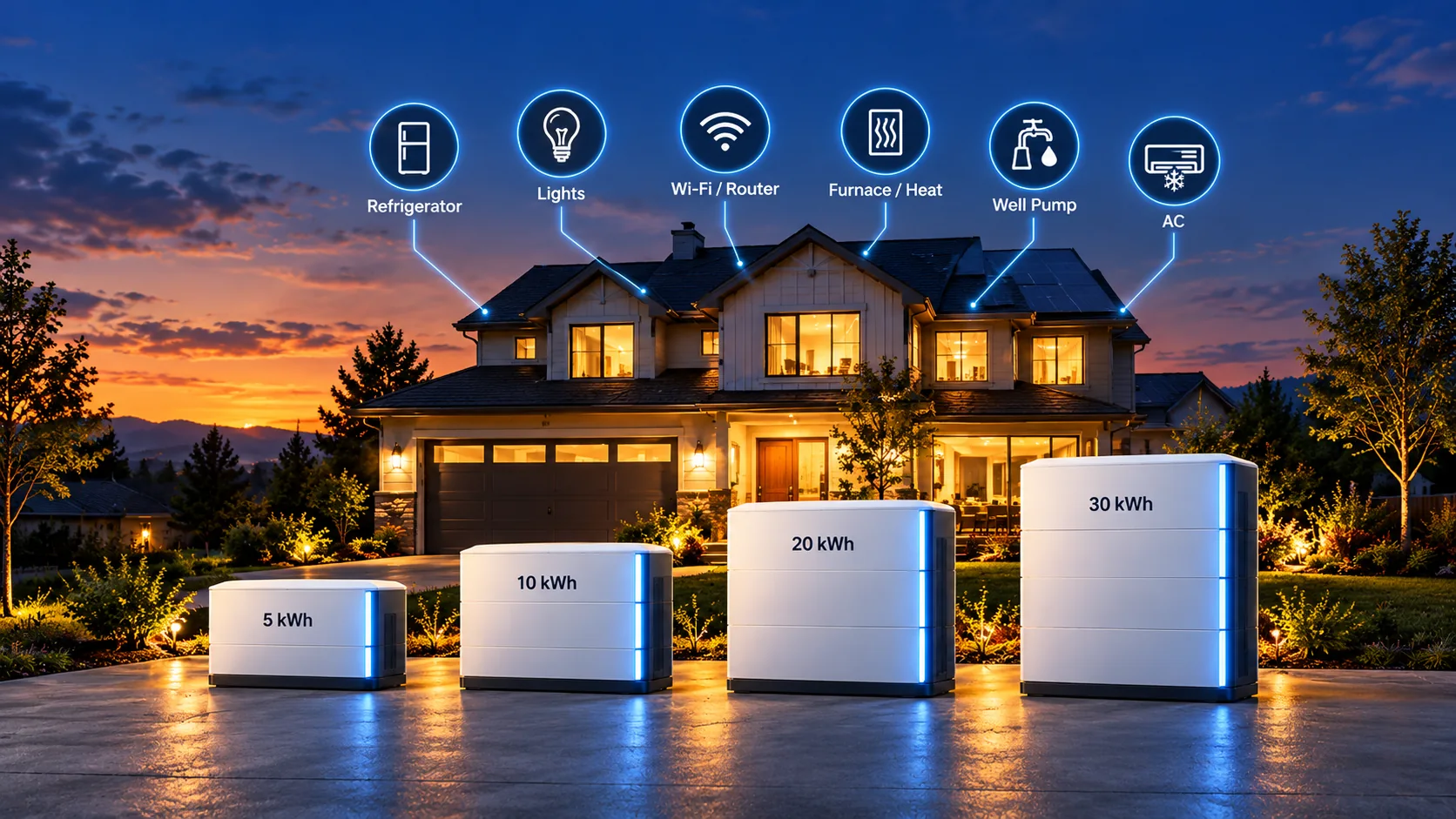
A 10 kWh home battery sounds substantial. A 20 kWh battery sounds even better. But will either one keep your refrigerator cold, your furnace running, your well pump working, and your lights on during a two-day power outage?
The answer depends on something battery manufacturers cannot tell you from a product specification alone: how much electricity your household actually needs when the grid goes down.
Whether you live in a 1,000-square-foot cottage or a 3,000-square-foot house, the right battery size depends more on the appliances you need to run than on floor area alone. A home that normally consumes 35 kilowatt-hours (kWh) per day might need only 8 kWh to keep its most important appliances running. Another household could consume 15 kWh or more just maintaining comfortable indoor temperatures during extreme weather.
There is another complication. Battery capacity determines how much energy you have available, but it does not necessarily determine which appliances you can operate. A large 20 kWh battery connected to an undersized inverter might be unable to start a central air conditioner, even though it has plenty of stored energy.
This guide explains how to calculate the battery capacity your home needs, what different battery sizes can realistically support, and how solar panels or a generator can reduce the amount of storage you need to purchase.
Quick answer: Many households can cover essential appliances with approximately 5–15 kWh of battery storage for a day, depending on actual consumption and system efficiency. Maintaining more normal household operation may require 20–40 kWh or more per day, particularly with central air conditioning, electric heating, or other high-demand appliances. For multi-day outages without recharging, required capacity increases with each additional day. Square footage can help frame an initial estimate, but the right battery size depends on your selected loads, desired runtime, usable battery capacity, and inverter efficiency.
How Many kWh Does a House Need for Battery Backup?
The biggest mistake homeowners make when sizing a battery backup system is assuming they need to replace every kilowatt-hour their house normally consumes.
That is only true if the goal is to operate the entire home exactly as usual.
According to the U.S. Energy Information Administration, American households use roughly 30 kWh of electricity per day on average, although actual usage varies considerably by climate, household size, heating equipment, and other factors. That does not mean everyone needs a 30 kWh battery.
During an outage, you might temporarily stop using your electric dryer, oven, dishwasher, and other high-consumption appliances. Instead, you could prioritize refrigeration, lighting, internet access, heating-system controls, and essential electronics.
The difference can dramatically change the size and cost of your backup system.
Estimated Battery Capacity for Different Backup Goals
These are illustrative energy requirements for several household backup scenarios, not universal household averages.
| Backup goal | Assumed daily electricity use | Nominal battery capacity for 24 hours* |
|---|---|---|
| Basic essentials | 3 kWh | 3.6 kWh |
| Essentials + heating equipment | 6 kWh | 7.2 kWh |
| Expanded essentials | 8 kWh | 9.7 kWh |
| Essentials + moderate cooling | 12 kWh | 14.5 kWh |
| Reduced whole-home operation | 20 kWh | 24.2 kWh |
| Higher-consumption whole home | 30 kWh | 36.2 kWh |
*Calculated using 90% usable battery capacity and 92% inverter efficiency. Actual requirements depend on equipment specifications, standby losses, temperature, battery age, and operating conditions.
Notice how a household requiring 8 kWh of electricity during an outage needs approximately 9.7 kWh of nominal battery capacity under these assumptions. Not every kilowatt-hour stored in a battery necessarily reaches your appliances.
Your emergency electricity consumption—not your normal monthly electric bill—should drive the size of your backup battery unless you are deliberately planning for unrestricted whole-home operation.
If you are unsure which appliances deserve priority, start with our guide to the essential circuits worth backing up first.
How Many kWh of Battery Backup Do You Need Based on House Size?
Square footage can help you frame a starting estimate, but it should not be used as a direct battery-sizing formula. Larger homes may need more heating, cooling, and lighting, yet insulation, climate, HVAC technology, household occupancy, and appliance choices often have a greater effect on emergency electrical consumption.
The following table uses illustrative essential-load budgets for progressively larger homes. These figures are not measured averages for each floor area, nor are they predictions of a home’s actual consumption based on square footage.
| House size | Example essential-load energy per day | Nominal battery for 24 hours | Nominal battery for 48 hours |
|---|---|---|---|
| 1,000 sq. ft. | 4 kWh | 4.8 kWh | 9.7 kWh |
| 1,500 sq. ft. | 6 kWh | 7.2 kWh | 14.5 kWh |
| 2,000 sq. ft. | 8 kWh | 9.7 kWh | 19.3 kWh |
| 2,500 sq. ft. | 10 kWh | 12.1 kWh | 24.2 kWh |
| 3,000 sq. ft. | 12 kWh | 14.5 kWh | 29.0 kWh |
Illustrative scenarios only. Capacities are calculated assuming 90% usable battery capacity, 92% inverter efficiency, no recharging, and no additional standby losses. Actual energy demand must be established from the appliances being backed up.
For example, a 2,000-square-foot home that uses 8 kWh per day for essential loads needs about 9.7 kWh of nominal capacity for 24 hours, or 19.3 kWh for 48 hours, under these assumptions. If that same house runs central air conditioning or electric heating extensively, the required capacity could be much greater.
Likewise, a 3,000-square-foot home with efficient systems and fuel-fired heating may require less emergency electricity than a 1,200-square-foot home relying on electric resistance heat. Use house size as context, then size the battery from actual energy consumption and target outage duration.
kW vs. kWh: What Your Battery Can Actually Do
Before calculating storage requirements, understand two specifications that are frequently confused: kilowatts and kilowatt-hours.
- Kilowatts (kW) measure power: how much electricity equipment uses at a particular moment, or how much power an inverter can supply.
- Kilowatt-hours (kWh) measure energy: how much electricity is consumed or stored over time.
Consider a portable electric heater drawing 1,500 watts (1.5 kW). Running it continuously for one hour consumes 1.5 kWh; running it for eight hours consumes 12 kWh. That is more energy than many small home backup batteries can deliver.
Now consider a Wi-Fi router consuming 15 watts. Running it continuously for 24 hours requires just 0.36 kWh.
Why the Difference Matters
Imagine two systems:
- System A: 20 kWh of storage, with 3 kW continuous AC output.
- System B: 10 kWh of storage, with 6 kW continuous AC output.
System A has twice the stored energy, but System B can operate a larger simultaneous electrical load. If your central air conditioner and other appliances need 4,500 watts while running, System A cannot operate them together despite having the larger battery. System B might, assuming its voltage, surge capacity, and other specifications are adequate.
Every home battery system must therefore pass two tests: enough energy capacity (kWh) for the desired runtime and enough power output (kW and surge watts) to operate the selected equipment.
Our guide to starting watts vs. running watts explains how motor startup requirements affect generators, power stations, and home battery systems.
How to Calculate the Battery Capacity Your House Needs
You do not need an engineering degree to estimate your battery requirements. You do, however, need realistic consumption numbers.
Step 1: Identify the Appliances You Want to Back Up
Begin with the equipment that matters most:
- Refrigerator and freezer
- Internet router and modem
- LED lighting
- Phone and laptop charging
- Furnace blower and controls
- Sump pump or well pump
- Medical devices
- Selected outlets and electronics
Do not assume every appliance operates continuously. Refrigerator compressors cycle, pumps run intermittently, and furnace blowers respond to heating demand. These duty cycles are crucial to an accurate estimate.
Step 2: Estimate Each Appliance’s Daily Energy Consumption
Daily energy (kWh) = Watts × Operating hours ÷ 1,000
For equipment that cycles, use estimated total active operating time, not necessarily all 24 hours.
| Appliance | Power while operating | Daily operating time | Daily energy |
|---|---|---|---|
| Refrigerator | 150W | 8 hours | 1.20 kWh |
| Chest freezer | 100W | 8 hours | 0.80 kWh |
| Router and modem | 20W | 24 hours | 0.48 kWh |
| LED lighting | 80W | 5 hours | 0.40 kWh |
| Laptop and electronics | 100W | 6 hours | 0.60 kWh |
| Furnace blower and controls | 500W | 6 hours | 3.00 kWh |
| Sump pump | 800W | 0.5 hours | 0.40 kWh |
| Total | — | — | 6.88 kWh |
These are illustrative planning numbers. Real equipment consumption varies with temperature, design, household conditions, and operating schedules.
A sump pump that runs for 30 minutes on a normal day may operate for hours during severe rain. If basement flooding is a concern, calculate a separate heavy-pumping scenario rather than relying on average consumption.
Step 3: Account for Usable Capacity and Inverter Losses
Manufacturer specifications may describe nominal battery capacity, usable battery capacity, or energy delivered through AC outlets. Those are not necessarily the same.
- Usable capacity: Some systems reserve a portion of nominal storage to protect the battery or meet operating limits.
- Inverter efficiency: Converting DC battery power to household AC power introduces losses.
- System overhead: Inverters, controls, communications, and thermal management may consume additional electricity.
Temperature and battery aging can also affect capacity. For a simple example, assume 90% usable capacity and 92% inverter efficiency:
0.90 × 0.92 = 0.828
Approximately 82.8% of nominal battery energy reaches the modeled AC loads, before additional overhead.
These assumptions are not universal product specifications. If a manufacturer already provides an AC-delivered usable-capacity figure, do not deduct the same losses twice.
Step 4: Calculate Required Battery Capacity
Required nominal battery capacity (kWh) = Appliance energy required (kWh) ÷ (Usable battery fraction × Inverter efficiency)
Suppose your essential loads require 8 kWh per day. For 24 hours without recharging:
8 ÷ (0.90 × 0.92) = 9.66 kWh
A nominal 10 kWh system is close to the calculated minimum, but it leaves little room for unexpected consumption, standby losses, or operating-condition changes. A larger battery or the ability to recharge provides more flexibility.
Our battery runtime guide goes deeper into efficiency losses, and the Home Power Matrix Battery Runtime Calculator lets you test different capacities, appliances, and efficiency assumptions.
How Many kWh Do You Need for 8, 24, 48, or 72 Hours?
Consider a household consuming 8 kWh of electricity per day during an outage. With no recharging, required storage scales with duration:
| Outage duration | Appliance energy required | Nominal battery capacity needed |
|---|---|---|
| 8 hours | 2.67 kWh | 3.2 kWh |
| 12 hours | 4.00 kWh | 4.8 kWh |
| 24 hours | 8.00 kWh | 9.7 kWh |
| 48 hours | 16.00 kWh | 19.3 kWh |
| 72 hours | 24.00 kWh | 29.0 kWh |
Assumes consistent average consumption, 90% usable capacity, 92% inverter efficiency, no charging, and no added standby allowance.
A 10 kWh system might approach a full day of carefully managed essentials. A 20 kWh system could approach two days, and a 30 kWh system roughly three days, under the same assumptions.
What If Your House Uses 30 kWh Per Day?
At 30 kWh per day, the equivalent nominal storage would be approximately 36.2 kWh for 24 hours, 72.5 kWh for 48 hours, or 108.7 kWh for 72 hours. That is why unrestricted multi-day whole-home backup can become expensive quickly.
Battery Sizing for Different Household Needs
Essentials Only: Refrigerator, Freezer, Lights, and Internet
A basic backup arrangement prioritizes food preservation, communications, and lighting. Depending on actual use, these essentials might total around 3–5 kWh per day. A system in the 5–10 kWh class may support a meaningful portion of a day or more, depending on loads and conversion losses.
Modular portable power stations can be useful at this scale, but their AC outlets, voltage support, inverter output, and safe circuit connections still matter.
Essentials Plus Heat: Gas or Oil Furnace
Gas, propane, and oil furnaces create heat from fuel, but still need electricity for blowers, ignition or burner controls, thermostats, and sometimes pumps. This is typically much less electrical demand than resistance heating, yet it can add up.
A 500W blower operating for 10 hours consumes 5 kWh, before other system loads. Winter heating needs can therefore consume most of a small battery’s daily energy budget.
Our guide to powering a refrigerator, freezer, and furnace during an outage explores this common combination.
Water-Dependent Homes: Well Pumps and Sump Pumps
Pumps create two distinct design challenges: daily electricity consumption and motor starting demand. A well pump may need 120V or 240V power. A sump pump may use little energy on a typical day but operate frequently during intense rainfall.
Confirm horsepower, voltage, running current, startup requirements, and realistic pump cycling. For basement protection, see how to keep a sump pump running during an outage.
Medical-Critical Households: CPAP and Oxygen Equipment
Medical equipment should be sized from its exact model and operating mode. Heated CPAP humidifiers and tubing can materially increase consumption, while some oxygen concentrators draw much more power than small electronics.
Check manufacturer-supported power arrangements and establish sufficient backup redundancy. A single consumer battery should not be assumed adequate for life-sustaining equipment. See our CPAP and oxygen concentrator backup guide.
Comfort Backup: Window AC or Mini-Split
A window air conditioner averaging 700W during 10 hours of operation consumes 7 kWh—in addition to every other household load. Mini-split demand varies with capacity, climate, thermostat settings, and efficiency.
Backing up one important room can require far less stored energy than cooling an entire house.
Near-Whole-Home Backup
Near-whole-home backup may keep refrigeration, lighting, home offices, water pumps, communications, and selected HVAC equipment running while restricting EV charging, electric dryers, resistance heat, or other heavy loads. Depending on the home, 20–40 kWh or more of storage may be appropriate for roughly one day, but the correct number comes from a load calculation—not a product label.
5 kWh vs. 10 kWh vs. 20 kWh vs. 30 kWh Home Battery Backup
The following table estimates AC runtime from different nominal battery capacities at four hypothetical average loads:
| Battery capacity | 250W average | 500W average | 1,000W average | 2,000W average |
|---|---|---|---|---|
| 5 kWh | 16.6 hours | 8.3 hours | 4.1 hours | 2.1 hours |
| 10 kWh | 33.1 hours | 16.6 hours | 8.3 hours | 4.1 hours |
| 20 kWh | 66.2 hours | 33.1 hours | 16.6 hours | 8.3 hours |
| 30 kWh | 99.4 hours | 49.7 hours | 24.8 hours | 12.4 hours |
Illustrative runtimes assume 90% usable capacity, 92% inverter efficiency, and no additional standby losses. Individual products differ.
Affiliate disclosure: As an Amazon Associate, Home Power Matrix earns from qualifying purchases. Product links may earn us a commission at no additional cost to you.
Is a 5 kWh Battery Enough for a House?
A 5 kWh battery can be a starting point for selected essentials—refrigeration, internet, lighting, and electronics—but generally cannot sustain unrestricted whole-home operation. The Jackery Explorer 5000 Plus is an example of a larger portable system with about 5.04 kWh of base storage and expansion options.
Example: Jackery Explorer 5000 Plus on Amazon
Is a 10 kWh Battery Enough for a House?
A 10 kWh battery may approach one day of essential-load operation for a home using around 8 kWh per day, under our modeled assumptions. It offers considerably less runtime for homes using 20–30 kWh daily. Expandable systems such as the Anker SOLIX F3800 family—with approximately 3.84 kWh of base capacity per main unit—allow compatible configurations to grow beyond the original battery.
Example: Anker SOLIX F3800 on Amazon
Is a 20 kWh Battery Enough for Whole-Home Backup?
Twenty kilowatt-hours can provide substantial reserve for managed essential loads. At 8 kWh/day, it can approach two days of coverage without charging under our assumptions. But a house consuming 30 kWh per day would drain that storage much faster. The EcoFlow DELTA Pro Ultra is one example of a modular platform that can be configured with multiple batteries to reach higher storage capacities.
Example: EcoFlow DELTA Pro Ultra on Amazon
Is a 30 kWh Battery Enough for a Whole House?
A nominal 30 kWh battery yields approximately 24.8 kWh delivered to modeled AC loads at our assumed efficiency. It may last more than a day with reduced consumption, or less than a day with unrestricted loads. Larger systems may require professionally installed switching, battery management, and load controls.
For a practical high-capacity example, see our Anker SOLIX E10 whole-home backup guide, including its different load and runtime scenarios.
Why a 20 kWh Battery Might Still Not Run Your Whole House
Imagine a 20 kWh battery with an inverter rated for 3,000W continuous output and 6,000W temporary surge. If other running loads already use 2,500W and central AC draws another 3,500W, the total continuous demand is 6,000W—twice the inverter’s continuous rating.
Adding battery storage alone does not fix that bottleneck. Some modular systems increase output when compatible equipment is added; others increase capacity only.
120V vs. 240V Output Matters
American homes commonly use 120/240V split-phase service. Central air conditioners, some well pumps, electric dryers, and other large appliances may require 240V. A 120V-only power station cannot directly operate them simply because it has sufficient kWh.
Before buying, verify continuous output, surge output and duration, voltage, motor-start compatibility, transfer equipment, and expansion requirements. Our guide to sizing backup power for central air conditioning explains why startup demand matters.
Can an AC Soft Starter Help?
An appropriately matched soft starter can reduce compressor startup current, potentially making AC easier to start from a compatible inverter. Micro-Air advertises reductions of up to 75% in some applications; that is a manufacturer maximum, not a guarantee.
A soft starter does not substantially lower the air conditioner’s normal running energy use. For details, see our air conditioner soft-start guide.
Product example: Micro-Air EasyStart FLEX on Amazon. A qualified HVAC professional should confirm compatibility and installation requirements.
How to Measure Your Home’s Actual Backup Electricity Needs
Appliance wattage charts are useful starting points, but measured consumption provides better estimates. If your utility bill shows 900 kWh over 30 days, your whole-house average is 30 kWh/day. It does not tell you how much each essential appliance uses.
Use a Plug-In Energy Monitor
A plug-in monitor can track energy used by compatible 120V appliances over time. If a refrigerator consumes 2.4 kWh in 48 hours, its measured average is 1.2 kWh/day—much more useful than assuming its compressor runs nonstop.
Measurement tool: P3 Kill A Watt on Amazon. Ordinary plug-in monitors should not be assumed to accurately capture very brief motor inrush peaks.
Use Whole-Home or Circuit-Level Monitoring
Circuit monitoring can help identify heating, cooling, and other loads that are difficult to measure with a plug-in device. The Emporia Vue 3 energy monitor on Amazon is one example. Panel-mounted monitoring must be installed according to its instructions and applicable electrical codes, with a qualified electrician where appropriate.
Measure More Than One Scenario
Estimate mild-weather demand, hot-weather cooling demand, cold-weather heating demand, and unusually heavy pump operation during storms. Your backup system should be sized for the outage conditions you most need it to handle—not only the most convenient average day.
How Solar Changes the Battery Size You Need
All previous calculations assume the battery starts fully charged and is never replenished. Compatible solar charging changes that equation.
If a home uses 8 kWh/day but the backup solar system delivers 6 kWh/day of usable electricity during an outage, its simplified daily energy deficit is only 2 kWh rather than 8 kWh.
Actual solar output depends on panel size, shade, weather, temperature, season, and charge-system limits. Battery storage must also bridge nights and cloudy periods, and the battery may need enough instantaneous output to carry daytime loads regardless of solar production.
Not every grid-tied solar installation can provide electricity when utility power fails. Systems must have the appropriate islanding-capable backup equipment and compatible charging configuration. Learn more in our solar + battery + generator home backup guide.
How a Generator Can Let You Buy Less Battery
A generator can reduce the need to store several full days of electricity upfront. Instead of buying approximately 29 kWh of nominal battery capacity for three days of 8 kWh/day emergency use, a homeowner may use a smaller battery and recharge it periodically through a manufacturer-approved arrangement.
Example: Charging During a Multi-Day Outage
If the battery needs 6 kWh of replenishment and the compatible charger actually delivers 3 kW to the battery, the ideal calculation is 6 kWh ÷ 3 kW = 2 hours. Real charging can take longer because of losses, charging curves, thermal limits, and any other loads sharing generator output.
The generator must be appropriately sized, and the battery must explicitly support the intended charging arrangement. Never improvise connections to a home panel, transfer switch, or inverter.
Battery discharge can provide quiet power for essentials; solar adds energy when available; and a generator can replenish reserves when sunlight is insufficient. The tradeoffs are fuel use, maintenance, installation cost, and more complex integration. See our hybrid solar, battery, and generator guide for a fuller explanation.
How Much Does Home Battery Backup Cost per kWh?
Two batteries advertising the same kWh can have very different total costs because of inverter output, chemistry, hardware, warranties, installation, transfer equipment, monitoring, and permit requirements.
Installed cost per usable kWh = Total installed system cost ÷ Usable battery capacity
| Hypothetical comparison | System A | System B |
|---|---|---|
| Installed cost | $12,000 | $17,000 |
| Usable capacity | 10 kWh | 15 kWh |
| Installed cost per usable kWh | $1,200 | $1,133 |
System B offers a lower storage cost per usable kWh, but it is not automatically better: output power, circuit compatibility, controls, and the loads you actually need may matter more. Compare fully installed configurations and the capacity metric each manufacturer uses.
Should You Buy More Battery Capacity Than You Need?
Some reserve protects against unexpected loads, poor operating conditions, and eventual capacity loss. But buying vastly more storage than your actual emergency needs can be an expensive way to avoid measuring them.
First calculate appliance consumption, outage duration, inverter requirements, charging options, and reasonable reserve. Then compare systems using usable capacity and total installed cost. Our broader home battery backup systems guide
Common Home Battery Sizing Mistakes
- Using normal electric bills without considering load reduction. Emergency essentials may consume far less than your usual daily total.
- Treating nominal capacity as delivered AC energy. Verify what the manufacturer’s kWh rating actually represents.
- Ignoring continuous and surge output. A large battery still may not start a pump or central AC.
- Underestimating heating and cooling. These can dominate demand during the very weather that causes an outage.
- Forgetting charging plans. One day of capacity is not an indefinite backup solution.
- Assuming solar will always produce enough. Model poor weather and winter output.
- Buying extra batteries instead of managing loads. Selective circuits, staggered equipment, and compatible recharging may be more economical.
Frequently Asked Questions
How many kWh of battery backup does a 2,000-square-foot house need?
If a 2,000-square-foot home uses 8 kWh per day for essential loads, it needs approximately 9.7 kWh of nominal battery storage for 24 hours under the 90% usable-capacity and 92% inverter-efficiency assumptions used here. This is an illustrative load scenario, not a requirement determined by square footage. Heating, cooling, and other major loads can increase demand substantially.
How many batteries does a 1,500-square-foot home need?
Battery count depends on the capacity of each compatible module and the actual energy used during an outage. For example, a 1,500-square-foot home needing 6 kWh of essential-load energy per day would require approximately 7.2 kWh of nominal storage for 24 hours under the assumptions in this guide.
Does a bigger house always need a bigger backup battery?
No. A larger, efficient home with fuel-fired heat can need less emergency electricity than a smaller house with electric resistance heating. The appliances selected for backup, their operating time, climate, and efficiency matter more than square footage alone.
How many kWh of battery backup does an average house need?
U.S. homes average roughly 30 kWh of daily grid electricity consumption, but essential outage loads can be much lower. An illustrative 5–15 kWh/day emergency energy budget may cover selected essentials in some homes, while unrestricted operation can require 30 kWh/day or more. Battery nameplate capacity must also account for usable-storage and efficiency losses.
Is 10 kWh enough to power a house?
A 10 kWh battery may approach a day of carefully managed essentials for a home using around 8 kWh per day, but it generally will not maintain unrestricted household use if daily consumption is 20–30 kWh or more.
How long will a 20 kWh battery power a house?
At a combined usable-capacity and inverter-efficiency factor of 82.8%, a nominal 20 kWh system delivers about 16.6 kWh to the modeled AC loads: approximately 33 hours at a 500W average load, 16.6 hours at 1,000W, or 8.3 hours at 2,000W, excluding further system overhead.
How many batteries do I need for 48 hours of backup?
Divide two days of essential-load energy by the usable-storage fraction and inverter efficiency. At 8 kWh/day, the example assumptions in this guide yield approximately 19.3 kWh of nominal battery capacity. The physical battery count depends on the capacity of each compatible module.
Is 30 kWh enough for whole-house backup?
It may approach a day of reduced whole-home use, but heavier air conditioning, heating, and other appliances can shorten runtime considerably. Inverter output, voltage, and circuit integration must also be adequate.
Can a 5 kWh battery run a refrigerator and freezer?
Yes, if the inverter meets their voltage and starting requirements. If their combined average demand is 100W, their energy use is about 2.4 kWh per day before inverter losses and other loads.
Do I need 240V output for whole-home battery backup?
To operate 240V equipment such as many central air conditioners or well pumps, you need an appropriately configured 120/240V-capable system. A 120V-only power station may still support selected essentials.
Does adding more batteries increase inverter power?
Not always. Some modular platforms can increase output with specific compatible configurations; others increase energy storage only. Check manufacturer documentation.
Can solar panels reduce the battery size I need?
Yes. Compatible solar charging can replenish energy during the outage, but poor weather, shading, seasonal production, and nighttime demand still require adequate storage.
Is a generator cheaper than buying more batteries?
In some multi-day backup scenarios, recharging a smaller battery with a compatible generator can lower upfront storage costs. Include fuel, maintenance, installation, operating costs, noise, and system compatibility in the comparison.
The Bottom Line: Size Your Battery for the Outage You Actually Want to Survive
A 5 kWh battery can be useful for basic essentials; 10 kWh may cover meaningful overnight or daylong demand; 20 kWh offers more flexibility; and 30 kWh or more begins to approach larger home-backup requirements. But no capacity guarantees a particular runtime without knowing the loads.
Size your battery for the kWh your appliances need, verify that the inverter delivers enough kW and startup power, and make sure the system supports your home’s voltage and circuit requirements.
Most importantly, size for the electricity you actually intend to use during an outage—not automatically everything your house normally consumes. Compatible solar or generator charging can extend runtime without requiring you to store multiple complete days of energy in advance.
Start with the loads. Calculate the energy. Verify the inverter. Then choose the battery.
Use our Battery Runtime Calculator to explore different capacities and loads, then review our Home Battery Backup Systems Guide to compare equipment.