

A home does not need to operate normally during a power outage to remain livable.
You probably do not need the television, dishwasher, electric dryer, every light in the house, or even most kitchen appliances. During a long winter outage, a much shorter list matters: keep your food cold, keep enough heat operating to prevent dangerous indoor temperatures and frozen pipes, and preserve power for whatever other genuinely essential equipment your household depends on.
That makes a surprisingly small backup-power system useful.
Quick answer: Refrigerators and freezers can generally be powered directly from a generator or portable power station using properly rated extension cords. A hardwired gas, propane, or oil furnace normally needs a listed transfer switch or another properly installed backup-power connection. Once those connections are prepared, a relatively modest backup system can preserve refrigeration and operate the electrical portions of a fuel-burning heating system without attempting to power the entire house.
A large portable power station or generator can potentially sit at the center of an emergency setup while heavy-duty extension cords reach refrigerators and freezers elsewhere in the house. A fuel-burning furnace can often join the same system, but there is an important distinction: a hardwired furnace should not simply have its blower motor connected to an extension cord. The complete furnace circuit needs a safe way to transfer from utility power to backup power.
The goal is not to recreate normal life. It is to build an electrical lifeboat that keeps the most important parts of the house functioning.
What Actually Matters During a Winter Power Outage?
For a stripped-down emergency plan, divide household loads by what actually happens if they lose power.
| Priority | Load | Why it matters |
|---|---|---|
| Critical | Furnace or boiler controls and circulation | Maintains heat and can help protect plumbing |
| Critical | Refrigerator | Protects perishable food and medications requiring refrigeration |
| Critical | Freezer | Protects frozen food during longer outages |
| House-dependent | Sump pump | Can prevent basement flooding |
| House-dependent | Well pump | Maintains water where municipal water is unavailable |
| Personal critical | Medical equipment | May be medically necessary or life-sustaining |
| Useful | Router, phone chargers, LED lighting | Communication and basic visibility |
| Usually optional | Microwave, television, small kitchen appliances | Useful, but normally not continuous necessities |
| Usually avoid on a small backup system | Electric resistance heaters, dryers, ranges and water heaters | Very high continuous electrical demand |
This is the same philosophy behind identifying the essential circuits worth backing up first. Instead of sizing backup power around the entire electrical panel, identify the handful of loads that protect food, plumbing, heat, communications and health.
If someone in the household depends on electrically powered respiratory equipment, our guide to backup power for CPAP machines and oxygen concentrators covers that category separately.
The important idea is load reduction. A house that can draw tens of thousands of watts under normal conditions may remain surprisingly functional on only a few hundred or few thousand watts when nonessential loads are deliberately abandoned.
The Central Power Hub Approach
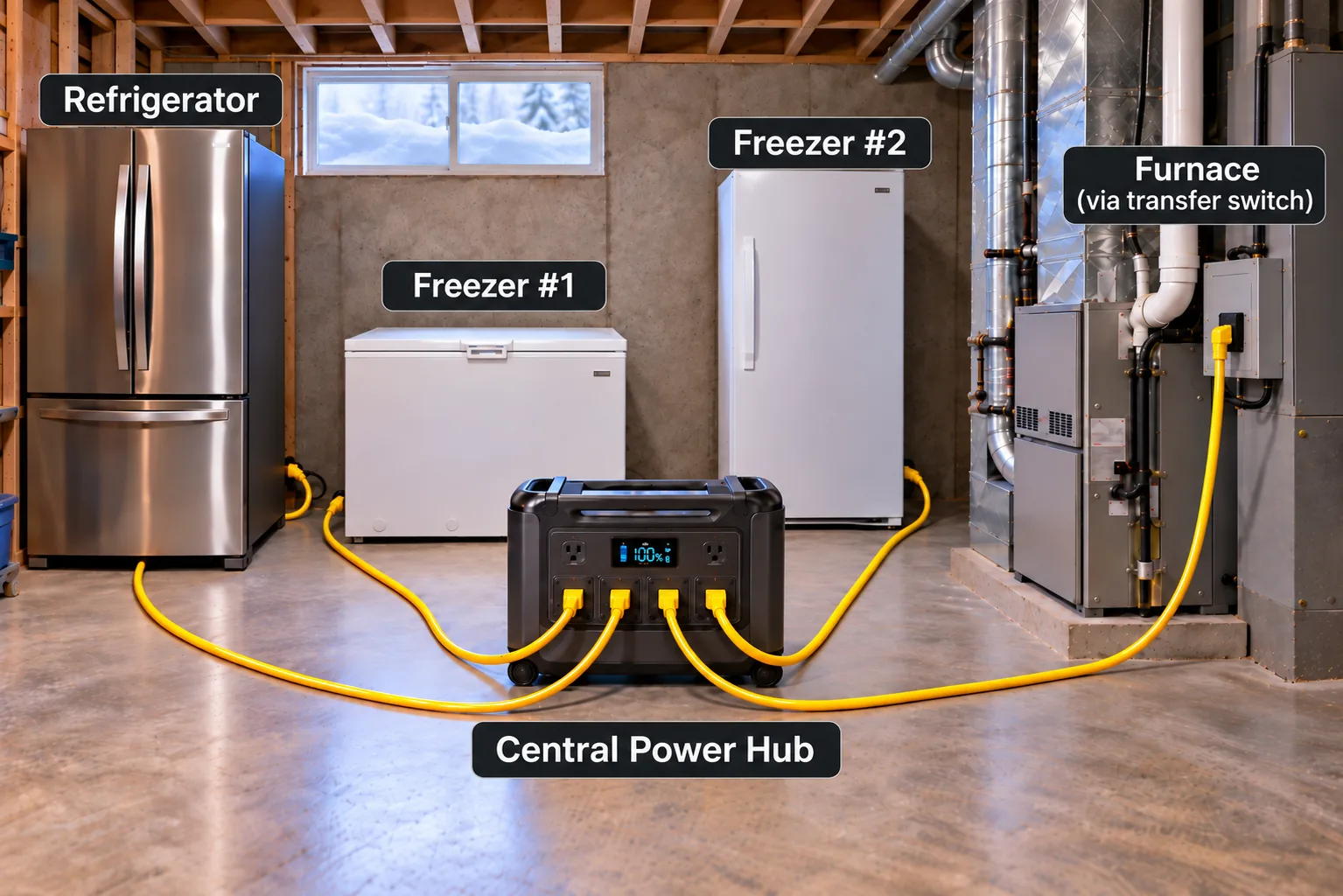
For a portable battery system, one of the simplest outage setups is a central power station with several dedicated cords radiating outward.
Think of it as a hub-and-spoke system:
- Portable power station → refrigerator
- Portable power station → freezer
- Portable power station → second freezer
- Portable power station → properly installed furnace transfer connection
- Portable power station → small essential electronics, if capacity remains
This avoids moving a heavy battery around the house every time another appliance needs power. The power station can remain in a dry, accessible central location while appropriately rated cords reach the important loads.
Before an emergency, label the cords:
- REFRIGERATOR
- BASEMENT FREEZER
- GARAGE FREEZER
- FURNACE
That sounds almost comically basic until the electricity disappears during an ice storm at 2 a.m. At that point, not playing Which Yellow Cord Is This? becomes a legitimate emergency-preparedness advantage.
Remember that several outlets on a portable power station do not represent several independent power supplies. They normally share the inverter’s total continuous and surge capacity.
Refrigerators and Freezers Are the Easy Part
Most ordinary residential refrigerators and freezers are cord-and-plug appliances, which makes them particularly well suited to temporary backup power.
During an outage:
- Disconnect the appliance from its normal receptacle.
- Connect it to a properly rated grounded extension cord.
- Connect that cord to the generator or portable power station.
- Confirm that the backup source can handle both normal running demand and compressor startup demand.
No modification to the refrigerator or freezer itself should normally be necessary.
Honda describes extension cords as a basic generator connection option for individual appliances such as refrigerators, while distinguishing that approach from hardwired household equipment. See Honda’s generator connection guidance for the distinction.
If you are sizing a battery specifically around cold storage, our guide to what size portable power station you need for a refrigerator covers realistic inverter and capacity requirements in more detail.
Do not forget compressor starting watts
A refrigerator may consume relatively little power after the compressor is running but briefly demand significantly more when the compressor starts.
The same applies to a freezer.
That means a system carrying a refrigerator, two freezers and a furnace cannot be sized simply by adding their normal running wattages.
You have two different questions:
- Can the power source continuously operate everything that may be running simultaneously?
- Can the power source survive the brief moment when one of those motors or compressors starts?
Our full guide to starting watts versus running watts explains that math in depth.
When possible, bring major motor loads online individually rather than intentionally starting several compressors and blowers at the same moment.
How Long Can Food Stay Safe Without Backup Power?
Backup power is valuable, but you do not necessarily have to energize every refrigeration load the instant utility power disappears.
According to the U.S. Food and Drug Administration, an unopened refrigerator generally keeps food cold for about four hours.
A full freezer can maintain temperature for approximately 48 hours, while a half-full freezer is closer to 24 hours, provided the door remains closed.
That creates opportunities for intelligent load management. If battery capacity is scarce, a freezer that is still safely frozen may not deserve electricity ahead of a furnace or warming refrigerator.
An appliance thermometer makes that decision easier because it replaces guessing with actual temperature information. The AcuRite 00986M refrigerator/freezer thermometer on Amazon uses remote sensors to monitor refrigerator and freezer temperatures and can be useful during extended outages.
Do not assume that freezing outdoor weather automatically turns your porch into a safe refrigerator. FoodSafety.gov warns against relying on outdoor winter temperatures because conditions fluctuate and direct sunlight can warm food even in cold weather.
Use Serious Extension Cords
Long extension cords introduce electrical resistance and voltage drop.
That matters particularly for compressor and motor loads because low voltage during startup can make an already difficult startup harder.
For many long 120V emergency appliance runs, a 12/3 grounded heavy-duty extension cord is a useful category to consider, provided its rating meets the connected appliance load and the required distance.
A 12/3 cord uses substantially heavier conductors than the lightweight extension cords intended for lamps, holiday decorations and small electronics.
For example, homeowners building this kind of emergency setup can compare a Southwire 50-foot 12/3 heavy-duty extension cord on Amazon. Longer runs may warrant a 100-foot 12/3 heavy-duty cord if the connected load, cord rating and installation permit it.
That does not mean every refrigerator automatically belongs on a 100-foot 12-gauge cord. Check:
- Appliance amperage and wattage
- Extension-cord amperage and wattage rating
- Cord length
- Manufacturer requirements
- Plug and receptacle configuration
- Indoor or outdoor rating
- Motor or compressor startup demand
For emergency equipment, having more conductor capacity than the bare minimum is generally preferable to designing around the edge of a cord’s rating.
Extension-cord rules that matter
- Use grounded three-conductor cords for grounded appliances.
- Never remove the ground pin.
- Do not connect multiple extension cords end-to-end to create a much longer run.
- Do not route cords beneath rugs.
- Do not pinch cords beneath doors or through windows.
- Do not staple or nail extension cords to walls.
- Do not exceed the cord’s electrical rating.
- Inspect cords for damaged insulation, loose plugs or evidence of overheating.
- Treat extension cords as temporary emergency distribution, not permanent household wiring.
The Electrical Safety Foundation International’s extension-cord guidance specifically warns against daisy-chaining cords, routing them beneath rugs and using extension cords as permanent wiring.
The Furnace Is Different
Most gas, propane and oil furnaces still require electricity.
The fuel creates the heat, but electricity commonly operates:
- Thermostat transformer and controls
- Control board
- Igniter
- Inducer motor
- Gas-valve controls
- Safety switches
- Main blower motor
That means losing electricity can disable an otherwise functional gas or oil heating system.
It also explains why the phrase “I just want to power the furnace blower” is misleading.
Do not power the blower motor by itself
You normally want to power the complete furnace, not bypass the furnace controls and independently energize its blower motor.
A modern forced-air furnace operates through a controlled sequence. The thermostat calls for heat, the furnace verifies safety conditions, the inducer operates, ignition occurs, flame is proven, and the main circulating blower starts at the appropriate point.
Simply energizing the blower motor does not create normal furnace heat and can bypass controls that are intentionally part of the system.
The correct goal is:
Give the complete furnace branch circuit a safe alternate source of power while preventing backup electricity from feeding back into utility wiring.
A Furnace Transfer Switch Makes the System Much Cleaner
A single-circuit furnace transfer switch is almost tailor-made for this use.
Under normal conditions:
Utility power → transfer switch → furnace
During an outage:
Backup generator or compatible inverter → transfer switch → furnace
The transfer device selects which source supplies the furnace while preventing the two sources from being connected together.
Reliance Controls manufactures Easy/Tran transfer equipment designed for individual loads such as forced-air furnaces. Homeowners comparing equipment can look at the Reliance Controls TF151W Easy/Tran furnace transfer switch on Amazon.
The exact device must match the furnace circuit and installation. A transfer switch should be installed according to its listing, manufacturer instructions and applicable electrical requirements.
For many homeowners, this is a very reasonable job to have completed by an electrician before an outage occurs.
Once the transfer equipment is installed correctly, normal emergency operation becomes far simpler: connect the alternate power source, select the appropriate source according to the equipment instructions, and allow the furnace to operate as a complete system.
Never Backfeed the House to Power the Furnace
There is an unsafe shortcut that repeatedly appears online: connecting a generator to a household receptacle through a cord with male plugs on both ends.
Do not do this.
A male-to-male cord can expose energized prongs and can send generator power backward through wiring that utility workers reasonably expect to be de-energized.
The U.S. Consumer Product Safety Commission has specifically warned consumers against male-to-male generator cords because of electrocution and fire hazards.
A properly designed transfer device exists specifically to prevent the utility source and backup source from being inadvertently interconnected.
No male-to-male cords. No dryer-outlet backfeeding. No improvised method that depends entirely on remembering which breaker must be switched off.
Furnace Compatibility Is About More Than Wattage
Suppose a portable power station appears to have plenty of wattage, but the furnace still refuses to operate normally.
The battery may not necessarily be too small.
Modern furnaces contain electronic controls, and some systems can be sensitive to characteristics of the alternate source, including:
- Voltage
- Frequency
- Waveform quality
- Correct polarity
- Neutral and ground configuration
A particular complication is that some portable generators and battery inverters use a floating neutral, while other systems have neutral and ground bonded.
The correct configuration depends on the backup source, transfer method and furnace.
If a furnace operates normally on utility power but fails ignition or flame proving on backup power, the generator or inverter configuration, transfer equipment and furnace requirements should be evaluated together.
Do not assume that a homemade bonding adapter seen in an online video is appropriate for every system. Neutral-ground relationships are a system-level electrical design issue.
Which Heating Systems Work Best With This Strategy?
Not every heating system presents the same backup-power problem.
| Heating system | Small generator/battery practicality | Why |
|---|---|---|
| Natural-gas forced-air furnace | Often very good | Fuel creates the heat; electricity operates controls and motors |
| Propane forced-air furnace | Often very good | Similar electrical requirements to many gas furnaces |
| Oil furnace | Often feasible | Requires electrical power for burner, controls and blower |
| Gas or oil boiler | Often feasible | Backup must support controls and required circulation pumps |
| Pellet stove | Often feasible | Electrical demand may be modest, but model requirements vary |
| Electric resistance furnace | Usually poor for small portable systems | Heating elements can require enormous continuous electrical power |
| Central heat pump | More demanding | Compressor operation and commonly 240V requirements increase system size |
| Heat pump with electric auxiliary heat | Potentially extremely demanding | Resistance backup strips can dominate the electrical load |
This distinction is enormous.
A fuel-burning furnace may only need backup electricity for controls and motors. An electric furnace produces heat with electricity, so there is no comparable low-power shortcut.
Our guide to running an electric furnace during a power outage explains why resistance heating can push generator requirements into an entirely different class.
Why a Space Heater Is Usually a Poor Battery Strategy
A portable electric space heater looks deceptively simple.
Plug it into a portable power station and you have heat.
The problem is that a typical high-output space heater can consume around 1,500 watts continuously. That is an enormous draw compared with the electrical components of many fuel-burning furnaces.
The Electrical Safety Foundation International also recommends plugging portable heaters directly into wall receptacles rather than extension cords or power strips because of overheating and fire risks. See ESFI’s home electrical safety guidance.
If the home already has a gas, propane or oil furnace, spending battery energy operating its controls and motors is usually far more practical than using stored electricity to create resistance heat.
The fuel handles the thermal work.
The battery keeps the machinery alive.
That is an extremely useful distinction in a winter outage.
How Much Backup Power Do You Actually Need?
There are two separate sizing problems.
1. Power: watts
The generator or inverter needs enough continuous wattage for everything that may operate simultaneously.
It also needs enough surge output for refrigerators, freezers, furnace blowers and other motors as they start.
Consider this illustrative emergency load:
| Load | Illustrative running power |
|---|---|
| Refrigerator | 200W |
| Freezer | 150W |
| Second freezer | 150W |
| Gas furnace while operating | 600W |
| Router and basic lighting | 100W |
| Potential simultaneous load | 1,200W |
A 2,000-watt inverter appears comfortably capable of supplying a 1,200-watt continuous load.
But if the furnace blower and refrigerator compressor happen to start near the same time, temporary demand may be considerably higher.
That is why the surge rating still matters.
The numbers above are planning examples rather than universal appliance specifications. Use the nameplates and documentation for your own equipment whenever possible.
A plug-in energy monitor can also help determine the actual running consumption of 120V appliances. The P3 Kill A Watt electricity monitor on Amazon is a familiar option for refrigerators, freezers and other plug-in loads.
Keep in mind that an ordinary energy monitor may not capture a very fast startup transient, so it should not automatically be treated as a complete measurement of compressor inrush.
You can also enter your essential-load list into the Home Power Matrix generator size calculator to estimate an appropriate generator range.
2. Energy: watt-hours
Battery systems introduce a second limitation.
Even if the inverter is powerful enough to start every appliance, how long can the battery operate them?
A rough runtime calculation is:
Usable battery watt-hours ÷ average load in watts = approximate runtime in hours
The complication is that refrigerators, freezers and furnaces cycle on and off.
A refrigerator compressor may operate for only part of each hour. A furnace may run heavily during a cold night and relatively little during a warmer afternoon.
That means actual daily energy consumption is often more useful than multiplying every appliance’s maximum running wattage by 24 hours.
Suppose, purely for illustration:
- Refrigerator consumes 1.1kWh per day
- Freezer consumes 0.9kWh per day
- Heating system consumes 2.5kWh of electricity during a cold day
Those three loads would require roughly 4.5kWh per day before inverter and system losses.
A 2kWh portable power station does not become a multi-day system simply because its inverter is powerful enough to start the furnace and refrigerator.
Our guide to calculating realistic battery runtime explains the difference between inverter output and stored energy, and you can plug your own numbers into the Home Power Matrix battery runtime calculator.
The related guide What Can a 2,000-Watt Portable Power Station Run? also provides practical appliance examples.
Load Management Can Dramatically Extend Battery Runtime
The emergency system does not necessarily need to run every load continuously.
Suppose the freezer is still safely below 0°F.
There may be little reason to spend limited battery energy maintaining it continuously while the furnace is struggling to keep the house warm.
Likewise, the refrigerator and furnace naturally cycle.
A practical winter priority might look like:
- Maintain medically necessary equipment, if applicable.
- Maintain safe indoor heat.
- Keep refrigerator temperature below 40°F.
- Preserve frozen food.
- Maintain communications and essential lighting.
The order will vary by household, but the principle does not:
Battery capacity is a resource to manage, not merely a number to buy.
The Hybrid Setup: Battery Indoors, Generator Outdoors
There is an especially useful version of this architecture.
Use the portable power station as the indoor central hub.
It quietly powers the refrigerator, freezer and appropriately prepared furnace connection.
Then use a portable generator outdoors when necessary to recharge the battery, provided the power station manufacturer supports generator charging and the generator produces power that meets its charging requirements.
This approach can provide:
- Quiet battery operation inside the home
- No need to operate a generator all night solely for small cycling loads
- Reduced fuel consumption
- Immediate backup power while the generator is off
- The possibility of supplementing charging with solar
- One central electrical source feeding several critical loads
Our comparison of a portable power station vs. generator explains why many homes benefit from owning both rather than treating the two technologies as competitors.
The generator remains outdoors.
The battery remains indoors in an appropriate location and is operated according to its manufacturer’s requirements.
For an extended outage, this can be considerably more pleasant than operating a combustion engine continuously because a refrigerator compressor may occasionally want a few hundred watts.
Portable Generator Safety Is Non-Negotiable
A battery power station does not create combustion exhaust.
A gasoline, propane or natural-gas portable generator does.
The U.S. Consumer Product Safety Commission recommends operating portable generators outdoors only, at least 20 feet from the home, with exhaust directed away from the building and away from doors, windows and other openings.
A garage or carport is not safe simply because the garage door is open.
Working carbon-monoxide alarms should be installed and maintained according to their instructions. A battery-operated model such as the First Alert CO400 carbon-monoxide alarm on Amazon can continue monitoring during a utility outage.
Do not position the generator beside a basement window simply because it makes the extension-cord run shorter. Carbon monoxide does not care about convenient cable management.
A Better Permanent Upgrade: Back Up the Essential Circuits
Four long extension cords are inexpensive and flexible.
They are not necessarily the final form of a home backup system.
For a house that experiences repeated outages, a more permanent solution may use a properly installed:
- Generator inlet
- Manual transfer switch
- Approved panel interlock where permitted and correctly configured
- Essential-load subpanel
- Home battery backup panel
- Load-management system
Then the refrigerator, freezer, furnace, sump pump and selected receptacles can remain connected to their normal circuits while selected household loads are safely supplied from backup power.
The extension-cord method is useful for portable temporary loads.
Transfer equipment is generally cleaner for hardwired loads and repeated long-duration outages.
The two approaches can coexist.
A Practical Bare-Bones Winter Backup System
For many homes with a gas, propane or oil furnace, a realistic emergency setup might look like this:
| Connection | Load | Typical approach |
|---|---|---|
| Backup source | Central power supply | Portable power station or adequately sized generator |
| Cord 1 | Refrigerator | Dedicated heavy-duty grounded extension cord |
| Cord 2 | Main freezer | Dedicated heavy-duty grounded extension cord |
| Cord 3 | Additional freezer | Dedicated cord if inverter and battery capacity permit |
| Cord 4 | Furnace | Supplies a previously installed listed furnace transfer device rather than improvised furnace wiring |
| Optional small loads | Phones, router and LEDs | Use remaining capacity while staying within system ratings |
That gets surprisingly close to what many households actually need during an outage:
- Cold food
- Heat
- Communication
- Basic lighting
Everything else can wait.
Test the Entire System Before Winter
Do not wait for an outage to discover that the refrigerator cord is eight feet too short or the furnace does not operate properly from your inverter.
Perform a planned backup test before cold weather.
Verify:
- Every extension cord reaches comfortably
- Every cord is labeled
- The refrigerator starts successfully
- Each freezer starts successfully
- The furnace completes a normal heating cycle
- The backup source handles realistic simultaneous loads
- Battery displays show expected consumption
- Generator charging works as intended if using a hybrid system
- Transfer equipment operates correctly
- Carbon-monoxide alarms function
- Appliance thermometers work
- Other household members understand the basic procedure
A system that has been physically tested is dramatically more valuable than a theoretical collection of equipment stored in the garage.
Things You Should Never Do
Several shortcuts can transform an outage-preparedness project into an electrocution, fire or carbon-monoxide problem.
- Do not backfeed the house through an ordinary receptacle.
- Do not use a male-to-male generator cord.
- Do not operate a portable generator inside a house, basement, garage, shed or carport.
- Do not bypass furnace controls and directly energize the blower motor as a heating strategy.
- Do not assume every generator or inverter has the neutral/ground configuration your furnace requires.
- Do not operate important loads through damaged or undersized extension cords.
- Do not daisy-chain multiple extension cords together.
- Do not bury active extension cords beneath rugs.
- Do not pinch cords beneath doors or through windows.
- Do not treat extension cords as permanent household wiring.
- Do not assume battery watt-hours and inverter watts mean the same thing.
And perhaps most importantly:
Do not build the emergency system for the first time during the emergency.
Build the House’s Electrical Lifeboat Before You Need It
A useful home backup system does not have to power every circuit.
In fact, deliberately refusing to power most of the house can make meaningful backup electricity far more affordable.
For a winter outage, the essential electrical system may consist of little more than refrigeration, a fuel-burning heating system, communications, basic lighting and whatever pumps or medical equipment your particular home requires.
A central portable power station can distribute electricity to ordinary plug-in appliances through properly selected temporary cords. A portable generator can perform the same job from outdoors or recharge the battery during a longer outage. A furnace-specific transfer switch can bring a hardwired heating system into the same plan without unsafe improvisation.
That creates something more useful than bragging rights about how many watts a generator produces.
It creates a minimum viable house.
The refrigerator stays cold.
The freezer stays frozen.
The furnace keeps producing and circulating heat.
The pipes are better protected.
And the limited backup energy goes where it actually matters.
Frequently Asked Questions
Can I run my refrigerator and freezer from a portable power station?
Usually, yes, if the power station has enough continuous inverter output and enough surge capacity to start their compressors. Battery capacity in watt-hours then helps determine how long the appliances can operate.
Can I use an extension cord for a refrigerator during an outage?
A properly rated grounded extension cord can be used temporarily for backup power. The cord should meet or exceed the electrical requirements of the appliance and should be appropriate for the required distance and environment.
What gauge extension cord should I use for a refrigerator or freezer?
The correct cord depends on the appliance load and distance. For longer emergency appliance runs, a heavy-duty 12/3 cord can provide substantially more conductor capacity than lightweight household extension cords, but the actual cord rating and appliance requirements still need to be checked.
Can I plug my furnace into a portable power station?
A normally hardwired furnace should not simply be disconnected from household wiring and improvised onto an extension cord. A properly installed furnace transfer switch or other approved backup-power arrangement can allow a compatible generator or battery inverter to supply the furnace circuit safely.
Can I just power the furnace blower motor?
That is not the appropriate way to provide normal furnace heat. A forced-air furnace relies on controls, ignition equipment, safety devices, inducer components and the main blower operating together. The complete furnace circuit should be backed up rather than bypassing its normal controls.
Can a 2,000-watt power station run a gas furnace?
Many fuel-burning residential furnaces have electrical requirements well below 2,000 running watts, but startup surge and equipment-specific requirements still matter. Check the furnace nameplate, manufacturer documentation and inverter compatibility rather than assuming that wattage alone guarantees operation.
Can a portable power station run an electric furnace?
Usually not an ordinary portable model. Central electric resistance furnaces may require 10kW, 15kW, 20kW or more and commonly operate at 240V, placing them in a very different backup-power category.
Can one battery run a refrigerator, freezer and furnace simultaneously?
Potentially. Add the loads that can operate simultaneously, verify the inverter’s surge rating against motor and compressor startups, and compare expected daily energy consumption with usable battery capacity.
How long will a refrigerator stay cold without electricity?
The FDA says an unopened refrigerator generally keeps food cold for approximately four hours. Keep the door closed as much as possible and use an appliance thermometer to monitor temperature.
How long will a freezer stay frozen without electricity?
A full unopened freezer can maintain temperature for approximately 48 hours, while a half-full freezer is closer to 24 hours, according to FDA guidance.
Can I run a generator in my garage with the door open?
No. Portable generators should be operated outdoors, well away from the home, with exhaust directed away from doors, windows and other openings. An open garage door does not make indoor generator operation safe.
Is a furnace transfer switch worth installing?
For a home with a fuel-burning furnace and meaningful winter outage risk, a furnace transfer switch can be a particularly useful backup-power upgrade because it gives the hardwired heating circuit a safe way to receive compatible portable generator or inverter power without backing up the entire electrical panel.