

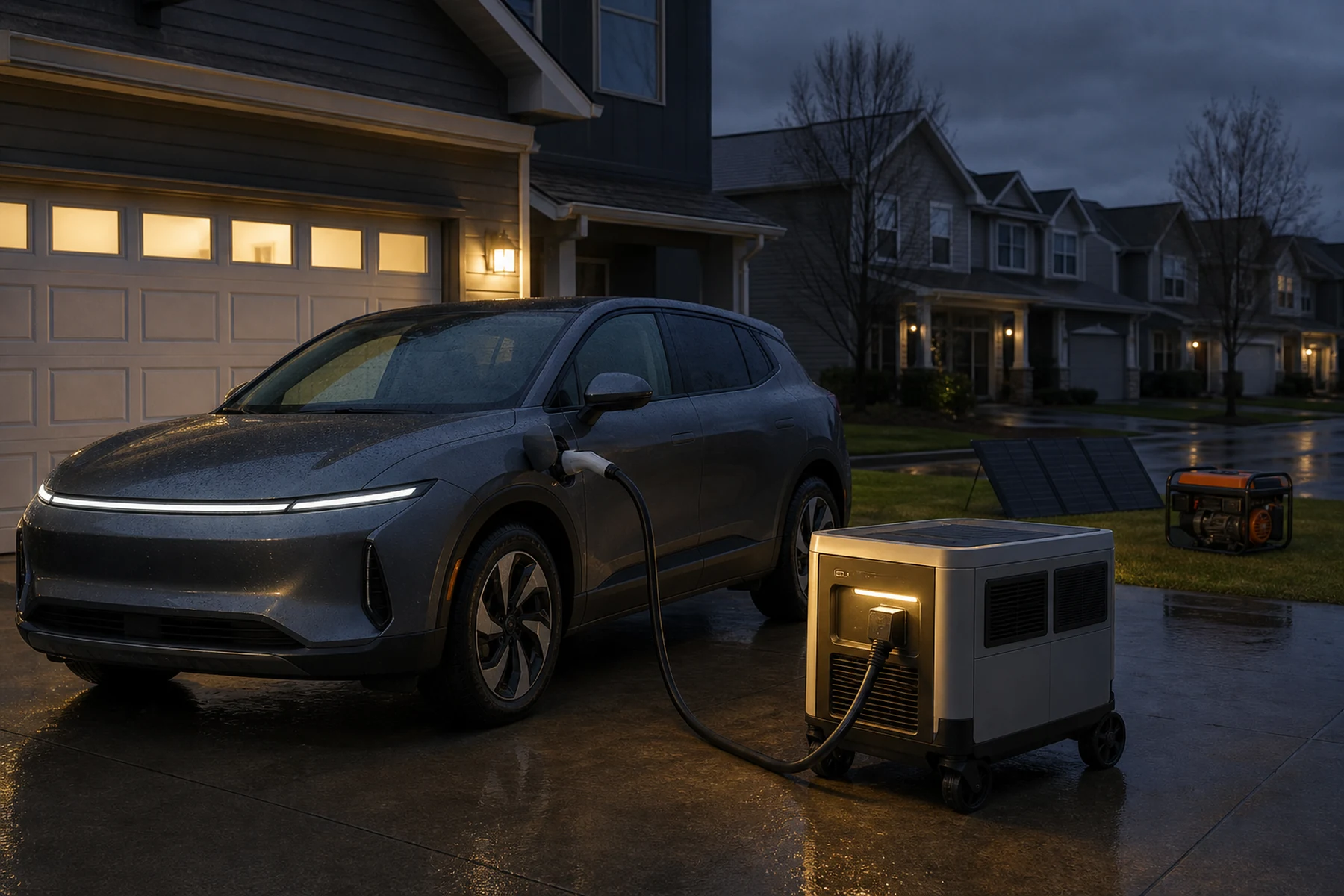
Electric vehicles are becoming increasingly common, but home charging still raises plenty of questions—especially for renters, new homeowners, travelers, and anyone who has not installed a dedicated EV charger.
One question comes up frequently:
Can you charge an electric vehicle with a portable power station?
Yes, you can—but whether it makes practical or financial sense depends heavily on the power station, the vehicle, the available charging equipment, and what you expect the setup to accomplish.
A large portable power station can provide emergency driving range, support limited off-grid charging, or temporarily charge an EV during a power outage. Certain premium systems can even deliver 240-volt power for Level 2 charging.
However, a portable power station is not generally the best replacement for charging an EV directly from a household outlet. If your vehicle can safely reach a suitable 120-volt or 240-volt outlet, plugging the vehicle into that outlet is simpler and more efficient than first storing the electricity in another battery.
The real value of a portable power station is not that it magically eliminates the need for electricity. It gives you a flexible way to store electricity now and use it somewhere else later.
What Is a Portable Power Station?
A portable power station is a rechargeable battery system with a built-in inverter, battery-management system, charging electronics, and multiple electrical outlets.
The inverter converts the battery’s stored direct-current electricity into alternating-current electricity that household appliances—and most portable EV charging cables—can use.
Unlike a conventional gasoline generator, a portable power station has:
- No internal-combustion engine
- No gasoline tank
- No oil changes
- No exhaust fumes
- No engine noise
- No need to operate outdoors solely because of carbon-monoxide emissions
Most modern power stations can be recharged from one or more of the following sources:
- Standard 120-volt household outlets
- Compatible 240-volt outlets
- Solar panels
- Portable generators
- RV electrical hookups
- Vehicle alternator chargers
- Compatible public EV charging equipment
Portable power stations range from lightweight units intended to charge phones and laptops to expandable home-energy systems capable of powering major appliances and producing both 120-volt and 240-volt electricity.
For EV charging, the small camping models are generally not useful. You need enough continuous inverter output to run the vehicle’s charging equipment and enough battery capacity to add a meaningful amount of driving range.
Can a Portable Power Station Really Charge an EV?
Yes. Many electric vehicles can accept power from a compatible portable power station through the same portable charging cable used with a household outlet.
Depending on the vehicle and charging connector, that equipment may include:
- A Tesla Mobile Connector
- A manufacturer-supplied portable EV charging cable
- A portable J1772 charging cable
- A portable NACS charging cable
- A compatible Level 1 or Level 2 EVSE
Technically, the cable commonly called an “EV charger” is usually electric-vehicle supply equipment, or EVSE. The vehicle’s onboard charger performs the final conversion from AC electricity into DC electricity stored in the traction battery.
The portable power station must provide:
- The correct voltage
- Enough continuous wattage
- A compatible receptacle
- Proper grounding and neutral configuration
- A stable pure-sine-wave AC output
- Enough stored energy to make the exercise worthwhile
That fourth requirement is easy to overlook. EV charging equipment performs safety checks before it allows electricity to flow. Some power stations use a floating-neutral electrical design that certain EVSE units interpret as a grounding fault.
Therefore, you should not assume that every EV, EVSE, and power station will work together merely because the plugs physically fit.
Look for manufacturer documentation specifically mentioning EV charging, and do not defeat ground-fault protection or improvise a bonding adapter unless the equipment manufacturer explicitly approves that configuration. Electrical safety is not the ideal arena for interpretive dance.
The Important Reality: Charge Directly From the Wall When Possible
If you already have a safe, grounded outlet near your parking location, you usually do not need a portable power station simply to avoid installing a permanent wall charger.
Many EVs can charge directly from a standard 120-volt outlet using portable Level 1 equipment. The U.S. Department of Energy notes that many drivers can meet their normal daily driving needs through overnight Level 1 charging without installing additional charging equipment.
For example, Tesla says its Mobile Connector can add approximately 2 to 3 miles of range per hour from a standard 120-volt outlet. Tesla also states that this can be sufficient for drivers traveling less than approximately 30 to 40 miles per day.
Using a power station as a middleman would require you to:
- Charge the power station from the wall.
- Convert household AC power into battery DC power.
- Store that energy in the power station.
- Convert it back into AC power.
- Send it through the EVSE.
- Convert it back into DC power inside the vehicle.
Every conversion loses some energy. Directly connecting the EV to a suitable outlet avoids several of those losses.
A portable power station makes more sense when you need to store power for later, transport it to the vehicle, recharge from solar or a generator, or maintain an emergency energy reserve.
Level 1 vs. Level 2 EV Charging
The charging speed you can achieve depends primarily on the power station’s output voltage and wattage, the EVSE, and the maximum AC charging rate supported by the vehicle.
Level 1 Charging: 120 Volts
Level 1 charging uses a standard 120-volt AC supply.
The U.S. Department of Energy estimates that Level 1 charging typically adds approximately 5 miles of range per hour, although the actual result varies by vehicle, weather, charging current, and driving efficiency.
Tesla gives a more conservative estimate of up to approximately 3 miles per hour from its Mobile Connector on a conventional household outlet.
A common Level 1 EVSE may draw approximately 12 amps from a 15-amp circuit:
120 volts × 12 amps = 1,440 watts
Your power station therefore needs to sustain at least that output continuously, preferably with additional overhead.
A 2,000-watt inverter may be enough for many Level 1 charging setups, but battery capacity remains the limiting factor. A power station can have enough inverter output to start charging while containing only enough energy to add a few miles.
Level 2 Charging: 240 Volts
Only a small group of high-output systems can support this kind of connection. The Anker SOLIX lineup, particularly the F3800 class, is one example of how portable storage is moving toward 240-volt home and vehicle applications.
Level 2 charging uses a 208- to 240-volt electrical supply. According to the Department of Energy, a typical Level 2 charging station adds around 25 miles of driving range per hour, although higher-powered systems and efficient vehicles can add more.
Tesla states that its Mobile Connector can add up to approximately 30 miles of range per hour when connected to a suitable 240-volt outlet, depending on the vehicle.
Only certain large power stations provide true 240-volt output. Some require two inverter units, a special hub, or a manufacturer-specific accessory to create split-phase 240-volt power.
Examples of higher-capacity systems with 120/240-volt capabilities include:
- Anker SOLIX F3800 portable power station
- EcoFlow DELTA Pro Ultra
- EcoFlow DELTA Pro 3
- Jackery Explorer 5000 Plus
- BLUETTI AC500 systems
The Anker SOLIX F3800, for example, starts with 3.84 kWh of storage and provides up to 6,000 watts of AC output. Anker specifically markets the system for 240-volt EV charging.
EcoFlow’s DELTA Pro Ultra begins with a 6 kWh battery and supports 240-volt output, while the DELTA Pro 3 provides dual 120/240-volt output with up to 4,000 watts of rated AC output.
The Jackery Explorer 5000 Plus provides approximately 5.04 kWh of battery capacity, 7,200 watts of rated output, and both 120-volt and 240-volt support.
These are substantial home-backup systems, not the little orange lunchboxes people carry into the woods to charge a Bluetooth speaker.
Can a Portable Power Station Fully Charge an EV?
Theoretically, yes. Practically, one standalone power station will rarely hold enough energy to fully recharge a modern long-range EV.
Portable power stations and EV battery packs operate on dramatically different scales.
A large portable power station may contain:
- 2 kWh
- 3.6 kWh
- 3.84 kWh
- 5 kWh
- 6 kWh
A modern EV may contain:
- 50 kWh
- 60 kWh
- 75 kWh
- 100 kWh
- More than 120 kWh
A 3.84 kWh power station therefore holds only a small fraction of the energy stored in a 75 kWh EV battery.
Even that 3.84 kWh is not all likely to reach the vehicle. Some energy is lost through:
- Power-station inverter losses
- EVSE consumption
- The EV’s onboard charger
- Battery heating or cooling
- Battery-management overhead
- Cables and electrical resistance
For realistic planning, it is reasonable to assume that only around 80% to 90% of the power station’s advertised capacity may ultimately reach the EV battery, although the actual result depends on the equipment and operating conditions.
How Much Driving Range Can a Power Station Add?
You can estimate the added range with this formula:
Added range = power-station capacity × transfer efficiency ÷ EV energy consumption
Suppose you have:
- A 3.84 kWh power station
- An estimated 85% overall transfer efficiency
- An EV consuming 0.28 kWh per mile
The calculation would be:
3.84 × 0.85 ÷ 0.28 = approximately 11.7 miles
Here are rough planning estimates:
| Power-Station Capacity | Approximate Energy Reaching EV | Estimated Range Added |
|---|---|---|
| 1 kWh | 0.80–0.90 kWh | 2–4 miles |
| 2 kWh | 1.60–1.80 kWh | 5–7 miles |
| 3.84 kWh | 3.07–3.46 kWh | 10–14 miles |
| 5 kWh | 4.00–4.50 kWh | 13–18 miles |
| 6 kWh | 4.80–5.40 kWh | 16–22 miles |
| 10 kWh | 8.00–9.00 kWh | 27–36 miles |
These estimates assume an EV efficiency of approximately 0.25 to 0.30 kWh per mile. A large electric pickup, cold battery, highway driving, cabin heating, steep terrain, or poor weather can reduce the resulting range.
A compact, efficient EV may travel farther on the same stored energy than an electric truck or large SUV.
Battery Capacity and Inverter Output Are Not the Same Thing
When evaluating a portable power station, do not confuse battery capacity with inverter output.
Battery capacity, measured in watt-hours or kilowatt-hours, determines:
- How much energy the power station stores
- How long it can run a load
- How many miles it may add to an EV
Inverter output, measured in watts, determines:
- How much power it can deliver at one time
- Whether it can operate the EVSE without overloading
- Whether it supports Level 1 or Level 2 charging rates
A power station with a 3,000-watt inverter and a 1 kWh battery may be powerful enough to begin charging an EV, but it will run out of energy quickly.
Conversely, a battery with substantial capacity but insufficient AC output may be unable to operate the EVSE at its requested charging rate.
For EV charging, you need both adequate output and adequate capacity. For a deeper explanation of usable watt-hours and inverter losses, see our battery runtime explainer. You can also estimate household loads with the battery capacity and runtime calculator.
What Size Power Station Do You Need?
The right size depends on your goal.
For a Very Small Emergency Reserve
A power station in the 2 kWh range may add only several miles of range, but that could be enough to move the vehicle, reach a nearby outlet, or avoid being completely stranded.
Look for:
- At least 1,800 to 2,400 watts of continuous 120-volt output
- Pure-sine-wave AC power
- Manufacturer-confirmed EVSE compatibility
- A LiFePO4 battery
- Fast AC and solar recharging
Browse 2,000-watt and larger portable power stations.
For Approximately 10 to 20 Miles of Emergency Range
Consider a system with approximately 3.5 to 6 kWh of capacity.
This category includes products such as:
These products may also provide enough output for refrigerators, sump pumps, heating equipment, well pumps, and selected home circuits, depending on the model and installation.
For Repeated or Extended EV Charging
You will likely need an expandable system with multiple batteries, substantial solar capacity, or a generator capable of repeatedly recharging the power station.
At that point, you are no longer buying a simple portable battery. You are building a modular home-energy system—and the cost can rival or exceed that of installing conventional Level 2 charging.
Situations Where Charging an EV From a Power Station Makes Sense
Charging an EV from another battery is inefficient compared with direct grid charging, but efficiency is not always the only priority.
Emergency Range During an Outage
A charged power station can add enough energy to:
- Reach an operating public charger
- Pick up emergency supplies
- Travel to work
- Move the vehicle out of a hazardous area
- Reach a location with grid power
- Maintain a minimum evacuation reserve
This is one of the most defensible uses for the setup. You are not trying to refill the entire EV battery. You are buying a limited amount of mobility when the normal charging system is unavailable. Build the rest of that reserve strategy with our outage planning guide.
Charging From Solar Power
Solar panels can recharge a compatible power station during daylight hours. The stored energy can then be transferred to the EV.
Browse 400-watt portable solar panels.
The limitations are substantial, however. A nominal 400-watt solar panel does not continuously produce 400 watts from sunrise to sunset. Output changes with:
- Cloud cover
- Season
- Panel angle
- Shade
- Temperature
- Cable losses
- Charge-controller efficiency
Even an excellent day of portable solar production may add only a modest amount of EV range. Larger fixed solar arrays are much better suited to regular vehicle charging.
Portable solar still has real emergency value because sunlight can replenish at least some energy without fuel or an operating utility grid.
Generator-to-Battery-to-EV Charging
A portable generator can recharge the power station, which can then charge the EV. Our home generator selection guide explains how to size and compare generator options before building this kind of hybrid setup.
At first glance, this sounds like an unnecessarily elaborate energy conga line. In some circumstances, however, it provides useful operational flexibility.
The generator can run during the day at an efficient load while simultaneously:
- Recharging the power station
- Powering household appliances
- Supporting refrigeration
- Running pumps or tools
The generator can then be shut down overnight while the power station silently operates essential loads or transfers a limited amount of energy to the EV.
Potential benefits include:
- Less overnight noise
- Reduced low-load generator operation
- Fewer generator starts and stops
- Battery power for sensitive electronics
- The ability to store excess generator capacity
- Greater flexibility in allocating fuel
Browse inverter generators suitable for charging power stations.
Always confirm the power station’s accepted generator input, grounding requirements, and maximum charging wattage. Do not operate a fuel-powered generator inside a garage, basement, enclosed porch, or other occupied structure.
Temporary Charging While Waiting for Electrical Work
A power station may provide a temporary charging option while you wait for:
- A Level 2 charger installation
- A service-panel upgrade
- Landlord approval
- HOA approval
- Repairs to an existing charging circuit
- Construction at a new home
Even here, direct Level 1 charging is preferable when a suitable outlet is available. The power station becomes useful when the outlet cannot safely or conveniently reach the vehicle.
Cabins, Campsites, RVs, and Remote Properties
A large power station can be transported to locations without conventional EV infrastructure.
It may be useful at:
- Cabins
- Campsites
- Rural properties
- Hunting or fishing camps
- Farms
- RV sites
- Temporary work locations
However, many of the systems capable of meaningfully charging an EV weigh well over 100 pounds. “Portable” sometimes means “it has wheels and two adults can bully it into a truck,” not “toss it over your shoulder and frolic into the wilderness.”
Does a Power Station Help Renters and Apartment Residents?
Potentially, but it is not a universal solution.
A renter could recharge a power station inside the residence and transport it to the parked EV. The problems are:
- Large units are extremely heavy.
- Carrying them down stairs may be impractical.
- Building rules may restrict equipment in hallways or garages.
- The unit still consumes household electricity.
- Repeated charging and discharging wastes more energy than direct charging.
- A small power station may add only a few miles.
- You should not run extension cords through common areas or across sidewalks.
For an apartment resident with no nearby outlet, a portable power station may provide occasional emergency charging. It is unlikely to be a pleasant long-term substitute for accessible charging infrastructure.
Choosing Compatible EV Charging Equipment
Your vehicle may already include portable charging equipment. If not, you may need a compatible EVSE.
Amazon options include:
- Portable Level 1 J1772 EV chargers
- Portable Level 1 and Level 2 J1772 chargers
- Portable NACS EV chargers
- J1772-to-NACS charging adapters
- NACS-to-J1772 charging adapters
Choose equipment that is properly certified by a recognized testing laboratory, such as UL or ETL. Confirm that the connector, voltage, amperage, receptacle, and vehicle compatibility match your exact setup.
Avoid treating a suspiciously cheap, unlisted charging cable as an exciting bargain. It is carrying sustained high current into one of the most expensive objects you own.
What to Check Before Connecting Your EV
Before attempting to charge an EV from a portable power station, verify all of the following.
Continuous Output
The power station’s continuous output—not merely its surge rating—must exceed the EVSE’s power draw.
Output Voltage
A 120-volt EVSE requires 120-volt AC output. A 240-volt EVSE requires a compatible 240-volt supply and receptacle.
Outlet Type
Common receptacles may include:
- NEMA 5-15
- NEMA 5-20
- NEMA 14-30
- NEMA 14-50
- NEMA L14-30
- TT-30
Never assume that a plug adapter makes two electrically different systems compatible.
Grounding and Neutral Configuration
Some power stations may not pass the EVSE’s grounding checks. Use only manufacturer-approved accessories and procedures.
Charging Current
If your EV or EVSE allows current adjustment, you may need to reduce the charging amperage to remain within the power station’s continuous-output limit.
State of Charge
Confirm that the power station contains enough energy to add meaningful range. Running a 1.4 kW EVSE from a nearly empty 2 kWh battery is less an energy strategy and more a brief electrical anecdote.
Temperature
Both EV batteries and portable power stations may reduce charging power in very hot or cold conditions.
Ventilation and Weather Protection
Battery power stations do not produce carbon monoxide, but they still require airflow and protection from rain, flooding, and extreme heat. Check the product’s ingress-protection rating before using it outdoors.
Portable Power Station vs. Dedicated Home EV Charger
| Feature | Portable Power Station | Dedicated Level 2 Charger |
|---|---|---|
| Permanent installation | Usually not required | Usually required |
| Portability | Yes, although large units are heavy | No |
| Normal charging speed | Usually slow to moderate | Moderate to fast |
| Energy efficiency | Lower | Higher |
| Battery capacity limit | Yes | Uses continuous grid power |
| Works during outage | Yes, until depleted | Usually no |
| Solar compatibility | Often direct | Usually through home system |
| Powers household appliances | Yes | No |
| Best use | Backup, travel, temporary charging | Daily home charging |
For everyday use, a dedicated home charging circuit is generally the superior solution.
For resilience, travel, and emergency energy storage, a portable power station offers capabilities a wall-mounted charger does not.
Many households may eventually benefit from owning both.
Portable Power Station vs. Gasoline Generator for EV Charging
| Feature | Portable Power Station | Fuel-Powered Generator |
|---|---|---|
| Exhaust | None during operation | Produces dangerous exhaust |
| Indoor use | Often possible within manufacturer limits | Never in occupied structures |
| Noise | Very low | Moderate to loud |
| Stored runtime | Limited by battery capacity | Limited by available fuel |
| Refueling | Electricity, solar, or generator | Gasoline, propane, or natural gas |
| Maintenance | Relatively low | Engine maintenance required |
| EV compatibility | Depends on inverter and grounding | Depends on output and grounding |
| Best role | Quiet stored energy | Extended fuel-based generation |
A hybrid strategy can provide the strongest outage resilience:
- Use the generator to produce energy.
- Use the power station to store and distribute it.
- Use solar to extend runtime.
- Reserve EV charging for transportation needs.
- Shut down the generator when silence or fuel conservation matters.
Do Not Drain Your Entire Backup Battery Into the Car Without a Plan
During a power outage, transportation is important—but so are your refrigerator, well pump, sump pump, communications equipment, medical devices, and lights.
Before transferring several kilowatt-hours into the EV, consider what else that energy needs to support.
A 3.84 kWh power station might add approximately 10 to 14 miles to an EV. The same stored energy could potentially keep smaller essential household loads running for many hours.
Set an emergency energy budget before the outage:
- Reserve a minimum EV state of charge.
- Reserve power-station capacity for critical household loads.
- Estimate when solar or generator recharging will be available.
- Identify nearby charging stations that may remain energized.
- Avoid using the EV for unnecessary trips.
- Recharge whenever grid power temporarily returns.
The objective is not necessarily to fill the car. It is to preserve enough mobility and household power to reach the next reliable energy source.
Are Portable Power Stations Worth Buying for EV Charging?
Buying a large power station solely to charge an EV is difficult to justify for most households.
A conventional Level 1 cable may already provide enough overnight charging for a modest commute. A dedicated Level 2 circuit delivers faster charging with fewer conversion losses. Public charging remains far faster than transferring energy from a residential battery.
A portable power station becomes more compelling when EV charging is only one part of its job.
It may also provide:
- Refrigerator and freezer backup
- Sump-pump power
- Internet and Wi-Fi backup
- CPAP or medical-equipment power
- Lighting
- Television and computer power
- Furnace controls
- Small-appliance operation
- Power-tool charging
- Camping and RV power
- Solar-energy storage
- Quiet overnight power
- Emergency EV range
When evaluated as a multipurpose home-resilience system, the investment can make considerably more sense.
Who Should Consider This Setup?
A portable power station capable of EV charging may be worthwhile for:
- EV owners preparing for prolonged outages
- Homeowners who already want battery backup
- Rural drivers far from public charging
- Owners of cabins or off-grid properties
- RV travelers and campers
- Households combining solar, battery, and generator power
- People awaiting permanent charger installation
- Drivers who want a transportable emergency energy reserve
- Families living in storm-, wildfire-, or evacuation-prone areas
It is less suitable for someone seeking the cheapest and most efficient way to charge an EV every night.
Frequently Asked Questions
Can any portable power station charge an electric car?
No. The station must provide sufficient continuous AC output, the correct voltage and receptacle, proper grounding behavior, and enough battery capacity. The EVSE must also accept the power source.
Can a 1,000-watt power station charge an EV?
Usually not with conventional Level 1 charging equipment, which may require around 1,400 watts. Some EVSE units can be configured for lower amperage, but compatibility varies and the small battery would add very little range.
Can a 2,000-watt power station charge an EV?
Possibly. A 2,000-watt pure-sine-wave inverter may support certain 120-volt Level 1 EVSE units, provided the station passes the charging equipment’s safety checks. Capacity—not just wattage—determines how much range it can add.
Can you Level 2 charge from a portable power station?
Yes, but only from systems that produce compatible 208- or 240-volt output and can sustain the requested charging load. Large systems such as the Anker SOLIX F3800, EcoFlow DELTA Pro Ultra, and Jackery Explorer 5000 Plus are examples of products offering 240-volt capabilities.
How long does it take to charge an EV from a power station?
Charging time depends on the EVSE power draw. At approximately 1.4 kW, transferring 3 kWh may take a little over two hours, plus overhead. A 240-volt setup can transfer the stored energy faster, but it does not create additional capacity.
Can solar panels fully charge an EV through a power station?
A sufficiently large solar array and expandable battery system can eventually provide a full charge. A few portable panels will generally add only modest range each day.
Can I keep the power station in the car as an emergency charger?
Possibly, but review the manufacturer’s storage-temperature limits. Vehicle interiors can become extremely hot or cold, which may damage batteries or trigger safety protections. Large systems are also heavy and must be secured so they cannot move during sudden braking or a collision.
Can I charge the power station while it charges the EV?
Some systems support pass-through operation, but there may be limits on voltage, input source, output power, or battery behavior. Consult the exact product manual rather than assuming simultaneous charging and discharging is supported.
Is this the same as vehicle-to-home power?
No. Vehicle-to-home technology sends energy from the EV battery into a home. Charging an EV from a portable power station sends energy in the opposite direction.
Final Thoughts
You can charge an electric vehicle from a portable power station, but the most important question is not whether it is technically possible.
The better question is:
What problem are you trying to solve?
If you have a safe household outlet near the vehicle, direct Level 1 charging is usually simpler, cheaper, and more efficient. If you want faster everyday charging, a professionally installed Level 2 circuit is generally the best long-term solution.
A portable power station earns its place when you need flexibility:
- Emergency driving range during an outage
- Stored solar energy
- Quiet nighttime power
- Remote or off-grid charging
- Generator-assisted energy storage
- Temporary charging while awaiting electrical work
- One battery system capable of supporting both the home and vehicle
It will not recharge a large EV battery from empty unless you invest in a substantial expandable system. What it can do is provide the 10, 20, or 30 miles that allow you to reach safety, find an operating charger, finish an essential trip, or maintain transportation during a prolonged outage.
That makes a portable power station less of a replacement for a home EV charger and more of a versatile energy bridge—one that can support your vehicle, your home, and your emergency plan when the electrical grid stops cooperating.