

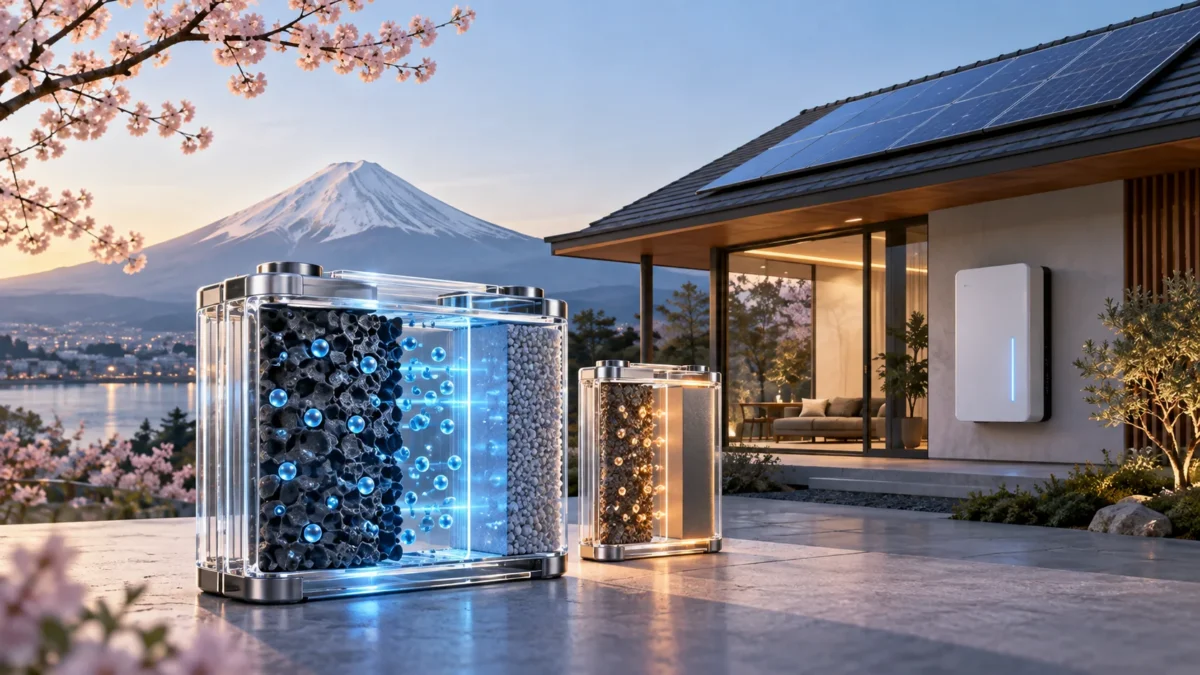
Lithium-ion batteries have transformed home backup power. Portable power stations, wall-mounted home batteries, solar-storage systems, and even DIY battery banks can now provide hours or days of electricity without running an engine.
They also come with a persistent concern: fire.
Modern lithium iron phosphate, or LiFePO4/LFP, batteries are considerably more thermally stable than older nickel-rich lithium-ion chemistries, and properly designed battery-management systems add multiple layers of protection. Researchers and manufacturers continue looking for battery chemistries that offer even greater safety, reduce dependence on lithium and other constrained raw materials, perform well in extreme temperatures, and can be manufactured economically at enormous scale.
One of the most promising candidates is sodium-ion.
Japan launched a major new sodium-ion battery development program in July 2026, bringing together Tokyo University of Science, GS Yuasa, other manufacturers, universities, and Japan’s government-backed New Energy and Industrial Technology Development Organization, or NEDO. The goal is to develop a new generation of sodium-ion batteries with high performance, lower resource risk, improved safety, and eventual commercialization.
Sodium-ion is also moving beyond the laboratory. Chinese manufacturers are entering mass production, commercial sodium-ion energy-storage systems are beginning deployment, and the first sodium-ion residential batteries have started appearing in European homes.
So what exactly is a sodium-ion battery, why might it be safer than lithium-ion, what are its disadvantages, and how soon might one realistically power your refrigerator during the next outage?
Quick answer: Sodium-ion batteries work similarly to lithium-ion batteries but use sodium ions as the primary charge carrier instead of lithium. Sodium is abundant and inexpensive, and emerging sodium-ion designs can offer excellent cold-weather performance, reduced reliance on lithium and graphite, and potentially improved safety. Their biggest current weakness is lower energy density. That matters greatly in electric vehicles, but much less for stationary home batteries. Early residential sodium-ion systems are already entering the market in 2026, although Japan’s newly announced next-generation program is targeting commercialization in the mid-2030s. Sodium-ion is best viewed as an emerging complement to lithium iron phosphate, rather than a reason to postpone a backup-power system you need today.
What Is a Sodium-Ion Battery?
A sodium-ion battery is a rechargeable battery in which sodium ions move back and forth between a positive electrode, or cathode, and a negative electrode, or anode, as the battery charges and discharges.
The basic operating principle is similar to that of a lithium-ion battery. During charging, ions move through the electrolyte toward the anode, where energy is stored electrochemically. During discharge, the ions move back toward the cathode while electrons travel through the external circuit and power whatever is connected to the battery.
The main difference is the ion doing the traveling. Lithium-ion batteries use lithium, while sodium-ion batteries use sodium.
Sodium sits directly below lithium on the periodic table and shares useful chemical properties with it. Unlike lithium, however, sodium is extraordinarily abundant. It exists throughout the Earth’s crust and oceans, and sodium compounds are already produced at massive industrial scale.
That does not mean someone can fill a Powerwall with table salt and call it innovation. Battery-grade electrodes, electrolytes, separators, current collectors, battery-management electronics, and precise manufacturing processes remain highly sophisticated.
The attraction is that one of the battery’s fundamental ingredients is widely available.
Why Can’t Manufacturers Simply Replace Lithium With Sodium?
Unfortunately, atoms have opinions.
A sodium ion is larger and heavier than a lithium ion. Its electrochemical characteristics also make it harder to achieve the same energy density that lithium-ion cells can provide.
One particularly important problem involves the anode.
Graphite works extremely well as the conventional anode material in lithium-ion batteries because lithium ions can fit into its layered structure. Sodium does not behave as conveniently in ordinary graphite-based cells.
For that reason, many sodium-ion designs use hard carbon instead.
Hard carbon contains a more irregular structure, including disordered carbon layers, defects, surfaces, and microscopic pores in which sodium can be stored. This material has become one of the most important areas of sodium-ion research.
In February 2026, researchers from Tokyo University of Science and several collaborating Japanese institutions announced that they had directly observed sodium moving into hard carbon during battery charging using neutron-scattering equipment at Japan’s J-PARC research facility.
They identified a three-stage storage process: sodium first interacts with surfaces and defects, then enters spaces between carbon layers, and finally fills nanoscale pores in the hard carbon. Better understanding that process could allow researchers to design anodes that store more sodium, charge faster, and last longer. Tokyo University of Science explains the research in more detail here.
That work builds on research stretching back well over a decade. Professor Shinichi Komaba and colleagues at Tokyo University of Science demonstrated a rechargeable sodium-ion cell using hard carbon and a layered sodium cathode in research published in 2011.
Japan’s current sodium-ion push is the latest stage of a long-running battery-development effort, rather than a sudden discovery.
What Is Japan Developing in 2026?
On July 9, 2026, Japan’s NEDO announced a new program focused on advanced battery technologies that could reduce resource and supply-chain risk.
One of the selected projects is the development of next-generation sodium-ion batteries, led by Tokyo University of Science through an industry-academia-government consortium.
Participants include GS Yuasa, MU Ionic Solutions, Kuraray, Toagosei, Musashi Energy Solutions, Osaka University, the University of Tokyo, Tohoku University, Waseda University, the National Institute for Materials Science, and several other research institutions.
NEDO describes sodium as an inexpensive and stably available resource that can even be obtained from seawater. The program is also targeting batteries capable of rapid charging or improved low-temperature charge and discharge performance.
GS Yuasa says the consortium is targeting commercialization in the mid-2030s. The company also plans to fabricate and demonstrate prototype sodium-ion cells using existing lithium-ion battery manufacturing equipment.
That could matter almost as much as the chemistry itself.
A battery technology does not become cheap simply because its raw materials are cheap. It becomes cheap when enormous numbers of cells can be produced reliably using mature equipment, trained workers, established suppliers, predictable quality control, and high factory utilization.
If sodium-ion production can reuse a meaningful portion of the infrastructure developed for lithium-ion batteries, the path toward large-scale manufacturing becomes considerably easier.
Are Sodium-Ion Batteries Safer Than Lithium-Ion?
Potentially, but the answer depends on the specific chemistry and system design.
There is no universal sodium-ion chemistry. Different sodium batteries use different cathodes, electrolytes, separators, cell designs, and thermal-management systems, so their safety characteristics can differ substantially.
Sodium-ion batteries are attracting attention partly because some designs can offer improved thermal stability and reduced fire propagation compared with conventional lithium-ion batteries. Manufacturers are developing them for that reason.
However, researchers have also demonstrated that sodium-ion batteries can experience overheating, gas generation, electrolyte decomposition, internal short circuits, and thermal runaway under abusive conditions.
A 2025 review comparing thermal runaway in lithium-ion and sodium-ion batteries concluded that sodium-ion technology has promising thermal-stability characteristics, while thermal runaway remains a safety issue requiring continued development. The full review is available here.
Sodium-ion batteries therefore should not be treated as fireproof.
That distinction becomes especially important when comparing sodium-ion with today’s lithium iron phosphate batteries.
LFP is already one of the more thermally stable mainstream lithium-ion chemistries. The safety improvement of a particular sodium-ion battery relative to an LFP system may therefore be much less dramatic than its improvement relative to a high-energy nickel-manganese-cobalt, or NMC, lithium-ion battery.
The individual cell chemistry and system design matter more than the word “sodium” printed on the label.
Sodium-Ion vs. Lithium Iron Phosphate for Home Backup
For homeowners, LFP is the most useful comparison because it currently dominates many portable power stations and stationary storage systems.
| Feature | Sodium-ion | LiFePO4 / LFP |
|---|---|---|
| Commercial maturity | Emerging rapidly | Highly mature |
| Energy density | Generally lower | Higher |
| Raw-material availability | Excellent sodium availability | Requires lithium |
| Cold-temperature potential | Excellent in leading designs | Often reduced at very low temperatures |
| Thermal safety | Potentially excellent, chemistry-dependent | Very good for lithium-ion |
| Supply chain | Immature and highly concentrated | Large global manufacturing base |
| Cost today | Not automatically cheaper | Extremely competitive due to scale |
| Future cost potential | Strong | Already highly optimized |
| Residential availability | Early products entering market | Widely available |
| Stationary-storage suitability | Potentially excellent | Already proven |
The International Energy Agency estimates that leading sodium-ion cells can now reach around 175 Wh/kg, compared with roughly 205 Wh/kg for leading LFP and 255 Wh/kg for nickel-rich NMC cells.
That gap is meaningful in an electric vehicle because every additional pound of battery must be accelerated down the road.
Inside a basement, garage, utility room, or outdoor battery enclosure, weight is usually less important. A home battery weighing 250 pounds instead of 190 pounds is inconvenient on installation day, but it does not reduce your home’s driving range.
That makes stationary energy storage one of sodium-ion’s most logical applications.
Why Sodium-Ion Could Be Especially Good for Home Energy Storage
A home backup battery needs a somewhat different set of characteristics than an EV battery.
Physical weight matters, but not nearly as much. Long cycle life, reasonable cost, safety, reliability, temperature tolerance, and easy integration with solar and inverters matter considerably more.
Sodium-ion could eventually perform particularly well in several of those areas.
Better performance in very cold temperatures
Cold weather is one of sodium-ion’s most interesting advantages.
The IEA reports that the latest sodium-ion batteries can retain around 90% of nominal capacity at temperatures as low as -40°C and operate at temperatures as high as 70°C, although those figures should not be assumed for every sodium chemistry or product.
That could make sodium storage particularly attractive for outdoor installations and colder climates where battery heating and winter derating complicate lithium-based systems.
For homeowners in places where January regularly looks like nature is attempting a hostile takeover, that is a meaningful advantage.
Less dependence on lithium
Sodium is abundant, widely distributed, and inexpensive.
That does not automatically make complete sodium-ion batteries cheap, because electrodes, electrolytes, factories, control electronics, certification, and manufacturing yields still cost money. It does, however, give manufacturers another battery chemistry to use when lithium prices rise or supply chains tighten.
Potentially lower material costs
Some sodium-ion designs also avoid graphite and can reduce the need for copper by using aluminum current collectors more extensively.
Those material advantages could eventually lower cell cost, although LFP manufacturing has become highly efficient. Massive factories and enormous demand have pushed lithium battery costs downward, meaning sodium-ion cells must compete against a technology that has spent decades optimizing production.
The IEA currently concludes that sodium-ion generally does not undercut LFP on cost in most applications at today’s lithium prices.
Cheap sodium is an advantage, but it does not guarantee cheap batteries.
Energy Density Is Still Sodium-Ion’s Biggest Problem
If sodium-ion batteries have so many attractive properties, why aren’t they already everywhere?
Energy density remains the clearest answer.
Sodium ions are larger and heavier than lithium ions, and sodium chemistry generally operates at less favorable electrochemical potentials for maximizing energy storage per unit of mass.
That creates a larger and heavier battery for a given amount of stored energy.
For smartphones, drones, aircraft, and long-range electric vehicles, the difference is a serious disadvantage. For grid storage and home batteries, it is much less damaging.
A 10-kWh battery mounted beside a garage wall does not have to fly, fit in your pocket, or carry itself around for 300 miles.
Stationary storage therefore gives sodium-ion room to compete on characteristics other than maximum Wh/kg, including price, cycle life, safety, cold-weather operation, resource availability, and longevity.
Our guide to home battery backup systems explains why capacity, inverter output, expansion capability, and installation architecture frequently matter more to homeowners than battery weight alone.
Sodium-Ion Batteries Are Already Becoming Commercial
This is where the sodium-ion timeline gets confusing.
Japan’s newly announced next-generation battery project is targeting commercialization in the mid-2030s, while other sodium-ion products are already entering commercial deployment.
CATL, the world’s largest battery manufacturer, has moved aggressively into sodium-ion production. Its second-generation Naxtra sodium-ion technology entered large-scale industrialization during 2026, and CATL says full-scale mass production is expected by the end of 2026.
In June 2026, CATL unveiled its TENER Sodium stationary energy-storage system. The company says its mass-production lines are commissioned and operational, Chinese deliveries are beginning in September 2026, cumulative shipments are expected to reach 1 GWh by the end of the year, and international deliveries are scheduled for June 2027. CATL’s announcement provides the complete deployment timeline.
CATL has also announced major sodium-ion production expansion and a three-year 60-GWh storage agreement with HyperStrong.
These developments primarily involve large-scale energy storage rather than a battery intended to sit next to your washing machine. Residential sodium-ion products are beginning to appear as well.
Can You Buy a Sodium-Ion Home Battery Yet?
Commercial availability remains limited, but early products are entering the market.
In July 2026, California-based UNIGRID announced the first deliveries of its Na+Casa sodium-ion residential battery, with initial installations taking place in Europe.
The wall-mounted system provides 9.25 kWh of usable storage and uses the company’s sodium chromium oxide, or NCO, chemistry. UNIGRID says its system is designed for more than 10,000 cycles and operation across a very wide temperature range.
The company expects U.S. residential installations by the end of 2026, subject to completion of additional North American compliance requirements. UNIGRID announced its first residential deliveries in July 2026.
Those longevity and safety figures remain manufacturer claims that will need long-term real-world validation. The product nevertheless marks an important shift in the sodium-ion conversation.
The question is increasingly whether early systems can compete with mature lithium products on certification, cost, warranties, inverter compatibility, installation support, and long-term reliability.
Should You Wait for Sodium-Ion Before Buying a Home Battery?
For most homeowners who need backup power now, probably not.
Lithium iron phosphate systems are already mature, widely available, extensively tested, and supported by established inverter, solar, and home-energy ecosystems.
Current portable systems such as the Anker SOLIX C2000 Gen 2 on Amazon, Jackery Explorer 2000 v2 on Amazon, and BLUETTI AC200L on Amazon use LFP battery chemistry and provide roughly 2-kWh-class storage with high-output AC inverters.
For example, the Jackery Explorer 2000 v2 provides roughly 2,042Wh of storage and 2,200W of continuous AC output, while the BLUETTI AC200L provides roughly 2,048Wh with 2,400W continuous output.
Those systems can be purchased and used today.
Our guide to what a 2,000-watt portable power station can actually run shows what this class of battery can support during an outage and why inverter watts and battery watt-hours need to be evaluated separately.
A sodium-ion product has to compete with more than the chemistry inside those batteries. It must also match their warranty networks, accessories, expansion batteries, apps, solar inputs, certifications, replacement parts, distribution networks, and years of accumulated field experience.
Early adopters may find sodium-ion appealing as residential products reach the United States. Other buyers may prefer to wait until the technology has accumulated more field data.
Where Sodium-Ion Could Change Home Backup the Most
The biggest sodium-ion opportunity may not be replacing every portable lithium power station. It may be enabling larger amounts of stationary storage at lower cost.
Imagine a home with 20, 30, or 40 kWh of battery capacity paired with rooftop or ground-mounted solar.
At those capacities, physical battery weight is already secondary. The important questions become how much each usable kilowatt-hour costs, how many cycles the batteries can deliver, how safely they can operate, and how many years the system can remain in service.
That fits directly into the architecture described in our guide to building a solar, battery, and generator home backup system that can last for days.
A battery handles overnight loads and short outages. Solar recharges it whenever weather permits. A generator provides an additional energy source when sunlight and stored electricity cannot keep up.
If sodium-ion eventually makes stationary storage less expensive or increases usable lifetime, homeowners could install more battery capacity for the same budget.
In backup power, additional usable kilowatt-hours can be considerably more valuable than shaving another 15 pounds off the battery enclosure.
Lithium Isn’t Sodium-Ion’s Only Supply-Chain Problem
Sodium-ion is sometimes presented as a battery chemistry free of critical-mineral concerns, but the reality is more complicated.
Removing lithium is significant, yet sodium-ion batteries still need cathode materials, carbon anodes, electrolyte compounds, separators, aluminum, electronics, and manufacturing infrastructure.
Some commercially promising sodium cathodes also use materials such as nickel and manganese.
The IEA estimates that nearly all existing sodium-ion manufacturing capacity is currently located in China and that China accounts for more than 95% of announced global sodium-ion manufacturing capacity through 2030.
Sodium-ion may eventually diversify raw-material sourcing while creating another manufacturing supply chain heavily concentrated in one country.
Japan’s program is therefore interesting for more than battery performance. It is also part of an attempt to develop domestic expertise and manufacturing options outside China’s rapidly expanding sodium-ion ecosystem.
Sodium-Ion Is Not the Same as a Sodium-Sulfur Battery
Anyone researching this topic will quickly encounter another Japanese battery technology: the NAS battery.
NAS batteries are sodium-sulfur batteries developed by Japan’s NGK and Tokyo Electric Power Company for large stationary energy-storage applications.
They use sodium and sulfur separated by a ceramic electrolyte and have been deployed commercially for grid storage.
They are not the same technology as modern room-temperature sodium-ion batteries.
Sodium-ion batteries operate much like lithium-ion cells, shuttling sodium ions between host electrode materials. Traditional sodium-sulfur systems operate at elevated temperatures and rely on a different electrochemical reaction and system architecture.
NGK’s NAS battery documentation describes the sodium-sulfur technology and its grid-storage applications.
Both use sodium, but treating them as interchangeable would be like saying a toaster and a Tesla are basically the same thing because both contain wires.
What Happens Next?
The next several years should reveal whether sodium-ion develops into a mainstream third pillar of battery storage alongside LFP and higher-energy lithium-ion chemistries.
The technology does not need to replace lithium in every application to succeed. It needs applications where its own advantages matter more.
Cold-weather storage, grid-scale batteries, and residential solar storage are all potential markets.
Hybrid systems may also use multiple chemistries together. A manufacturer could select lithium cells where maximum energy density matters and sodium cells where temperature performance, cost, or cycle life matters more.
That is already how battery technology tends to evolve. There is rarely one chemistry that wins every possible application.
The Homeowner Sodium-Ion Timeline
As of September 2026, the sodium-ion timeline looks roughly like this:
| Timeframe | What is happening |
|---|---|
| Now | Early sodium-ion products are already commercial, including initial residential installations in Europe and large-scale energy-storage deployments. |
| Late 2026 | CATL is targeting full-scale Naxtra sodium-ion production, while UNIGRID expects U.S. residential installations pending compliance approvals. |
| 2027 | CATL plans international deliveries of its TENER Sodium stationary-storage system beginning in June. |
| Late 2020s | Sodium-ion manufacturing capacity and real-world deployments should provide much better evidence about cost, reliability, degradation, and safety. |
| Mid-2030s | Japan’s new NEDO-backed consortium is targeting commercialization of its next-generation sodium-ion technology. |
Those dates describe different products and development programs, not one universal sodium-ion launch date.
You do not need to wait until 2035 to see sodium-ion batteries. You may, however, need to wait years before sodium-ion becomes as ordinary, inexpensive, and easy to buy as an LFP power station is today.
A Good Video Introduction to Sodium-Ion Technology
For homeowners who want a visual explanation of the technology and its economics, “How CATL Made Batteries 90% Cheaper (And What Happens Next)” from Undecided with Matt Ferrell provides a useful overview of sodium-ion batteries, CATL’s development work, cost potential, and limitations.
The video has accumulated more than 2.3 million views and covers sodium basics, CATL’s Naxtra technology, drawbacks, and the broader outlook.
The video predates some of the 2026 developments covered in this article, including Japan’s new NEDO-backed program and the first residential sodium-ion deployments. It works best as a visual introduction to the underlying technology rather than a complete account of where the market stands today.
What Sodium-Ion Means for Home Backup Power
Sodium-ion does not make today’s lithium batteries obsolete. The rise of sodium-ion instead highlights how strong lithium-ion technology has become.
For sodium batteries to succeed, they must compete with LFP cells that are already inexpensive, long-lived, thermally stable, energy dense enough for home storage, and manufactured on an enormous scale.
Stationary storage gives sodium-ion a favorable market. A home battery does not need exceptional energy density. It needs safe, dependable, affordable kilowatt-hours.
That is where sodium’s abundant raw materials, cold-weather performance, potential longevity, and evolving safety characteristics could become valuable.
If manufacturers can translate those advantages into inexpensive certified products with good warranties and reliable inverter integration, sodium-ion could eventually become one of the most logical battery chemistries for home backup and solar storage.
Until then, homeowners should compare actual products rather than chemistry hype.
Whether your battery contains lithium or sodium, you still need enough inverter output to start your equipment and enough stored watt-hours to keep it running.
A simple plug-in monitor such as the P3 Kill A Watt electricity monitor on Amazon can help measure the running consumption of ordinary 120V appliances before you size a backup battery. Keep in mind that basic plug-in meters may not capture every fast compressor or motor startup peak.
You can then use the Home Power Matrix battery runtime calculator to estimate how long a battery of any chemistry will power your selected loads.
The ions may change, but the math remains undefeated.
Frequently Asked Questions
Are sodium-ion batteries safer than lithium-ion batteries?
Some sodium-ion chemistries may offer improved thermal stability and reduced fire propagation compared with certain lithium-ion chemistries, but sodium-ion batteries are not universally fireproof. Thermal runaway is still possible under some failure conditions. Safety depends on electrode chemistry, electrolyte, cell construction, thermal management, and battery-management systems.
Can sodium-ion batteries catch fire?
Yes. Sodium-ion batteries can experience thermal runaway and electrolyte-related fires under certain abuse or failure conditions. Claims that all sodium-ion batteries have zero fire risk should be treated cautiously unless they refer to specific validated cell designs.
Are sodium-ion batteries better than LiFePO4?
Not universally. Sodium-ion can offer excellent cold-weather performance, abundant raw materials, and potentially attractive cost and safety characteristics. LFP currently offers higher energy density, enormous manufacturing scale, mature supply chains, widespread certification, and established reliability.
Why are sodium-ion batteries cheaper?
The raw material sodium is abundant and inexpensive, and some sodium-ion designs can reduce dependence on lithium, graphite, and copper. Sodium-ion batteries are not currently guaranteed to cost less than LFP because lithium-ion manufacturing has achieved enormous economies of scale.
How long do sodium-ion batteries last?
Cycle life varies dramatically by chemistry and manufacturer. Some emerging stationary sodium-ion products claim 10,000 or more cycles, but long-term field data for residential products remains limited.
Can sodium-ion batteries work in cold weather?
Cold-weather performance is one of sodium-ion’s strongest potential advantages. Leading modern sodium-ion technologies have demonstrated substantially better low-temperature performance than conventional LFP cells, although specifications vary by battery.
Can I buy a sodium-ion home battery in the United States?
Commercial availability remains limited as of September 2026. Sodium-ion residential systems have begun installations in Europe, while manufacturers including UNIGRID have announced plans for U.S. installations pending certification and compliance requirements.
When will Japan’s sodium-ion batteries be available?
The Japanese NEDO-backed next-generation sodium-ion development program announced in July 2026 is targeting commercialization in the mid-2030s. Other sodium-ion batteries are already emerging through commercial products and early residential systems developed elsewhere.
Are sodium-ion batteries good for solar energy storage?
Potentially very good. Stationary solar storage is less sensitive to weight and energy density than vehicles, allowing sodium-ion’s potential advantages in cost, cycle life, resource availability, temperature performance, and safety to become more important.
Should I wait for sodium-ion before buying a home backup battery?
Probably not if you need backup power now. Modern LFP systems are already mature and widely available. Sodium-ion is worth watching closely, particularly for large stationary systems and cold climates, but its residential market is still at an early stage.