

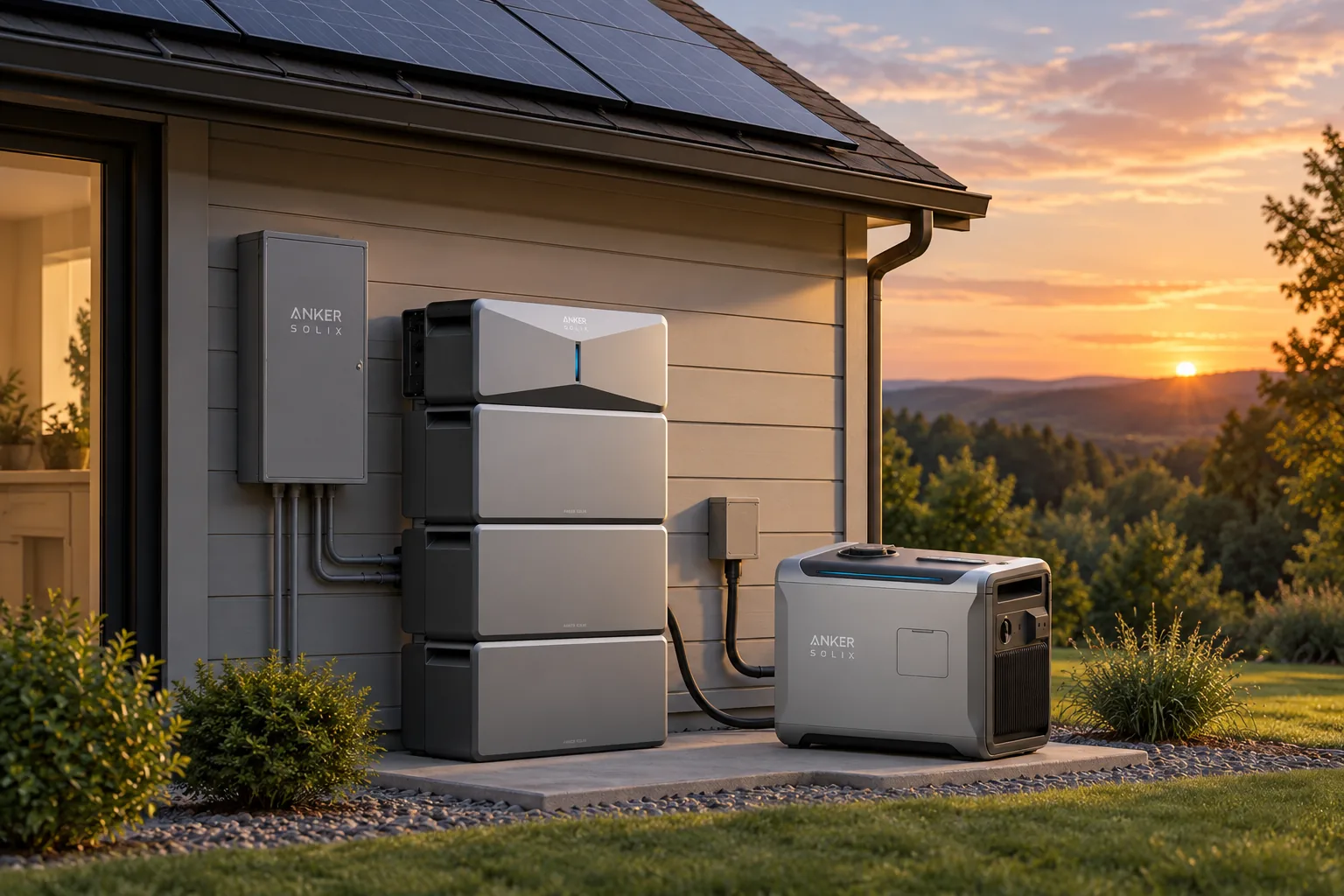
A conventional standby generator solves a straightforward problem. The utility power fails, the generator starts, and an automatic transfer switch moves the house onto generator power until the grid returns.
The Anker SOLIX E10 takes a different approach. It combines expandable battery storage, solar charging, automatic home backup, intelligent load management, and an optional tri-fuel generator in one integrated system. During an outage, the batteries can take over almost immediately. Solar can replenish those batteries during the day. If solar production and stored energy are not enough, the Smart Generator 5500 can automatically start and recharge the battery system using gasoline, propane, or natural gas.
For an off-grid property, that combination can support a much more flexible energy system than solar batteries or a fuel generator alone. For a grid-connected home, the same equipment can provide outage protection while also using solar generation and battery storage during ordinary operation.
The E10 is not necessarily a direct replacement for every Generac or Kohler standby generator. A large conventional standby unit can provide much more continuous generator output from a single machine. The E10 instead uses batteries as the primary power source and treats the generator as one of several ways to replenish them.
That distinction affects fuel use, noise, solar integration, available power, runtime, cost, and how the system behaves during a long outage.
Quick answer: A single Anker SOLIX E10 provides 7,680W of continuous 120/240V output and can expand from 6.144 kWh to 30.72 kWh of battery storage. With two or more batteries, it can provide up to 10,000W in Turbo Backup mode for as long as 90 minutes. Multiple E10 systems connected through the Power Dock can expand storage to roughly 90 kWh and rated output to 22.8 kW. The optional Smart Generator 5500 can automatically recharge the batteries through a dedicated DC connection using gasoline, propane, or natural gas.
What Is the Anker SOLIX E10?
The E10 is a modular home energy storage system built around an inverter-equipped Power Module and Anker’s B6000 lithium iron phosphate battery modules.
Each B6000 stores 6.144 kWh. Up to five can be installed with one E10 Power Module, giving one E10 stack approximately 30.72 kWh of nominal battery capacity.
The Power Dock can connect as many as three E10 systems. That allows an installation to grow from one 6.144 kWh battery to approximately 90 kWh of total storage, depending on configuration. Anker markets the overall range as 6 to 90 kWh. You can review the current E10 specifications directly from Anker SOLIX.
| E10 battery configuration | Approximate nominal capacity |
|---|---|
| 1 B6000 | 6.14 kWh |
| 2 B6000 | 12.29 kWh |
| 3 B6000 | 18.43 kWh |
| 4 B6000 | 24.58 kWh |
| 5 B6000 | 30.72 kWh |
| Multiple E10 systems | Up to about 90 kWh |
This gives homeowners considerable flexibility when sizing a system. Someone primarily concerned about short outages may not need 30 kWh on day one. Another household with a well pump, central air conditioning, medical equipment, refrigeration, and frequent multiday outages may have a much stronger reason to install several battery modules.
If you are sizing a system around essential loads, start with the Home Power Matrix guide to the essential circuits worth backing up first. Battery capacity becomes much easier to plan once you know which loads actually need to remain powered.
The Power Dock Turns the E10 Into a Whole-Home System
An E10 can be used in several configurations, but the Power Dock is the component that makes it particularly relevant for homeowners comparing it with a permanent standby generator.
The Power Dock supports a 200A service entrance, automatic backup operation, and up to three connected E10 systems. Anker advertises backup switchover in 20 milliseconds or less. It also provides 12-circuit intelligent load management.
Load management matters because battery backup does not have to treat every circuit equally. Refrigeration, a well pump, sump pump, furnace blower, medical equipment, and basic lighting may have much higher priority than an electric dryer, pool equipment, or EV charger.
A properly configured system can preserve capacity for high-priority circuits as available energy falls. That can be more useful during an extended outage than simply allowing every connected appliance to compete for power until the batteries are depleted.
How Much Power Does One E10 Provide?
A single E10 is rated for 7,680W of continuous 120/240V AC output. That is the normal sustained output available to household loads.
With at least two B6000 battery modules installed, one E10 can increase its output to 10,000W for up to 90 minutes using Turbo Backup mode.
That distinction matters because Turbo Backup is not merely a split-second surge rating.
A refrigerator or air-conditioner compressor may create a very brief startup spike. Turbo Backup can support a higher overall household load for a much longer period, up to 90 minutes under Anker’s stated conditions.
| E10 specification | Single E10 | What it means |
|---|---|---|
| Normal continuous AC output | 7,680W | Sustained household load |
| Turbo Backup with 2+ batteries | 10,000W for up to 90 minutes | Temporary period of higher sustained load |
| DC generator input | Up to 4,500W | Charging power from Smart Generator |
| Solar input | Up to 9,000W | Maximum PV input per E10 |
| Battery storage | 6.144 to 30.72 kWh | Stored energy available over time |
Power and stored energy should be considered separately. A 30.72 kWh battery bank may contain plenty of energy for an overnight outage while still being limited to the inverter’s available output at any particular moment.
Conversely, an inverter capable of supplying 7,680W could empty a relatively small battery quickly if household demand remained near that level.
Our Starting Watts vs. Running Watts guide explains the same distinction for generators and portable power stations. Continuous output determines what the system can keep running, while motor-starting capability determines whether it can handle brief inrush loads from compressors, pumps, and other motors.
Starting Central Air Conditioners, Well Pumps and Other Large Motors
The E10 also has a separate motor-starting specification.
Anker lists 120A LRA-equivalent starting capability with one battery and 155A with two or more batteries connected to a single inverter. Larger multi-E10 configurations can reach 275A. Anker markets properly configured systems as capable of starting some central air-conditioning systems up to five tons.
LRA, or locked-rotor amps, relates to the very high current a motor may demand during startup. It should not be confused with the amount of power the air conditioner consumes continuously once its compressor is running.
A soft starter may still be useful for homes with large central air-conditioning loads because reducing compressor inrush leaves more starting capacity available for other equipment. Micro-Air says its EasyStart FLEX can reduce compressor startup current by as much as 75%, although the actual reduction depends on the equipment and installation.
Homeowners considering this approach can review the Micro-Air EasyStart FLEX 398 on Amazon. An HVAC professional should verify voltage, compressor specifications, existing start components, and compatibility before installation.
Why the Smart Generator’s DC Connection Matters
The Smart Generator 5500 can operate independently as a conventional 120V portable generator with 3,600W of continuous AC output. Its more distinctive role in an E10 installation is charging the battery through a dedicated DC connection.
Lithium batteries store energy as direct current, or DC.
A conventional generator normally produces alternating current, or AC. If that AC electricity is used to recharge a battery, a charger must convert it back into DC before the battery can store it.
The Smart Generator 5500 can instead send as much as 4,500W directly into the E10’s DC generator input when running on gasoline or propane. Natural-gas operation is rated for up to 4,000W of DC output. Anker describes this as DC coupling and says the dedicated connection carries both power and communication between the generator and E10. You can see the Smart Generator 5500 specifications here.
The E10 still converts stored DC electricity into 120/240V AC when the house uses it. Household appliances do not suddenly become DC equipment. The efficiency advantage occurs during the generator-to-battery charging process.
| Charging path | Energy conversions |
|---|---|
| Conventional AC generator charging a battery | Generator → AC → charger converts AC to DC → battery → inverter converts DC to AC → household loads |
| Anker Smart Generator charging E10 through DC | Generator → DC charging input → battery → inverter converts DC to AC → household loads |
Every real conversion involves some loss, so avoiding an unnecessary AC-to-DC conversion is useful when the purpose of running the engine is primarily to recharge storage.
The Generator Can Recharge the Battery Instead of Following the House Load
The DC connection also changes how the generator can operate during a long outage.
With a normal portable generator connected directly to household loads, engine output has to respond to whatever the home is doing. Refrigerators cycle. Pumps start. Lights turn on and off. Air conditioning can change the load considerably.
With the E10 architecture, the battery and inverter can handle those changing household loads while the generator concentrates on charging the energy-storage system.
When connected to the E10, the Smart Generator can be controlled automatically or manually through the system. Anker also provides automatic start based on battery state of charge. If solar and stored energy are sufficient, the generator can remain off. If battery charge falls too far, the generator can run to add energy back to storage.
This can be particularly useful overnight. There may be little reason to run a combustion engine for eight hours if the batteries have enough energy to carry the house through the night. The generator can operate when battery replenishment is actually required.
That same strategy is covered more broadly in our guide to building a solar + battery + generator home backup system that can last for days.
Gasoline, Propane or Natural Gas
The Smart Generator 5500 supports three fuels:
- Gasoline
- Propane/LPG
- Natural gas
Gasoline and propane provide up to 4,500W of rated DC charging output. Natural gas is rated at up to 4,000W. Standalone AC output is rated at 3,600W on all three fuels.
The product name can cause some confusion. The 5,500W figure is starting power, not continuous output.
| Smart Generator 5500 rating | Gasoline | Propane | Natural gas |
|---|---|---|---|
| Starting power | 5,500W | 5,500W | 5,500W advertised starting rating |
| DC rated output to E10 | 4,500W | 4,500W | 4,000W |
| Standalone AC rated output | 3,600W | 3,600W | 3,600W |
The tri-fuel design gives homeowners several fuel strategies. A grid-connected property with natural gas may favor the convenience of an existing gas supply. A rural or off-grid property may already store propane. Gasoline provides another option when neither gaseous fuel is available.
Fuel availability during the type of outage you are preparing for should be part of the system design. Natural gas is convenient while gas service remains available. Propane can be stored for long periods. Gasoline is widely available but requires more attention to storage and fuel condition.
Solar Can Supply Up to 9 kW Per E10
Each E10 supports two PV inputs rated at up to 4,500W each, for 9 kW of solar input per E10.
With three E10 systems connected through the Power Dock, solar input can scale to 27 kW, subject to system design and installation requirements.
That solar capacity matters during prolonged outages because battery storage does not have to supply every kilowatt-hour consumed from the moment the grid fails until the moment it returns.
Suppose the home begins an outage with 30 kWh stored. It consumes 15 kWh overnight, but solar generates enough usable energy the following day to replace 12 kWh. The battery has experienced only a 3 kWh net deficit instead of a 15 kWh deficit.
A solar-plus-battery backup system therefore works as an energy balance rather than a simple countdown. Poor weather can still create a deficit. Several cloudy days may leave solar production well below household consumption, which is where the generator can provide another source of energy.
What Does 30 kWh of Storage Actually Run?
A five-battery E10 stack contains approximately 30.72 kWh of nominal storage.
Simple division gives a useful first estimate:
| Average household backup load | Theoretical runtime from 30.72 kWh |
|---|---|
| 500W | About 61 hours |
| 1,000W | About 31 hours |
| 2,000W | About 15 hours |
| 3,000W | About 10 hours |
| 5,000W | About 6 hours |
These are theoretical figures using nominal capacity. Real runtime will vary because of inverter losses, reserve settings, battery temperature, changing loads, and other system consumption.
Use the Home Power Matrix Battery Runtime Calculator to model your own loads rather than relying on generic averages.
For ordinary plug-in appliances, the P3 Kill A Watt electricity monitor on Amazon can help measure running consumption.
For a broader picture of household demand, the Emporia Vue 3 whole-home energy monitor on Amazon can monitor real-time electricity usage and individual circuits with the appropriate sensors. Installation requires work inside the electrical panel and should only be performed by someone qualified to do so safely.
Could This Work for an Off-Grid House?
The E10 architecture fits off-grid use well because it can combine stored energy, renewable generation, and dispatchable fuel generation.
Anker markets the E10 for off-grid applications and supports third-party generators in addition to its own Smart Generator 5500. Third-party generators do not necessarily provide the same integrated DC charging and communication features as the Smart Generator, so compatibility and connection requirements should be verified before designing the system around another generator.
An off-grid design still has to be sized around actual seasonal conditions. A solar array that easily covers summer demand may produce much less during short winter days, snow, heavy cloud cover, or prolonged storms.
For that reason, a robust off-grid system normally needs enough storage to bridge low-production periods and enough generator capacity to prevent a run of poor solar days from exhausting the battery bank.
The E10 does not eliminate that calculation. It packages the major components into a system designed to manage them together.
Can the E10 Lower Your Electric Bill?
For a grid-connected homeowner, solar and battery storage can also be used while utility service is functioning.
The E10 supports Self-Consumption and Time-of-Use modes intended to increase use of electricity generated on the property and take advantage of differing utility rates. Solar energy can be stored during the day and used later instead of purchasing the same amount of electricity from the utility during higher-cost periods.
Anker advertises potential electricity-bill reductions of up to 80%, but homeowners should treat that as a manufacturer best-case claim rather than an expected result.
Actual savings depend on factors including:
- Local electricity rates
- Time-of-use rate differences
- Solar-array size
- Roof orientation and shading
- Seasonal solar production
- Household electricity consumption
- Battery cycling strategy
- Equipment and installation cost
- Available state, local, or utility incentives
If electricity prices rise because of grid expansion, generation costs, transmission investments, increased industrial demand, or other regional factors, producing and storing more electricity on the property can reduce the amount purchased from the utility.
Our investigation into whether data centers could raise electric bills or increase outage risk looks at the growing electricity-demand issue in more detail.
Can You Sell E10 Power Back to the Grid?
No, not through the E10 or Power Dock under Anker’s current specifications.
Anker’s E10 FAQ states that neither the E10 nor the Power Dock supports feeding electricity back to the utility grid.
This is an important limitation for homeowners expecting to use the system for net metering. The E10 can use stored solar energy to reduce the electricity you purchase, but its current configuration should not be purchased on the assumption that excess electricity can be exported for utility credits.
A home may have separate grid-tied solar equipment with its own approved export arrangement, but that would be a separate system configuration subject to the utility’s interconnection requirements.
The E10’s economic case is therefore based primarily on avoided electricity purchases, time-of-use management, solar self-consumption, and backup value, rather than income from exporting power.
The Federal Residential Solar and Battery Credit Is Gone for New 2026 Installations
Another financial assumption worth updating is the federal Residential Clean Energy Credit.
The 30% federal residential credit previously covered qualifying solar and battery-storage expenditures. According to the Internal Revenue Service’s current Residential Clean Energy Credit guidance, the credit is not available for qualifying property placed in service after December 31, 2025.
That means homeowners planning a new system in 2026 should not automatically subtract 30% from the projected cost because an older article, calculator, or solar salesperson still uses the previous federal incentive structure.
State, local, and utility incentives may still be available. Tax rules and incentive programs can also change, so current requirements should be verified before making a purchase based on an expected credit.
Anker SOLIX E10 vs. Generac Standby Generator: Which Is Better for Home Backup?
The Anker SOLIX E10 and a conventional Generac standby generator can both provide automatic whole-home backup, but they solve the problem in very different ways.
Quick answer: A Generac standby generator is usually the simpler choice when the priority is high continuous power during an outage and a dependable natural-gas or propane supply is available. The Anker SOLIX E10 is better suited to homeowners who also want battery storage, solar charging, quiet backup operation, load management, and the ability to use stored energy without running an engine continuously.
The biggest mistake is comparing the two systems only by their headline kilowatt ratings. A Generac is primarily a fuel-powered generator. The E10 is primarily a battery-and-inverter system that can be replenished by solar, the utility grid, or an optional fuel generator.
| Feature | Anker SOLIX E10 | Typical Generac Guardian Standby Generator |
|---|---|---|
| Primary backup source | Battery storage and inverter | Natural-gas or propane engine |
| Continuous output | 7.68 kW per E10; multiple E10 systems can increase total output | Common residential models range well above 10 kW; 22–26 kW units are available |
| Temporary higher output | Up to 10 kW for as long as 90 minutes with two or more batteries on one E10 | Designed to supply rated generator output continuously while fuel is available |
| Stored electrical energy | 6.144–30.72 kWh per E10; larger Power Dock systems can approach 90 kWh | No meaningful household battery storage |
| Solar integration | Built into the platform; up to 9 kW of solar input per E10 | Requires separate solar and battery equipment |
| Operation during short outages | Can run silently from batteries without starting a generator | Engine normally starts when utility power fails |
| Long-outage strategy | Battery + solar + optional generator replenishment | Generator continues operating as long as fuel is available |
| Fuel options | Optional Smart Generator supports gasoline, propane, and natural gas | Residential standby units commonly use natural gas or propane |
| Noise when running from battery | Very low | Combustion engine operates during backup |
| Everyday energy use | Can support solar self-consumption and time-of-use energy management | Primarily installed for outage backup |
| Best fit | Homeowners who want storage, solar, generator backup, and energy management in one system | Homeowners who primarily want simple, high-output automatic standby generation |
Where Generac Has the Advantage: Continuous Power
A conventional Generac standby generator has a major advantage when the goal is simply to supply a large amount of power for as long as fuel remains available.
For example, Generac offers residential Guardian systems rated around 22 kW and 26 kW, depending on the model and fuel. That is substantially more continuous power than the 7.68 kW available from a single E10 under normal operation. Generac’s 26 kW Guardian, for example, is rated for up to 26 kW on propane and 22.5 kW on natural gas.
That extra continuous output can matter in a large all-electric home with several major loads operating together, such as central air conditioning, electric cooking, well pumps, electric water heating, or other high-demand equipment.
See the current Generac Guardian specifications for model-specific output and fuel-consumption figures.
Where the Anker E10 Has the Advantage: It Does More Than Generate Power
The E10 approaches outages differently. Instead of requiring an engine to run whenever backup power is needed, stored battery energy can carry the house silently. Solar can add energy back during daylight, and the Smart Generator can remain off until battery charge actually falls far enough to justify using fuel.
That can be especially useful during outages that last several days. A conventional standby generator may run for much of the outage because it is directly supplying household loads. With an E10 system, the battery and inverter handle those changing loads while solar and the optional generator function as ways to replenish stored energy.
The result is not necessarily more power than a large Generac. It is a more flexible mix of stored electricity, solar production, load management, and fuel generation.
Which System Uses Less Fuel During a Long Outage?
There is no universal answer because fuel consumption depends on household demand, generator size, solar production, battery capacity, weather, and outage length.
However, the E10 has an important structural advantage: the generator does not necessarily need to operate whenever the house needs electricity. If batteries can carry the overnight load and solar replaces much of that energy the following day, the generator may remain off for long periods.
A conventional standby generator has no large battery bank to bridge those periods. When it is the home’s backup source, the engine generally runs while outage loads are being supplied.
On the other hand, if solar production is poor and the batteries repeatedly need recharging, the E10’s Smart Generator will still consume fuel. Batteries do not create energy; they change when and how available energy is used.
Which Is Better for Central Air Conditioning?
A large Generac standby generator often has the simpler path to running central air because of its greater continuous output. But compressor startup demand matters in either system.
One E10 with two or more batteries can provide 10 kW in Turbo Backup mode for up to 90 minutes, and Anker lists 155A LRA-equivalent motor-starting capability for that configuration. Larger multi-E10 systems provide additional output and motor-starting capability.
A properly sized air-conditioner soft starter can further reduce compressor inrush and leave more electrical headroom for other household loads.
Regardless of which backup system you choose, central-air compatibility should be based on the actual condenser nameplate, voltage, running current, LRA, other simultaneous loads, and the specifications of the installed backup system—not AC tonnage alone.
Which Is Better if You Already Want Solar?
This is where the E10 becomes much more compelling.
A Generac standby generator is excellent outage equipment, but it normally sits idle when utility power is available. The E10’s batteries and solar input can also participate in everyday household energy use, including solar self-consumption and time-of-use strategies where applicable.
If you were already planning to buy substantial battery storage and solar, comparing the E10 only with the purchase price of a generator can therefore be misleading. The E10 is replacing or combining several pieces of equipment rather than only providing emergency generation.
Our guide to building a solar + battery + generator home backup system explains how those three energy sources can work together during extended outages.
Which Is Better if You Just Want Automatic Backup?
If your priority is straightforward—the grid fails, an engine starts automatically, and the house keeps running—a conventional Generac standby generator remains difficult to beat.
There is no battery-capacity calculation, no dependence on solar production, and no need to decide how much stored energy should be reserved for tomorrow. With an adequately sized generator and a reliable natural-gas or propane supply, the system can continue producing electricity for the duration of the outage.
The E10 makes more sense when you actually value what the additional complexity buys you: silent battery operation, solar replenishment, modular storage, intelligent load management, reduced dependence on fuel, or energy management outside of outages.
Anker SOLIX E10 vs. Generac Standby Generator
Choose a conventional Generac standby generator if your top priority is high continuous outage power with the simplest possible automatic fuel-based system.
Choose the Anker SOLIX E10 if you want a broader home-energy system built around battery storage, with solar and fuel generation available to replenish that storage when necessary.
For many homeowners, the question is therefore not whether the E10 is universally “better” than Generac. It is whether you want your backup system to be primarily a generator or a solar-and-battery system that also has a generator available when stored and renewable energy are not enough.
If the priority is running a very large home with several major electrical loads during an outage and a reliable natural-gas or propane supply is readily available, a conventional large standby generator may be simpler.
If the homeowner already wants solar and storage, values quiet battery operation, wants backup electricity available before an engine starts, or is designing around off-grid or multiday resilience, the E10 offers a different set of capabilities.
Our portable power station vs. generator comparison covers the broader differences between stored battery power and fuel generation.
Outdoor Installation and Weather Resistance
The E10 Power Module and B6000 battery system carry a NEMA Type 4/IP66 rating and are designed for long-term outdoor use. Anker lists an operating-temperature range of -4°F to 131°F.
The system supports both floor and wall mounting. Anker specifically recommends considering wall mounting in flood-prone areas, provided the supporting structure can safely carry the system’s substantial weight.
Each E10 Power Module weighs about 60.6 pounds, while each B6000 battery weighs approximately 130 pounds. A five-battery installation therefore represents hundreds of pounds of equipment before mounting hardware and other components are considered.
The Smart Generator 5500 carries a NEMA 3R enclosure rating and is designed for outdoor operation. Weather resistance does not make a combustion generator safe to operate indoors.
The U.S. Consumer Product Safety Commission recommends operating portable generators outdoors only, at least 20 feet from the home, with exhaust directed away from the structure.
Homes using any combustion generator should also have working carbon-monoxide alarms. One familiar option is the Kidde battery-operated carbon monoxide alarm with digital display on Amazon.
Battery Chemistry and Expected Cycle Life
The B6000 uses lithium iron phosphate, or LFP, battery chemistry.
Anker states that the E10 battery retains approximately 80% of its original capacity after 4,000 charge cycles. That cycle-life claim should be considered separately from the written warranty.
According to Anker’s E10 warranty policy:
- E10 Power Module: 5 years
- B6000 Battery Module: 5 years or 15 MWh of total throughput, whichever occurs first
- Power Dock: 10 years
- Smart Inlet Box: 10 years
- Smart Generator 5500: 3 years
The B6000 battery warranty guarantees at least 60% of original capacity during the applicable warranty period.
For an expensive permanently installed energy system, warranty terms deserve the same attention as battery chemistry, cycle-life marketing, and initial purchase price.
How Much Does an Anker SOLIX E10 System Cost?
The price depends heavily on the number of batteries and the type of home connection.
As of September 2026, Anker lists a one-battery E10 system starting around $3,999 during current promotional pricing. The company lists one-battery E10 configurations with the Power Dock around $5,799, additional B6000 batteries around $2,000 each during the current promotion, and the Smart Generator 5500 around $1,600.
That puts an E10 + Power Dock + Smart Generator configuration into the neighborhood of $7,400 before solar equipment, professional installation, permitting, fuel plumbing, or additional batteries are included. A two-battery configuration and larger systems increase the price accordingly.
Because these are current promotional prices, check the Anker SOLIX E10 product page for current pricing rather than assuming these numbers will remain unchanged.
A larger installation may also involve:
- Professional electrical installation
- Power Dock and service equipment
- Solar panels and mounting hardware
- PV wiring and disconnect equipment
- Natural-gas or propane plumbing
- Permits and inspections
- Site preparation
- Additional E10 Power Modules
- Additional B6000 batteries
When comparing the E10 with a standby generator, compare the total installed cost of each complete system. Comparing a fully integrated battery, solar, and generator installation against the retail price of an uninstalled standby generator does not give a useful financial comparison.
Drawbacks to Consider Before Buying
The E10 has an impressive feature set, but it also has limitations that matter when deciding whether it fits a particular home.
It cannot currently export power to the utility grid
This limits the financial strategies available to grid-connected homeowners. Solar and stored energy can offset electricity you would otherwise buy, but the E10 and Power Dock do not currently support utility grid export.
One E10 has much less continuous output than a large standby generator
A normal 7.68 kW limit is enough for many carefully managed backup loads, but it is far below the continuous output available from many large whole-home standby generators.
Homes with electric resistance heat, large central air conditioners, electric water heaters, ranges, dryers, EV charging, or multiple pumps may need aggressive load management or multiple E10 systems.
Turbo Backup has a time limit
The 10 kW Turbo rating with two or more batteries lasts for up to 90 minutes. It should not be used as the system’s indefinite continuous-output rating.
The Smart Generator 5500 is not a 5,500W continuous generator
The 5,500W number refers to starting power.
Its standalone AC rating is 3,600W. Its dedicated E10 DC output reaches 4,500W on gasoline or propane and 4,000W on natural gas.
The system depends heavily on the Anker ecosystem
The close integration between the Power Dock, E10 Power Modules, batteries, app, and Smart Generator is one of the platform’s advantages, but it also creates vendor dependence.
Anker supports third-party generators in some E10 configurations, but those generators do not automatically gain all of the dedicated DC charging, communication, and automation features of the Smart Generator 5500.
Large battery systems are heavy
Each B6000 weighs about 130 pounds. A full five-battery stack contains roughly 650 pounds of batteries before the Power Module and mounting equipment are included.
Installation location, floor or wall structure, flood exposure, working clearance, and code requirements all need to be considered.
Whole-home integration requires professional electrical work
The modular battery design can make later capacity expansion easier, but installation of the Power Dock or Smart Inlet Box and connection to the home’s electrical service require a professional electrician according to Anker.
Permanent 120/240V service work is not a casual DIY project.
The federal 30% residential clean-energy credit no longer applies to new 2026 installations
Homeowners comparing the E10 with older solar or battery cost estimates need to account for the expiration of the federal residential clean-energy credit after 2025. State, utility, and local incentives may still alter the economics.
Who Is the E10 Best Suited For?
The system makes the most sense for homeowners who want several capabilities from the same installation.
A rural homeowner with a well, propane storage, frequent outages, and good solar exposure could use batteries for routine backup power, solar for replenishment, and the generator during extended periods of poor weather.
A grid-connected homeowner may care more about automatic outage protection, time-of-use electricity rates, solar self-consumption, and reducing dependence on purchased utility electricity.
An off-grid homeowner may value the ability to combine a large PV array with up to 90 kWh of storage and fuel generation in one coordinated system.
A conventional standby generator may still be the more practical choice for someone who simply wants very high continuous output whenever utility power fails and has little interest in batteries or solar.
Is the Anker SOLIX E10 Better Than a Standby Generator?
It depends on what problem the homeowner is trying to solve.
A large Generac or Kohler standby generator can supply considerably more continuous power than a single E10. If the goal is to run almost every large load in the house during an outage and a reliable fuel supply is available, that simplicity has real value.
The E10 offers a different approach. Batteries provide nearly instantaneous backup and quiet operation. Solar can replenish stored energy without consuming fuel. Intelligent load management can preserve energy for essential circuits. If battery charge continues to fall, the tri-fuel generator can add energy through its dedicated DC connection.
For a short outage, the generator may never need to start.
During a longer outage with good solar production, the generator may run only occasionally. During prolonged poor weather, it can provide another way to replenish the same battery bank instead of forcing the house to operate directly from an engine around the clock.
For homeowners already considering solar and substantial battery storage, that can make the E10 a more complete home-energy system than a generator by itself.
Frequently Asked Questions
How much battery storage can one Anker SOLIX E10 have?
One E10 Power Module supports up to five B6000 battery modules. Each B6000 has 6.144 kWh of nominal capacity, giving one fully expanded E10 approximately 30.72 kWh of battery storage.
Can the Anker SOLIX E10 expand to 90 kWh?
Yes. Anker says a Power Dock can connect up to three E10 units. With fully expanded battery stacks, the system can reach approximately 90 kWh of total storage.
How much continuous power does one E10 provide?
A single E10 is rated for 7,680W of continuous 120/240V AC output. With at least two battery modules, it can provide up to 10,000W in Turbo Backup mode for as long as 90 minutes.
Is the E10’s 10,000W Turbo mode the same as surge power?
No. Turbo Backup can support up to 10,000W for as long as 90 minutes with two or more batteries. Motor-starting or surge capability covers much shorter inrush events such as an air-conditioner compressor or well-pump motor starting.
Why does the Anker Smart Generator use a DC connection?
The E10 battery stores DC electricity. The Smart Generator can send up to 4,500W directly through the E10’s dedicated DC generator input on gasoline or propane, avoiding an additional AC-to-DC charging conversion that would occur when using an ordinary AC generator to recharge a battery.
Is the Smart Generator 5500 actually a 5,500W generator?
The 5,500W specification refers to starting power, not continuous output. The generator is rated for 3,600W of standalone AC output. Its dedicated DC output to the E10 is rated for up to 4,500W on gasoline or propane and 4,000W on natural gas.
Can the Smart Generator 5500 run on natural gas?
Yes. The generator supports gasoline, propane/LPG, and natural gas. Only one fuel is used at a time.
Can the Smart Generator start automatically when the E10 battery gets low?
Yes. When connected to an E10, the Smart Generator supports automatic control based on the energy-storage system and battery state of charge, as well as manual and app-based operation.
How much solar can one E10 accept?
One E10 supports two PV inputs rated at up to 4,500W each, for up to 9 kW of solar input. Larger multi-E10 configurations can scale solar input up to 27 kW.
Can an Anker SOLIX E10 run central air conditioning?
Potentially. Anker rates one E10 with two or more batteries for 155A LRA-equivalent starting capability and says properly configured systems can start some central air-conditioning systems up to five tons. Actual compatibility depends on the air conditioner’s voltage, running demand, locked-rotor current, other active loads, and system configuration.
Can the E10 sell solar electricity back to the utility grid?
No. Anker’s current FAQ states that neither the E10 nor Power Dock supports feeding electricity back to the utility grid. The system can still reduce purchased electricity through solar self-consumption and time-of-use energy management.
Can the E10 be installed outdoors?
Yes. Anker rates the E10 Power Module and battery system NEMA Type 4/IP66 and states that it supports long-term outdoor installation. The Smart Generator is NEMA 3R and must be operated outdoors because it produces carbon monoxide.
Can I install an E10 myself?
Anker requires a professional electrician to install the Smart Inlet Box or Power Dock and connect the system to the home’s electrical service. Additional battery modules can be easier to add after the underlying electrical infrastructure is installed.
Does the 30% federal solar tax credit still apply to an E10 installed in 2026?
The federal Residential Clean Energy Credit is not available for qualifying residential clean-energy property placed in service after December 31, 2025, according to current IRS guidance. State, local, and utility incentives may still be available.
Is an E10 better than a Generac or Kohler standby generator?
The systems have different strengths. A large standby generator can provide much more continuous engine-generated power from one unit. The E10 combines battery storage, solar charging, intelligent load management, and optional tri-fuel generation, allowing the home to operate from batteries and solar without requiring a combustion engine to run throughout every outage.