

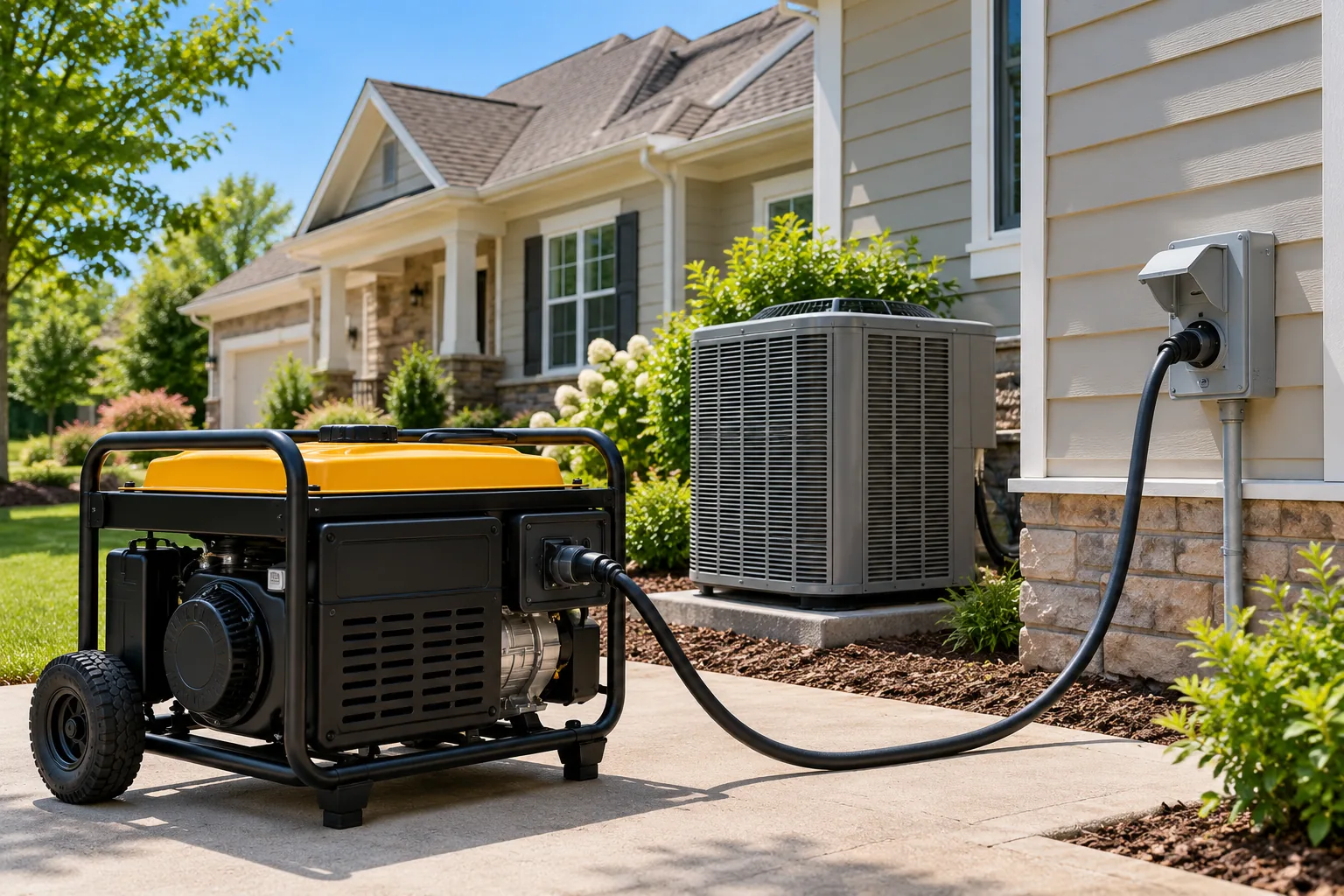
A central air conditioner is one of the hardest household loads to run from a portable generator—not necessarily because it consumes an enormous amount of electricity once it is operating, but because the compressor can demand a massive burst of current when it starts.
That is why a generator that appears large enough based on running watts may still bog down, trip its overload protection, or fail to start the air conditioner at all.
The generator size you need depends on the air conditioner’s running load, compressor startup demand, voltage, whether a soft starter is installed, and what else you expect to power at the same time. AC tonnage gives you a useful starting point, but the condenser’s electrical specifications provide a much better answer.
Quick answer: Many 2- to 4-ton central air conditioners can be supported by generators providing roughly 7,500 to 13,000+ running watts, particularly when the AC has a properly matched soft starter and other household loads are controlled. Smaller systems may need less, while large 4- or 5-ton systems, high-LRA compressors, or homes running pumps and other major loads simultaneously may require a larger portable or standby generator. Most conventional central air conditioners also require 120/240V generator output, not merely enough total wattage.
The most reliable way to size the generator is to look beyond tonnage and identify the AC’s actual electrical requirements—including its RLA, LRA, voltage, normal running demand, and startup behavior.
Generator Size by Central AC Tonnage
Air-conditioning capacity is measured in tons. One ton of cooling capacity equals approximately 12,000 BTU per hour, so a 3-ton air conditioner is nominally a 36,000-BTU system.
Tonnage does not directly tell you electrical consumption, however. Two 3-ton systems can have very different compressor designs, efficiency ratings, startup characteristics, and electrical requirements.
Champion Power Equipment’s generator wattage chart provides useful preliminary estimates for conventional central air conditioners:
| Central AC size | Cooling capacity | Estimated running watts | Estimated starting watts |
|---|---|---|---|
| 2 ton | 24,000 BTU | 2,000–2,500W | 3,500–4,500W |
| 3 ton | 36,000 BTU | 3,000–3,500W | 5,000–6,000W |
| 4 ton | 48,000 BTU | 4,000–5,000W | 6,500–8,000W |
These numbers are useful for early planning, but they should not be treated as universal generator-sizing specifications. Real equipment can demand substantially more current during compressor startup than a generic wattage chart suggests.
A 7,500-watt generator, for example, might successfully operate one 3-ton system while completely failing to start another 3-ton system. The difference may come down to compressor LRA, generator surge capability, voltage sag, other active loads, and whether the air conditioner has a soft starter.
That is why the next place to look is the equipment itself.
Why AC Tonnage Alone Does Not Tell You Generator Size
Tonnage tells you how much heat an air conditioner is designed to remove. It does not tell you exactly how much electricity its compressor uses or how difficult that compressor is to start.
Electrical requirements can change substantially because of:
- Compressor design and efficiency
- Single-stage, two-stage, variable-speed, or inverter operation
- Equipment age and condition
- Refrigerant and system pressures
- Voltage at startup
- Condenser fan demand
- Existing start components
- Ambient temperature
- Soft-start equipment
Current Goodman specification data shows how compressor locked-rotor amperage can increase dramatically across different residential system capacities. That is why equipment-specific electrical data beats a generic tonnage chart when you are making the final generator decision.
In other words, “What size generator runs a 3-ton AC?” has no single universal answer.
Tonnage gets you into the right neighborhood. The nameplate tells you which house you are actually looking for.
Find RLA and LRA on the AC Nameplate
The outdoor condenser usually has a manufacturer data plate listing several electrical values.
Two of the most useful terms for backup-power planning are RLA and LRA.
RLA: Rated Load Amps
RLA is associated with the compressor’s normal operating current. It gives you useful information about how heavily the compressor loads the electrical system once it is running.
It is not necessarily the exact amperage you will see every second the AC operates, and it does not represent every electrical component in the complete HVAC system.
LRA: Locked Rotor Amps
LRA represents the extremely high current associated with the compressor motor when the rotor is not yet turning.
Copeland explains that compressor locked-rotor amperage, or inrush current, can be several times higher than normal running current during the brief period when the compressor begins moving.
That short event is one of the main reasons central air is difficult for generators.
Imagine a compressor that runs normally without stressing a generator once it reaches operating speed. Every time the thermostat calls for cooling, however, that compressor suddenly asks the generator for several times its normal current.
If the generator cannot maintain sufficient voltage and output during that instant, the compressor may fail to start even though the generator has plenty of capacity to run it afterward.
Our guide to starting watts vs. running watts explains this distinction in more detail. When sizing backup power, you have to pass both tests: enough continuous capacity for everything operating normally and enough temporary capacity for the largest realistic startup event.
Don’t Multiply LRA by 240 and Call It Exact Starting Watts
You may see generator-sizing advice that takes an AC’s LRA, multiplies it by 240 volts, and calls the result the air conditioner’s starting watts.
For example:
75A × 240V = 18,000VA
That calculation is useful—but it needs the correct label.
Volts multiplied by amps gives volt-amperes, or VA, which represents apparent power. An AC motor is not a simple resistive load such as an electric heating element. Power factor, voltage sag, compressor behavior, generator transient response, and the extremely short duration of the startup event all affect what happens in the real world.
So an AC with 75A LRA should not automatically be interpreted as requiring an 18,000-running-watt generator.
Instead, use LRA to understand the severity of the startup event and compare that with generator motor-starting capability, manufacturer requirements, and—when available—measured startup current.
This is also why an HVAC technician’s measurement can be more useful than a generic online calculator when you are trying to operate a particularly demanding system from backup power.
A Soft Start Can Dramatically Change the Generator Requirement
For many conventional single-stage central air conditioners, a properly matched soft starter is one of the most effective ways to make generator operation practical.
A soft starter electronically manages compressor startup instead of allowing the compressor to immediately draw its full conventional inrush current.
Micro-Air says its EasyStart FLEX can reduce startup current by up to 75% and is designed for a wide range of residential AC applications.
That does not mean a soft starter reduces a 4,000-watt air conditioner to a 1,000-watt air conditioner while it is running.
Its biggest benefit for generator sizing is reducing the short startup spike.
Suppose a central AC normally requires about 3,500 watts while operating but has a compressor startup event that overwhelms a particular generator. Reducing that starting demand can allow the same generator to successfully get the compressor moving while still having enough continuous capacity to run the system afterward.
That is why homeowners sometimes discover that installing a soft starter makes more sense than jumping from an already-large portable generator to an enormous one.
Our complete guide to the benefits of an AC soft start explains how soft starters work, how they differ from hard-start kits, compatibility considerations, and when installing one makes sense.
Homeowners comparing products can also review the Micro-Air EasyStart FLEX 398 on Amazon or the AIRGO 16–32A AC soft starter on Amazon. An HVAC professional should confirm compressor type, voltage, existing start components, and product sizing before installation.
A Soft Start Does Not Solve an Undersized Generator
There is an important limit.
If your central air needs 4,500 watts while running and the rest of your house is already using 4,000 watts, a 6,000-running-watt generator remains undersized no matter how gently the compressor starts.
The soft starter helps with surge capacity.
The generator still needs enough continuous capacity.
That distinction matters because it is where a tremendous amount of generator-sizing advice goes off the rails.
What Size Generator for a 2-Ton Central AC?
A generic 2-ton central air conditioner may use approximately 2,000 to 2,500 running watts and have a startup requirement around 3,500 to 4,500 watts according to Champion’s planning chart.
A generator in roughly the 6,000- to 8,000-watt class may therefore be workable for some 2-ton systems when household loads are limited, particularly with a properly matched soft starter.
Without a soft starter, a higher-LRA compressor can demand considerably more transient capability than the generic chart implies.
If you also need to run a refrigerator, freezer, well pump, sump pump, lights, and electronics, moving into the 7,500- to 10,000-watt class can provide considerably more useful headroom.
Check the actual condenser before making the purchase.
What Size Generator for a 3-Ton Central AC?
A 3-ton system is one of the most common cases where the answer changes dramatically depending on startup current.
Champion lists a rough estimate of 3,000 to 3,500 running watts and 5,000 to 6,000 starting watts for a 3-ton central AC.
That makes a 7,500- to 10,000-watt generator a reasonable class to investigate for a 3-ton AC with a soft starter and a controlled set of household loads.
Without a soft starter, however, some conventional compressors can present a much more severe startup event. A larger 10,000- to 12,500-watt-class generator may provide more realistic transient headroom—but even that should not be treated as a guarantee until you inspect the condenser specifications.
This is one of those situations where buying the generator first and checking the air conditioner later is exactly backward.
What Size Generator for a 4-Ton Central AC?
Champion estimates approximately 4,000 to 5,000 running watts and 6,500 to 8,000 starting watts for a typical 4-ton central air conditioner.
Once you add the indoor blower and other household loads, a small generator becomes unrealistic very quickly.
A generator in the 10,000- to 13,000-watt class may be appropriate to investigate for a 4-ton system with a soft starter and sensible load management.
Without startup reduction, some 4-ton compressors have sufficiently high LRA that even a large portable generator can struggle. In that case, a larger portable unit, aggressive load management, or a standby generator may be the better solution.
Again, the condenser nameplate wins the argument.
What Size Generator for a 5-Ton Central AC?
Five-ton central air conditioners push toward the upper end of what many homeowners realistically operate from portable generators.
The compressor’s normal electrical load is substantial, and conventional startup current can be enormous.
A large 12,000- to 15,000+ watt portable generator combined with an appropriate soft starter may be capable of operating some 5-ton systems while supporting selected household loads.
Without a soft starter—or when the house also has a large well pump, electric water heater, multiple refrigeration loads, or other heavy equipment—you may be moving into territory where a properly sized standby generator is the more practical answer.
Do not size a 5-ton system from tonnage alone.
Can a 7,500-Watt Generator Run Central Air?
Sometimes.
A 7,500-running-watt generator can be enough for some smaller 2- or 3-ton central air conditioners, particularly when:
- The generator provides 120/240V output
- The AC has manageable startup current or a soft starter
- Other household loads are limited
- Large motors are not starting simultaneously
- The generator’s actual surge rating is sufficient
It can also fail with another AC of the same tonnage if that compressor has high LRA.
The number printed in enormous font on the generator does not override its actual continuous rating or the air conditioner’s electrical requirements.
Can a 10,000-Watt Generator Run Central Air?
A generator providing around 10,000 running watts gives you substantially more flexibility.
Many 2- and 3-ton systems—and some 4-ton systems—can fall within this territory when startup current is controlled and the remaining household load is reasonable.
But pay attention to whether 10,000 watts refers to starting output or running output.
A generator advertised as a “10,000-watt generator” may actually provide only 8,000 watts continuously.
Those are very different machines for AC sizing.
Can a 12,000-Watt Generator Run Central Air?
A generator capable of approximately 12,000 continuous watts can support a considerable home-backup load and gives you much more room for central air.
That still does not guarantee that every large compressor will start successfully.
A high-LRA 4- or 5-ton compressor can remain challenging, especially if a well pump, sump pump, refrigerator, or freezer happens to start at nearly the same time.
A soft starter and thoughtful load management can often be more valuable than simply buying the largest generator you can move around the driveway.
Your Generator Probably Needs 240V Output
Generator wattage is only part of the equation.
Most conventional residential central-air condensers use approximately 208/230V single-phase power. That means a generator intended to run central air generally needs 120/240V output.
A 7,000-watt generator that provides only 120V output cannot magically become a suitable 240V source because the wattage number is large enough.
Check:
- Generator voltage
- Generator receptacles
- Transfer equipment
- Circuit capacity
- AC voltage requirements
A proper transfer switch, appropriately installed interlock where permitted, or other listed connection equipment must also be capable of supplying the circuit safely.
Never attempt to power a home’s electrical system by backfeeding through a receptacle.
Don’t Forget the Indoor Blower
The outdoor condenser is not the entire cooling system.
When central air operates, the indoor HVAC equipment must move conditioned air through the house. Depending on the system, that means powering an air handler or furnace blower in addition to the outdoor compressor and condenser fan.
That blower may introduce both additional running demand and its own motor-starting demand.
So the sizing calculation is not:
Outdoor condenser = generator size
It is closer to:
Outdoor AC load + indoor blower + all other simultaneous household loads + realistic startup headroom = generator requirement
Our Home Power Matrix generator size calculator lets you build a household load list and add custom equipment so you can see how the AC fits into the complete backup plan.
Other Household Loads Can Change the Answer Completely
Suppose your central air uses approximately 3,500 watts while running.
You may also have:
| Load | Example running demand |
|---|---|
| Central AC | 3,500W |
| Indoor blower | 500W |
| Refrigerator | 200W |
| Freezer | 150W |
| Sump pump | 900W |
| Lights, router, and electronics | 300W |
| Total running load | 5,550W |
A generator providing 7,500 running watts appears comfortable.
But the sump pump, refrigerator, freezer, blower, and AC compressor are all motor-driven loads that may cycle independently.
If the AC starts while the sump pump is already running, or the sump pump starts shortly after the compressor, your temporary demand can climb quickly.
This is why our guide to the essential circuits worth backing up first recommends prioritizing loads instead of assuming every circuit needs to behave exactly as it does on grid power.
During an outage, turning off an electric water heater, range, clothes dryer, or other nonessential high-demand load can free substantial capacity for cooling and essential equipment.
How to Calculate Your Generator Requirement
A practical sizing process uses two separate checks.
Test 1: Continuous Load
Add the running demand of everything that may operate at the same time.
The total must remain below the generator’s running-watt rating.
If your selected loads need 8,000 watts continuously, a generator rated for 7,500 running watts is undersized regardless of its temporary surge rating.
Test 2: Compressor and Motor Startup
For equipment where you know both total starting demand and running demand, calculate:
Additional startup demand = total starting watts − running watts
Then estimate:
Required temporary output = total running load + largest additional startup demand
That result needs to remain within the generator’s temporary starting or surge capability.
If multiple large independently cycling loads could realistically start together, test that scenario too.
You do not need to design around every absurd mathematical possibility, but a sump pump does not care that your air conditioner already called dibs on the generator.
A Worked Central AC Generator Example
Consider a home with the following approximate loads:
| Load | Running watts | Total starting watts | Additional startup demand |
|---|---|---|---|
| Central AC with soft starter | 3,500W | 5,500W | 2,000W |
| Indoor blower | 500W | 1,200W | 700W |
| Refrigerator | 200W | 800W | 600W |
| Freezer | 150W | 600W | 450W |
| Sump pump | 900W | 2,700W | 1,800W |
| Lights, router, and electronics | 300W | 300W | 0W |
| Total running load | 5,550W | — | — |
Now compare that load with a hypothetical generator rated for 7,500 running watts and 9,500 starting watts.
- Normal operation: 5,550W remains below the 7,500W continuous rating.
- AC starts: 5,550W + 2,000W = 7,550W, below the 9,500W surge rating.
- Sump pump starts: 5,550W + 1,800W = 7,350W, below the 9,500W surge rating.
- AC and freezer overlap: 5,550W + 2,000W + 450W = 8,000W, also below the temporary rating.
This example passes the basic continuous and startup tests.
It does not prove that every generator with the same advertised wattage will behave identically. Generator transient response, surge duration, voltage regulation, fuel choice, temperature, altitude, and the actual AC all still matter.
Leave Some Generator Headroom
Sizing a backup system exactly to the theoretical load leaves little room for real-world conditions.
Generator output and starting performance can be affected by fuel, temperature, altitude, maintenance, voltage drop, transient response, and the characteristics of the connected motors.
Additional capacity also helps when someone turns on an appliance you forgot was connected.
For a home running central air, operating the generator comfortably below its continuous ceiling during normal conditions is generally preferable to designing a system that spends every hot afternoon fighting for its life at nearly full load.
More headroom becomes particularly useful when the home includes a well pump, sump pump, multiple refrigerators or freezers, or other equipment that can start automatically.
Gasoline, Propane, and Natural Gas May Produce Different Generator Ratings
If you are buying a dual-fuel or tri-fuel generator, size the system using the output rating for the fuel you actually intend to use.
The same generator may produce different wattage on gasoline, propane, and natural gas.
For example, Champion’s 100416 tri-fuel generator is rated differently depending on fuel:
| Fuel | Starting output | Running output |
|---|---|---|
| Gasoline | 10,000W | 8,000W |
| Propane | 9,000W | 7,200W |
| Natural gas | 8,750W | 7,000W |
If your sizing calculation requires 7,600 running watts, the same generator may fit the numbers on gasoline while falling short on natural gas.
Ignoring fuel-specific output is an excellent way to perform all the other math correctly and still buy the wrong generator.
Portable Generators Worth Comparing for Central AC
There is no single “best generator for central air,” because the correct unit depends on the AC and the rest of the household load.
However, larger 120/240V portable generators provide useful reference points.
Champion 100416 Tri-Fuel Generator
The Champion 100416 provides up to 8,000 running watts and 10,000 starting watts on gasoline, with lower output on propane and natural gas. It also provides 120/240V output.
This generator class can make sense for some smaller central AC systems, particularly when compressor startup demand has been reduced and the remaining household load is controlled.
See the Champion 100416 Tri-Fuel Generator on Amazon.
DuroMax XP13000HX
For heavier loads, the DuroMax XP13000HX moves into a larger portable-generator class. DuroMax rates it for 10,500 running watts and 13,000 peak watts on gasoline, with slightly lower ratings on propane.
That additional continuous capacity can be useful when central air must operate alongside pumps, refrigeration, lights, and other household circuits.
See the DuroMax XP13000HX on Amazon.
These are examples of generator classes worth comparing—not promises that either model will start your specific air conditioner.
Verify the AC first. Then buy the generator.
Generator THD Matters Too
Once the generator is large enough, power quality becomes another consideration.
Total harmonic distortion, or THD, describes distortion in the generator’s AC waveform. It is separate from generator wattage: a machine can have more than enough power while still producing a relatively distorted waveform.
Modern HVAC systems may contain electronic controls, variable-speed motors, communication boards, and other electronics in addition to the compressor itself.
Our guide to generator total harmonic distortion explains how conventional generators and inverter generators differ and when lower-distortion power deserves more attention.
Do not assume that simply buying the generator with the biggest engine and largest wattage number automatically gives you the best power source for every piece of modern equipment in the house.
Variable-Speed and Inverter AC Systems Are Different
Not every central air conditioner experiences the same brutal across-the-line compressor startup.
Variable-speed and inverter-driven HVAC systems electronically control compressor speed and may ramp up much more gradually than conventional single-stage equipment.
That can dramatically change generator behavior.
It also means you should not automatically add an aftermarket soft starter to a variable-speed system. Some systems already incorporate sophisticated motor-control electronics, and aftermarket soft starters may not be appropriate or compatible.
Check the HVAC manufacturer’s backup-power requirements before modifying this type of equipment.
Portable Generator or Standby Generator for Central Air?
A large portable generator can be an excellent solution if your goal is to run central air along with a carefully selected group of essential circuits.
It becomes less attractive when you want the house to behave almost exactly as it does on utility power.
If your outage plan includes a large AC system plus a well pump, electric water heater, cooking equipment, multiple refrigerators, electric heat, and other major loads simultaneously, a permanently installed standby generator may offer a cleaner solution.
The tradeoff is cost.
A soft starter plus a well-sized portable generator can sometimes provide central cooling and essential-load backup at a fraction of the installed cost of a large standby system.
Our guide to building a solar, battery, and generator home backup system also explains how multiple backup technologies can work together when you want longer-duration resilience without operating a combustion generator continuously.
Central AC vs. Electric Heat: Very Different Generator Problems
Central air is primarily difficult because of the compressor’s startup event.
Electric resistance heat creates a different problem: enormous continuous demand.
A soft starter can reduce a compressor’s startup current. It cannot make a 10,000-watt electric heating load stop requiring approximately 10,000 watts of sustained power.
If your HVAC system uses electric resistance heat or auxiliary heat strips, do not assume that a generator capable of running the AC compressor can also operate full electric heating.
Our guide to running an electric furnace from a generator explains why electric heat can require a dramatically larger backup system.
A Practical Central AC Generator Sizing Checklist
Before choosing a generator, identify:
- AC tonnage or BTU capacity
- Condenser voltage
- Compressor RLA
- Compressor LRA
- Whether the system is conventional, two-stage, variable-speed, or inverter-driven
- Whether an appropriate soft starter is installed
- Indoor blower or air-handler demand
- Other loads that must operate during cooling
- Generator running watts
- Generator surge or starting watts
- Generator output on your chosen fuel
- 120/240V capability
- Transfer-switch or inlet capacity
- Realistic headroom for overlapping loads
Then use the Home Power Matrix generator size calculator to build an initial household load estimate.
For large central AC systems, unusual electrical specifications, or borderline generator sizing, have an HVAC technician or electrician verify startup current and compatibility rather than designing the system around an internet average.
Generator Safety When Running Central Air
Large portable generators produce extremely dangerous carbon monoxide.
The U.S. Consumer Product Safety Commission says portable generators should be operated outdoors only, at least 20 feet from the home, with the exhaust directed away from the building. Working carbon-monoxide alarms should also be installed in the home.
Never run a portable generator inside a garage, basement, shed, enclosed porch, or other enclosed or partially enclosed space simply because a door is open.
Central AC also requires a proper electrical connection. Never connect a generator to house wiring by backfeeding through an outlet.
Use properly rated transfer equipment and have permanent electrical work installed in accordance with local requirements.
So, What Size Generator Do You Actually Need?
For many homes, a central air conditioner moves generator planning into the large-portable-generator range.
A 2-ton system may sometimes work with a roughly 6,000- to 8,000-watt-class generator when startup demand and other loads are modest.
A 3-ton system often pushes planning toward roughly 7,500 to 10,000 watts with startup reduction and controlled loads, while high-LRA systems may justify moving higher.
A 4-ton system commonly points toward the 10,000- to 13,000-watt class or beyond.
A 5-ton system can require one of the largest portable generators—or a standby generator—particularly without a soft starter.
Those ranges are useful for narrowing your shopping list.
They are not substitutes for the condenser label.
The sizing rule worth remembering: Your generator must provide enough continuous power for the air conditioner, indoor blower, and every other load running at the same time. It must also have enough temporary capability to survive compressor startup. A soft starter can dramatically reduce that startup requirement, but it cannot make an undersized generator carry more continuous load than it was designed to supply.
Read the AC specifications first, determine what else needs power, account for the generator’s actual output on your chosen fuel, and leave useful breathing room.
That’s how you end up with a backup system that actually starts the AC when the grid dies instead of a very expensive gasoline-powered lawn ornament.
Frequently Asked Questions
What size generator do I need for a 3-ton central air conditioner?
A 3-ton central AC may use roughly 3,000 to 3,500 running watts according to generic planning charts, but actual compressor startup demand varies substantially. A generator in roughly the 7,500- to 10,000-watt class can be worth investigating when a soft starter is installed and household loads are controlled. Systems with high LRA may require substantially more startup capability.
Will a 7,500-watt generator run central air?
It can run some smaller central AC systems, particularly with a soft starter, but 7,500 watts is not universally enough. Verify whether that figure is the generator’s running or starting rating and compare the AC’s actual electrical specifications.
Will a 10,000-watt generator run a 3-ton AC?
Often, but not automatically. A generator with approximately 10,000 running watts provides substantial capacity for many 3-ton systems and other essential loads, especially with reduced compressor startup current. A generator advertised as “10,000 watts” may provide less than 10,000 watts continuously, so check the specifications.
Will a 12,000-watt generator run central air?
A 12,000-running-watt generator can operate many residential central AC systems, but a large high-LRA compressor may still create a challenging startup event. Other simultaneous household loads also need to be included.
Can a portable generator run a 5-ton AC?
Some of the largest portable generators can run certain 5-ton central air conditioners, particularly when an appropriate soft starter is installed. Verify compressor LRA, normal operating demand, generator surge capability, voltage, and remaining household load before choosing one.
Does central AC need a 240V generator?
Most conventional residential central-air condensers use approximately 208/230V power, so the generator generally needs 120/240V output and an appropriate connection to the home’s electrical system. Check the equipment nameplate before assuming.
Does a soft start reduce how many generator watts I need?
It can reduce the generator’s required startup capability by substantially reducing compressor inrush current. It does not significantly eliminate the AC’s normal running demand, so the generator still needs sufficient continuous wattage.
What are LRA and RLA on an air conditioner?
RLA relates to compressor operating current, while LRA—locked rotor amps—describes the much higher current associated with compressor startup. LRA can be several times higher than running amperage.
Can I calculate AC starting watts by multiplying LRA by 240V?
Multiplying volts by amps gives volt-amperes, or VA, rather than exact real power in watts for an AC motor. The calculation demonstrates how severe startup current can be, but it should not be treated as a precise generator-size requirement.
Do I need to include the furnace blower when sizing a generator for AC?
Yes. A central AC normally relies on an indoor blower or air handler to circulate cooled air. Include its running and startup demand along with the outdoor condenser.
Does propane reduce generator output?
It can. Many dual-fuel and tri-fuel generators produce different running and starting wattage depending on whether they are operating on gasoline, propane, or natural gas. Always use the rating for the fuel you plan to use.
Will an AC soft starter work with a variable-speed air conditioner?
Not necessarily. Variable-speed and inverter-driven HVAC systems already use electronic motor controls and may be incompatible with aftermarket soft starters. Follow the HVAC and soft-start manufacturers’ compatibility requirements.
Can I run central AC and a sump pump from the same generator?
Yes if the generator has enough continuous and temporary capacity, but both devices can have substantial motor-starting demand. Test a realistic scenario in which one starts while the other is already operating—or consider load management to prevent problematic overlap.