

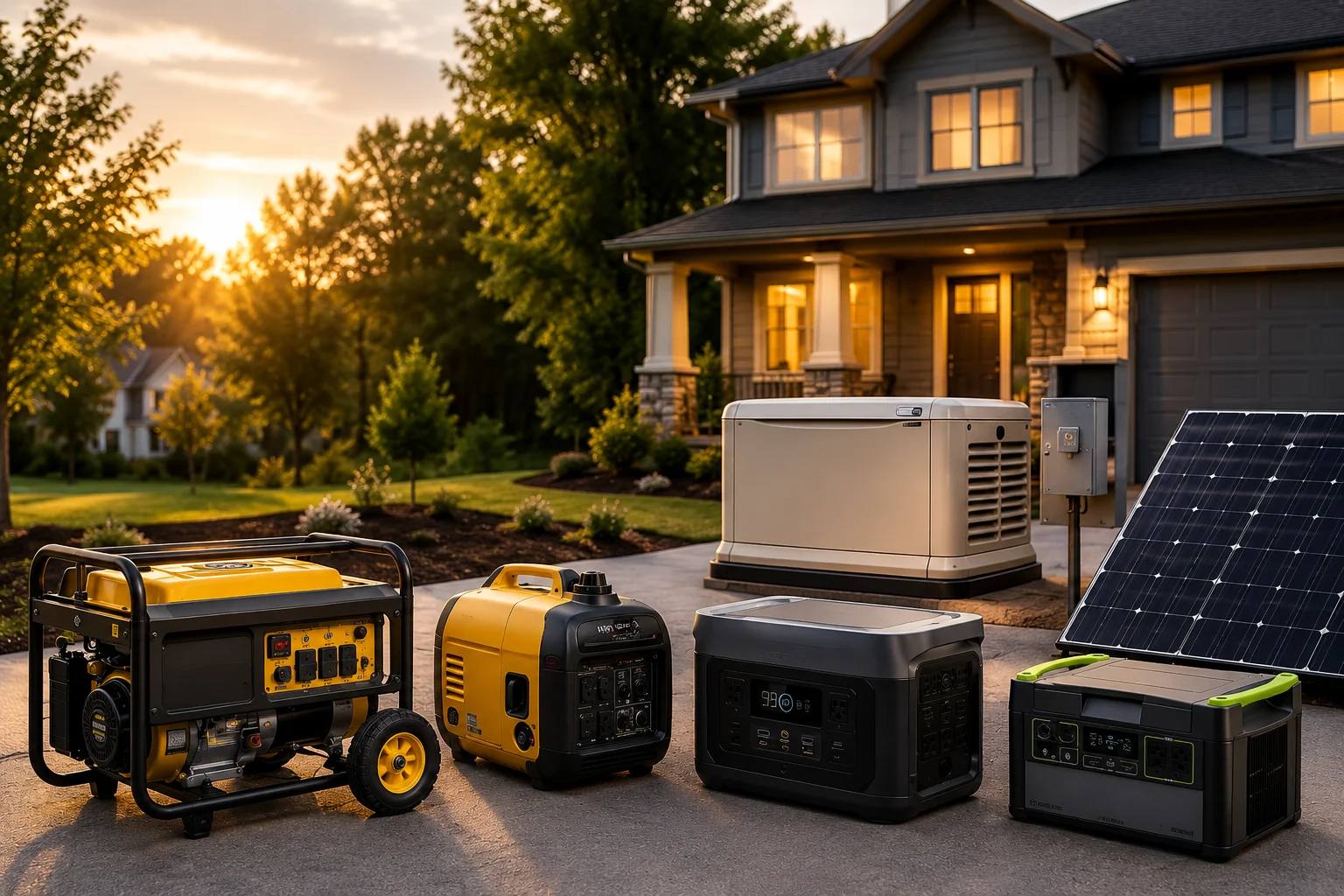
Choosing a generator for home backup power sounds simple until you begin comparing running watts, starting watts, fuel types, inverter technology, transfer switches, total harmonic distortion, portable power stations, and enough electrical terminology to make a normal person quietly close seventeen browser tabs.
The right generator is not necessarily the largest generator you can afford. It is the generator—or combination of generators and batteries—that can reliably power the equipment you care about, handle temporary startup surges, connect safely to your home, and continue operating with the fuel you can realistically store or access during an outage.
This guide explains how to choose the right generator for your house, including:
-
How to calculate the generator wattage you need
-
Running watts versus starting watts
-
Inverter generators versus conventional open-frame generators
-
Total harmonic distortion and sensitive electronics
-
Gasoline, propane, natural gas, diesel, dual-fuel, and tri-fuel options
-
Portable generators versus standby generators
-
Battery power stations and solar charging
-
Transfer switches, interlocks, cords, outlets, and 240-volt loads
-
Generator safety, placement, and carbon monoxide protection
Use the HomePowerMatrix Generator Size Calculator before comparing specific models. A generator should be selected around your actual loads—not a generic recommendation based only on your home’s square footage.
Quick answer: Add the running wattage of everything you expect to operate at the same time, then account for the largest additional starting surge. Choose a generator that can meet that demand without running continuously at its absolute maximum output.
Start With What You Actually Want to Run
There is an enormous difference between keeping a refrigerator, internet connection, sump pump, and a few lights operating and trying to run an entire electric home as though the outage never happened.
Before choosing a generator, divide your electrical loads into three groups.
Critical household loads
These are the devices that protect health, safety, food, water, or the house itself:
-
Refrigerator
-
Freezer
-
Sump pump
-
Well pump
-
Furnace blower
-
Boiler controls and circulators
-
Medical equipment
-
Security system
-
Internet modem and router
-
Basic lighting
-
Phone charging
Important comfort loads
These make a longer outage considerably less miserable:
-
Television
-
Computers
-
Microwave
-
Coffee maker
-
Window air conditioner
-
Portable heater, where appropriate
-
Garage door opener
-
Washing machine
-
Additional lighting and receptacles
High-demand loads
These can dramatically increase the generator size required:
-
Central air conditioner
-
Electric water heater
-
Electric range or oven
-
Electric clothes dryer
-
Heat pump with electric auxiliary heat
-
Large well pump
-
Hot tub
-
EV charger
-
Multiple large appliances operating simultaneously
A modest generator may cover most critical loads. Whole-home operation, especially in an all-electric house, can require a substantially larger portable generator, a permanently installed standby generator, careful load management, or a combination of generation and battery storage. If resistance heating is part of the plan, calculate it separately: our guide to sizing a generator or battery for an electric furnace shows why the heating load can overwhelm otherwise capable backup equipment. An EV charger deserves its own calculation; if emergency vehicle range matters to you, compare that setup with charging an electric vehicle from a portable power station.
Use a Generator Wattage Calculator Before Shopping
Generator advertisements emphasize wattage because it provides one large, impressive number. Unfortunately, that number does not always tell you how much power the generator can continuously provide.
Use the HomePowerMatrix calculators to estimate:
-
Your combined running load
-
The largest likely starting surge
-
Your required 120-volt and 240-volt capacity
-
Estimated fuel consumption
-
Battery runtime for selected loads
Appliance wattages shown in calculators and charts should be treated as planning estimates. The most reliable figure is the electrical information on the appliance nameplate, manufacturer documentation, or a measured reading from appropriate electrical monitoring equipment.
Do not size a generator by square footage alone
Two homes of the same size can have radically different power requirements.
A 2,000-square-foot home with propane heat, a gas range, municipal water, and a gas water heater may have relatively modest outage loads. Another 2,000-square-foot home with a heat pump, electric water heater, well pump, electric range, and central air conditioning may require several times as much power.
Square-footage recommendations are useful only as rough starting points. Your appliances determine your load.
Running Watts vs. Starting Watts
Understanding running and starting watts is the most important part of generator sizing.
What are running watts?
Running watts—sometimes called rated watts—are the amount of power a device requires during normal continuous operation.
If your refrigerator uses 200 watts while running, those 200 watts contribute to the continuous load placed on the generator.
What are starting watts?
Motors and compressors frequently require a brief surge of additional power when starting. This temporary demand may also be called:
-
Starting watts
-
Surge watts
-
Peak watts
-
Inrush current
-
Locked-rotor demand
Refrigerators, freezers, pumps, compressors, air conditioners, furnace blowers, and some power tools can require considerably more power during startup than during normal operation.
Champion’s generator-sizing guidance recommends adding the highest individual starting requirement to the combined running wattage of the loads being operated.
A simplified generator-sizing example
Suppose you want to operate:
| Device | Running Watts | Additional Starting Watts |
|---|---|---|
| Refrigerator | 200 | 800 |
| Freezer | 200 | 600 |
| Sump pump | 800 | 1,200 |
| Furnace blower | 600 | 1,000 |
| Router and modem | 40 | 0 |
| Television | 100 | 0 |
| Lights | 200 | 0 |
| Total | 2,140 | — |
The combined running load is approximately 2,140 watts.
The largest additional startup requirement is the sump pump’s estimated 1,200 watts. That produces an estimated peak requirement of:
2,140 running watts + 1,200 additional starting watts = 3,340 watts
You would not normally buy a generator rated for exactly 3,340 watts. Additional capacity provides room for load variation, future additions, brief overlapping surges, temperature-related performance changes, and the reality that operating any machine permanently at its limit is rarely a brilliant long-term strategy.
Starting Watts Are Not Always Additive
Most simple generator-sizing calculations assume that only one major motor starts at a time. That is often reasonable, but it is not guaranteed.
A refrigerator compressor could start while a sump pump is already starting. A central air conditioner may cycle on while a well pump is operating. Automatic equipment does not politely coordinate itself around your generator’s feelings.
Homes with several motor-driven loads may need:
-
Additional surge capacity
-
Manual load sequencing
-
Soft starters
-
Load-management modules
-
A larger generator
-
A transfer switch that controls which circuits can operate together
A soft starter can reduce the starting demand of some air-conditioning systems, but compatibility and expected reduction should be confirmed for the specific HVAC equipment. It should not be treated as magic dust that automatically makes every small generator capable of starting every central air conditioner.
How Much Generator Headroom Should You Allow?
A practical system should have capacity above the minimum calculated load. The exact amount depends on the generator, the connected equipment, and how actively you are willing to manage circuits.
Headroom may help accommodate:
-
Brief overlapping startup surges
-
Loads that consume more than their estimated wattage
-
Future appliances
-
Reduced output when operating on propane or natural gas
-
Voltage and frequency stability under rapidly changing loads
-
High-altitude or high-temperature derating
-
Battery charging loads
-
Normal generator aging
You do not necessarily need to double your calculated load. You also should not select a generator that will live at 100% output every time the refrigerator and sump pump become ambitious at the same moment.
Choose the Right Type of Generator
Home backup equipment falls into four broad categories:
-
Conventional portable generators
-
Inverter generators
-
Permanently installed standby generators
-
Battery power stations and home battery systems
Each solves a different version of the outage problem.
Conventional Open-Frame Portable Generators
A conventional portable generator uses an engine to rotate an alternator and produce alternating-current electricity. Open-frame models are generally easy to recognize by their exposed engine and tubular metal frame.
Advantages of open-frame generators
-
High power output for the purchase price
-
Larger fuel tanks on many models
-
Common 120/240-volt outlets
-
Broad selection of dual-fuel and tri-fuel models
-
Strong suitability for pumps, heating systems, refrigerators, tools, and household circuits
-
Easier access to engine components for maintenance
-
Widely available replacement parts and accessories
Disadvantages of open-frame generators
-
Usually louder than enclosed inverter models
-
Often heavy
-
Fuel consumption may remain relatively high at light loads
-
Power quality varies considerably by model
-
Some models produce higher total harmonic distortion
-
Engine speed generally remains fixed near its operating target rather than dropping significantly with light demand
Open-frame generators are often the best value for homeowners who need substantial 120/240-volt output and are primarily concerned with refrigerators, pumps, heating equipment, lighting, and ordinary household loads.
However, “open frame” and “dirty power” are not synonyms. Some modern conventional generators advertise low THD, while some open-frame models are themselves inverter generators. Read the electrical specifications rather than judging the machine exclusively by whether you can see its engine.
Open-frame generator example
The Westinghouse WGen11500TFc is an example of a high-output tri-fuel portable generator designed for substantial home-backup loads. Current retailer listings describe gasoline, propane, and natural-gas operation, 120/240-volt capability, a 50-amp outlet, a carbon-monoxide sensor, and low-THD output. Specifications and output vary by fuel, so buyers should compare the manufacturer’s rated—not merely peak—wattage for each fuel.
Affiliate disclosure: HomePowerMatrix participates in the Amazon Services LLC Associates Program. As an Amazon Associate, we may earn from qualifying purchases made through links on this page, at no additional cost to you.
View Westinghouse WGen11500TFc listings on Amazon
Other high-output models worth comparing include:
Inverter Generators
An inverter generator does not simply send the alternator’s raw output directly to its receptacles. Its electronics convert and regulate the electricity to create stable AC output.
Inverter models are popular for electronics, camping, RV use, nighttime backup, and applications where noise and fuel efficiency matter.
Advantages of inverter generators
-
Low total harmonic distortion on most quality models
-
Stable output for sensitive electronic loads
-
Quieter operation, particularly in enclosed designs
-
Variable engine speed on many models
-
Better efficiency under lighter loads
-
Compact options for small emergency systems
-
Parallel capability on some models
Disadvantages of inverter generators
-
Higher cost per watt
-
Repairs may involve more complex electronics
-
Small models may provide only 120-volt output
-
Enclosed units can be less convenient to service
-
Large 120/240-volt inverter generators can be expensive and heavy
Generac describes inverter generators as useful for sensitive electronics because of their regulated output, lower THD, quieter operation, and fuel-efficiency advantages.
Small premium inverter generator example
The Honda EU2200i is a widely recognized compact inverter generator rated at 2,200 starting watts and 1,800 running watts. Its size makes it more appropriate for selected essentials, recreational use, or battery charging than for running an entire house.
View Honda EU2200i listings on Amazon
Mid-sized inverter generator example
The Champion 4,500-watt open-frame inverter generator illustrates why “open-frame” and “inverter” are not mutually exclusive categories. Retail listings describe 4,500 starting watts, 3,650 running watts, inverter electronics, and a carbon-monoxide shutoff system.
View Champion 4,500-watt inverter generators on Amazon
Larger home-backup inverter generators
Larger inverter models can provide 120/240-volt service and enough output for selected home circuits. Examples include:
These larger models narrow the traditional gap between quiet inverter power and high-output portable home backup, although they remain more expensive than many conventional generators with similar rated output.
Inverter Generator vs. Open-Frame Generator
The correct choice depends on what you value most.
| Consideration | Inverter Generator | Conventional Open-Frame Generator |
|---|---|---|
| Purchase price per watt | Usually higher | Usually lower |
| Noise | Usually lower | Usually higher |
| Light-load fuel economy | Often better | Often less efficient |
| THD | Commonly low | Varies by model |
| High-output 240V options | Available but expensive | Widely available |
| Weight | Lower in small models | Often heavy |
| Electronics | Excellent when THD is low | Confirm manufacturer specifications |
| Home transfer equipment | Model-dependent | Common on larger models |
| Maintenance complexity | More electronics | Mechanically simpler |
For a small group of essentials, electronics, camping, or nighttime operation, an inverter generator is often the more pleasant machine to live with.
For maximum home-backup wattage per dollar, a conventional open-frame generator may be the stronger value.
For buyers who want both high output and cleaner, quieter operation, a large 120/240-volt inverter generator may justify the additional cost.
What Is Total Harmonic Distortion?
Total harmonic distortion, abbreviated THD, describes distortion in an AC electrical waveform relative to an ideal sine wave.
Utility electricity is expected to maintain a relatively stable waveform, voltage, and frequency. Generator output can vary depending on the design, load, engine regulation, alternator, and electronic controls.
Lower THD generally indicates a waveform closer to a clean sine wave.
Why THD matters
Many ordinary resistive loads are not especially demanding about waveform quality. Examples include basic incandescent lighting and simple heating elements.
Electronic and digitally controlled equipment may be more sensitive, including:
-
Desktop computers
-
Servers and networking hardware
-
Televisions and audio equipment
-
UPS systems
-
Battery chargers
-
Variable-speed furnace and HVAC controls
-
Modern refrigerators and appliances with control boards
-
Medical devices
-
Smart-home equipment
Generac states that its inverter generators produce no more than 3% THD and advises against using output in the 6%–30% range for sensitive electronics. Some of its conventional low-THD portable and standby models are also marketed for electronic loads.
Is 5% THD the universal dividing line?
Five percent is commonly used by manufacturers as a clean-power benchmark, but it should not be treated as a magical legal boundary between perfectly safe and instantly destructive electricity.
Equipment tolerance varies. THD is also only one power-quality measurement. Voltage regulation, frequency stability, transient response, grounding configuration, surge protection, and generator behavior under nonlinear loads also matter.
The safest approach is to:
-
Check the generator’s published THD specification.
-
Check the requirements of unusually expensive, sensitive, or medically important equipment.
-
Avoid assuming that every generator produces low-THD power.
-
Use an appropriate inverter generator or manufacturer-designated low-THD model where sensitive electronics are a major part of the load.
Can a UPS clean generator power?
Sometimes, but not always.
Many consumer uninterruptible power supplies simply pass acceptable incoming AC power through to connected equipment. Some may reject generator power if voltage or frequency falls outside their accepted range. A true online double-conversion UPS regenerates its output differently, but it is more expensive and still must be compatible with the generator.
Buying a random inexpensive UPS should not be treated as a guaranteed cure for unstable generator output.
Portable vs. Standby Generators
Portable and standby generators can both power household circuits, but the ownership experience is very different.
Portable generators
Portable generators are manually positioned, fueled, started, and connected during an outage.
They generally offer:
-
Lower initial cost
-
Flexible fuel choices
-
Portability
-
Manual control over operation
-
Easier replacement
-
The ability to use one machine for home backup, work, or recreation
They also require:
-
Safe outdoor placement
-
Manual refueling
-
Protected fuel storage
-
Extension cords or professionally installed connection equipment
-
Regular maintenance
-
Someone capable of setting up and operating the system
Standby generators
A standby generator is permanently installed outside the home and connected through an automatic transfer switch. It can detect an outage, start automatically, and supply selected circuits or a large portion of the house.
Standby generators are especially valuable when:
-
Automatic operation is important
-
The home may be unattended
-
Residents cannot move or manually connect a portable generator
-
Outages are frequent
-
Natural gas or a large propane supply is available
-
Central air conditioning or other large loads must remain available
The major disadvantage is cost. The generator itself is only part of the expense. Installation can involve electrical work, fuel plumbing, permits, site preparation, and ongoing professional maintenance.
View home standby generator listings on Amazon
A standby system should be sized and installed by qualified professionals according to the actual loads, local codes, fuel supply, and manufacturer requirements.
Choose a Generator Fuel Type
Fuel availability may matter more during a long outage than the generator’s maximum wattage.
A huge generator without usable fuel is an extremely expensive lawn ornament.
Gasoline generators
Gasoline generators are widely available and often provide their highest advertised output when operating on gasoline.
Advantages include:
-
Easy local availability under normal conditions
-
High output
-
Broad generator selection
-
Familiar refueling process
Disadvantages include:
-
Limited storage life
-
Need for appropriate approved containers
-
Fuel deterioration and carburetor problems
-
Increased demand and station outages during emergencies
-
Flammability and storage limitations
Gasoline stored for backup should be rotated and treated according to the fuel, container, equipment manufacturer, and applicable safety requirements.
Propane generators
Propane can be stored for long periods without degrading like gasoline, provided the cylinder and valves remain in safe condition.
Advantages include:
-
Long-term storage
-
Cleaner combustion than gasoline
-
No carburetor varnish from stored liquid gasoline
-
Common dual-fuel availability
-
Easy cylinder rotation
Disadvantages include:
-
Lower generator output on many models
-
Reduced vaporization in extreme cold or under heavy demand
-
Limited runtime from small cylinders
-
Need for properly sized regulators, hoses, tanks, and connections
A standard barbecue-sized cylinder may run a modest load, but it is not an endless home-backup fuel supply. Large generators operating under substantial load can consume propane quickly.
Natural-gas generators
Natural gas eliminates manual refueling as long as utility service remains available.
Advantages include:
-
Continuous fuel supply during many outages
-
No portable containers
-
Convenient operation
-
Strong fit for standby and tri-fuel systems
Disadvantages include:
-
Lowest output of the three fuels on many tri-fuel generators
-
Utility service can be interrupted
-
The home’s gas meter and piping must support the required flow
-
Connection work may require permits and qualified professionals
-
Portable generator hoses should not be improvised
Never assume that an existing natural-gas connection can supply a large generator simply because the fittings can physically be adapted. Pipe diameter, run length, pressure, meter capacity, other gas appliances, and generator demand all matter.
Diesel generators
Diesel generators are common in commercial, agricultural, and heavy-duty backup applications.
Advantages include:
-
Durability
-
Strong fuel efficiency under load
-
High torque
-
Long service life in appropriate designs
Disadvantages include:
-
Higher purchase cost
-
Greater weight
-
Noise
-
Cold-weather considerations
-
Fewer small residential portable choices
Dual-fuel and tri-fuel generators
Dual-fuel generators commonly operate on gasoline and propane. Tri-fuel generators add natural gas.
These models provide valuable flexibility during emergencies. However, buyers must compare output separately for each fuel. A generator advertised using its maximum gasoline starting wattage may provide materially lower running wattage on natural gas.
Browse dual-fuel generators on Amazon
Browse tri-fuel generators on Amazon
Do You Need 120-Volt or 120/240-Volt Output?
Small generators often provide only 120-volt output. That may be sufficient for extension-cord loads or selected 120-volt circuits.
Larger household equipment may require 240 volts, including:
-
Many well pumps
-
Central air conditioners
-
Electric water heaters
-
Electric dryers
-
Electric ranges
-
Some heat pumps
-
Certain shop equipment
-
Level 2 EV charging equipment
A generator’s total wattage does not automatically mean it supports 240-volt loads. Confirm the voltage, receptacles, phase configuration, breaker capacity, and transfer equipment.
Balanced loading matters
A typical North American home receives split-phase 120/240-volt service. A 120/240-volt generator supplies two 120-volt legs.
Large imbalances between those legs can limit usable capacity even when total wattage appears to remain available. A properly designed transfer setup and thoughtful circuit distribution can help manage this issue.
Generator Outlets: 30-Amp vs. 50-Amp
Larger portable generators commonly include locking 30-amp or 50-amp receptacles.
A 30-amp 120/240-volt connection has a theoretical capacity of:
240 volts × 30 amps = 7,200 watts
A 50-amp 120/240-volt connection has a theoretical capacity of:
240 volts × 50 amps = 12,000 watts
Actual usable output remains limited by the generator’s rated capacity, breakers, connection equipment, temperature ratings, and applicable electrical rules. Installing a 50-amp inlet does not transform a 7,500-watt generator into a 12,000-watt generator. Electricity remains stubbornly immune to optimism.
Transfer Switches and Generator Interlocks
A portable generator can power appliances through extension cords or connect to selected home circuits through approved transfer equipment.
Manual transfer switch
A manual transfer switch selects between utility and generator power for specified circuits. It prevents the generator from energizing utility lines and provides an organized way to power hardwired equipment.
Generator interlock
An approved panel interlock mechanically prevents the main utility breaker and generator breaker from being on simultaneously.
Interlocks can provide flexible access to panel circuits, but they must be compatible with the exact electrical panel, installed correctly, and permitted by the local authority having jurisdiction.
Automatic transfer switch
An automatic transfer switch is commonly used with standby generators. It detects an outage, disconnects the home from utility power, and connects the generator according to the system design.
Never backfeed through a household outlet
Connecting a generator to a dryer outlet, range outlet, or ordinary receptacle using a double-male cord is profoundly unsafe. It can energize utility lines, expose workers and neighbors to lethal voltage, bypass normal protections, and create serious fire and electrocution hazards.
Use listed equipment designed for generator connection and have household transfer equipment installed by a qualified electrician.
Extension Cord Size Matters
Undersized or excessively long extension cords can cause voltage drop, overheating, poor motor performance, and fire risk.
Choose cords based on:
-
Load amperage
-
Cord length
-
Wire gauge
-
Outdoor rating
-
Receptacle type
-
Generator and appliance instructions
Use heavy-duty outdoor cords in good condition. Do not conceal connections in wet grass, create improvised adapters, or run damaged cords through places where they can be pinched.
HomePowerMatrix will provide a dedicated Extension Cord Voltage Drop Calculator and wire-gauge guide for planning longer generator runs.
Portable Power Stations and Home Batteries
A battery power station stores electricity rather than generating it from fuel. Most combine:
-
A lithium battery
-
An inverter
-
AC receptacles
-
USB and DC outputs
-
Wall charging
-
Optional solar charging
-
Battery-management electronics
Advantages of battery power stations
-
Silent operation
-
No exhaust
-
Indoor use when operated according to manufacturer instructions
-
Instant power
-
Minimal routine maintenance
-
Clean inverter output on reputable models
-
Excellent support for electronics
-
Convenient nighttime operation
-
Ability to recharge from several sources
Limitations of battery systems
-
Finite stored energy
-
Longer recharge times during extended outages
-
High cost for large capacities
-
Output and capacity are separate limitations
-
Solar charging depends on panel capacity, weather, orientation, and daylight
-
Some models cannot supply 240-volt loads
-
Cold and heat can affect performance and charging
Watts vs. watt-hours
Generator output is measured primarily in watts. Battery capacity is measured in watt-hours.
A 2,000-watt power station may be able to operate a 1,500-watt appliance, but its runtime depends on battery capacity.
A simplified runtime estimate is:
Usable watt-hours ÷ load watts = estimated runtime in hours
A 2,048Wh battery operating a constant 200-watt load would have a theoretical runtime of slightly more than ten hours. Real runtime will be lower because of inverter losses, idle consumption, temperature, battery-management limits, and changing appliance demand.
Portable power station examples
The Anker SOLIX F2000 is an example of a 2,048Wh-class power station with approximately 2,400 watts of continuous AC output, expansion capability, solar input, and available transfer-switch bundles.
View Anker SOLIX F2000 listings on Amazon
The EcoFlow DELTA 2 Max is another expandable 2kWh-class system with approximately 2,400 watts of AC output.
View EcoFlow DELTA 2 Max listings on Amazon
Larger systems such as the Anker SOLIX F3800 are designed around higher-output and home-backup applications, including 120/240-volt capability in supported configurations. Our deeper look at the Anker SOLIX home-backup ecosystem explains where that expandability is useful.
View Anker SOLIX F3800 listings on Amazon
Always verify the current manufacturer specifications, included cables, transfer-equipment compatibility, output voltage, and battery capacity before purchasing.
Solar Generators Are Battery Systems With Solar Charging
The term “solar generator” usually describes a portable power station sold with or connected to solar panels.
The solar panel produces DC electricity. A charge controller manages battery charging, and an inverter converts stored DC energy into AC electricity for household devices. The U.S. Department of Energy describes the inverter as the component that converts DC electricity from solar generation into AC electricity used by household and grid-connected equipment.
Solar charging can extend runtime, but panel wattage is not guaranteed output. Actual production changes with:
-
Cloud cover
-
Season
-
Time of day
-
Shade
-
Panel angle
-
Temperature
-
Cable losses
-
Charge-controller limits
-
Battery state of charge
A “400-watt” panel array should not be assumed to produce 400 watts continuously from sunrise to sunset.
Browse portable solar panels on Amazon
Consider a Hybrid Generator-and-Battery System
For many homes, the most practical backup system is not one enormous generator or one enormous battery. It is a hybrid setup.
A generator can:
-
Operate larger daytime loads
-
Recharge a battery power station
-
Pump water
-
Run refrigeration
-
Support heating or cooling
-
Reduce dependence on weather for recharging
A battery can:
-
Power electronics overnight
-
Keep the refrigerator cycling without constant engine noise
-
Run internet equipment and lighting indoors
-
Bridge refueling or maintenance periods
-
Reduce generator runtime and fuel consumption
This generator-by-day, battery-by-night strategy can be quieter, more fuel-efficient, and more flexible than operating an internal-combustion generator continuously.
Before charging a power station from a generator, confirm that the generator’s power quality, neutral configuration, voltage, frequency, and output are accepted by the power station. Some power stations may reject unstable input or charge at a reduced rate.
Generator Noise
Generator noise is measured in decibels, but published numbers are not always directly comparable. Manufacturers may test at different distances, loads, operating modes, and acoustic conditions.
In general:
-
Small enclosed inverter generators are usually the quietest engine-driven option.
-
Open-frame inverter generators occupy the middle ground.
-
Large conventional open-frame generators are usually louder.
-
Battery systems are nearly silent aside from cooling fans and connected equipment.
Noise matters during long outages, particularly at night. It also affects neighbor relations and may be regulated by community rules or local ordinances.
Do not place a generator closer to a home simply to hide its noise. Carbon-monoxide safety takes priority over acoustic convenience.
Carbon Monoxide and Generator Placement
Portable generators produce carbon monoxide, an invisible and potentially lethal gas.
The U.S. Consumer Product Safety Commission says portable generators should be operated outside only, at least 20 feet from the house, with exhaust directed away from the home and other occupied structures. Generators should never be operated in a garage, basement, shed, porch, or carport, even when doors or windows are open.
Essential generator safety rules
-
Operate portable generators outdoors only.
-
Keep the generator at least 20 feet from the home.
-
Direct exhaust away from doors, windows, vents, and neighboring buildings.
-
Maintain working carbon-monoxide alarms on every level and outside sleeping areas.
-
Keep the generator dry without enclosing it in an unsafe structure.
-
Do not refuel a hot or running generator.
-
Store fuel in approved containers.
-
Follow the generator manufacturer’s instructions.
-
Keep children and pets away from hot surfaces and moving equipment.
The CPSC also recommends considering generators with carbon-monoxide shutoff technology. Models certified to current PGMA G300 or UL 2201 standards incorporate CO-safety features, although no sensor makes indoor or near-building operation safe.
Browse portable generators with CO shutoff on Amazon
Generator Maintenance and Long-Term Reliability
A generator that has spent four years collecting dust and stale gasoline is not automatically emergency-ready.
Maintenance requirements vary by model but may include:
-
Engine-oil changes
-
Air-filter inspection and replacement
-
Spark-plug inspection
-
Starter-battery charging or replacement
-
Fuel-system maintenance
-
Valve-clearance inspection
-
Running the generator periodically
-
Testing under meaningful electrical load
-
Inspecting cords, hoses, regulators, and transfer equipment
-
Updating battery power-station firmware where appropriate
-
Checking stored fuel and propane cylinders
Exercise runs should include an appropriate load when recommended by the manufacturer. Starting a generator briefly with nothing connected confirms that it can make noise. It does not fully prove that it can carry the house when the lights go out.
Questions to Ask Before Buying a Home Generator
Before purchasing, confirm the following:
-
What must remain powered during an outage?
-
What is the combined running wattage?
-
What is the largest starting surge?
-
Do any loads require 240 volts?
-
Does the generator provide enough output on the fuel you intend to use?
-
What is the manufacturer’s published THD?
-
Can it connect to the intended transfer switch, interlock, inlet, or cords?
-
Does it include a 30-amp or 50-amp 120/240-volt outlet?
-
How much fuel will it consume at realistic loads?
-
Where can it operate at least 20 feet from the home?
-
How will it be protected from rain without trapping exhaust?
-
Can the residents move, start, connect, and refuel it safely?
-
How loud will it be during overnight use?
-
Is local service and parts support available?
-
Would a generator-and-battery combination work better?
Generator Recommendations by Use Case
Best for a refrigerator, electronics, and a few essentials
Choose a compact inverter generator or 1–2kWh battery power station.
Potential examples:
Best for essential household circuits
Consider a roughly 4,000–8,000-watt generator, depending on calculated loads, startup requirements, voltage, and fuel.
Potential examples:
Best for substantial portable home backup
Consider a high-output 120/240-volt generator with a suitable home connection and enough running capacity on your preferred fuel.
Potential examples:
Best for automatic whole-home backup
Consider a professionally installed standby generator with an automatic transfer switch and properly sized natural-gas or propane supply.
Browse standby generators on Amazon
Best for quiet overnight power
Use a battery power station sized around refrigeration, internet equipment, lighting, medical devices, and electronics.
Potential examples:
Frequently Asked Questions
What size generator do I need to run a house?
The answer depends on the loads, not the house alone. A small generator may operate refrigeration, heating controls, internet equipment, lights, and a sump pump. If basement flooding is a concern, size around the pump’s startup demand and review the options for keeping a sump pump running during an outage. A home with central air conditioning, a well pump, electric heat, an electric water heater, or an electric range may require far more capacity.
Use the HomePowerMatrix Generator Size Calculator and verify major appliance wattages before purchasing.
Is a 7,500-watt generator enough for a house?
It may be enough for a carefully managed group of household essentials and some larger appliances. It may not be sufficient for simultaneous central air conditioning, electric water heating, cooking, clothes drying, and other high-demand loads.
Confirm whether the 7,500-watt figure represents starting or running output and whether the generator maintains that rating on your intended fuel.
Can a portable generator run central air conditioning?
Some can, provided the generator supports the required voltage, running wattage, starting surge, and connection equipment. The HVAC unit’s compressor startup can be the limiting factor. A compatible soft starter may reduce starting demand, but the system should be evaluated using the HVAC nameplate and manufacturer information.
Is an inverter generator worth the money?
An inverter generator is often worth the additional cost when noise, light-load fuel efficiency, portability, or low-THD power are priorities. A conventional generator may provide more wattage per dollar for larger home-backup loads.
Will a regular generator damage electronics?
Not every conventional generator damages electronics, and not every conventional generator produces the same power quality. Check the manufacturer’s published THD, voltage regulation, and electronic-load guidance. Choose a low-THD generator when sensitive electronics represent an important part of the load.
Can I plug a generator into a wall outlet?
No. A generator should never be connected to a household receptacle using a double-male cord. Use properly rated extension cords or approved transfer equipment installed for generator use.
Can I run a generator in a garage with the door open?
No. The CPSC says portable generators should never be operated in a garage, basement, shed, porch, or carport. Operate the generator outdoors at least 20 feet from the home with the exhaust directed away.
Is propane better than gasoline for a generator?
Propane is easier to store long term and avoids gasoline-related carburetor problems. Gasoline often provides more output and may be more readily available during ordinary conditions. Many homeowners choose a dual-fuel or tri-fuel generator so they are not dependent on one fuel source.
How long will a battery power station run a refrigerator?
Runtime depends on battery capacity, refrigerator consumption, compressor cycling, ambient temperature, inverter losses, and the power station’s idle draw. Use the HomePowerMatrix Battery Runtime Calculator rather than dividing the advertised watt-hours by the refrigerator’s maximum nameplate wattage alone.
Can solar panels recharge a power station during an outage?
Yes, when the panels, voltage range, connectors, and charge controller are compatible. Actual recharge time depends heavily on available sunlight and the power station’s maximum solar-input rating.
Final Generator Buying Checklist
The best home generator is the one that fits the complete system:
-
Correct continuous wattage
-
Adequate starting capacity
-
Required 120/240-volt output
-
Acceptable THD
-
Realistic fuel availability
-
Safe placement
-
Proper transfer or cord connection
-
Manageable noise
-
Maintainable equipment
-
Enough runtime for the expected outage
Do not purchase based solely on the largest starting-watt number printed on the box. Compare rated output on the fuel you will actually use, check whether the generator supports your 240-volt equipment, verify its THD, and plan the physical connection before the outage arrives.
Start with the HomePowerMatrix Generator Size Calculator, then compare generator types, fuel consumption, battery runtime, solar recharge time, and connection options.
A good backup-power system should not merely start successfully in the driveway. It should safely keep the loads that matter operating for as long as the outage lasts.
Disclosure: HomePowerMatrix participates in the Amazon Services LLC Associates Program. As an Amazon Associate, we may earn from qualifying purchases made through links on this page, at no additional cost to you.