

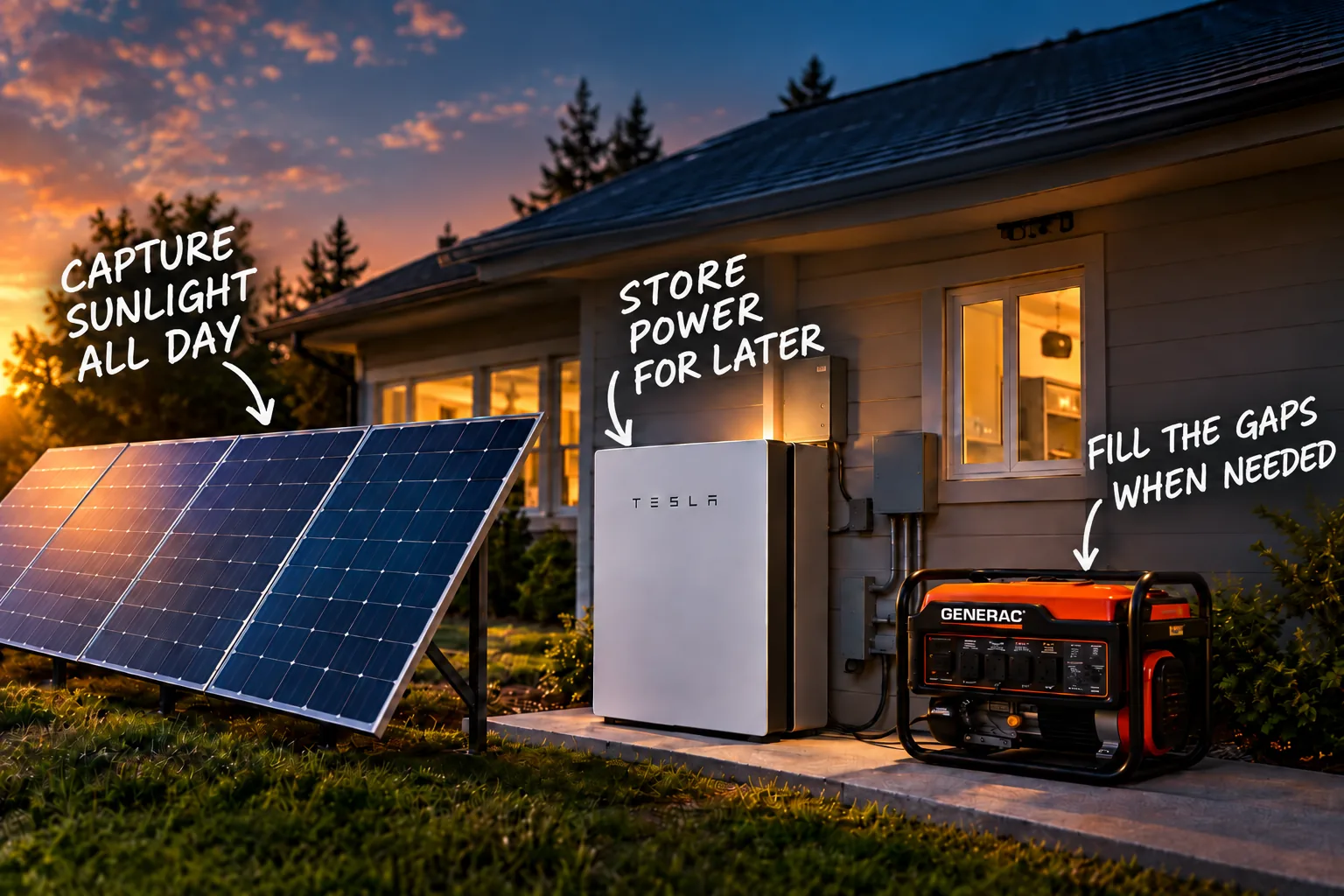
Most backup-power systems are designed around one question: What will keep the lights on when the grid goes down?
For a short outage, the answer may be simple. A portable power station can run a refrigerator, lights, internet equipment, and other essentials for several hours. A generator can keep larger loads running as long as you have fuel. A home battery can switch on almost instantly and operate quietly without exhaust.
Multi-day outages are different.
Once an outage lasts beyond the first night, backup power stops being only a question of how many watts your equipment needs. It becomes an energy-management problem. A battery contains a finite amount of stored energy. Solar panels can replenish that energy, but only when enough sunlight is available. A generator can produce electricity regardless of the weather, but it requires fuel, maintenance, and safe outdoor operation.
That is why one of the most resilient home-backup strategies can be a combination of all three:
battery storage for immediate, quiet backup; solar for daily replenishment; and a generator for the periods when stored energy and sunlight are not enough.
You do not necessarily need all three. The right system depends on your home, budget, essential loads, and the type of outages you are preparing for. But understanding how these technologies can work together makes it much easier to design backup power that lasts more than a few hours.
Quick answer: A battery can carry your home through short outages and overnight periods, solar can recharge the battery during daylight, and a compatible generator can provide additional energy when poor weather or heavy loads create a shortfall. The goal is not necessarily to store several days of electricity at once. It is to keep replacing enough of the energy you use that the battery does not run empty.
Solar, Batteries, and Generators Solve Different Problems
It is tempting to compare batteries, solar panels, and generators as competing backup technologies. In reality, they have very different strengths.
A battery stores energy that is already available. It can respond almost instantly when the grid fails, operate silently, and power a house without producing exhaust. But every battery has a finite capacity measured in kilowatt-hours.
Solar panels generate new electricity when sunlight is available. Solar can power loads directly and replenish batteries, which is what makes it so valuable during a long outage. But solar output changes with weather, time of day, season, shading, orientation, and system design.
A generator creates electricity from fuel. Unlike solar, it does not care whether it is nighttime or cloudy. A properly sized generator can support large loads for as long as an adequate fuel supply remains available. The tradeoffs are fuel cost, noise, exhaust, maintenance, and safe operation.
| Backup source | Major strength | Major limitation |
|---|---|---|
| Battery | Instant, quiet stored power | Finite stored energy |
| Solar | Produces new energy without fuel | Weather- and daylight-dependent |
| Generator | Dispatchable power for long outages | Fuel, noise, exhaust, and maintenance |
| Combined system | Each source covers weaknesses of the others | Higher cost and system complexity |
The U.S. Department of Energy explains that properly configured solar-plus-storage systems can operate in an islanded mode during grid outages, allowing local solar generation and batteries to continue supporting the home after utility power disappears.
Adding a generator creates another layer of redundancy.
If you are still deciding whether a battery or generator makes more sense as your first backup source, see our guide to portable power stations vs. generators.
Think in Both Kilowatts and Kilowatt-Hours
One of the easiest ways to undersize backup power is to confuse power with energy.
Kilowatts, or kW, tell you how much power the system can deliver at one moment.
Kilowatt-hours, or kWh, tell you how much energy is stored or consumed over time.
You need enough of both.
A large battery might contain 20 kWh of stored energy, but if its inverter cannot provide enough instantaneous output to start your central air conditioner or well pump, all that stored energy does not solve the startup problem.
Conversely, a system might provide 10 kW or more of output and comfortably start large equipment, but a small battery underneath it could still be depleted quickly under heavy loads.
This is also where starting watts vs. running watts matter. Motors and compressors can briefly demand much more power when they start than they consume after they are running. Refrigerators, freezers, sump pumps, well pumps, furnace blowers, and central air conditioners all deserve special attention.
For a multi-day backup system, think of it as two separate tests:
- Can the system deliver enough power to operate and start the equipment?
- Does it contain or produce enough energy to keep doing that for as long as you need?
You need to pass both.
Start With the Loads You Actually Need
Before choosing batteries, solar panels, or a generator, decide what the system is expected to power.
There is an enormous difference between backing up:
- Refrigerator and freezer
- Lights
- Internet equipment
- Sump pump
- Gas-furnace blower
- CPAP or other medical equipment
and attempting to operate:
- Central air conditioning
- Electric resistance heat
- Electric water heating
- Electric range
- Clothes dryer
- Hot tub
- EV charging
The first group can often be supported with a reasonably sized essential-load system. The second can require a very large battery bank, inverter, solar array, and generator.
Start with our guide to the essential circuits worth backing up first rather than automatically designing around every circuit in the house.
Medical equipment deserves particularly high priority. If someone in the home relies on a CPAP, BiPAP, oxygen concentrator, or another electrically powered medical device, build those requirements into the system before deciding how much capacity remains for convenience loads. Our guide to backup power for CPAP machines and oxygen concentrators covers that planning in detail.
How Much Battery Capacity Does a Home Need?
There is no useful universal answer such as “every house needs two batteries.”
Start with energy use.
If your selected backup loads consume an average of 8 kWh in one day, then a battery containing 8 kWh of usable energy would theoretically contain roughly one day’s worth of that consumption.
Real systems need additional margin.
Inverter losses, battery reserve settings, standby consumption, temperature, aging, and changing household demand all affect actual runtime. You also generally do not want a resilience plan designed around reaching exactly zero percent charge every morning.
Our Battery Runtime Calculator can help estimate runtime for specific loads, while Battery Runtime Explained covers the factors that make real-world runtime different from simple watt-hour division.
Home-energy monitoring, smart-panel data, and plug-in electricity meters can also help identify where your electricity is going.
Affiliate disclosure: Home Power Matrix may earn a commission from qualifying purchases made through links on this page. This does not affect the price you pay.
For ordinary 120V plug-in equipment, a meter such as the P3 Kill A Watt electricity monitor on Amazon can help measure actual running consumption before you start sizing expensive backup equipment.
The most important point, however, is that once solar or generator charging enters the system, battery capacity is no longer the same thing as outage duration.
A Multi-Day System Does Not Necessarily Need Several Days of Battery Storage
This is the concept that makes hybrid backup power much easier to understand.
Suppose your essential loads consume:
8 kWh per day.
Without any way to recharge, three days of operation would require roughly:
24 kWh of usable energy
before adding reserve capacity and accounting for losses.
Now suppose your solar array produces 6 kWh that can actually be used by the house or stored in the battery during the first outage day.
Your net battery deficit is not 8 kWh.
It is approximately:
8 kWh used − 6 kWh replenished = 2 kWh deficit.
The battery is serving as a bridge between energy production and energy use rather than trying to contain the entire outage in advance.
A multi-day backup system does not necessarily need enough battery capacity to store several days of electricity at once. It needs enough storage to bridge the periods when your available energy sources cannot keep up with your loads.
That distinction can dramatically change how much battery capacity you actually need.
Solar Turns Battery Backup From a Countdown Into an Energy-Balance Problem
Without charging, a battery is essentially a countdown.
You start at 100 percent and move toward zero.
Solar changes that.
During daylight, solar production can power current household loads while excess production recharges the battery. The battery can then take over when solar output falls in the evening.
The cycle can repeat the next day.
A properly designed solar-and-battery system can therefore maintain essential loads much longer than battery capacity alone would suggest.
But that does not mean a solar array guarantees indefinite backup.
The system still needs to balance:
energy consumed versus energy generated.
If you consume 10 kWh per day but poor weather limits usable solar production to 3 kWh per day, you are losing roughly 7 kWh of stored energy each day.
Eventually, the battery runs out.
That is where the third layer becomes valuable.
Our guide to using solar panels during a power outage explains why normal grid-tied solar often shuts down when the utility fails and what equipment is required for outage operation.
Do Not Size Outage Solar From the Number on the Panel
An 8 kW solar array is not an 8 kW generator that produces full rated output whenever the sun is visible.
Actual solar production changes throughout the day and across the year.
Important factors include:
- Cloud cover
- Winter versus summer sunlight
- Roof orientation
- Panel angle
- Tree and building shade
- Snow accumulation
- Panel temperature
- Inverter limitations
- System losses
- How much of the array remains available while the home is islanded
The Department of Energy notes that solar production can vary because of season, time of day, clouds, rain, snow, dirt, and shading. Storage helps bridge the mismatch between when solar electricity is generated and when a home needs it.
For outage planning, the important number is not merely the array’s nameplate wattage.
It is the energy the system is realistically likely to produce during the conditions when you expect to need it.
A system that performs beautifully during a clear June afternoon may behave very differently during a cloudy January outage.
Serious resilience planning should therefore include a poor-production scenario rather than relying exclusively on annual-average solar output.
Rooftop Solar vs. Ground-Mounted Solar for Backup
Both can be part of an effective backup system.
Rooftop panels use space that would otherwise sit unused and are the most common residential approach.
Ground-mounted arrays can offer advantages when the property has enough space. They may allow better orientation toward the sun, easier access for maintenance and snow removal, and more flexibility when expanding the array.
The tradeoff is additional land use, trenching, racking, and installation cost.
Solar trackers can increase energy harvest in certain installations by moving panels to follow the sun, but they add mechanical complexity and cost. For most residential backup systems, fixed rooftop or ground-mounted arrays are the more straightforward design.
For resilience, system simplicity and reliable production usually matter more than squeezing every theoretical watt out of the array.
What Happens When You Get Several Cloudy Days?
This is where batteries and solar reveal their shared weakness.
A battery can store electricity but cannot create it.
Solar can create electricity but cannot guarantee when enough sunlight will be available.
A multi-day storm can therefore produce the exact situation that makes a hybrid system valuable: the grid is down at the same time that solar production is unusually poor.
If the battery continues losing more energy each day than the solar array replaces, you eventually need another source.
That source can be a generator.
The Generator Becomes the Weather-Independent Backup Layer
A generator does not need to be the primary source of electricity in a hybrid system.
In many designs, it is more useful as the last line of defense.
The battery can provide immediate backup when the grid fails. Solar can support the home and replenish storage whenever conditions allow. The generator can remain off until battery state of charge falls too far, solar production remains inadequate, or household demand exceeds what the battery system can comfortably provide.
Current home-energy systems are increasingly designed around this layered approach.
Generac describes a home-energy architecture combining solar, battery storage, and a standby generator. In compatible configurations, the generator can support the home and replenish battery storage when needed.
Enphase also supports generator integration with compatible Enphase Energy System configurations, including systems where generator power can support home loads and battery charging.
Some newer battery platforms are also designed around multiple charging sources rather than one fixed source.
The principle is straightforward:
Use stored energy when it is convenient, replenish from the sun when it is available, and burn fuel when you actually need it.
Why You Might Not Want the Generator Running 24 Hours a Day
Suppose your home needs only 400 or 500 watts overnight for refrigeration, internet equipment, lighting, electronics, and other small loads.
Running a large generator continuously just to serve that light load may be noisy, maintenance-intensive, and inefficient.
A battery can handle those smaller overnight loads silently.
Then the generator can operate during a shorter period when it has something substantial to do: support household loads and, where the battery system permits it, replenish storage.
Once the battery has recovered, the generator can shut down again.
This does not mean every generator-and-battery combination automatically saves fuel. Charging losses exist, inverter losses exist, and generator efficiency varies with load.
But a properly integrated hybrid system can reduce generator operating hours and give homeowners much more control over when the engine needs to run.
Potential benefits include:
- Less nighttime generator noise
- Fewer engine hours
- Longer intervals between maintenance
- More flexibility over fuel use
- Quiet battery operation during low-load periods
Not Every Home Battery Can Be Charged From a Generator
This is one of the most important details in the entire article.
Do not assume that because your home has a generator and battery, the generator can simply recharge the battery.
System architecture matters.
Tesla Powerwall is a good example.
Tesla allows Powerwall to coexist with a backup generator through appropriate transfer equipment, but Tesla says Powerwall and the generator are not directly integrated and the generator does not charge Powerwall.
During an outage, Powerwall responds first. The generator can later serve the home when Powerwall reaches a low charge or when household demand exceeds the Powerwall system’s available output.
So this may be supported:
Generator → home loads
while this is not:
Generator → Powerwall recharge
Other battery systems use different architectures.
Before buying equipment, verify:
- Whether the generator is officially supported
- Whether the generator can charge the battery
- Maximum generator charging power
- Automatic-start support
- Required transfer equipment
- Voltage and waveform requirements
- How the system behaves at minimum battery state of charge
A collection of compatible-looking equipment is not automatically an integrated energy system.
Portable Hybrid Systems Can Follow the Same Basic Strategy
You do not need permanently installed whole-home batteries to benefit from the same architecture.
A smaller system might consist of:
portable power station + portable solar panels + portable generator.
A large expandable platform such as the Anker SOLIX F3800 on Amazon illustrates this category well. It starts with several kilowatt-hours of battery storage, supports high-output 120/240V applications, and can be expanded with additional batteries.
Other large portable or semi-permanent ecosystems include the EcoFlow DELTA Pro Ultra on Amazon and Jackery Explorer 5000 Plus on Amazon.
These systems occupy an interesting middle ground. They can provide far more output and storage than a small camping battery but do not necessarily require homeowners to begin with a permanently installed whole-home system.
That can be attractive if you want to build capacity gradually.
Our guide to what a 2,000-watt portable power station can run explains the same output-versus-capacity distinction on a smaller scale.
Portable Solar Can Extend a Power Station’s Runtime
For portable systems, folding or movable solar panels can provide the replenishment layer.
A 400-watt-class panel is not going to replace a large rooftop array, but it can make a meaningful difference when the loads are modest and an outage lasts several days.
Homeowners comparing that type of setup can browse Renogy 400W portable solar panels on Amazon.
The important word is compatible.
Before connecting third-party solar panels to a power station, confirm:
- Maximum solar input voltage
- Maximum input current
- Connector type
- Series and parallel limits
- The power station manufacturer’s supported input range
Do not buy solar panels solely because the advertised wattage sounds appropriate.
Voltage limits matter just as much as watts.
Whole-Home Systems Require More Than a Giant Battery
A whole-home battery system is not simply a portable power station scaled upward.
The design may involve:
- One or more battery cabinets
- A grid-forming inverter
- Solar inverter or microinverters
- Automatic transfer equipment
- Smart load management
- Critical-load or whole-home panels
- Generator integration
- Utility interconnection
- Energy-management software
At this scale, professional system design matters.
The inverter needs enough continuous and temporary output for the loads you intend to operate, while the battery bank needs enough usable energy to bridge low-production periods.
If you are comparing installed storage architectures, our guide to home battery backup systems provides a broader overview.
Central Air Conditioning Can Dominate the Power Side of the Design
A central air conditioner is a perfect example of why battery capacity is only half the problem.
A home may contain enough stored energy to operate the air conditioner for several hours, but the compressor’s starting current can still exceed the inverter or generator’s temporary capability.
Installing a properly matched soft starter can significantly reduce compressor startup demand on compatible equipment.
That can make it easier for a generator or battery inverter to start the air conditioner while leaving more surge headroom for a refrigerator, freezer, sump pump, or other motor that happens to start nearby.
Our guide to air-conditioner soft starts explains how that works.
One product homeowners commonly compare is the Micro-Air EasyStart FLEX on Amazon. An HVAC professional should confirm compressor type, voltage, existing start components, and product compatibility before installation.
A soft starter does not eliminate the air conditioner’s normal running demand. If the AC consumes several kilowatts while operating, the backup system still needs enough continuous power and stored or generated energy to support it.
A Worked Three-Day Outage Example
Consider an illustrative essential-load system with:
15 kWh of usable battery storage
and household backup loads consuming approximately:
8 kWh per day.
Those loads might include refrigeration, a sump pump, gas-furnace blower, lights, internet equipment, electronics, a CPAP machine, and intermittent kitchen loads.
The figures below are simplified to make the energy flow easy to follow. A real system would also need margin for inverter losses, charging losses, reserve settings, battery temperature, and changing loads.
| Day | Household use | Solar contribution | Generator contribution | Net battery change | Battery at end of day |
|---|---|---|---|---|---|
| Starting point | — | — | — | — | 15 kWh |
| Day 1: Good solar | 8 kWh | 6 kWh | 0 kWh | −2 kWh | 13 kWh |
| Day 2: Heavy clouds | 8 kWh | 1 kWh | 0 kWh | −7 kWh | 6 kWh |
| Day 3: Generator support | 8 kWh | 4 kWh | 6 kWh | +2 kWh | 8 kWh |
Day 1 is easy. The house consumes 8 kWh while solar replaces 6 kWh, so the battery loses only 2 kWh.
Day 2 is the problem. Heavy clouds reduce solar production to 1 kWh, creating a 7 kWh deficit and dropping the battery to 6 kWh.
On Day 3, the generator operates long enough to provide 6 kWh of useful energy through a system designed to accept generator charging. Solar contributes another 4 kWh while the home consumes 8 kWh. The battery therefore gains approximately 2 kWh during the day and finishes at 8 kWh.
Instead of operating the generator continuously for three days, this hypothetical system needed fuel-backed support only after poor solar production created a meaningful energy deficit.
The generator does not have to replace solar and batteries. In a compatible hybrid system, it can fill the gaps they cannot cover.
Example Backup System Tiers
The right architecture depends much more on the loads you expect to support than on the number of bedrooms in the house.
| System type | Typical loads | Battery/solar approach | Generator role |
|---|---|---|---|
| Essential-load starter system | Refrigerator, freezer, lights, router, CPAP, charging, gas-furnace blower | Portable or expandable battery with modest solar input | Emergency recharge or extended bad-weather backup |
| Extended-outage essential system | Starter loads plus sump pump, well pump, more refrigeration, limited cooking | Larger battery bank, meaningful solar array, 120/240V capability where required | Periodic battery charging and high-load support |
| Whole-home resilience system | HVAC, pumps, kitchen loads, water heating, other major circuits | Large installed batteries, substantial solar, automatic load management | Automatic or manual long-duration fallback |
The important lesson is that a system designed for essential loads can provide much longer runtime from the same amount of battery and solar than one attempting to recreate normal unlimited grid use.
For examples of individual outage loads, see our guides to keeping a sump pump running during an outage, refrigerator and freezer backup, and running an electric furnace from a generator.
Load Management Can Be Cheaper Than More Battery
This is one of the most underappreciated parts of backup-system design.
Suppose your home theoretically needs an enormous inverter because every large appliance could operate at the same time.
You may not actually need to support that scenario.
A smart load-management system can temporarily disable or postpone nonessential circuits when major loads need power.
For example:
- Do not run the clothes dryer while central AC is starting.
- Pause EV charging during an outage.
- Delay electric water heating when battery state of charge is low.
- Prioritize the well pump and sump pump.
- Reduce HVAC demand overnight.
- Stagger motor-driven loads instead of allowing several large startup surges together.
Every kilowatt you avoid using is capacity you do not need to buy.
Every kilowatt-hour you conserve is stored energy that remains available later.
Before increasing generator size automatically, use our Generator Size Calculator to estimate the loads you actually intend to operate together.
Solar and Batteries Can Provide Value When the Grid Is Working
A generator usually provides little financial benefit while utility power is operating.
It waits for an outage.
Solar and batteries can be different.
Solar can reduce the amount of electricity purchased from the utility, while batteries may be able to store excess solar or inexpensive grid electricity for later use.
Some systems can also respond to time-of-use electricity pricing.
Tesla, for example, says Powerwall can charge from the grid under supported configurations, including situations where maintaining backup reserve or electricity-price optimization makes grid charging useful.
Whether that actually saves enough money to justify a battery is highly location-dependent.
Electricity rates, solar production, net-metering rules, time-of-use pricing, incentives, system cost, and household consumption all matter.
Backup resilience can be valuable even when the financial payback calculation alone does not justify the system.
Tesla Solar and Powerwall: Where They Fit
Tesla Powerwall is a useful example of solar-plus-storage operating as one coordinated system.
Powerwall can store solar energy during normal operation and continue using properly configured solar during an outage. Powerwall 3 integrates a solar inverter into the battery architecture.
Where homeowners need to be careful is generator integration.
Tesla supports installing Powerwall in a home that also has a backup generator, but the generator does not directly charge Powerwall.
That means Tesla Solar + Powerwall + generator can still provide layered resilience, but it does not behave the same way as a system specifically designed for generator-to-battery charging.
That distinction matters enormously when your goal is surviving several cloudy days without the grid.
What About Plug-In Solar?
Plug-in or balcony solar occupies a very different part of the market.
These systems are designed primarily to feed modest amounts of solar power into a home’s electrical system and reduce ordinary grid consumption where they are permitted.
They should not be confused with a professionally designed, islandable solar-and-battery backup system.
A normal grid-connected solar system must disconnect from the utility during an outage unless it includes equipment specifically designed to safely establish an independent local electrical system.
Our guide to plug-in solar panels and where they are legal covers this emerging category in detail.
If multi-day outage resilience is the objective, the important question is not merely:
Do I own solar panels?
It is:
Can my solar system actually operate when the grid is down, and can it recharge my backup batteries while islanded?
Those are very different questions.
Gasoline, Propane, or Natural Gas?
The generator layer also needs to match the outage you are preparing for.
Gasoline
Portable gasoline generators are widely available and can deliver substantial power for relatively little upfront cost.
The problem during extended outages is fuel.
Gasoline must be stored safely, rotated, and replenished, and a major regional outage can affect local fuel availability.
Propane
Propane stores well and is a popular option for both portable and standby generators.
Larger stationary tanks can provide substantial runtime without the same fuel-aging concerns as gasoline.
Natural gas
A permanently installed standby generator connected to utility natural gas can potentially operate for long periods without homeowners manually refueling it.
But natural gas is still an external utility service, and generator fuel consumption can become significant under heavy load.
Dual-fuel and tri-fuel generators
Fuel flexibility can be valuable for preparedness because the system is not dependent on one fuel source.
Homeowners considering that approach can compare models such as the Westinghouse WGen11500TFc tri-fuel generator on Amazon, while keeping in mind that the correct generator size depends on your actual load and charging requirements.
Our Fuel Runtime Calculator can help estimate how quickly a generator may consume stored fuel.
What About a Dedicated Battery Room?
Large amounts of storage do not mean homeowners should simply start stacking batteries in an unused basement room.
Modern home-energy storage equipment has manufacturer requirements for mounting, spacing, temperature, ventilation where applicable, electrical protection, and installation location. Local electrical and fire codes can also affect what is permitted.
Some batteries are designed for indoor installation, some for outdoor installation, and some support either when their installation requirements are met.
Large permanently installed storage systems should be designed and installed by qualified professionals.
A dedicated energy-storage area may make sense in some homes.
A homemade room full of randomly interconnected lithium batteries is not the same thing.
Generator Safety Still Applies in a Hybrid System
Adding sophisticated batteries and solar does not make a combustion generator harmless.
Portable generators produce carbon monoxide.
The U.S. Consumer Product Safety Commission says portable generators should be operated outdoors only, at least 20 feet away from the home, with exhaust directed away from the building. Maintain working carbon-monoxide alarms on every level of the home and outside sleeping areas.
Never operate a portable generator in a garage, basement, shed, crawlspace, or other enclosed area.
A generator supplying household circuits also needs proper transfer equipment.
Never backfeed a house through a receptacle.
A hybrid home-energy system needs to control which source is connected to which loads and ensure that the home is safely isolated from the utility grid during an outage.
The fact that a generator plug physically fits into something is not proof that the electrical architecture is safe or supported.
How to Build Your System in the Right Order
If you are starting from scratch, approach the project in this order:
- Measure your important loads. Determine both running energy consumption and startup demand.
- Choose your critical circuits. Decide what genuinely needs to operate during a long outage.
- Estimate daily energy consumption. Work in kilowatt-hours, not just watts.
- Choose enough battery capacity to bridge realistic low-production periods.
- Size the inverter for running loads and starting surges.
- Add enough solar to replace a meaningful share of your daily consumption.
- Model poor solar days, not just perfect ones.
- Choose a generator strategy for the remaining energy deficit.
- Verify that the battery, generator, inverter, and transfer equipment are actually compatible.
- Add load management before automatically buying more capacity.
That process usually produces a more sensible system than starting with the largest battery, generator, or solar array you can afford and hoping the pieces work together later.
Which Type of Backup System Makes Sense for You?
You mostly experience short outages
A portable power station or modest home battery may be enough.
Solar can be useful, but it may not be necessary solely for outage preparedness if outages are brief.
You regularly experience outages lasting a day or more
Battery storage becomes much more useful when paired with solar because some of the energy can be replenished during the outage.
A portable generator can provide another layer of redundancy when sunlight is poor.
You are preparing for multi-day outages
This is where the three-layer architecture becomes particularly compelling:
battery + solar + fuel-backed generation.
You are no longer betting the entire house on one finite battery, one weather-dependent source, or one fuel supply.
You have critical medical, water, heating, or flood-control loads
Design around those loads first.
A system that keeps the television and kitchen outlets running but allows a sump pump, well pump, furnace, or medical device to fail is not resilient simply because it contains a large battery.
Redundancy matters more when the consequences of losing power are more serious.
You Do Not Need to Build the Entire System at Once
Another advantage of a layered strategy is that it can often be built over time.
A homeowner might begin with:
portable battery backup
then add:
solar charging
and later add:
a generator or larger battery bank.
Another homeowner may already own a generator and later install solar and storage to reduce how often the engine needs to run.
Others may begin with rooftop solar for everyday energy savings and add batteries when outage protection becomes a priority.
The important part is planning future compatibility before purchasing the first component.
The Bottom Line
There is no single backup-power technology that is perfect for every outage.
A generator can produce large amounts of electricity for a long time, but it depends on fuel and creates noise, exhaust, and maintenance requirements.
A battery is quiet, automatic, and convenient, but stored energy eventually runs out.
Solar can replenish that energy without fuel, but sunlight is not guaranteed.
Put the right versions of all three together, and the system becomes much harder to defeat.
The battery carries the house when immediate, quiet power is needed. Solar replaces energy whenever the weather cooperates. The generator covers the periods when consumption exceeds what the sun and batteries can provide.
The goal is not necessarily to purchase enough batteries to power the entire house for a week with no outside energy.
The smarter goal is to build a system where the batteries rarely have to do that.
A well-designed multi-day backup system manages power, stored energy, replenishment, and load priority as one system.
And that is ultimately what turns backup power from a temporary emergency supply into genuine home-energy resilience.
Frequently Asked Questions
Can solar panels and a generator charge the same home battery?
Sometimes. It depends on the battery system and its approved architecture. Some systems support generator-assisted battery charging, while others do not. Tesla Powerwall can coexist with a generator but does not charge directly from it.
How much battery storage do I need for a three-day outage?
It depends on how much energy your essential loads consume and how much energy can be replenished during the outage. If your loads consume 8 kWh per day, three days with no charging would require roughly 24 kWh before accounting for losses and reserve margin. If solar replaces much of that energy each day, the required battery capacity can be substantially lower.
Can solar panels power my home when the grid is down?
Only if the system is designed for outage operation. Ordinary grid-tied solar generally shuts down when utility power fails. An island-capable system with appropriate inverter, transfer, and storage equipment can continue operating independently of the grid.
Is a home battery better than a generator?
They solve different problems. Batteries are quiet, automatic, and require no fuel while operating, while generators can continue producing electricity as long as an adequate fuel supply remains available. Combining them can provide greater resilience than relying exclusively on either one.
Can I run a generator only to recharge batteries?
Some systems support this strategy, and it can reduce the number of hours the generator needs to operate. However, the battery system must explicitly support generator charging, and generator sizing, charge rate, efficiency, and transfer equipment all matter.
Does a bigger battery mean I can run bigger appliances?
Not necessarily. Battery capacity in kilowatt-hours determines stored energy. Inverter output in kilowatts determines how much power can be delivered at once. A system can contain plenty of energy but still be unable to start a large compressor or motor.
Do I need whole-home backup?
No. Backing up essential circuits can dramatically reduce battery, generator, inverter, and solar requirements. Refrigeration, water, heating, medical equipment, communications, and basic lighting may matter much more during an outage than high-demand convenience loads.
Can I add a generator later?
Often, but generator integration should be considered when choosing the original battery architecture. Some systems make generator integration relatively straightforward, while others require specific transfer equipment or do not support generator charging.
Is solar plus battery plus generator worth it?
For homeowners who experience long outages, have critical electrical loads, or want very high energy resilience, the combination can be compelling. For someone who experiences only occasional short outages, a simpler and less expensive system may make more financial sense.