

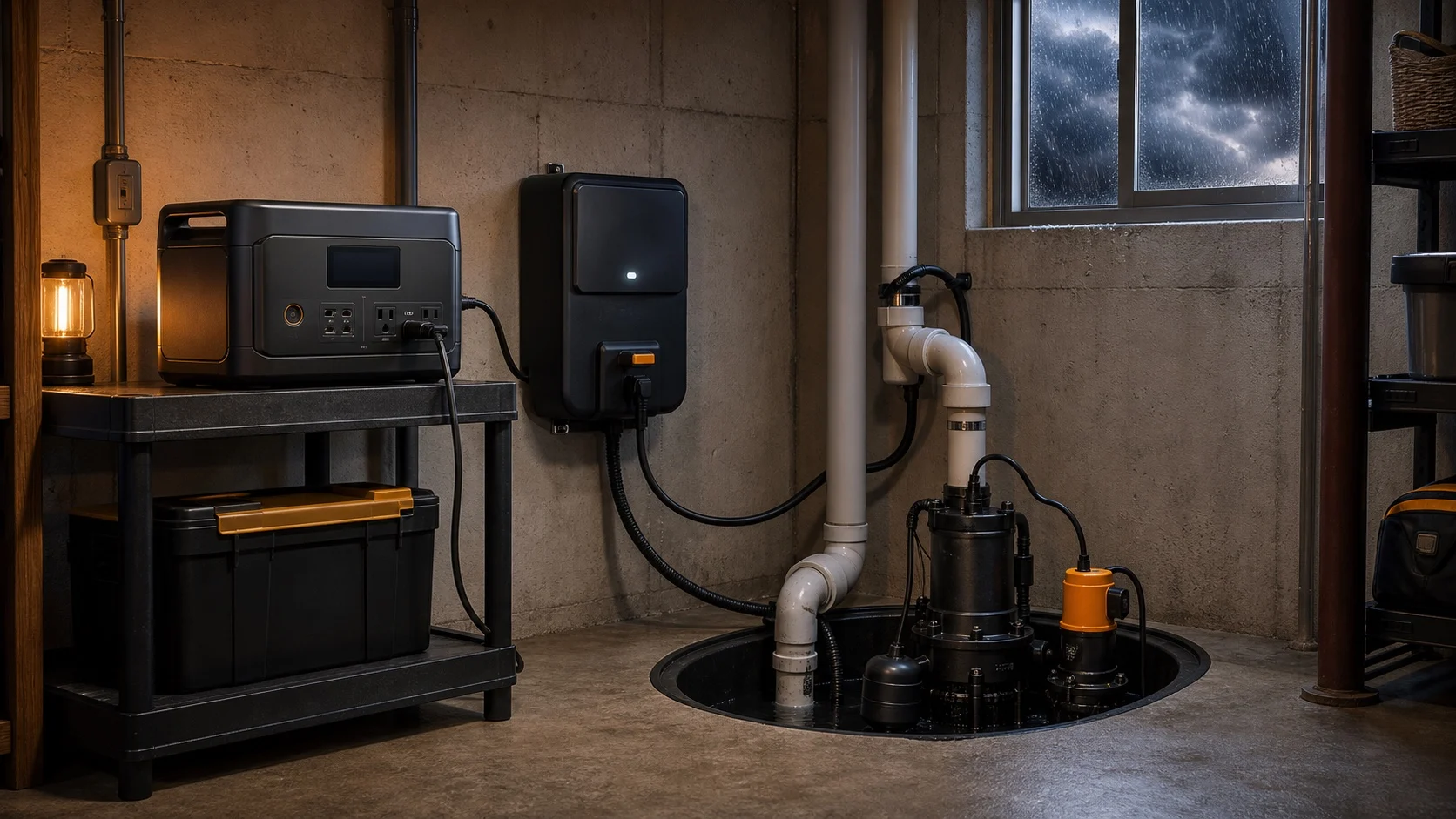
A power outage is inconvenient when the lights go dark. It can become expensive very quickly when the same storm that knocked out the power is also sending water toward your foundation.
A sump pump cannot protect the basement without electricity. The safest backup plan is usually not one oversized battery or a generator you hope to find and start after the rain begins. It is a layered system that can start automatically, handle the pump’s startup surge, and keep moving water for the conditions your home actually experiences.
This guide explains how to keep a sump pump running during a power outage with a dedicated battery-backup pump, portable power station, generator, water-powered backup, or a combination of systems. It also explains how to estimate runtime without pretending that a sump pump draws constant power all day.
Quick answer: For automatic protection, install a separate battery- or water-powered backup sump pump with its own float switch. A properly sized portable power station can keep an existing AC pump operating through shorter outages, while a generator is better suited to long outages and heavy pumping. The strongest plan combines automatic short-term backup with a tested way to recharge or provide longer-duration power.
Why Sump Pump Backup Power Is Different
A refrigerator can usually remain closed for a while. A sump basin does not stop filling because the utility is having a bad afternoon.
Sump-pump backup is unusually demanding for four reasons:
-
The outage and the water may arrive together. Thunderstorms, hurricanes, ice storms, and saturated ground can increase drainage while interrupting utility power.
-
The pump has a motor. Motors can require a brief startup surge substantially higher than their normal running wattage.
-
The load cycles. A pump may run for seconds or minutes, stop, and restart repeatedly. Runtime depends on how often it cycles, not only its nameplate wattage.
-
The system may need to work while nobody is home. A manual generator is useful only when someone can safely start, connect, fuel, and monitor it.
That is why a good plan separates two questions:
-
What will start automatically when the power fails?
-
What will sustain pumping if the outage lasts longer than the first backup source?
Sump Pump Backup Options at a Glance
| Backup option | Starts automatically? | Best use | Main limitation |
|---|---|---|---|
| Dedicated battery-backup pump | Usually | Immediate protection and primary-pump failure | Limited battery energy and pumping capacity |
| Portable power station | Sometimes | Quiet indoor power for the existing AC pump | Must handle startup surge and automatic-transfer behavior |
| Portable generator | No | Long outages and multiple household loads | Manual setup, fuel, noise, weather, and carbon monoxide risk |
| Standby generator | Yes | Automatic, long-duration home backup | High installation and maintenance cost |
| Water-powered backup pump | Usually | Long backup with municipal water service | Uses potable water and is not suitable for every home |
No single option is universally best. The right choice depends on the pump, water-inflow rate, expected outage duration, utility-water availability, budget, and whether automatic operation is essential.
Start With Your Sump Pump’s Actual Power Requirements
Do not size backup power from horsepower alone. Two pumps labeled with the same horsepower can have different current draw, starting behavior, flow rate, and performance at a given discharge height.
Check the pump nameplate and manual for:
-
Voltage
-
Running amps
-
Maximum or starting amps, if published
-
Horsepower
-
Required branch-circuit rating
-
Gallons per hour at your approximate pumping height
For a 120-volt pump, a rough estimate of running watts is:
Volts × running amps = apparent watts
This is useful for planning, but it is not a perfect measurement of real power for an AC motor. The manufacturer’s wattage data or an appropriate meter provides a better figure. Never measure equipment around a wet sump pit using improvised connections.
Starting Watts Matter as Much as Running Watts
A power source can contain enough stored energy to run a pump for hours and still fail the instant the motor tries to start. That happens when the inverter or generator cannot provide the brief surge demanded by the motor.
When comparing a portable power station or generator, verify both:
-
Continuous output: enough for the pump while it is running
-
Surge output: enough to start the motor reliably
Marketing features that temporarily boost inverter output do not always behave like true surge capacity, especially with motor loads. The safest evidence is manufacturer compatibility guidance or a real test with the exact pump.
Use the Generator Size Calculator when the sump pump will share a generator with refrigeration, a furnace blower, a well pump, or other household loads.
How Long Will Backup Power Run a Sump Pump?
The wrong way to estimate runtime is to divide battery watt-hours by the pump’s running watts and stop there. That calculation assumes continuous operation. Most sump pumps cycle.
A more useful estimate considers:
-
Usable battery capacity
-
Inverter and standby losses
-
Pump running wattage
-
Minutes of pumping per hour
-
Changing groundwater conditions
-
Battery temperature and age
Suppose a pump draws 800 watts but runs for a total of 10 minutes each hour:
800 watts × 10/60 hour = about 133 watt-hours per hour
A nominal 1,024Wh power station might appear to provide more than seven hours at that duty cycle before accounting for inverter losses, reserve capacity, and the power station’s own consumption. If the pump begins running for 30 minutes per hour, the same battery can be depleted roughly three times faster.
The cycling rate you observe on a dry afternoon is not a safe basis for a once-in-a-decade storm. Watch how quickly the basin fills during heavy rain, then plan conservatively.
Use the Home Power Matrix Sump Pump Backup Calculator to compare battery capacity, pumping frequency, generator demand, and target outage duration. For general battery loads, see Battery Runtime Explained.
Option 1: Dedicated Battery-Backup Sump Pump
A dedicated battery-backup system normally adds a second low-voltage pump, separate float switch, charger, controller, alarm, and deep-cycle battery. The backup float is positioned above the primary pump’s normal activation level. If the primary pump loses power, fails mechanically, or cannot keep up, the rising water activates the backup pump.
Pump manufacturer Liberty Pumps describes backup sump pumps as secondary pumps for power outages or primary-pump failure and offers both battery- and water-powered designs.
Advantages
-
Automatic operation
-
Protection when the primary pump fails even if utility power remains on
-
Separate pump, float switch, and control system
-
Audible alarms on many systems
-
No fuel, exhaust, or outdoor setup
-
Lower cost than a standby generator
Limitations
-
Backup pumps may move less water than the primary pump
-
Runtime depends on battery condition and pumping frequency
-
Lead-acid batteries require inspection and periodic replacement
-
The basin must have room for the second pump and floats
-
A shared discharge pipe can still become a single point of failure
A dedicated backup pump is usually the best first layer because it responds without waiting for a person, an app notification, or a generator. It should be sized against the home’s actual water inflow and discharge head—not selected solely because the box says “backup.”
One high-capacity example is the Basement Watchdog Big Dog CONNECT BWD12-120C. Its published rating is 3,500 GPH at zero lift and 2,200 GPH at a 10-foot lift, and it includes a dual float switch, 20-amp charger, automatic weekly pump testing, and monitoring with optional Wi-Fi alerts. The required battery is sold separately, and the system still needs to be checked against your basin size, discharge height, and water inflow.
View the Basement Watchdog Big Dog CONNECT on Amazon
Compare additional battery-backup sump pump systems on Amazon
Option 2: Portable Power Station
A portable power station uses a rechargeable battery and inverter to provide standard AC power. It can keep the existing 120-volt sump pump operating without fuel or indoor exhaust.
This can be an excellent short- or medium-duration solution when the unit has:
-
Enough continuous inverter output
-
Enough motor-starting surge capacity
-
A pure-sine-wave AC output
-
Sufficient stored energy for the expected duty cycle
-
Acceptable transfer time and backup behavior
-
A safe, dry, elevated location
Do Not Assume Every EPS or UPS Mode Will Work
Some power stations can remain connected between a wall outlet and the pump, then switch to battery when utility power fails. Manufacturers may call this UPS, EPS, pass-through, or backup mode.
Those terms do not guarantee sump-pump compatibility. Verify:
-
Whether the AC output stays enabled during an outage
-
The transfer time
-
Whether the inverter can start the pump while operating in backup mode
-
Whether long-term plugged-in operation is supported
-
Whether automatic shutdown or energy-saving settings can disable the outlet
Test the complete setup by safely disconnecting utility power and allowing the pump to cycle several times. A glowing display and a successful phone charge prove almost nothing about motor-starting performance.
Portable Power Station Limitations
A power station keeps the primary pump alive but does not create a second pump. It cannot protect against a seized motor, failed float switch, blocked intake, damaged discharge line, or pump capacity that is too low for the inflow.
For that reason, a power station is strongest when paired with a separate backup pump or high-water alarm.
For a larger AC pump, the EcoFlow DELTA 2 Max is one power station worth comparing. It provides 2,400 watts of continuous AC output, a 4,800-watt surge rating, and 2,048Wh of battery capacity, with expansion available when a longer runtime is required. Those specifications make it a credible candidate for many residential pumps, but they are not a compatibility guarantee: verify the pump nameplate and test several real startup cycles before relying on it.
View the EcoFlow DELTA 2 Max on Amazon
Compare additional portable power stations for motor loads on Amazon
Option 3: Portable or Standby Generator
A generator can provide far more energy than a practical battery if fuel remains available. It can run the sump pump while also supporting refrigeration, heating equipment, lights, and other essential household circuits.
Portable Generator
A portable generator is often the most economical long-duration option, but it is not automatic. Someone must be present to operate it, and the backup pump or battery must protect the basement until the generator is running.
The Champion 200988 4,500-watt dual-fuel inverter generator is a practical example for a 120-volt sump pump plus selected household essentials. It provides 3,500 running watts on gasoline, electric start, gasoline-or-propane operation, and inverter output. Confirm the pump surge, total simultaneous load, cord requirements, and the generator’s lower output when operating on propane before buying.
View the Champion 200988 dual-fuel inverter generator on Amazon
The generator must handle the pump’s starting surge and any simultaneous loads. Use a heavy-duty outdoor extension cord with the gauge and length required by the pump and generator manufacturers, or approved transfer equipment installed for home backup. Never energize household wiring through a dryer outlet or other receptacle.
Carbon monoxide warning: Never operate a portable generator inside a home, basement, garage, shed, porch, or carport. The U.S. Consumer Product Safety Commission says to operate portable generators outside only, at least 20 feet from the home, with the exhaust directed away from the house. Maintain working carbon-monoxide alarms on every level and outside sleeping areas.
See How to Choose the Right Generator for Your Home for fuel, wattage, noise, THD, and connection guidance.
Standby Generator
A permanently installed standby generator can start automatically and power selected circuits or much of the home through an automatic transfer switch. It offers the strongest generator-based protection when nobody is home, but installation, fuel supply, placement, testing, and maintenance require professional planning.
A standby generator is not a substitute for maintaining the sump pump. It also benefits from a separate high-water alarm or backup pump in case the generator or primary pump fails.
Option 4: Water-Powered Backup Sump Pump
A water-powered backup pump uses pressure from a municipal water supply to create suction and remove water from the sump basin. It requires no large battery and can continue operating through a long electrical outage as long as municipal water pressure remains available.
Water-powered systems can be compelling for homes that:
-
Have reliable municipal water rather than a private well
-
Maintain adequate water pressure during outages
-
Permit this equipment under local plumbing rules
-
Have an approved backflow-prevention arrangement
-
Can tolerate the potable-water consumption
They are generally unsuitable for homes whose well pump also loses power. Pumping capacity, supply pressure, water usage, discharge routing, and plumbing requirements vary by model. Use a qualified plumber and follow local codes.
Can You Use a Computer UPS for a Sump Pump?
Usually, this is a bad idea.
Most desktop UPS units are designed for computers, networking equipment, and brief shutdown time—not high-inrush pump motors or hours of storm protection. A UPS may have insufficient surge output, a small battery, a stepped approximation to a sine wave, or overload behavior that causes it to shut down immediately.
Use equipment whose manufacturer explicitly supports the pump’s electrical demand and motor load. Do not infer suitability from the number of outlets or a wattage printed on the front.
The Best Sump Pump Backup Plan Is Layered
A layered plan prevents one failed component from turning into a flooded basement.
Basic Plan
-
Reliable primary sump pump
-
Battery-powered high-water alarm
-
Clear discharge line with a working check valve
-
A written response plan
This is better than nothing, but it still depends on someone receiving the alarm and restoring pumping quickly.
Strong Automatic Plan
-
Primary AC sump pump
-
Dedicated battery- or water-powered backup pump
-
Separate float switch
-
Local alarm and remote notification
-
Regular testing under realistic conditions
Strong Long-Outage Plan
-
Automatic backup pump for immediate protection
-
Portable power station or standby generator for automatic AC backup
-
Portable generator for extended runtime and battery recharging
-
Stored fuel and safe outdoor operating location
-
Load plan covering the sump pump and other essentials
The portable generator does not need to run continuously if an automatic battery system can bridge the quiet periods. It can operate the pump during heavy inflow, recharge the battery, and support other critical loads before shutting down again.
Sump Pump Backup Installation Checklist
-
Record the primary pump’s model, voltage, running amps, and startup information.
-
Measure the sump basin and confirm space for a second pump and independent floats.
-
Estimate the vertical lift and discharge-pipe length.
-
Observe pump cycling during heavy rain.
-
Calculate the required backup capacity with conservative assumptions.
-
Place batteries, controllers, outlets, and power stations above potential water levels.
-
Confirm that cords, plugs, receptacles, and ground-fault protection meet manufacturer instructions and local requirements.
-
Install a battery-powered high-water alarm even if the backup system includes an alarm.
-
Label the primary and backup circuits, plugs, valves, and test controls.
-
Test utility failure, primary-pump failure, high-water activation, alarms, and generator operation.
-
Write down battery replacement dates and maintenance intervals.
-
Repeat testing before storm season and after any plumbing or electrical work.
Anything involving permanent wiring, new receptacles, transfer equipment, or plumbing modifications should be completed or reviewed by qualified professionals as required by local codes.
Frequently Asked Questions
What size portable power station do I need for a sump pump?
Choose a power station whose continuous output exceeds the pump’s running demand and whose surge rating can start the motor. Capacity should be sized from the pump’s wattage, minutes of operation per hour, expected outage length, inverter losses, and a safety reserve. Test the exact combination before relying on it.
How long will a battery run a sump pump?
Runtime can range from a few hours to more than a day because pumping frequency varies enormously. A pump running five minutes per hour uses roughly one-sixth as much energy as the same pump running 30 minutes per hour. Battery capacity, inverter losses, temperature, battery age, and standby consumption also matter.
Can a 1,000-watt power station run a sump pump?
Possibly, but the 1,000-watt label may describe either inverter output or battery capacity, which are different. Many pumps demand more than 1,000 watts briefly during startup. Verify continuous output, surge output, battery watt-hours, and the exact pump specifications.
Can I plug a sump pump directly into a generator?
Yes, when the generator and a properly rated outdoor extension cord can handle the pump’s running and starting demand. Keep every connection dry and follow both manufacturers’ instructions. Operate the generator outdoors at least 20 feet from the home with exhaust pointed away.
Will a battery-backup sump pump work if the primary pump fails?
A dedicated secondary pump with its own float switch can activate when water rises above the normal level, whether the cause is an outage, failed primary pump, stuck float, or unusually high inflow. It will not help if a shared discharge line is blocked or frozen.
Is a water-powered backup sump pump worth it?
It can be an excellent long-duration backup for a home with dependable municipal water pressure. It is not appropriate for every plumbing system, may consume substantial potable water, requires backflow protection, and will not work when the home depends on an unpowered well pump.
Do I need a second sump pump if I have a generator?
A second pump is still valuable. A portable generator does not start automatically, and no generator can repair a failed motor, blocked intake, or stuck float. A dedicated backup pump protects against both power loss and several primary-pump failures.
How often should I test a sump pump backup system?
Follow the manufacturer’s schedule and test before storm season, after maintenance, after battery replacement, and after any outage or high-water event. A useful test confirms pump activation, water movement, alarms, battery condition, and the power-transfer behavior—not merely that an indicator light is on.
Final Recommendation
For most homes with a serious sump-pump risk, the best starting point is a dedicated automatic backup pump with its own float switch and alarm. Add a portable power station when you want quiet automatic operation of the primary pump, or a generator when you need to sustain pumping and other household loads through a long outage.
Do not choose backup power from horsepower, advertised battery capacity, or generator peak watts alone. Confirm the pump’s startup requirement, observe its real cycling rate, account for worsening storm conditions, and test the finished system before the forecast turns ugly.
Start with the Sump Pump Backup Calculator, then build enough redundancy that one dead battery, stuck float, or delayed generator start does not decide whether the basement stays dry.