

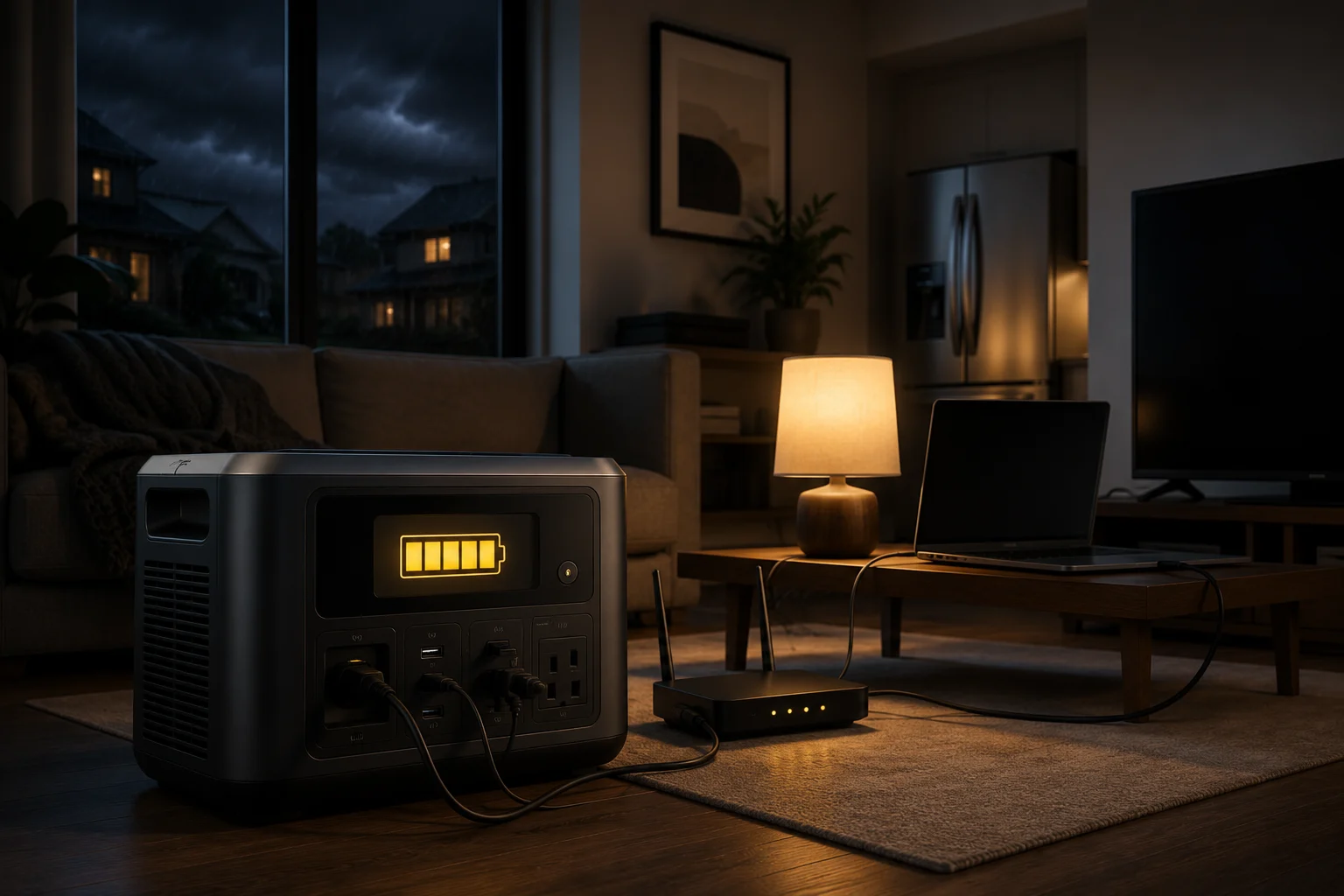
A portable power station may advertise 1,024 watt-hours of battery capacity, but that does not mean it will run a 100-watt appliance for exactly 10.24 hours. Some of the stored energy is consumed by the power station itself, some is lost while converting battery power into household electricity, and real appliances rarely draw one perfectly steady amount of power.
That gap between the number printed on the battery and the runtime you experience is where most confusion begins.
The basic calculation is still simple:
Rule of Thumb
Estimated runtime = usable battery capacity ÷ average device load
The trick is determining what “usable capacity” and “average load” actually mean in the real world. This guide explains the numbers, the losses that matter, and how to build a runtime estimate you can reasonably count on during an outage.
You can also use the Home Power Matrix Battery Runtime Calculator to enter your battery capacity and device load, compare efficiency assumptions, and create an itemized power plan.
Watts vs. Watt-Hours: The Most Important Difference
Watts and watt-hours sound nearly identical, but they measure two different things.
Watts measure power demand
A watt is a measure of how quickly a device is using energy.
- A modem and router may draw 20 watts.
- A television may draw 100 watts.
- A portable refrigerator may draw 50 watts while its compressor is running.
- A space heater may draw 1,500 watts.
The higher the wattage, the faster the device drains a battery.
Watt-hours measure stored energy
Watt-hours measure how much energy a battery can store or deliver over time.
- 1,000 watts for one hour
- 500 watts for two hours
- 100 watts for ten hours
- 20 watts for fifty hours
That is the clean laboratory version. Real equipment introduces losses, variable loads, shutdown reserves, and other complications.
The U.S. Department of Energy explains that batteries store chemical energy and release it as electricity when needed. Energy storage and retrieval are never perfectly efficient, so the amount delivered to your appliances will be lower than the battery’s theoretical stored capacity. Read the DOE battery overview.
The Basic Battery Runtime Formula
Start with this formula:
Runtime in hours = battery capacity in watt-hours ÷ device load in watts
Suppose you have a 1,024Wh portable power station and want to run a steady 120W load:
1,024Wh ÷ 120W = 8.53 hours
That result assumes you can use every watt-hour in the battery with no conversion loss. You cannot, because physics remains stubbornly committed to charging admission.
A more realistic formula is:
Runtime = battery capacity × usable-capacity percentage ÷ average load
Using an 85% usable-capacity estimate:
1,024Wh × 0.85 = 870Wh usable
870Wh ÷ 120W = 7.25 hours
Your practical estimate is therefore approximately 7 hours and 15 minutes, rather than 8 hours and 32 minutes. That estimate can still move in either direction depending on the power station, output type, temperature, battery condition, and behavior of the connected devices.
Rated Capacity Is Not the Same as Usable Capacity
The capacity printed on a power station normally represents its rated or nominal battery capacity. It does not guarantee that every stored watt-hour will reach the outlet.
- Inverter conversion losses
- Internal electronics and cooling fans
- Battery-management-system reserves
- Low-voltage shutdown protection
- Wiring and conversion losses
- Very light or very heavy loads
- Battery temperature
- Battery age and condition
A manufacturer may also reserve a small portion of the battery at the top or bottom of its charge range to protect the cells. The display can show 0% even though the battery-management system has prevented the cells from reaching a truly empty state. That is generally a feature, not missing capacity someone stole during shipping.
A practical efficiency range
| Usable-capacity assumption | Best used for |
|---|---|
| 75% | Conservative planning, older batteries, cold conditions, uncertain loads |
| 85% | A reasonable general estimate for a modern portable power station |
| 90% | Efficient equipment, favorable temperatures, and well-understood loads |
These are planning assumptions rather than universal product specifications. A particular power station may perform better or worse depending on its design and how it is used.
The Battery Runtime Calculator lets you compare conservative, typical, and optimistic estimates instead of pretending one suspiciously precise number is destiny.
Why Inverters Reduce Battery Runtime
Battery cells store and release direct current, or DC electricity. Most household appliances use alternating current, or AC electricity.
When you plug a television, refrigerator, computer, or other standard appliance into a power station’s AC outlet, its inverter converts the battery’s DC power into AC power. The Department of Energy’s inverter overview explains this conversion in more detail.
That conversion creates heat and consumes energy.
Modern inverters can be highly efficient under favorable conditions, but efficiency is not one fixed percentage at every load. For example, Victron publishes both maximum efficiency and no-load consumption for its inverter hardware, illustrating why very small loads can be disproportionately affected by inverter overhead.
Small loads can suffer disproportionately
Imagine leaving the AC inverter active to run a single 5W device. If the power station itself consumes several additional watts while maintaining AC output, its internal overhead may rival or exceed the device load.
Whenever practical, use:
- USB ports for phones and tablets
- USB-C Power Delivery for compatible laptops
- Regulated DC outputs for suitable equipment
- The AC inverter only for devices that actually need AC power
Direct DC output is not automatically lossless, but avoiding an unnecessary DC-to-AC conversion can improve runtime.
Useful Tool: Measure the Load Instead of Guessing
A plug-in electricity monitor can show instantaneous watts and track kilowatt-hour use over time, which is especially useful for refrigerators, freezers, televisions, and other variable loads. The P3 Kill A Watt P4400 electricity usage monitor on Amazon is a straightforward option for standard 120V plug-in appliances.
Affiliate note: confirm the meter’s voltage, current, and outlet limits before connecting any appliance. It is not intended for hardwired equipment or loads beyond its rating.
Runtime Examples for a 1,024Wh Battery
Assume a 1,024Wh power station provides approximately 85% usable capacity:
1,024Wh × 0.85 = about 870Wh
| Average device load | Estimated runtime |
|---|---|
| 10W | 87 hours |
| 20W | 43.5 hours |
| 40W | 21.8 hours |
| 60W | 14.5 hours |
| 100W | 8.7 hours |
| 120W | 7.25 hours |
| 300W | 2.9 hours |
| 500W | 1.74 hours |
| 1,000W | 52 minutes |
These figures are mathematical estimates, not guaranteed runtimes. At very low loads, the power station’s own consumption may shorten runtime significantly. At high loads, inverter efficiency, heat, cooling fans, and battery voltage behavior may also reduce the result.
Appliances Rarely Draw Their Listed Wattage Continuously
A device’s label may show its maximum input, rated power, or a representative operating value. That number may not equal its average consumption.
This matters because battery runtime depends on average wattage over time, not merely the highest number you see.
Refrigerators and freezers cycle
A refrigerator may use 100 to 200 watts while its compressor is running but substantially less when the compressor is off.
- Room temperature
- Thermostat setting
- Insulation
- Door openings
- Food temperature
- Appliance size and age
- Compressor duty cycle
A refrigerator drawing 150W for one-third of each hour has an approximate compressor-related average of 50W, although control boards, fans, defrost cycles, and startup surges can add to that total.
You should not automatically calculate refrigerator runtime by dividing battery capacity by the compressor’s full running wattage. You also should not assume a low average without measuring it. Refrigerators are moody little insulated caves, and outage conditions can change their behavior.
Televisions vary with settings and content
- Screen size
- Brightness
- Display technology
- HDR mode
- Picture settings
- Attached streaming devices or cable boxes
Using an energy meter provides a better estimate than relying on a generic online wattage chart.
Fans change with speed
A fan may draw considerably less power on its lowest speed than on its highest. Measure or check the manufacturer’s specifications for the setting you expect to use.
CPAP machines can change dramatically with accessories
- A heated humidifier
- Heated tubing
- Higher pressure
- AC power instead of a compatible DC adapter
For overnight medical-device planning, use manufacturer data for the exact configuration and leave a substantial reserve. Do not build a critical medical backup plan around the most optimistic number a calculator can produce.
Starting Watts Affect Compatibility, Not Just Runtime
Some appliances briefly require much more power when starting than they use while running.
- Refrigerators
- Freezers
- Sump pumps
- Well pumps
- Air conditioners
- Power tools
- Furnaces with blower motors
A refrigerator might run at 150W but briefly demand several times that amount when the compressor starts.
- Does the battery contain enough energy to run the appliance for the required time?
- Can the inverter deliver enough instantaneous power to start it?
A large battery capacity does not guarantee a strong inverter. Likewise, a high-output inverter does not guarantee long runtime.
- Continuous AC output rating
- Surge or peak output rating
- Surge duration
- Outlet limitations
- Manufacturer restrictions
If the inverter cannot handle the startup surge, the power station may shut down immediately—even though the runtime calculation says the battery contains hours of energy.
Continuous Output and Battery Capacity Solve Different Problems
Battery shoppers often focus on the largest number printed on the box. Unfortunately, manufacturers know this and have responded with a festive parade of large numbers describing entirely different things.
Consider a power station advertised as:
- 2,000Wh capacity
- 2,400W continuous output
- 4,800W surge output
- 2,000Wh describes stored energy.
- 2,400W describes how much continuous AC load the inverter can support.
- 4,800W describes a temporary surge capability under specified conditions.
The 4,800W number does not mean the power station can run a 4,800W load for an hour. It may support that level only briefly, or only through a special operating mode.
For runtime, begin with watt-hours. For appliance compatibility, examine continuous and surge watts. You need both sides of the equation before trusting the setup.
Example 1kWh-Class Power Station
A roughly 1kWh portable power station is a useful reference point because it makes runtime math easy to visualize. Browse the Anker SOLIX C1000 portable power station listings on Amazon to compare current capacities and output ratings. Product revisions change, so verify the exact watt-hour capacity, continuous output, surge behavior, and included charging cables on the listing you select.
Battery Runtime Drops in Cold Weather
Battery temperature can affect both available capacity and power delivery. Lithium-ion performance and service life are strongly influenced by operating temperature, and cold conditions are particularly relevant when batteries are stored in garages, sheds, vehicles, or unheated utility spaces.
For a technical overview, see the National Renewable Energy Laboratory report on lithium-ion battery thermal performance.
- Deliver less usable energy
- Experience greater voltage drop under load
- Reach its protective shutdown threshold sooner
- Accept charging more slowly
- Refuse charging entirely until it warms
Discharging and charging are also different issues. Some lithium batteries can safely discharge below freezing but should not be charged below a specified temperature unless they include internal heating or low-temperature charging protection.
Check the manufacturer’s operating and charging temperature ranges. Do not assume that because a power station can turn on in freezing conditions, it can also be safely recharged there.
For winter outage planning, store the battery in a temperature-controlled area when possible and use a conservative runtime assumption.
Battery Age and Cycle History Matter
Rechargeable batteries gradually lose capacity as they age and accumulate charge cycles.
- Battery chemistry
- Number of cycles
- Depth of discharge
- Storage temperature
- Time spent at very high or low states of charge
- Charge and discharge rates
- Overall battery-management design
If an older power station has noticeably shorter runtime, use its measured performance rather than its original box specification.
A simple test is to power a known, steady load from a full charge and record:
- Starting state of charge
- Device wattage
- Elapsed runtime
- Remaining state of charge
- Whether the inverter or cooling fan remained active
This will not produce laboratory-grade capacity testing, but it can reveal whether your real-world planning assumption is wildly optimistic.
LiFePO4 vs. NMC: Does Chemistry Change Runtime?
Portable power stations commonly use lithium iron phosphate, usually abbreviated LiFePO4 or LFP, or a nickel-based lithium-ion chemistry often grouped under NMC.
When two batteries have the same usable watt-hour capacity, chemistry alone does not magically make one run a 100W load twice as long. Watt-hours are still watt-hours.
- Cycle life
- Weight
- Energy density
- Temperature behavior
- Voltage characteristics
- Storage recommendations
- Replacement timeline
LFP batteries are now common in home-backup products because they generally offer long cycle life and strong thermal stability. NMC batteries can provide higher energy density, allowing more capacity in a smaller or lighter package.
For runtime calculations, focus on the actual usable watt-hours delivered by the complete system rather than assuming one chemistry automatically produces more runtime.
Variable Loads Need a Better Calculation
If several devices run at different times, adding all their maximum wattages can severely underestimate runtime. But ignoring their overlap can produce an estimate that collapses the moment dinner, refrigeration, and entertainment all happen at once.
Daily energy use = device watts × hours used per day
| Device | Average watts | Daily use | Daily energy |
|---|---|---|---|
| Router and modem | 20W | 24 hours | 480Wh |
| LED lights | 30W | 5 hours | 150Wh |
| Television | 100W | 3 hours | 300Wh |
| Laptop | 60W | 4 hours | 240Wh |
| Fan | 45W | 8 hours | 360Wh |
| Total | 1,530Wh/day |
A battery providing 870 usable watt-hours could not support that complete plan for a full day without recharging.
- Turn off the router overnight
- Reduce television use
- Charge the laptop only when needed
- Use lower fan speeds
- Recharge from solar, a vehicle, or a generator
- Add an expansion battery
- Separate essential and optional loads
This daily energy-budget method is especially useful for multi-day outages.
How Solar Charging Changes the Runtime Question
Once a battery is being recharged during use, runtime is no longer determined solely by stored capacity.
Net battery drain = appliance load − charging input
Suppose your devices consume 200W while solar panels are supplying 150W. The battery is losing energy at approximately 50W, plus system losses.
If solar input rises above the load, the battery may begin gaining charge. If clouds reduce solar production to 40W, the battery begins draining faster again.
- Time of day
- Season
- Cloud cover
- Shade
- Panel angle
- Panel temperature
- Charge-controller limits
- Cable losses
- The power station’s maximum solar input
Do not calculate multi-day survival using the solar panel’s advertised wattage as though it will produce that amount continuously from dawn to dusk. The sun has declined to sign your service-level agreement.
Instead, treat solar production as variable replenishment and maintain enough stored capacity to cover poor weather and overnight use.
Portable Solar Reference
For a portable charging example, see the Renogy 200W foldable portable solar panel on Amazon. Before buying any panel, confirm connector compatibility, open-circuit voltage, current limits, and your power station’s maximum solar input. A wattage match alone is not enough.
How to Get a More Accurate Runtime Estimate
1. Find the battery’s watt-hour capacity: Look for Wh or kWh on the product label or specification sheet. To convert kilowatt-hours to watt-hours: kWh × 1,000 = Wh. A 2.4kWh battery contains 2,400Wh of rated energy.
2. Estimate usable capacity: Use the manufacturer’s published usable capacity when available. Otherwise, choose 75% for conservative conditions, 85% for typical planning, or 90% for favorable conditions.
3. Measure the real load: A plug-in energy meter can show both instantaneous watts and energy consumed over time. For cycling appliances, measure consumption over several hours or a full day rather than recording a single moment.
4. Include every connected device: Do not forget modems, routers, cable boxes, streaming devices, chargers, external monitors, powered speakers, and USB accessories.
5. Check startup requirements: Verify that the inverter can support motor and compressor surges.
6. Build in a reserve: Do not plan to reach 0% at the exact moment utility power returns. Preserve margin for weather, changing loads, battery aging, delayed recharging, and a longer outage than forecast.
Common Battery Runtime Mistakes
Dividing rated watt-hours directly by load watts: This ignores inverter and system losses.
Using peak appliance wattage as the average: This can make cycling appliances appear to have much shorter runtime than they actually do.
Ignoring starting surge: The battery may have sufficient energy but an undersized inverter.
Assuming “off” means zero watts: Many electronics draw standby power. The power station’s inverter can also consume energy while active.
Treating the battery display as laboratory equipment: State-of-charge percentages are estimates generated by the battery-management system and can become less precise under rapidly changing loads or extreme temperatures.
Assuming solar panels always produce their rated output: Panel ratings describe standardized test conditions, not guaranteed backyard production.
Planning around the last available watt-hour: Backup power should include margin for uncertainty. An outage plan that works only under perfect conditions does not work.
How Much Battery Capacity Do You Actually Need?
Begin by separating your devices into three groups.
Essential loads
- Medical equipment
- Refrigerator or freezer
- Sump pump
- Well-system controls
- Furnace controls and blower
- Communications equipment
- Basic lighting
Useful loads
- Laptop
- Television
- Fans
- Small cooking appliances
- Additional lighting
- Device charging
Optional high-demand loads
- Space heaters
- Electric water heaters
- Clothes dryers
- Electric ovens
- Large air conditioners
- EV charging
High-resistance heating appliances are especially punishing for batteries. A 1,500W heater can drain roughly 870 usable watt-hours in about 35 minutes, assuming the power station can supply the load.
That same energy could run a 20W communications setup for well over a day.
Battery planning is therefore less about asking, “Can this outlet power the appliance?” and more about asking, “Is this the smartest use of limited stored energy?”
Use the Battery Runtime Calculator
The Home Power Matrix Battery Runtime Calculator provides a faster way to compare different setups.
- Enter battery capacity in Wh or kWh
- Select a usable-capacity assumption
- Enter one combined load or build a device list
- Compare a realistic runtime range
- See estimated battery use per hour
- Export a printable power-planning report
The calculator is most useful after you have gathered realistic wattage numbers. It can perform the arithmetic flawlessly; it cannot personally inspect your 2008 refrigerator and discover that its compressor has chosen violence.
Use the result as a planning estimate, then add an appropriate reserve for important loads.
Frequently Asked Questions
How long will a 1,000Wh battery run a refrigerator?
It depends on the refrigerator’s average energy consumption, compressor duty cycle, startup surge, room temperature, and the power station’s usable capacity. If the refrigerator averages 60W and the battery provides 850Wh of usable energy, the estimate is about 14 hours. Actual runtime could be shorter or longer.
How long will a 1,000Wh battery run a 100W device?
At 85% usable capacity, the estimate is 8.5 hours. Very light or heavy loads, temperature, battery condition, and inverter overhead can change the result.
Why does my power station run out faster than the calculation predicts?
Common causes include inverter losses, internal power consumption, cold weather, battery aging, inaccurate appliance wattage, cycling loads, and accessories that were omitted from the calculation.
Does a 2,000W power station contain 2,000Wh?
Not necessarily. A 2,000W rating usually describes inverter output. Battery capacity should be listed separately in Wh or kWh.
Can I use the full advertised battery capacity?
Usually not at the AC outlets. Some energy is lost through conversion and internal operation, and the battery-management system may maintain a protective reserve.
Is DC output more efficient than AC output?
It can be, particularly when it avoids running the AC inverter. However, DC voltage conversion and connected-device electronics also create losses.
Should I turn off the AC inverter when I am not using it?
Generally, yes. An active inverter may consume power even when no appliance is drawing from the outlet. Check your power station’s manual for standby behavior and automatic shutoff settings.
Can I run appliances while the battery is charging?
Many power stations support some form of simultaneous charging and discharging, but operating limits vary. Check the manufacturer’s instructions for pass-through charging, UPS operation, and maximum combined input and output.
The Runtime Number You Can Count On
Battery runtime is not one magical number stamped onto the side of a power station. It is the result of stored energy, usable capacity, conversion efficiency, device behavior, environmental conditions, and your own power priorities.
- Start with watt-hours.
- Reduce rated capacity to a realistic usable amount.
- Use average device wattage rather than a convenient guess.
- Verify continuous and surge output requirements.
- Account for cold weather, battery age, and inverter overhead.
- Preserve a reserve for uncertainty.
A battery may technically power dozens of appliances. The useful question is how long it can power the appliances that matter most—and which loads are worth spending your limited energy on.
Use the Battery Runtime Calculator to test your setup, compare efficiency assumptions, and create a practical plan before the next outage turns battery arithmetic into a live-action group project.