

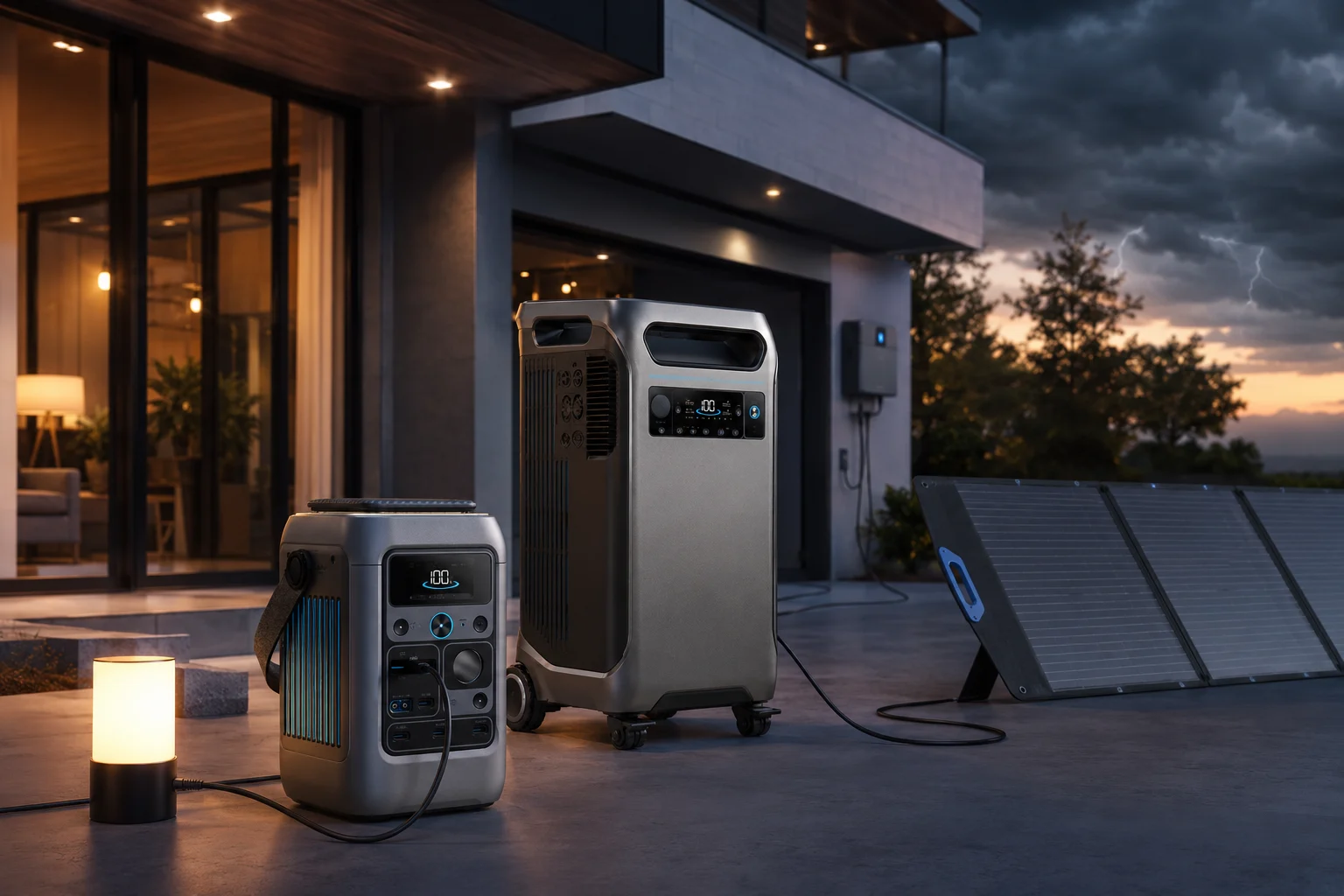
Anker built its reputation selling chargers and portable batteries, but its SOLIX line now stretches far beyond keeping a phone alive during a flight. The company offers compact portable power stations, expandable batteries, solar panels, 120V and 240V home-backup systems, EV charging support, and equipment designed to integrate portable storage with household circuits.
That range matters because backup power is rarely a single-product decision. A homeowner might begin with a battery that runs the router, television, lights, and laptops during a short outage. Later, they may want enough capacity for refrigeration, a furnace blower, a sump pump, solar charging, or selected household circuits.
Anker SOLIX makes that progression unusually coherent.
The company’s strongest advantage is not that every SOLIX product automatically defeats every EcoFlow, Bluetti, Jackery, or traditional generator. It is that Anker has developed a practical ecosystem spanning small-scale emergency power through expandable home backup while preserving relatively straightforward controls and fast recharge options.
Home Power Matrix verdict: Anker SOLIX is particularly compelling for homeowners who want to start with a portable system today without locking themselves out of more serious backup options later.
Affiliate disclosure: As an Amazon Associate, Home Power Matrix earns from qualifying purchases.
Why Anker SOLIX Stands Out
Portable power stations have become significantly more capable, but the market is still messy. Capacity, output, surge behavior, solar-input limits, battery chemistry, expansion support, charging speed, and home integration vary enormously between models.
Anker SOLIX gets several of these fundamentals right across much of its lineup.
Long-Life LiFePO4 Batteries
Current SOLIX power stations generally use lithium iron phosphate, or LiFePO4, battery chemistry. Anker rates products such as the C1000 and F3800-series systems for thousands of charge cycles and backs major SOLIX products with five-year warranties.
Official Anker SOLIX product information
Anker SOLIX C1000 product page
Anker SOLIX BP3800 expansion battery
LiFePO4 batteries are heavier than some alternatives, but they are well suited to backup systems expected to sit ready, cycle repeatedly, and remain useful for years.
Very Fast Wall Charging
Recharge speed matters enormously during an outage. A battery that takes most of a day to refill may be difficult to cycle from generator power or intermittent grid service.
The original Anker SOLIX C1000 can reach 80% charge in approximately 43 minutes and a full charge in under an hour under the specified fast-charging conditions.
Amazon listing for the Anker SOLIX C1000 Gen 2
That makes the C1000 line particularly useful in a generator-by-day, battery-by-night setup. Instead of running a noisy generator continuously, a homeowner can operate it during planned daytime windows, power major appliances, and recharge the SOLIX for quiet overnight use.
Expandable Capacity
Anker does not treat every power station as a sealed, fixed-capacity purchase.
The original C1000 can be paired with an additional 1,056Wh expansion battery, doubling its nominal storage. The larger F3800 system begins at 3.84kWh and can be expanded dramatically with additional batteries and paired units.
Anker SOLIX expansion battery information
Anker SOLIX F3800 product page
Expansion matters because many buyers underestimate their eventual needs. A battery purchased for refrigeration and lighting may later be expected to support heating controls, pumps, communications, cooking appliances, or longer outages.
Solar Support Throughout the Range
SOLIX products support solar input at multiple price and capacity levels. The C1000 accepts up to 600W of solar input, while the F3800 supports up to 2,400W.
Anker SOLIX C1000 specifications
Anker SOLIX F3800 specifications
Real-world solar charging depends on weather, panel placement, temperature, available sunlight, and system losses. Nevertheless, strong solar-input limits make the equipment more useful during long outages and for homeowners interested in using solar beyond emergencies.
App Monitoring Without Making the Hardware Unusable
Anker’s app allows users to monitor charging, output, battery status, and connected SOLIX equipment over Bluetooth or Wi-Fi on compatible products.
That is useful for checking consumption and remaining runtime without repeatedly walking over to the unit. More importantly, the physical equipment remains usable without requiring the app for basic operation. Nobody wants their refrigerator’s survival to depend on remembering a cloud password while the grid is down.
Anker SOLIX Product Comparison
| Product | Capacity | Continuous AC Output | Best Use |
|---|---|---|---|
| Anker SOLIX C300 | 288Wh | Up to 300W depending on version | Phones, laptops, router, lights, and basic charging |
| Anker SOLIX C1000 | 1,056Wh | 1,800W | Refrigeration, electronics, small appliances, and short outages |
| Anker SOLIX F3000 | 3,072Wh | 3,600W | Larger essential-load backup and extended runtime |
| Anker SOLIX F3800 / F3800 Plus | 3,840Wh | 6,000W with 120V and 240V output | Major appliances, RVs, EV charging, and home integration |
Capacities and outputs describe the base units. Expansion batteries and different configurations can substantially increase available storage.
Best Anker SOLIX for Basic Emergency Power: C300
The Anker SOLIX C300 occupies the affordable end of the ecosystem. Its 288Wh battery and approximately 300W output are not intended to run a house, refrigerator, furnace, or large cooking appliance. That is not a defect; it is a different category of preparedness.
The C300 is suited to:
- Charging phones and tablets
- Running laptops
- Keeping a router and modem powered
- Operating USB lighting
- Charging rechargeable lanterns
- Supporting small DC devices
- Maintaining communications during a short outage
This is the kind of product that makes backup power accessible to people who cannot spend thousands of dollars. A small system will not preserve every household convenience, but keeping communications, work devices, and safe LED lighting available is already a meaningful improvement over candles and dying phone batteries.
Best for: Apartments, renters, short outages, device charging, and entry-level preparedness.
Check the Anker SOLIX C300 on Amazon
Home Power Matrix note: Check carefully whether you are buying the C300 AC or C300 DC version. Their outlets, port selection, and intended uses differ.
Best Anker SOLIX for Most Households: C1000
The Anker SOLIX C1000 is where the SOLIX lineup begins to feel like serious household backup rather than an oversized power bank.
The original model combines:
- 1,056Wh of battery capacity
- 1,800W rated AC output
- Six AC outlets
- Capacity expansion through an additional battery
- Up to 600W solar input
- Bluetooth and Wi-Fi app monitoring
- Fast AC recharging
- LiFePO4 battery chemistry rated for thousands of cycles
A roughly 1kWh system can realistically support combinations such as:
- Refrigerator plus basic lighting
- Router, modem, computers, and phones
- Television and entertainment equipment
- CPAP equipment
- Fans
- Selected small appliances
- Short intermittent operation of higher-demand devices when compatible
Runtime depends on actual device consumption and inverter losses. A 1,056Wh rating does not mean users receive every watt-hour through the AC outlets. However, the C1000 offers enough storage and output to cover common short-outage needs without becoming physically enormous.
Best for: Refrigeration, work-from-home equipment, electronics, lights, and building a generator-and-battery hybrid system.
Check the original Anker SOLIX C1000 on Amazon
Check the Anker SOLIX C1000 Gen 2 on Amazon
Why the C1000 May Be the Sweet Spot
The C1000 is large enough to power genuinely useful household equipment but small enough to move, recharge quickly, and use without redesigning the home’s electrical system.
For many households, that is more practical than buying one giant battery and assuming it will run everything indefinitely.
A C1000 can be used alone during short outages, paired with solar, expanded with additional capacity, or recharged from a generator during the day. That flexibility is exactly what makes the SOLIX ecosystem attractive.
Best Anker SOLIX for Longer Essential-Load Backup: F3000
The Anker SOLIX F3000 moves into a substantially more capable class.
Depending on the exact configuration, it offers approximately:
- 3,072Wh of battery capacity
- 3,600W output
- High-capacity solar input
- Pass-through charging
- Expansion support
- The ability to pair compatible equipment for heavier loads
This level of capacity can support longer refrigeration runtime, multiple essential appliances, heavier electronics, and more realistic overnight operation.
It is also a more credible candidate for homeowners who want to use solar as part of daily energy management rather than merely keeping a lantern charged after a storm.
Best for: Multi-day essential-load planning, larger solar arrays, refrigeration, communications, and heavier household loads.
Search for the Anker SOLIX F3000 on Amazon
Browse the Anker Amazon storefront
Best Anker SOLIX for Serious Home Backup: F3800 Plus
The Anker SOLIX F3800 line is where Anker begins competing with installed home-energy systems rather than ordinary portable batteries.
The base F3800 platform provides:
- 3,840Wh of capacity
- 6,000W AC output
- 120V and 240V output from one unit
- Up to 2,400W solar input
- Expansion-battery support
- NEMA 14-50 and L14-30 connections
- Support for RV and EV charging applications
- Optional home-panel integration
Official Anker SOLIX F3800 product page
The Anker SOLIX F3800 Plus expands Anker’s hybrid-home-backup strategy further, including high-voltage solar inputs and compatibility with Anker’s generator and home-power equipment.
Official Anker SOLIX F3800 Plus information
What 120V and 240V Support Changes
Most smaller portable power stations supply ordinary 120V household output. That is enough for electronics and many appliances but not all major household systems.
The F3800’s 240V capability makes it potentially useful for:
- Well pumps
- Certain heating and cooling equipment
- Larger workshop equipment
- RV connections
- EV charging
- Selected household circuits through appropriate transfer equipment
Compatibility still depends on the appliance’s voltage, starting surge, sustained wattage, and connection method. A 6,000W power station is impressive, but it is not an enchanted cube that overrides wiring requirements or arithmetic.
Direct EV Charging
The F3800 includes a NEMA 14-50 connection for compatible EV charging equipment.
Official Anker F3800 EV and RV information
This does not mean a 3.84kWh battery will fully recharge a large electric vehicle. EV batteries may hold dozens of kilowatt-hours. Portable stored power may instead provide limited emergency range, supplement solar charging, or support carefully managed off-grid use. The practical limits are easier to see in our full guide to charging an electric vehicle with a portable power station.
Emergency EV charging is real. Pretending one portable battery casually replaces the electrical grid is marketing fan fiction.
Best for: 240V equipment, whole-home integration, large solar systems, EV or RV support, and expandable outage planning.
Check the Anker SOLIX F3800 on Amazon
Check the Anker SOLIX F3800 Plus on Amazon
Why Anker SOLIX Works Especially Well With a Generator
A portable power station and a fuel generator solve different problems.
Generators provide comparatively inexpensive sustained energy as long as fuel is available. Batteries provide silent indoor power without combustion, refueling, or exhaust.
Combining them allows each system to do what it does best.
Example Hybrid Outage Schedule
- Run the generator during the morning.
- Power the refrigerator, freezer, pumps, and heavier appliances.
- Recharge the SOLIX power station.
- Shut down the generator during quiet hours.
- Use the battery overnight for lighting, internet, electronics, and selected appliances.
- Repeat as necessary while monitoring fuel and battery reserves.
The C1000’s fast wall charging is particularly useful for this strategy because more of its capacity can be restored during a limited generator window.
The result can be lower fuel consumption, reduced generator noise, less engine wear, and quieter overnight power.
Solar Is More Than an Emergency Accessory
Solar panels are often treated as optional camping accessories, but they become much more valuable during prolonged outages.
A battery alone stores a fixed amount of energy. A solar-compatible battery has the potential to replenish some or all of that energy when weather conditions cooperate.
SOLIX systems support solar from compact portable configurations through larger arrays. The C1000 supports up to 600W of solar input, while the F3800 supports as much as 2,400W.
Solar may help:
- Extend refrigerator runtime
- Maintain communication devices
- Offset daily lighting and electronics use
- Reduce generator operating hours
- Recharge batteries when fuel access is limited
- Lower ordinary grid use outside emergencies
Actual output rarely matches panel nameplate wattage throughout the entire day. Shade, clouds, season, temperature, panel angle, and cable losses all matter. A useful solar plan should be based on conservative daily energy estimates rather than one glorious laboratory number.
Shop Anker SOLIX solar-generator bundles on Amazon
Example Anker SOLIX solar bundle
Where Anker SOLIX Is Not Automatically Better
Anker has a strong ecosystem, but no manufacturer wins every comparison.
It Is Not Always the Least Expensive
Competitors frequently discount power stations and bundles. Buyers should compare current price per watt-hour, output, solar input, included accessories, and expansion costs rather than relying on brand reputation alone.
Expansion Batteries Are Ecosystem-Specific
Once you invest in proprietary expansion batteries, home panels, and cables, changing brands becomes expensive. The ecosystem is convenient precisely because the components are designed to work together, but that convenience also creates lock-in.
Large Systems Are Still Large
The F3800 has wheels, but it is not something most people will casually carry upstairs. High-capacity batteries are heavy because physics remains deeply committed to ruining portability.
Solar Claims Require Realistic Conditions
Maximum solar-input ratings describe what the unit can accept, not what a given panel arrangement will produce throughout the day.
Some Buyers May Be Better Served by a Generator
For long outages, limited budgets, or extremely large continuous loads, a conventional generator may provide more sustained energy per dollar. A battery system becomes strongest when silence, indoor operation, solar integration, automatic behavior, and lower maintenance are valuable.
Anker SOLIX vs. EcoFlow, Bluetti, and Jackery
Anker is not alone in this market. EcoFlow, Bluetti, and Jackery all offer competitive batteries, solar panels, and expandable systems.
Anker SOLIX is particularly strong when the buyer values:
- Rapid wall charging
- Straightforward app controls
- A familiar consumer-electronics brand
- LiFePO4 battery longevity
- A clear progression from compact to whole-home products
- Strong solar-input options
- 240V and EV support at the high end
- Generator-and-battery hybrid operation
A competitor may still win based on a particular sale, port selection, system size, weight, expansion architecture, or installation requirement.
The smartest approach is to compare the complete setup needed, not merely the headline battery capacity.
A cheap base unit can become expensive once the buyer adds the necessary panels, expansion battery, transfer equipment, and proprietary cables.
Which Anker SOLIX Should You Buy?
Choose the C300 when:
- Your budget is limited
- You mainly need phones, laptops, communications, and lights
- Portability matters more than appliance support
- You want a practical first step into emergency power
Choose the C1000 when:
- You want the best all-around balance
- You need refrigeration or common household appliances
- You want very fast generator or wall recharging
- You may add solar or an expansion battery later
Choose the F3000 when:
- You need significantly longer runtime
- You want stronger solar capability
- You plan to support several household essentials
- The C1000 is too small but a full F3800 setup is excessive
Choose the F3800 or F3800 Plus when:
- You need 240V output
- You are considering selected-circuit or whole-home integration
- You want direct EV or RV support
- You plan to expand storage substantially
- You want a serious solar, battery, and generator ecosystem
Is Anker SOLIX Worth It?
Anker SOLIX is not the universal answer to every backup-power question. It is, however, one of the most coherent product ecosystems available to ordinary homeowners.
Someone can begin with a compact battery for lights and communications, move to a C1000 for refrigeration and household electronics, or build toward an F3800 system capable of 240V output, solar charging, EV support, and home integration.
That progression is the real reason SOLIX is becoming a gold standard.
The products are not merely isolated batteries in different sizes. They form a practical ladder from basic outage comfort to serious household resilience, allowing buyers to choose the rung that fits their needs and budget without pretending everyone requires a miniature private utility company in the garage.
Frequently Asked Questions
Can an Anker SOLIX Run a Refrigerator?
Several SOLIX models can run refrigerators, provided the refrigerator’s starting surge and running wattage remain within the unit’s output limits. Runtime depends on battery capacity, inverter losses, ambient temperature, and how frequently the compressor runs.
Can the Anker SOLIX C1000 Power a House?
The C1000 can power selected devices and appliances, but its 1,056Wh capacity is not equivalent to whole-home energy storage. It is best used for prioritized loads such as refrigeration, electronics, lighting, and small appliances.
Can the Anker SOLIX F3800 Charge an Electric Vehicle?
The F3800 provides a NEMA 14-50 connection for compatible EV charging. Its stored capacity will generally provide limited range rather than a full vehicle recharge.
Can You Recharge an Anker SOLIX With a Generator?
Compatible SOLIX power stations can recharge through AC power supplied by a suitable generator. The generator must provide stable output within the charging specifications of the particular SOLIX model.
Are Anker SOLIX Batteries Expandable?
Several models are expandable. The C1000 supports an additional battery, while the F3800 platform supports multiple BP3800 expansion batteries and larger paired configurations.