

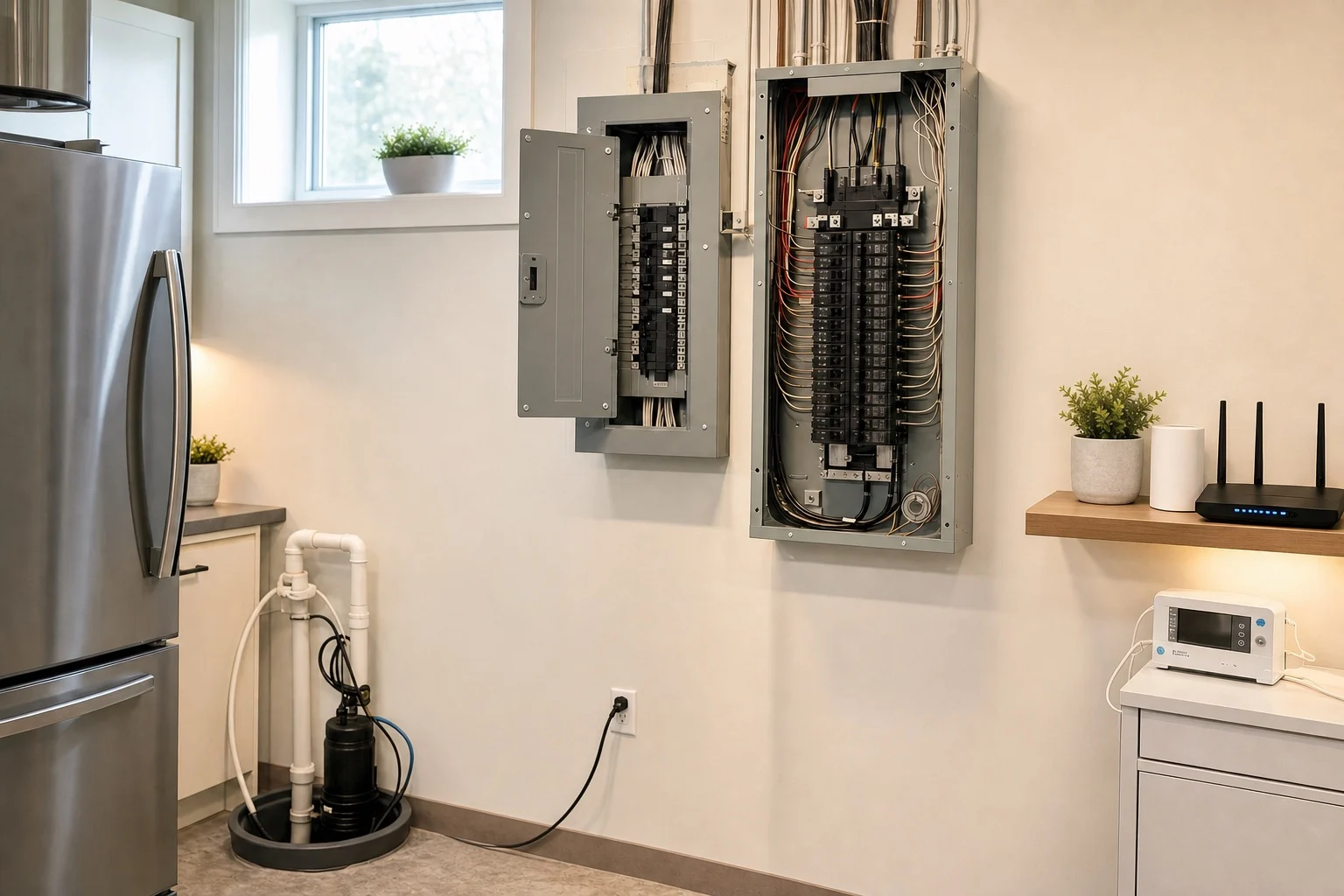
Backing up an entire house sounds simple until you add up the loads. Electric ranges, central air conditioners, water heaters, clothes dryers, well pumps, and other large appliances can turn a modest backup plan into a much larger and more expensive project.
A better starting point is to identify the circuits that protect health, safety, food, water, and communication. Once those needs are clear, you can size a generator or battery around the jobs that actually matter instead of paying to recreate normal grid service during an emergency.
Quick answer: Most homes should prioritize refrigeration, sump or well pumps, essential medical equipment, internet and phone charging, a few lighting circuits, and the minimum heating equipment needed to keep the home safe. The exact list depends on the season, the home’s water system, and the people living there.
What Makes a Circuit Essential?
An essential circuit prevents a meaningful consequence. Losing it may spoil food, allow water into a basement, interrupt a medical device, leave the household without safe heat, or cut off communication. Convenience loads such as a second television or decorative lighting can usually wait.
Make the list by consequence rather than appliance size. A 60-watt router may be more useful during an outage than a 1,500-watt countertop appliance. Likewise, a sump pump is idle most of the time, but its startup surge and ability to prevent major water damage make it a high priority in many homes.
| Home need | Typical priority | Main planning issue |
|---|---|---|
| Refrigerator and freezer | High | Compressor startup surge and cycling |
| Sump or well pump | High where applicable | Motor surge, voltage, and pump horsepower |
| Medical equipment | High | Manufacturer requirements and uninterrupted operation |
| Internet, phones, and radio | High | Low wattage but dependent on local service |
| Heating equipment | Seasonal high | Blower, controls, fuel source, and 120/240-volt needs |
| General lighting | Moderate | Select a few efficient LED circuits |
Refrigeration and Food Protection
A refrigerator is one of the most common first choices because it protects food and medication while using power intermittently. A separate chest freezer may also deserve priority, particularly if it stores a large amount of food. Both use compressor motors, so the backup system must handle startup power as well as normal running watts.
Do not assume every cold-storage appliance must run continuously. Keep doors closed, group food together, and power appliances in planned intervals when capacity is limited. Our guide to keeping a refrigerator and freezer safe during outages explains the food-safety side of that decision.
Sump Pumps, Well Pumps, and Water Systems
A sump pump can be the most important circuit in a wet basement. Check the pump label for horsepower, voltage, running current, and any listed starting requirement. If storms are the likely cause of the outage, the pump may also be working harder at the exact moment grid power disappears. Our guide to keeping a sump pump running during a power outage walks through battery, generator, and dedicated backup options.
Well pumps require similar care and may be 240-volt loads. A small portable power station that handles a refrigerator may not have the voltage or surge output to start a well pump. Use the sump pump backup calculator to estimate battery needs, and have an electrician confirm any hardwired connection.
Medical Equipment, Communications, and Lighting
List any electrically powered medical equipment before general household loads. Record its rated power, expected hours of use, backup battery behavior, and the manufacturer’s instructions. If continuous operation is medically necessary, discuss outage planning with the equipment provider and healthcare team rather than relying on a single untested power source.
Internet equipment, phone chargers, a weather radio, and a few LED lights consume relatively little energy and provide outsized value. They help the household receive alerts, contact family, work when service remains available, and move safely after dark. A small uninterruptible power supply can keep a modem and router from rebooting during brief interruptions; compare router UPS battery backups on Amazon if short interruptions are common.
Heating and Cooling Loads Need Special Planning
In cold climates, a gas or oil furnace still needs electricity for controls, ignition, and the blower. That circuit may be far easier to support than electric resistance heat. Boilers, circulator pumps, pellet stoves, and heat pumps all have different requirements, so read the equipment labels and include every component required for operation.
Central air conditioning and electric heat are large loads. Before placing resistance heat on an essential-load panel, determine what size generator an electric furnace actually requires and how quickly it would consume stored battery energy. A window air conditioner, room heat pump, or designated safe room may be a more practical emergency plan. Never use combustion heaters or generators indoors, and make sure working carbon monoxide alarms are installed where recommended.
How to Calculate Your Essential Load
Start with a circuit inventory. Write down the running watts for each load, the largest motor startup requirement, and how many hours per day each item must operate. Do not simply add every startup wattage together; motors rarely start at the exact same moment, but the backup source must still handle the largest realistic combination.
- List the equipment that must run.
- Record running watts and startup watts from labels or manuals.
- Separate continuous loads from cycling loads.
- Add reasonable capacity for future needs and measurement uncertainty.
- Verify voltage, outlet, transfer equipment, and fuel requirements.
The generator size calculator estimates running and surge capacity. For batteries and portable power stations, use the battery runtime calculator to compare usable watt-hours against the planned load. A plug-in electricity usage monitor can help confirm the real running draw of cord-connected appliances before you size the backup system.
Backup Panel, Transfer Switch, or Extension Cords?
Plug-in equipment can sometimes be powered directly with properly rated cords, but hardwired circuits need an approved transfer method. A manual transfer switch, generator interlock where permitted, or dedicated critical-load panel prevents dangerous backfeeding and keeps utility power isolated from the backup source.
Have a qualified electrician design and install equipment connected to the home’s wiring. Products from manufacturers such as Reliance Controls can provide a useful starting point for discussing manual transfer equipment, but the correct device depends on the panel, generator, local code, and loads being served.
Build Your Priority List Before the Outage
Create three groups: must run, useful if capacity allows, and nonessential. Test the plan under controlled conditions. Confirm that pumps start, refrigeration cycles normally, cords reach safely, batteries charge, and everyone in the household understands the sequence.
Then revisit the list seasonally. Heat may lead in January, while refrigeration, sump pumping, and a room air conditioner may matter more in July. A practical priority list makes it easier to choose between a portable power station and a generator without buying more system than the household can use.
Frequently Asked Questions
Should I back up every lighting circuit?
Usually not. Select a few central LED lighting circuits or use rechargeable lamps. That preserves capacity for refrigeration, pumps, communications, and other higher-consequence loads.
Can a portable power station run hardwired circuits?
Only when the product and installation are specifically designed for that purpose. Do not improvise a connection to the electrical panel. Use listed transfer equipment and professional installation.
How much extra generator capacity should I allow?
Allow room for startup surge, measurement uncertainty, and a small future load, but avoid extreme oversizing. The generator must meet both running and surge requirements at the same time.