

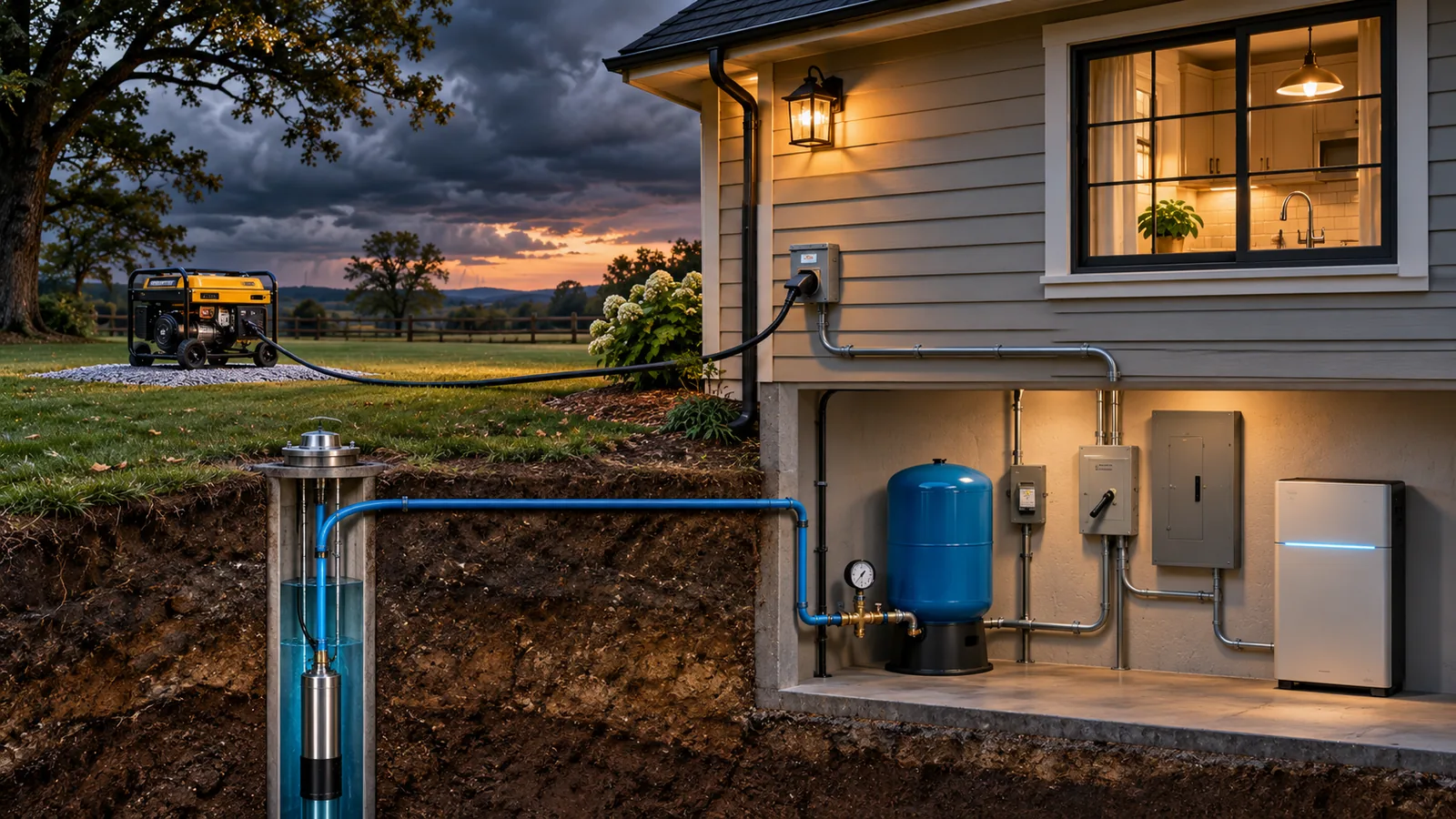
When the power goes out in a house connected to municipal water, the faucets may keep working because the water system maintains pressure independently of the home’s electricity. For homeowners with private wells, the situation is different. Once the pressure tank’s usable water is exhausted, an electric well pump cannot replenish it without backup power.
That means losing more than electricity. It can mean losing running water for drinking, bathing, washing dishes, flushing toilets, and other essential household needs.
A portable generator, battery backup system, or properly configured hybrid setup can keep a well pump operating during an outage. But choosing the right equipment requires more than matching a generator’s advertised wattage to the pump’s horsepower.
Many residential submersible well pumps operate at 230/240 volts, require substantial starting current, and rely on electrical controls that must be compatible with the backup power source. Even a powerful portable battery can be unsuitable if it cannot supply the correct voltage or start the motor.
Quick answer: A well pump needs a backup power source that provides the correct voltage, sufficient continuous output, and enough motor-starting capacity. Franklin Electric’s published generator-sizing guidance lists approximately 2,000 watts for certain 1/2 HP three-wire pump motors and 4,000 watts for 1 HP three-wire motors, with a recommended 50% increase for two-wire motors under the specified generator conditions. These figures apply to the pump alone and should not be treated as universal requirements for every pump or battery inverter.
This guide explains how to identify your well pump’s electrical requirements, compare generator and battery options, estimate runtime, and safely integrate backup water pumping into a household outage plan.
How a Well Pump Works During a Power Outage
Most residential private-well systems include a pump, pressure tank, pressure switch or electronic controller, and plumbing that delivers water throughout the house.
In a conventional pressure-switch system, the pump turns on when pressure falls to a preset level, replenishes the pressure tank, and shuts off when pressure reaches the upper limit.
A common configuration operates between approximately 40 and 60 PSI, although other settings are used.
When utility power fails, the water already stored under pressure may remain available. Opening a faucet allows that stored water to flow until pressure drops below the point at which the pump would normally restart.
Without electricity, the pump cannot replenish the pressure tank. Eventually, the remaining pressure becomes insufficient to deliver water normally.
The important distinction is that a well pump does not necessarily need to run continuously throughout an outage. In a conventional system, it operates in cycles determined by water consumption, tank capacity, pump output, and pressure settings.
That cycling behavior makes backup power possible with systems considerably smaller than those required to operate a large appliance continuously for days.
However, every pump cycle can introduce a substantial electrical starting load. A backup system must be capable of starting the pump repeatedly, not merely supporting its normal operating wattage.
A Pressure Tank Is Not the Same as a Water-Storage Tank
A pressure tank’s advertised capacity can be misleading.
According to Penn State Extension’s guidance on low-yielding wells, approximately 20% of a conventional pressure tank’s nominal capacity may represent usable water between pump cycles under the operating conditions described.
Its example of a 42-gallon pressure tank provides approximately eight gallons of usable drawdown.
Actual drawdown depends on the tank’s design, pressure settings, and precharge. A larger nominal tank does not necessarily provide enough water for an extended outage.
For homeowners who want substantial water reserves without operating a generator, a dedicated potable-water storage system can be more useful than simply installing a larger pressure tank.
120V vs. 240V Well Pumps: The First Compatibility Check
Before comparing generators or power stations, identify the electrical voltage your well pump requires.
Residential pumps may operate at approximately 115/120V or 230/240V, depending on their design.
Some smaller shallow-well jet pumps use 120V circuits. Many residential submersible well pumps, particularly those installed in deeper wells, use 230V-class motors.
The distinction matters because having enough watts does not automatically mean a power source can operate the pump.
A portable generator supplying 5,000 watts through 120V-only outlets is not an appropriate source for a 240V pump simply because its total output rating appears high enough.
Likewise, a portable power station with a large battery and 120V AC outlets cannot directly supply a hardwired 240V pump without compatible equipment designed for that application.
For a 240V pump, verify that the backup system provides the appropriate 120/240V split-phase output or other voltage configuration specified by the pump manufacturer.
Where to Find Your Pump’s Electrical Specifications
The most useful information includes:
- Motor horsepower: Common residential ratings include 1/3, 1/2, 3/4, 1, and 1.5 HP.
- Rated voltage: Typically identified on the motor specifications, controller, or installation records.
- Motor type: Conventional two-wire, three-wire, or electronically controlled.
- Running current: The electrical demand while the pump operates normally.
- Starting current: The higher demand associated with accelerating the motor.
- Control equipment: A separate control box, pressure switch, or variable-frequency drive may impose additional requirements.
The original well installation paperwork, pump model number, contractor records, and accessible control-box labels are good places to start.
The circuit breaker can provide clues about the electrical installation, but its amperage should not be mistaken for the pump’s normal running current or required generator size.
If the pump model or wiring configuration is uncertain, a qualified well contractor or electrician can identify the system without guessing.
Do not remove electrical panel covers or open energized pump controls to investigate the wiring.
Two-Wire vs. Three-Wire Well Pumps: Why Starting Requirements Differ
Two pumps with the same horsepower rating can have different electrical starting requirements.
For conventional single-phase submersible motors, the wiring configuration is one important reason.
Two-Wire Submersible Motors
A conventional two-wire submersible motor has its starting components incorporated into the motor assembly.
The two-wire designation refers to its power conductors, excluding the equipment grounding conductor.
These systems generally do not require a separate aboveground starting control box.
However, some two-wire motor designs can be particularly demanding when starting from a generator with limited short-term electrical output.
Three-Wire Submersible Motors
A conventional three-wire submersible motor uses three motor conductors, plus an equipment grounding conductor.
Starting components are typically housed in a separate aboveground control box.
Depending on the motor design, these starting arrangements can produce different generator-sizing requirements than comparable two-wire motors.
That difference is significant enough that Franklin Electric publishes an explicit adjustment for two-wire motor starting.
Its Application, Installation, and Maintenance manual recommends increasing the applicable minimum generator rating by 50% for best starting performance with two-wire motors.
The takeaway: Horsepower is only one part of generator sizing. Motor design and starting characteristics can be just as important.
These distinctions apply to the conventional motor types discussed here. Variable-speed and electronically controlled well-pump systems require separate consideration.
Generator Size by Well Pump Horsepower
Franklin Electric’s published AIM generator-sizing table provides a useful reference for submersible pump motors supplied by externally regulated, engine-driven generators.
The following figures are based on Table 3 of its 2023 AIM manual, including the manufacturer’s recommended 50% adjustment for two-wire motors.
| Well pump motor | Base minimum generator rating | Two-wire starting recommendation |
|---|---|---|
| 1/3 HP | 1,500W | 2,250W |
| 1/2 HP | 2,000W | 3,000W |
| 3/4 HP | 3,000W | 4,500W |
| 1 HP | 4,000W | 6,000W |
| 1.5 HP | 5,000W | 7,500W |
| 2 HP | 7,500W | 11,250W if applicable |
Source: Franklin Electric, 2023 AIM Manual, Table 3, Engine-Driven Generators. Base ratings are manufacturer minimums for externally regulated generators. The two-wire figures apply Franklin’s recommended 50% increase; the applicable motor model and available configurations must be verified. Consult the latest 2026 AIM Manual before selecting equipment.
These are generator output ratings for starting and operating the pump, not estimates of how many watts the motor continuously consumes.
A 1 HP motor does not normally require 4,000 or 6,000 watts every second it operates. Its actual electrical input is considerably lower.
The larger generator recommendation helps account for the difficult starting conditions of an electric motor.
Franklin also states that generators must maintain adequate voltage during starting so the motor can develop sufficient torque. Excessive voltage sag can prevent the motor from accelerating properly and may cause overheating or damage.
The table should not be applied automatically to every pump on the market. Motors using variable-frequency drives, specialized controllers, different starting arrangements, or manufacturer-specific electronics may have substantially different requirements.
Generator Starting Watts vs. Running Watts
Portable generators commonly advertise two output ratings:
Running watts describe the amount of power the generator can supply continuously.
Starting watts describe the higher output it can provide temporarily.
For example, a generator advertised as 9,500 running watts and 12,500 peak watts does not supply 22,000 watts. The 12,500-watt figure represents its temporary maximum output under the manufacturer’s specified conditions.
The generator must support the pump’s starting demand while continuing to supply other connected household loads.
Our guide to starting watts vs. running watts explains the difference and provides worked examples involving motor-driven appliances.
Voltage and Power Quality Matter Alongside Watts
A generator should also provide the proper frequency and maintain appropriate voltage during operation.
Most North American residential well pumps are designed for 60 Hz power.
A generator that struggles to maintain engine speed under load can produce poor frequency regulation. Voltage drops during pump startup can also interfere with motor performance.
Some electronic controllers have additional power-quality requirements that should be checked against the generator manufacturer’s specifications.
Our explanation of generator total harmonic distortion covers another electrical characteristic that may matter for sensitive equipment.
Conventional vs. Inverter Generators for Well Pumps
Both conventional portable generators and inverter generators can provide backup power for compatible well pumps.
The best choice depends on the motor, electrical controls, household loads, and how long the outage may last.
As an Amazon Associate, Home Power Matrix earns from qualifying purchases.
Conventional Portable Generators
A conventional portable generator is often an economical option when substantial electrical output is needed.
These generators are widely available with 120/240V outlets, dual-fuel capability, and enough running capacity to support a pump alongside essential household appliances.
Their disadvantages can include greater noise, higher fuel consumption at light loads, and power-quality characteristics that may be less suitable for certain sensitive electronics.
One example is the Westinghouse WGen9500DFc, a dual-fuel generator rated for approximately 9,500 running watts on gasoline and 8,500 running watts on propane, with 120/240V output.
Its available power makes it worth evaluating for households that need to operate a well pump together with refrigeration, lights, and selected heating equipment.
View the Westinghouse WGen9500DFc on Amazon.
Inverter Generators
An inverter generator uses a different electrical-generation architecture to provide regulated AC output.
Many inverter models offer lower total harmonic distortion than conventional generators, along with improved fuel efficiency under varying loads.
However, not every inverter generator supports 240V. Smaller portable models frequently provide only 120V output.
The Westinghouse iGen12000DFc is an example of a larger dual-fuel inverter-generator platform offering approximately 9,000 running watts on gasoline, 8,100 running watts on propane, and 120/240V output. Westinghouse publishes a THD specification of 3% or less for this model.
View the Westinghouse iGen12000DFc on Amazon.
The Amazon listing has previously been associated with the iGen11000DFc naming. Verify the exact currently offered model and specifications before purchasing.
Check the Outlet Rating, Not Just the Generator’s Total Output
This is an important distinction when connecting a generator to a house.
A generator rated for 9,500 running watts may offer a 120/240V, 30A outlet and a separate 50A outlet.
A 30A connection at 240V has a nominal maximum of 7,200 watts. It does not magically become a 9,500-watt connection because the generator has a higher overall rating.
The generator, outlet, cord, inlet, transfer equipment, and connected circuits must all be appropriately rated.
Your electrician should evaluate the entire connection path rather than choosing equipment based solely on the generator’s headline wattage.
Portable Power Stations and Home Batteries for Well Pumps
Battery-powered backup systems offer several advantages over fuel generators.
They can operate indoors without combustion exhaust, produce little noise, and supply electricity without needing gasoline or propane during discharge.
Some can also recharge from solar panels or a compatible external generator.
However, well pumps are among the household loads that expose the limitations of smaller portable power stations.
A Large Battery Does Not Guarantee Pump Compatibility
Battery systems have three separate specifications that matter:
- Battery capacity, usually measured in watt-hours or kilowatt-hours, determines how much energy is stored.
- Continuous inverter output determines how much electrical power can be supplied during normal operation.
- Surge or motor-starting capability determines whether the inverter can tolerate the pump’s starting demand.
Voltage compatibility is another independent requirement.
A power station storing 4 kWh but supplying only 120V cannot directly operate a 240V well pump.
A system with 240V output may still fail if its inverter cannot provide the necessary starting current.
These limitations explain why comparing portable power stations by battery size alone is misleading.
Anker SOLIX F3800
The Anker SOLIX F3800 combines a 3,840Wh lithium iron phosphate battery with 6,000W of continuous AC output and native 120/240V capability.
Anker publishes a 9,000W AC surge rating and offers expandable battery storage.
That makes the F3800 an interesting candidate for compatible well-pump applications, particularly where homeowners also want battery backup for other household circuits.
However, its published surge rating is not a universal guarantee that it can start every submersible pump. Confirm compatibility with the actual motor and controller, including voltage behavior under starting load.
View the Anker SOLIX F3800 on Amazon.
Anker also specifies operational restrictions involving certain charging and 240V output configurations. Review its official F3800 specifications when designing a system intended to recharge while supplying household loads.
EcoFlow DELTA Pro 3
The EcoFlow DELTA Pro 3 offers a 4,096Wh battery, 4,000W continuous AC output, and native 120/240V support.
EcoFlow publishes an 8,000W surge specification and includes well-pump operation among its intended applications.
The DELTA Pro 3 is worth considering when the desired system combines emergency water pumping with general-purpose household battery backup.
Its 120/240V output is limited to approximately 16.7A in the relevant configuration, and motor-starting compatibility must still be verified.
View the EcoFlow DELTA Pro 3 on Amazon.
EcoFlow provides additional information in its DELTA Pro 3 specifications.
Comparing Generators and Batteries for Well-Pump Backup
| Feature | Fuel generator | Battery power station |
|---|---|---|
| Power source | Gasoline, propane, or other supported fuel | Stored electrical energy |
| 240V availability | Common on larger models | Available on selected models |
| Motor startup | Depends on generator size and regulation | Depends on inverter surge behavior |
| Runtime | Limited by available fuel | Limited by usable battery capacity and recharge |
| Indoor operation | No | Generally yes, per product instructions |
| Noise | Engine noise | Usually much quieter |
| Routine maintenance | Engine, oil, fuel, and starting system | Battery care and electrical inspection |
| Solar charging | Requires separate equipment | Supported by selected models |
| Long outages | Can continue with adequate fuel | Needs sufficient storage or recharging |
For some households, a fuel generator remains the simplest and least expensive way to operate a demanding well pump.
For others, a compatible battery system may be worth the higher initial cost because it can also provide quiet overnight power and support daily energy management.
Our guide to home battery backup sizing explains how to estimate the storage required for essential household loads.
Well Pump Battery Runtime and Pressure Tank Cycling
Sizing a battery for a well pump requires estimating how long the pump actually operates, not simply how long the power outage lasts.
The basic energy calculation is:
Energy consumed (kWh) = Running watts × Operating hours ÷ 1,000
For example, imagine a well pump with a measured running demand of 1,000W.
If the pump operates for a combined 45 minutes throughout an outage day:
1,000W × 0.75 hours = 750Wh
That equals 0.75 kWh of AC energy.
A battery system must supply more than 0.75 kWh from its stored energy because converting DC battery power into AC power introduces losses.
Assuming 90% inverter efficiency:
0.75 kWh ÷ 0.90 = approximately 0.83 kWh of battery energy.
This example demonstrates why pump runtime can be relatively manageable once the motor-starting and voltage requirements have been satisfied.
However, the actual result depends on the pump’s electrical consumption, water demand, pressure settings, and operating conditions.
How Long Could a 4 kWh Battery Run a Well Pump?
Consider a hypothetical battery with 4 kWh of nominal capacity.
Assume:
- 90% of its capacity is available for planned use.
- DC-to-AC conversion efficiency averages 90%.
- The pump consumes 1,000W while operating.
- No other appliances use the battery during this example.
Usable AC energy would be approximately:
4 kWh × 0.90 × 0.90 = 3.24 kWh.
At 1,000W, that represents approximately 3.24 hours of cumulative pump operation.
It does not mean the household loses water after 3.24 hours of outage time.
If the pump runs only periodically, those operating hours may be spread across a much longer outage.
Conversely, heavy household water consumption can exhaust the available energy much faster.
These calculations are illustrative. The actual backup system must also be capable of starting the pump, operating at the correct voltage, and supplying other connected loads.
Powering a Well Pump, Refrigerator, and Furnace Together
A homeowner may purchase a generator specifically to restore running water, only to discover that the same generator is also needed for refrigeration, internet access, lights, and heating equipment.
This is where backup planning becomes more complicated.
Suppose a household wants to operate the following equipment:
| Household load | Illustrative running watts |
|---|---|
| Well pump | 1,000W |
| Refrigerator | 200W |
| Chest freezer | 150W |
| Gas-furnace blower and controls | 500W |
| Lights, router, and electronics | 150W |
| Total running demand | 2,000W |
On paper, a generator rated for 3,000 running watts appears sufficient.
But the pump’s motor may require considerably more power during startup.
Suppose, strictly for this example, that the pump requires an additional 3,500W above its normal running demand while starting.
The estimated temporary requirement becomes:
2,000W running load + 3,500W additional startup demand = 5,500W temporary output.
That is before considering any overlapping startup demand from the refrigerator, freezer, or furnace blower.
The example is intentionally simplified. Actual motor-starting behavior involves current, power factor, voltage response, and equipment-specific transient characteristics. It should not replace the pump manufacturer’s generator-sizing requirements.
It does illustrate an essential principle:
A generator must have enough continuous output for the selected household loads and enough starting capability for the motor-driven equipment that may start while those loads are operating.
A smaller generator may work when nonessential appliances are disconnected and the pump operates by itself.
A larger generator or properly designed load-management system may be necessary when several appliances must remain available simultaneously.
Our guide to powering a refrigerator, freezer, and furnace during an outage covers that combination in greater detail.
For a broader calculation, the Home Power Matrix Generator Size Calculator can help organize estimated running and starting loads before comparing them with equipment specifications.
Safe Generator and Battery Connections for Well Pumps
Most residential submersible well pumps are permanently wired into the home’s electrical system.
That means powering them during an outage is not as simple as plugging a refrigerator into a portable generator.
A safe installation must prevent generator electricity from energizing utility lines and ensure that the pump receives the correct voltage through appropriately rated electrical equipment.
Manual Transfer Switches
A manual transfer switch allows selected household circuits to receive power from either the utility or an approved backup source, while preventing the two sources from being connected simultaneously.
Some transfer switches support both 120V and 240V branch circuits.
The Reliance Controls 310CRK is an example of a 30A, 10-circuit transfer-switch kit incorporating a manual transfer switch, outdoor inlet, and compatible cord.
Find the Reliance Controls 310CRK on Amazon.
Whether a particular transfer switch can support a given well-pump circuit depends on its configuration, ratings, breaker requirements, and the connected backup source.
A qualified electrician should verify compatibility and perform the installation.
Generator Interlocks and Dedicated Backup Connections
A listed generator interlock may be another permitted solution when used with compatible electrical equipment and installed according to applicable requirements.
The installation must prevent simultaneous connection to utility power and backup generation.
A suitable connection also requires correct conductor sizing, overcurrent protection, grounding, neutral treatment, and equipment ratings.
Never connect a generator to household wiring through a dryer outlet, homemade backfeed cord, or another improvised connection.
These arrangements can create electrocution, fire, and utility-line hazards.
Why Ordinary Extension Cords Usually Aren’t the Solution
A hardwired well pump cannot simply be disconnected and attached to an extension cord in the same way as a portable appliance.
Even in installations with an accessible pump connection, voltage, motor-starting demand, conductor sizing, and installation requirements must be evaluated.
A permanently installed transfer system or approved dedicated connection is generally the more appropriate approach.
Measuring Actual Motor-Starting Current
A qualified electrician or pump technician can measure operating current and capture motor-starting demand using appropriately rated equipment.
A clamp meter with an inrush measurement function is useful for that work.
The Klein Tools CL810 is one example of a True-RMS clamp meter supporting AC/DC measurements and inrush-current measurement.
View the Klein Tools CL810 on Amazon.
This is professional diagnostic equipment, not a recommendation to open live electrical panels or work around energized well-pump controls without training.
Carbon Monoxide Safety
Portable gasoline, propane, and other combustion generators must operate outdoors.
The U.S. Consumer Product Safety Commission recommends placing portable generators at least 20 feet from the home, with exhaust directed away from windows, doors, and other openings.
Never operate a fuel generator inside a house, basement, garage, shed, or other enclosed or partially enclosed area, even if doors are open.
Install functioning carbon monoxide alarms in appropriate locations throughout the home.
A built-in generator CO sensor provides an additional protective feature but does not make indoor generator operation safe.
Special Considerations for Constant-Pressure Well Pumps
Not every well system uses a conventional pressure switch and fixed-speed motor.
Some homes have constant-pressure pumping systems that use electronic controllers and variable-frequency drives.
These systems adjust motor speed to maintain relatively stable water pressure as demand changes.
Their starting behavior may be different from that of conventional pumps, and some drives can start motors more gradually.
However, the controller introduces additional electrical compatibility requirements.
A backup generator or battery inverter may need to satisfy manufacturer limits involving voltage stability, frequency, harmonic distortion, phase configuration, and available electrical power.
Because of these differences, conventional horsepower-based generator tables should not automatically be applied to electronically controlled systems.
The correct approach is to identify the controller model and consult its published backup-generator requirements.
Also, do not install a generic reduced-voltage starter or air-conditioner soft-start device on a well pump as an improvised solution.
Franklin Electric specifically cautions against combining certain reduced-voltage starting arrangements with minimum-sized generators because the resulting voltage reduction can damage the motor.
Any modification to pump starting equipment should be approved for that particular motor and control system.
Backup Water Storage Without Running a Generator
An electrical backup system is not the only way to prepare a household with a private well.
Stored water can provide an important second layer of preparedness, particularly when an outage lasts longer than expected or backup equipment fails.
Keep Emergency Drinking Water Available
Store a dedicated supply of potable water in suitable containers.
This provides a basic reserve for drinking and food preparation even when the well pump cannot operate.
The amount needed depends on household size, duration, climate, and special requirements.
Understand the Limits of Pressure-Tank Storage
A conventional pressure tank can provide a small amount of water after power fails, but it is not designed to store several days’ worth of household water.
Larger pressure tanks may reduce pump cycling, but their usable drawdown remains substantially smaller than their nominal capacity.
Consider a Dedicated Storage System
Some rural households use larger water-storage tanks or cisterns to supplement well production.
A properly designed system can store substantially more water than a conventional pressure tank.
However, delivering that stored water to household plumbing may still require a separate booster or pressure pump, which introduces its own backup-power requirements.
Water-storage equipment also requires appropriate sanitation, freeze protection, plumbing safeguards, and maintenance.
For homeowners in areas with frequent extended outages, combining emergency water storage with a smaller backup electrical system may be more practical than relying on a single large generator.
Choosing the Right Well Pump Backup System
The best backup arrangement depends on the pump, desired operating time, and whether the homeowner wants to power additional household equipment.
| Household situation | Backup strategy worth considering | Main limitation |
|---|---|---|
| Smaller compatible 120V pump | Properly sized generator or battery system | Motor startup |
| Conventional 240V submersible pump | 120/240V generator with adequate starting capacity | Voltage and motor compatibility |
| Quiet backup for a compatible 240V pump | 240V-capable battery inverter | Surge capability and stored energy |
| Well pump plus essential appliances | Larger generator or engineered home battery system | Combined loads and overlapping starts |
| Multi-day outages | Fuel generator, expandable battery, or hybrid system | Fuel or recharge availability |
| Constant-pressure well system | Manufacturer-approved generator or battery configuration | Electronic controller compatibility |
| Frequent outages with limited water storage | Backup electrical power plus potable-water reserves | Storage, sanitation, and system design |
For a relatively simple installation, a correctly sized portable generator and professionally installed transfer equipment may provide the best balance of cost and capability.
For homeowners who also want quiet overnight power, solar charging, and expandable energy storage, a 240V-capable battery system may offer additional value.
Where long outages are common, a hybrid design can combine battery storage with generator recharging, reducing the need to operate a combustion engine continuously.
Our guide to solar, battery, and generator home backup systems explains how these sources can work together during extended utility interruptions.
The objective is not necessarily to purchase the largest possible generator or battery.
It is to identify the well pump’s actual requirements and build a system that can operate it reliably alongside the other loads that matter most.
Frequently Asked Questions
Can a portable generator run a well pump?
Yes. A properly sized portable generator can operate many residential well pumps if it provides the required voltage, sufficient motor-starting capacity, and adequate continuous power. Most permanently wired pumps also require an approved transfer arrangement or other properly installed connection.
Can a 120V generator power a 240V well pump?
Not directly. A pump designed for 240V requires a compatible power source supplying the correct voltage. A generator with only 120V outlets should not be assumed suitable regardless of its advertised wattage.
How many watts does a 1 HP well pump need?
A 1 HP pump does not continuously consume exactly 746 watts simply because one mechanical horsepower equals approximately 746 watts. Actual electrical input depends on motor efficiency, load, and operating conditions. Franklin Electric’s published generator-sizing table lists a 4,000W minimum generator rating for certain motors under specified conditions, with a recommended 50% increase for best starting performance with applicable two-wire motors. Verify the actual pump and controller before choosing equipment.
Will a 2,000W generator run a well pump?
It may operate certain smaller pumps, depending on voltage, motor design, and starting requirements. Franklin Electric’s published table includes a 2,000W minimum generator rating for a 1/2 HP motor under specified conditions, but recommends a larger rating for best starting performance with applicable two-wire motors. Other household loads require additional capacity.
Can a portable power station run a 240V well pump?
Some models can. The power station must provide compatible 240V output and sufficient continuous and motor-starting capability. Battery capacity determines runtime but does not establish motor-starting compatibility.
How long will a battery run a well pump?
Runtime depends on the pump’s running demand, total operating minutes, usable battery capacity, inverter efficiency, and other connected loads. Because conventional well pumps cycle according to water demand, several hours of cumulative pump operation may support a substantially longer outage period.
Will well water continue working when the electricity goes out?
A conventional pressure tank may provide a limited amount of water after power fails. Once the stored pressure is depleted, the electric pump cannot replenish the system without electricity. The usable amount depends on pressure-tank capacity, operating settings, and system design.
Does a well pump need a pure sine wave inverter?
A well pump generally needs a power source providing the voltage, frequency, waveform quality, and motor-starting performance specified by its manufacturer. Pure sine wave output is preferable for many residential electrical systems, especially those with electronic controls, but waveform quality alone does not guarantee successful pump operation.
Can solar panels power a well pump during a blackout?
Yes, when the solar installation includes suitable equipment capable of operating during a utility outage and supplying the pump’s electrical requirements. Ordinary grid-tied solar panels generally shut down during an outage unless the system includes approved backup or islanding capabilities. Battery storage may be needed to support pumping when solar production is insufficient.
Can I connect my well pump directly to a generator?
A permanently wired pump normally requires a properly designed and installed connection method, such as an approved transfer system or dedicated backup arrangement. Improvised backfeeding and unauthorized modifications to household wiring are unsafe.
Preparing Your Well Pump Before the Next Outage
A reliable backup plan begins with knowing exactly what equipment is installed.
Identify the pump motor, voltage, horsepower, wiring configuration, and controls. Obtain the manufacturer’s electrical and generator-sizing specifications, then determine whether the backup system also needs to power refrigeration, heating, lighting, or other essential appliances.
Verify that the chosen generator or battery system can handle both normal operating demand and motor startup, and have the connection equipment professionally installed.
Finally, test the completed backup arrangement under realistic conditions before an actual emergency. Confirm that the pump starts normally, pressure recovers as expected, and other essential household loads can operate without overloading the system.
A backup system that looks sufficient on a wattage chart is not the same thing as one that has successfully operated the actual pump.
For homes dependent on private wells, reliable backup power protects the household’s water supply—not just another electrical appliance.
The right system is one that can start the pump, maintain stable operation, deliver water when needed, and continue doing so safely for the duration of the outage.