

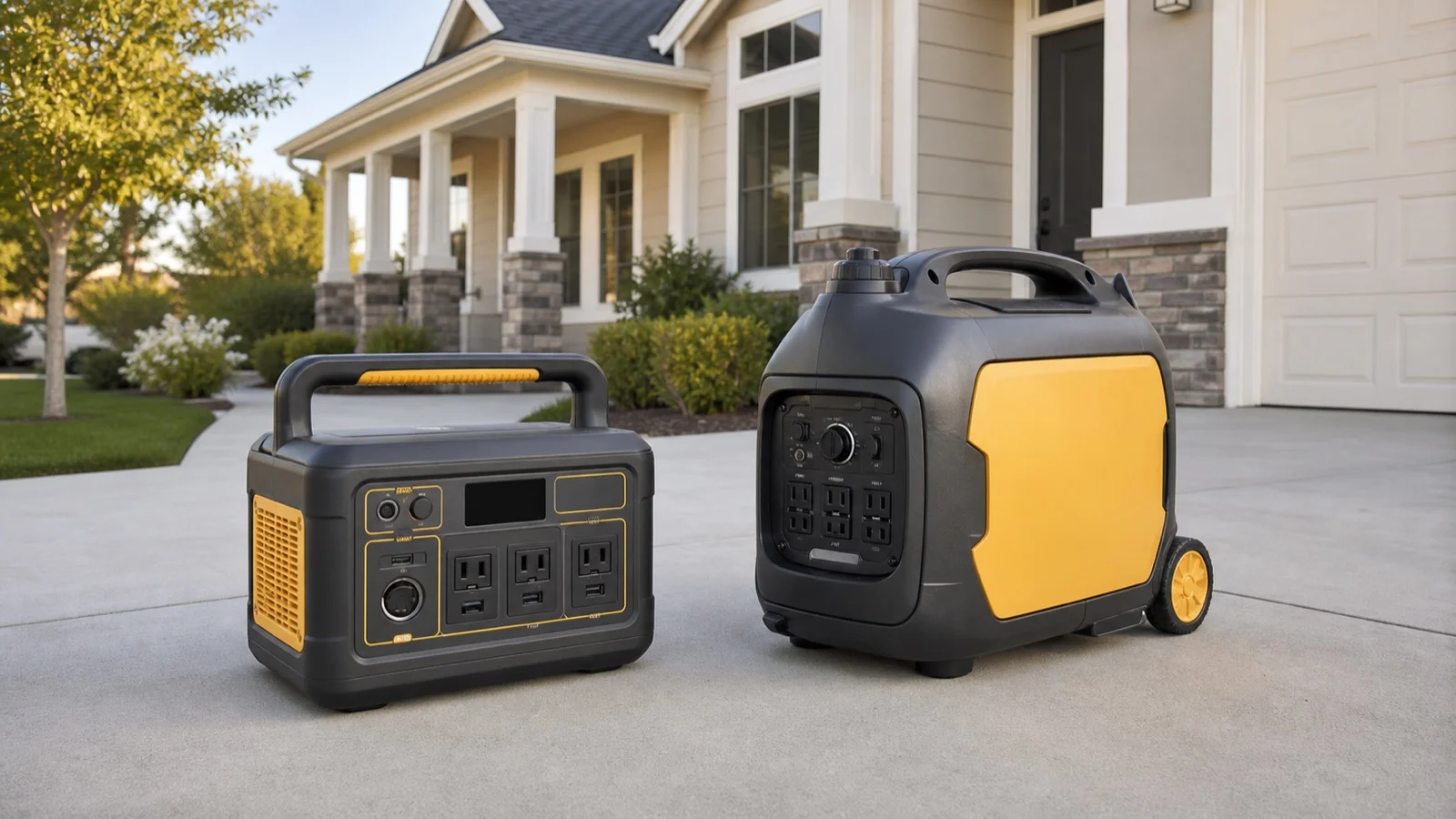
Portable power stations and generators can both keep essential equipment running during an outage, but they solve the problem in fundamentally different ways. A power station stores electricity in a battery. A generator makes electricity by burning fuel. The better choice depends on the loads, runtime, operating location, maintenance tolerance, and budget of the household.
Quick answer: Choose a portable power station for quiet indoor operation, electronics, short outages, and simple setup. Choose a generator when you need higher sustained output or multi-day runtime and can operate it safely outdoors. Many resilient homes benefit from both: a battery for immediate indoor power and a generator for longer outages or recharging.
Portable Power Station vs. Generator at a Glance
| Consideration | Portable power station | Portable generator |
|---|---|---|
| Energy source | Stored battery energy | Gasoline, propane, or natural gas |
| Operating location | Usually safe indoors when used as directed | Outdoors only, at least 20 feet from the home |
| Noise | Very quiet | Engine and exhaust noise |
| Runtime | Limited by battery capacity and recharge access | Continues while fuel and maintenance allow |
| Maintenance | Charge, inspect, and store correctly | Fuel, oil, starting battery, engine, and storage service |
| Best fit | Electronics, medical devices, refrigerator cycles, lights | Multiple appliances, pumps, tools, longer outages |
Neither category is automatically better. A huge battery can outperform a tiny generator, and a large generator can waste fuel when powering only a router and lamp. Compare systems around the work you need them to do.
How Portable Power Stations Work
A portable power station combines a rechargeable battery, inverter, charging hardware, and outlets in one enclosure. Capacity is measured in watt-hours (Wh), while inverter output is measured in watts (W). Capacity tells you how much energy is stored; output tells you how large a load the unit can run at one time.
They are quiet, emit no exhaust at the point of use, and can sit near the equipment they power. They start instantly, require no fuel handling, and can recharge from an outlet, vehicle, solar panels, or sometimes a generator. That makes them excellent for internet equipment, lights, CPAP machines, phones, laptops, and refrigerator duty.
The limitation is finite energy. A 1,024Wh battery may provide only roughly 800 to 900Wh of AC energy after reserve and inverter losses. Use the battery runtime calculator instead of dividing advertised capacity by load and assuming a perfect result.
How Portable Generators Work
A generator uses an engine to turn fuel into electrical power. Its output is normally listed as starting watts and running watts. Starting watts cover short motor surges; running watts describe the sustained load. A refrigerator, sump pump, furnace blower, or well pump may start at several times its normal running draw.
Generators offer strong output for their purchase price and can keep operating as long as fuel is safely available. They are often the practical choice for several compressors, pumps, heating equipment, or an outage measured in days rather than hours. They also require oil changes, fuel management, test runs, weather protection, safe cords or transfer equipment, and careful carbon-monoxide precautions.
Use the generator size calculator to build a load list, then check the fuel runtime calculator before deciding how much fuel to store. More wattage is useful only if the household can safely operate and feed the machine.
Safety and Operating Location
A battery power station can usually be operated indoors when it is dry, undamaged, ventilated according to its manual, and not exposed to extreme heat. Do not cover cooling vents, use damaged batteries, or improvise connections to a home electrical panel. Whole-home or circuit-level connections require listed equipment and qualified installation.
A fuel-burning generator must stay outdoors. The CPSC recommends at least 20 feet from the house with exhaust directed away from the home and other occupied buildings. A garage with the door open is not outdoors. Install carbon-monoxide alarms on every level and outside sleeping areas, and never backfeed a receptacle with a double-male cord.
If generator placement is impossible on a small property, apartment balcony, or dense urban lot, a power station may be the only responsible option. The article Total Harmonic Distortion Explained also covers power quality when sensitive electronics are part of the load.
Runtime, Recharging, and Fuel
Battery runtime is predictable once you know usable capacity and average load. Recharging is the harder part during a long outage. Solar can extend runtime, but panel rating is not daily energy production; weather, season, shade, angle, and charging limits matter. Fast AC charging is valuable when grid power returns briefly or a generator is available.
Generator runtime varies with load and fuel. Manufacturer runtime claims are commonly measured at one-quarter load, so they should not be treated as full-output results. Gasoline is energy dense but ages and requires careful storage. Propane stores more cleanly and is useful with dual-fuel models, although cold weather and cylinder size can limit vaporization under heavy loads.
For safe storage and rotation, read Fuel Storage Safety: Store It Right, Store It Safe. A battery avoids that fuel inventory, but enough expansion batteries to cover several days can cost substantially more than a generator and fuel reserve.
Recommended Product Types and Examples
For a compact one-kilowatt-hour battery class, the EcoFlow DELTA 3 Plus provides 1,024Wh of capacity, 1,800W of AC output, and expansion options. It is a practical class for electronics and many refrigerators, but not a whole-home battery. You can compare DELTA 3 Plus packages on Amazon.
For a small premium inverter generator, Honda lists the EU2200i Companion at 1,800 rated watts and 2,200 maximum watts. It is sized for selected essentials rather than a central air conditioner or full electric home. Honda EU2200i listings on Amazon can help compare kits and availability.
For more output and fuel flexibility, Champion’s 4,500-watt dual-fuel open-frame inverter runs on gasoline or propane and includes a carbon-monoxide shutoff system. It is heavier and louder than a small enclosed inverter but supports a broader essential-load plan. Compare Champion dual-fuel inverter generators on Amazon.
Product examples are starting points, not universal recommendations. Verify voltage, continuous output, surge capacity, outlet types, neutral configuration, cold-weather limits, and compatibility with any transfer equipment before purchase.
Which Option Fits Your Home?
Choose a portable power station when:
- You need quiet, simple indoor backup.
- Your priority loads are electronics, communications, medical equipment, lights, or one efficient refrigerator.
- Outages are usually short or you have reliable solar or AC recharging.
- You cannot safely place and operate a generator outdoors.
Choose a portable generator when:
- You need pumps, several appliances, heating equipment, or higher sustained wattage.
- Outages can last several days and fuel is available.
- You have a safe outdoor operating location at least 20 feet from the home.
- You are willing to maintain, test, and store the machine and fuel correctly.
Consider both when:
- You want silent overnight power but generator endurance during the day.
- You need instant battery backup while setting up the generator safely.
- You want to run the generator efficiently in shorter charging windows instead of all night.
Build the System Around Essential Loads
Begin with a list of essential circuits and devices, not a product. Record running watts, startup surge, hours of use, and whether each load must operate continuously. Our guide to choosing the right generator explains voltage, outlets, transfer equipment, and headroom in more detail. For battery-first systems, Home Battery Backup Systems compares the tradeoffs of larger expandable platforms.
A portable power station wins on simplicity and indoor usability. A generator wins on refuelable endurance and output per dollar. The right answer is the smallest safe system that reliably covers the loads your household truly needs, with a tested plan for what happens after the first battery is empty or the first fuel tank runs dry.