

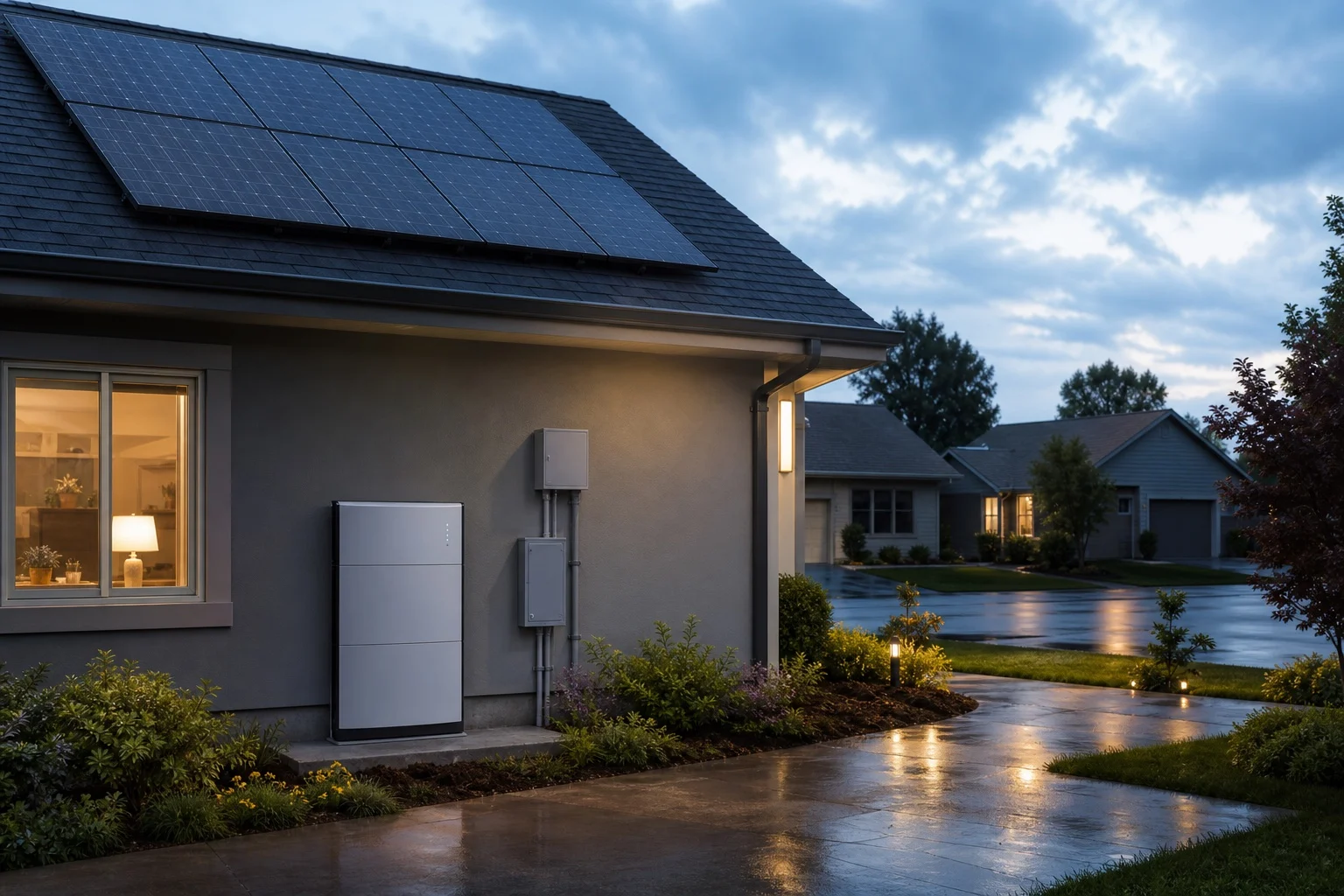
Rooftop solar panels can produce electricity while the sun is shining, but that does not automatically mean the home has power during a utility outage. Most standard grid-tied systems shut down when the grid fails, even on a bright day.
To keep operating, the system needs equipment designed to separate the home from utility lines and create a stable local source of electricity. In most modern residential designs, that means a compatible inverter, automatic isolation controls, and battery storage.
Quick answer: Solar panels can help power a home during an outage only when the system includes outage-capable equipment. A typical grid-tied solar array without batteries or a special backup mode shuts down for safety.
Why Most Solar Systems Shut Down During an Outage
A conventional grid-tied inverter follows the voltage and frequency supplied by the utility. When utility power disappears, the inverter stops exporting electricity. This anti-islanding behavior protects line workers and prevents the solar array from energizing lines that should be treated as de-energized.
The U.S. Department of Energy explains that most residential photovoltaic systems alone are not resilient during a grid outage. The system needs a way to disconnect from the grid and maintain a safe local electrical island before solar can continue serving the home.
What Equipment Lets Solar Work When the Grid Is Down?
An outage-capable solar system typically combines several coordinated parts:
- Solar panels that produce DC electricity.
- An inverter or microinverter system approved for backup operation.
- A battery that stores energy and stabilizes the local system.
- An automatic transfer or isolation device that disconnects the home from the utility.
- A backup panel or energy-management system that controls which loads receive power.
These components must be designed and commissioned as a system. Products such as Tesla Powerwall and the Enphase IQ Battery are examples of manufacturer ecosystems that can support solar backup when installed with their required controls and compatible equipment.
How Solar-Plus-Storage Operates During an Outage
When the grid fails, the backup controller isolates the protected part of the home. The battery immediately becomes the voltage and frequency reference for that local system. Solar can then power active loads and recharge the battery when production exceeds demand.
After sunset, the battery carries the selected loads until it reaches its reserve limit. The next day’s solar production can recharge it, but only after current household demand is met. Clouds, snow, shade, panel orientation, season, and temperature all change how much energy is available.
This is why battery capacity and solar-array size must be considered together. Our guide to battery runtime explains usable capacity, inverter losses, and load, while the battery runtime calculator lets you test specific scenarios.
Can Solar Panels Power a Home Without a Battery?
Some inverter systems offer a limited daytime backup mode that can supply a dedicated outlet or selected loads while sufficient sunlight is available. This is a product-specific capability, not a feature of ordinary grid-tied solar. Output can change quickly when clouds pass, and large motor loads may not start reliably.
Without a battery or another grid-forming source, there is usually no stable place for excess solar energy to go and no support when production suddenly drops. For predictable outage operation, storage is the more flexible approach.
How Much Battery Capacity Do You Need?
Start with energy, not just power. Inverter output in watts determines what can run at one time; battery capacity in watt-hours or kilowatt-hours determines how long those loads can run. A battery may have enough inverter power to start a refrigerator but too little stored energy to carry the home through the night. For a practical example, see how to choose the right portable power station size for a refrigerator.
List the essential loads, their running watts, expected daily hours, and motor surges. Refrigeration, communications, lighting, medical equipment, and pumps usually deserve attention before electric cooking, water heating, or central air conditioning. The guide to essential circuits worth backing up first provides a practical priority list.
For product research, systems such as the Anker SOLIX F3800 on Amazon and EcoFlow DELTA Pro Ultra on Amazon show how expandable batteries can bridge portable power and larger home-backup applications. Confirm panel integration, solar input, 120/240-volt capability, and code requirements before treating any portable system as whole-home equipment.
Whole-Home Backup Versus Essential Loads
Backing up a few circuits is more achievable than reproducing normal whole-home use. A critical-load panel can keep refrigeration, internet, selected lights, outlets, and a sump pump available while excluding large loads that would drain the battery quickly.
Whole-home systems can support more, but energy management still matters. Electric resistance heating, central air conditioning, electric vehicle charging, pool equipment, and water heating can consume a battery rapidly. Automatic load controls can temporarily disable lower-priority equipment when available power is limited.
Compare storage approaches in our guide to home battery backup systems, including capacity, output, expansion, and home integration.
What Happens During a Multi-Day Outage?
A solar battery is not a promise of unlimited power. Each day has an energy budget: battery charge carried into the morning plus solar generated during the day, minus household consumption and conversion losses.
Reduce loads early instead of waiting for the battery to become nearly empty. Raise or lower thermostat settings, delay laundry and vehicle charging, keep refrigerator doors closed, and monitor the weather forecast. Many systems allow the owner to adjust a backup reserve so more energy remains available when severe weather is expected.
Some households combine solar and batteries with a generator for extended outages. The battery handles instant transfer and quiet overnight loads, while the generator can support heavy demand or recharge storage during poor solar weather. A qualified designer must confirm compatibility and switching behavior.
Questions to Ask a Solar Installer
- Will the proposed system operate when the utility grid is down?
- Which circuits are included in the backup panel?
- What are the continuous and surge output limits?
- How many usable kilowatt-hours are available at the chosen reserve setting?
- Can solar recharge the battery while the system is islanded?
- What happens when the battery is full or depleted?
- Can capacity or inverter output be expanded later?
- Which permits, labels, disconnects, and code requirements apply?
The installer should model the actual home loads and explain the limits in plain language. Ask to see the backup mode demonstrated after commissioning rather than discovering the operating sequence during the first outage.
Frequently Asked Questions
Will my existing solar panels work with any battery?
Not necessarily. Compatibility depends on the inverter architecture, battery coupling method, communications, electrical ratings, and approved system design. Have the existing equipment evaluated before choosing storage.
Can solar run central air conditioning during an outage?
Some larger systems can, but the inverter must handle startup and running power and the battery must store enough energy. Load management or a soft-start device may be part of the design.
Do I need to turn solar off during an outage?
A properly installed system handles its approved operating mode automatically. Do not alter disconnects or wiring unless directed by the installer or emergency personnel.
Is solar-plus-storage safer than a generator?
It avoids engine exhaust and fuel handling at the point of use, but batteries and electrical systems still require code-compliant equipment, correct installation, clear labeling, and manufacturer-approved operation.