

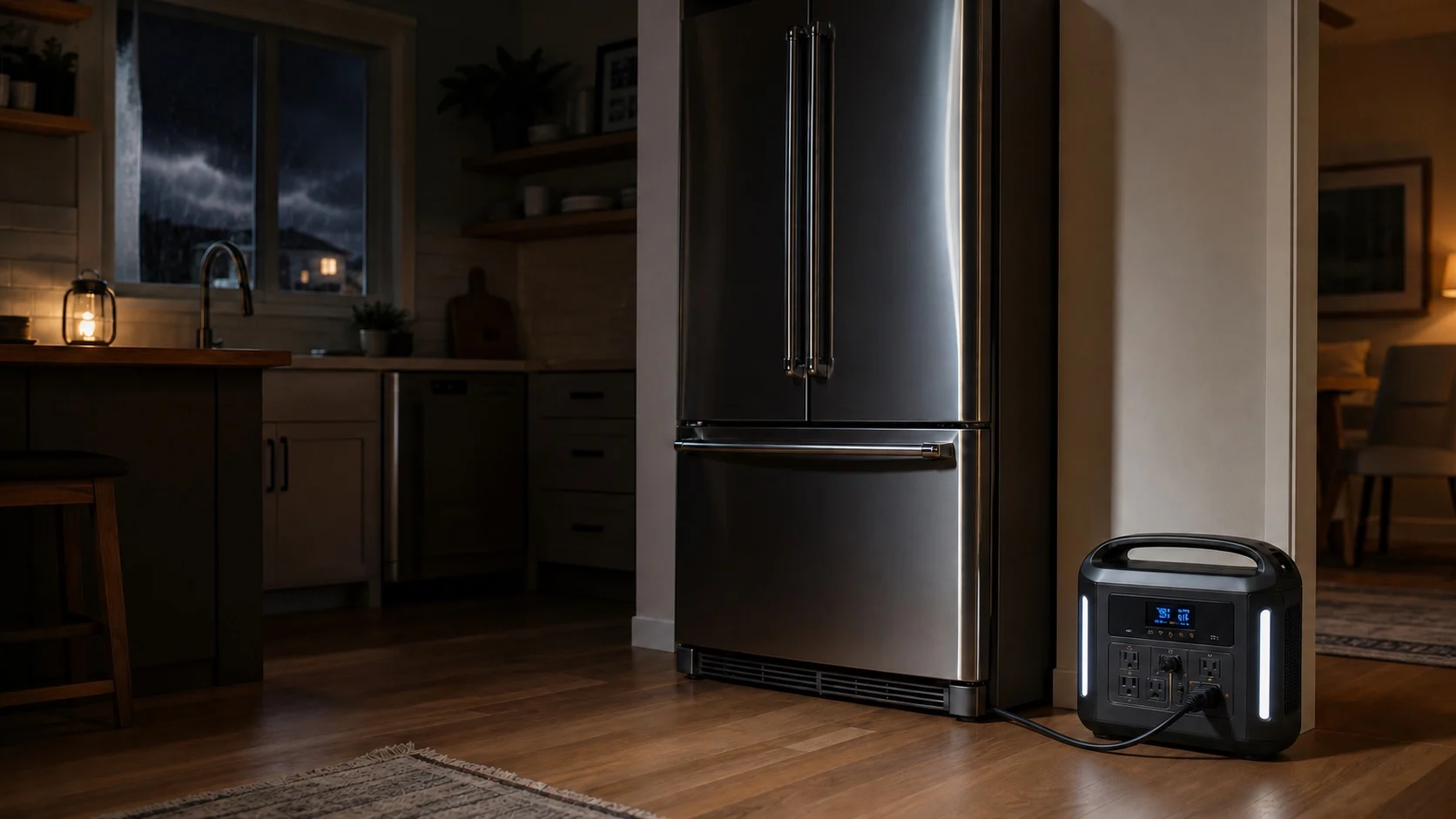
A refrigerator is one of the first appliances most households want to protect during an outage. It is also one of the easiest loads to size badly. The compressor does not run continuously, its startup demand can be much higher than its normal draw, and the advertised battery capacity is never the amount that reaches the appliance.
Quick answer: A 1,000Wh portable power station with at least 1,000W of continuous AC output is a practical starting point for many modern full-size refrigerators. It may provide roughly 10 to 18 hours of runtime under moderate conditions. For more dependable day-long refrigerator backup, a 2,000Wh-class power station provides substantially more breathing room. Always verify the refrigerator’s startup surge and actual daily energy use before buying.
The right size depends on two separate questions: can the inverter start the refrigerator, and does the battery store enough energy to keep it running for the outage you are planning around? This guide works through both, provides realistic runtime tables, and shows where solar charging can extend the plan.
What Size Portable Power Station Will Run a Refrigerator?
For many ordinary household refrigerators, these are useful planning ranges:
- 500Wh class: Short emergency coverage, highly efficient refrigerators, or compact models. This is often too little for comfortable overnight backup.
- 1,000Wh class: A practical minimum for many full-size refrigerators when the goal is overnight or partial-day coverage.
- 2,000Wh class: A stronger choice for roughly a day of refrigeration, an older appliance, hot weather, or a refrigerator plus a small additional load.
- 3,000Wh and larger: Better suited to extended outages, refrigeration plus a separate freezer, or a broader set of essential household circuits.
Those capacity labels describe stored energy, not guaranteed runtime. Two refrigerators of the same size can consume very different amounts of electricity, and the same refrigerator will run longer in a cool kitchen than in a hot one.
You Must Size Both Output and Capacity
Portable power stations advertise several large numbers. For refrigerator backup, two matter most.
AC Output Determines Whether the Refrigerator Can Start
Continuous output, measured in watts, tells you how much power the inverter can supply during normal operation. Surge or peak output describes the brief additional power available when a motor starts.
A refrigerator compressor may draw only a modest amount while running but demand several times that amount for a fraction of a second during startup. If the power station cannot handle that surge, it may shut down even though the battery contains plenty of energy.
For many full-size refrigerators, a pure-sine-wave power station with at least 1,000W of continuous output and generous surge capacity is a sensible starting point. That is not a universal guarantee. Check the appliance label, manual, manufacturer information, or measure the actual startup behavior when possible.
Battery Capacity Determines How Long It Runs
Capacity is measured in watt-hours. A 1,024Wh power station theoretically stores enough energy to supply 1,024 watts for one hour, 102.4 watts for ten hours, or any equivalent combination.
Real AC runtime is lower because the inverter consumes energy and the battery-management system keeps part of the pack in reserve. Using 80% to 90% of the advertised capacity is a reasonable planning range. Our battery-runtime guide explains these losses in more detail.
How Much Electricity Does a Refrigerator Use?
Do not size a battery from the refrigerator’s maximum nameplate wattage alone. That number may describe a worst-case operating condition rather than average energy use over an entire day.
The most useful number is annual energy consumption in kilowatt-hours per year. It appears on many EnergyGuide labels and in manufacturer specifications. Current ENERGY STAR refrigerator listings show how widely consumption varies by refrigerator type and size; ENERGY STAR notes that larger refrigerators generally consume more energy, while efficient compressors and improved insulation help certified models reduce electricity use.
Convert annual energy use into a daily estimate with this formula:
Annual kWh × 1,000 ÷ 365 = watt-hours used per day
For example, a refrigerator rated at 500 kWh per year uses an estimated:
500 × 1,000 ÷ 365 = 1,370Wh per day
That equals an average load of about 57 watts across 24 hours. The compressor will draw more than 57 watts when it is operating and nothing close to that when it is resting. The average is useful for runtime; the compressor’s highest startup draw is useful for inverter sizing.
Portable Power Station Refrigerator Runtime Table
The table below assumes 85% usable battery capacity. The 50W average-load column represents a relatively efficient refrigerator under favorable conditions. The 75W column represents a larger, older, warmer, or more frequently opened refrigerator.
| Advertised battery capacity | Usable energy at 85% | Runtime at 50W average | Runtime at 75W average |
|---|---|---|---|
| 500Wh | 425Wh | About 8.5 hours | About 5.7 hours |
| 1,000Wh | 850Wh | About 17 hours | About 11.3 hours |
| 2,000Wh | 1,700Wh | About 34 hours | About 22.7 hours |
| 3,000Wh | 2,550Wh | About 51 hours | About 34 hours |
These are planning estimates, not promises. Defrost cycles, ice makers, room temperature, food temperature, door openings, battery temperature, and inverter idle draw can all change the result. Enter your measured or label-based numbers in the Home Power Matrix battery runtime calculator for a more specific estimate.
Is a 500Wh Power Station Enough for a Refrigerator?
Sometimes, but it leaves little margin. A 500Wh unit may handle a compact refrigerator or provide several hours for an efficient full-size model. It can be useful for bridging a short outage, but it is a fragile plan if the outage begins before bedtime, the kitchen is hot, or the battery is not fully charged.
Output matters here too. A small station may advertise enough watt-hours for several hours of operation but use an inverter that cannot start the compressor. Check capacity, continuous output, and surge output separately.
Is a 1,000Wh Power Station Enough?
A 1,000Wh-class station is the practical sweet spot for many households seeking refrigerator-only backup. It is portable enough to move, large enough to cover a meaningful outage, and commonly paired with inverters that can handle ordinary appliance loads.
For a refrigerator averaging 50 to 75 watts over time, 1,000Wh may provide roughly 11 to 17 hours after normal conversion losses. A very efficient model may run longer. An older side-by-side refrigerator in a hot room may run for less.
This class works best when you have a recharge plan or when outages in your area are usually shorter than a day.
When a 2,000Wh Power Station Makes More Sense
Move into the 2,000Wh class when you want a full-day planning target, need more reserve, own an older refrigerator, or expect to power a router, lights, phones, or another small appliance at the same time.
That extra capacity is particularly useful during summer outages. High room temperature makes the compressor work harder, while opening the door repeatedly allows cold air to escape. A larger battery cannot fix wasteful habits, but it provides more margin when conditions are less than ideal.
Portable Power Station Examples by Capacity
Affiliate disclosure: Home Power Matrix may earn a commission from qualifying purchases made through the Amazon links below, at no additional cost to you. Product specifications and availability can change; verify the current listing before purchasing.
Approximately 1,000Wh: Anker SOLIX C1000 Gen 2
According to Anker’s current specifications, the Anker SOLIX C1000 Gen 2 is rated at 1,024Wh with 2,000W of AC output. That gives it substantially more inverter output than a refrigerator normally needs while placing it in the practical overnight-backup capacity class. It is a sensible example for a homeowner who wants refrigerator coverage plus limited electronics or lighting.
The original 1,056Wh, 1,800W Anker SOLIX C1000 may also be worth comparing when pricing changes. Our broader Anker SOLIX guide explains how these smaller models fit into the company’s expandable backup lineup.
Approximately 2,000Wh: Anker SOLIX F2000
The Anker SOLIX F2000 is rated at 2,048Wh with approximately 2,400W of output. The larger battery makes it more comfortable for day-long refrigerator planning or a refrigerator paired with selected low-wattage essentials. It is much heavier and more expensive than a 1,000Wh unit, so the extra capacity should solve a real need rather than merely produce a more impressive number.
Expandable High-Capacity Backup: Anker SOLIX F3800
The 3.84kWh Anker SOLIX F3800 is far more system than most households need for one refrigerator. It becomes relevant when refrigeration is only one part of a larger backup plan involving a freezer, pumps, multiple circuits, 120/240-volt capability, or expansion batteries.
Before spending at this level, compare portable systems with permanently connected home battery backup systems and confirm how the equipment will connect to the loads you intend to support.
Can Solar Panels Keep the Refrigerator Running Longer?
Yes, but only when the solar array can replace enough energy during the day to cover the refrigerator’s daily consumption and normal charging losses.
If the refrigerator uses 1.37kWh per day, the panels must deliver more than 1.37kWh to the battery because solar conditions and charge conversion are not perfect. A nominal 400W array does not produce 400 watts from sunrise to sunset. Clouds, shade, season, panel angle, temperature, and the power station’s solar-input limit all affect daily harvest.
Solar works best as a range extender: the battery handles compressor starts and nighttime operation, while the panels replenish energy during useful daylight. Our guide to using solar panels during a power outage explains why ordinary grid-tied panels shut down and what equipment allows solar-plus-storage to operate safely.
How to Connect a Refrigerator Safely
A portable power station designed for indoor use can usually run beside the appliance, provided it remains dry, has adequate airflow, and stays within the manufacturer’s temperature limits.
- Plug the refrigerator directly into the power station when the cord reaches safely.
- If an extension cord is necessary, use a grounded appliance-rated cord sized for the refrigerator and the distance.
- Keep cords away from water, pinching, sharp edges, doorways, and walking paths.
- Do not connect the power station to a household receptacle to energize home wiring. That is backfeeding and can create lethal hazards.
- Use listed transfer equipment and a qualified electrician for hardwired circuit backup.
- Never operate a gasoline, propane, or diesel generator indoors or use one as though it were a battery power station.
If you are deciding between stored battery power and engine-driven equipment, compare the tradeoffs in Portable Power Station vs. Generator.
Ways to Extend Refrigerator Runtime
- Keep the doors closed. Every inspection of the milk costs cold air.
- Start with a cold appliance. A refrigerator already at temperature uses less emergency energy than one cooling warm groceries.
- Disable optional features. Turn off the ice maker and unnecessary door heaters when the manufacturer permits it.
- Cool the room safely. Keep the appliance away from direct sun and heat-producing equipment without blocking ventilation.
- Power only what matters. Adding a microwave, coffee maker, or space heater can drain a refrigerator battery astonishingly quickly.
- Measure instead of guessing. A plug-in electricity meter can reveal both daily consumption and compressor behavior before an emergency.
Battery backup does not replace food-safety judgment. The USDA Food Safety and Inspection Service advises that an unopened refrigerator keeps food safely cold for about four hours, while a full freezer can hold temperature for approximately 48 hours and a half-full freezer for about 24 hours. Use an appliance thermometer and follow the detailed steps in our guide to keeping refrigerator and freezer food safe during outages.
A Simple Refrigerator Power Station Sizing Checklist
- Find the refrigerator’s annual kWh rating or measure 24-hour energy consumption.
- Convert that number to watt-hours per day.
- Choose the outage duration you want to cover.
- Add inverter losses and at least a modest emergency reserve.
- Verify continuous running watts and compressor startup surge.
- Add every other device you plan to run from the same station.
- Decide how the battery will recharge during a multi-day outage.
- Test the complete setup before severe weather arrives.
Do not buy by battery capacity alone. A useful system has enough inverter output to start the appliance, enough stored energy for the desired runtime, and a safe connection plan you can execute in the dark.
Frequently Asked Questions
Can a 500W portable power station run a refrigerator?
Possibly, but 500W describes inverter output rather than battery capacity. Some efficient refrigerators may run from a 500W inverter, yet the station can still fail during compressor startup. Check both surge output and watt-hour capacity.
How long will a 1,000Wh power station run a refrigerator?
A reasonable planning range for many full-size refrigerators is roughly 10 to 18 hours after inverter losses. Actual runtime depends on daily appliance energy use, room temperature, door openings, defrost cycles, battery condition, and other connected loads.
Do you need a pure sine wave inverter for a refrigerator?
A pure-sine-wave inverter is the preferred choice for refrigerator compressors and modern electronic controls. It more closely matches utility power and avoids the additional motor heating, noise, or compatibility problems that modified-wave inverters can cause.
Can a portable power station run a refrigerator and freezer together?
Yes, if the inverter can handle both normal loads and the possibility that both compressors start close together. Add their daily energy consumption and allow additional surge headroom. A 2,000Wh or larger system is often a more practical starting point than a 1,000Wh unit for two appliances.
Can you leave a refrigerator connected to a power station all the time?
Only if the manufacturer explicitly supports that use and its pass-through or UPS mode is appropriate for motor loads. Check transfer time, maximum bypass current, ventilation requirements, battery-care guidance, and warranty terms before treating a portable station as a permanent refrigerator UPS.
How much solar is needed to run a refrigerator?
Size solar from the refrigerator’s daily watt-hour consumption, not only its running watts. The array must harvest enough energy during realistic sun conditions to replace daily use plus charging losses, while the battery must cover nighttime and poor-weather operation.