

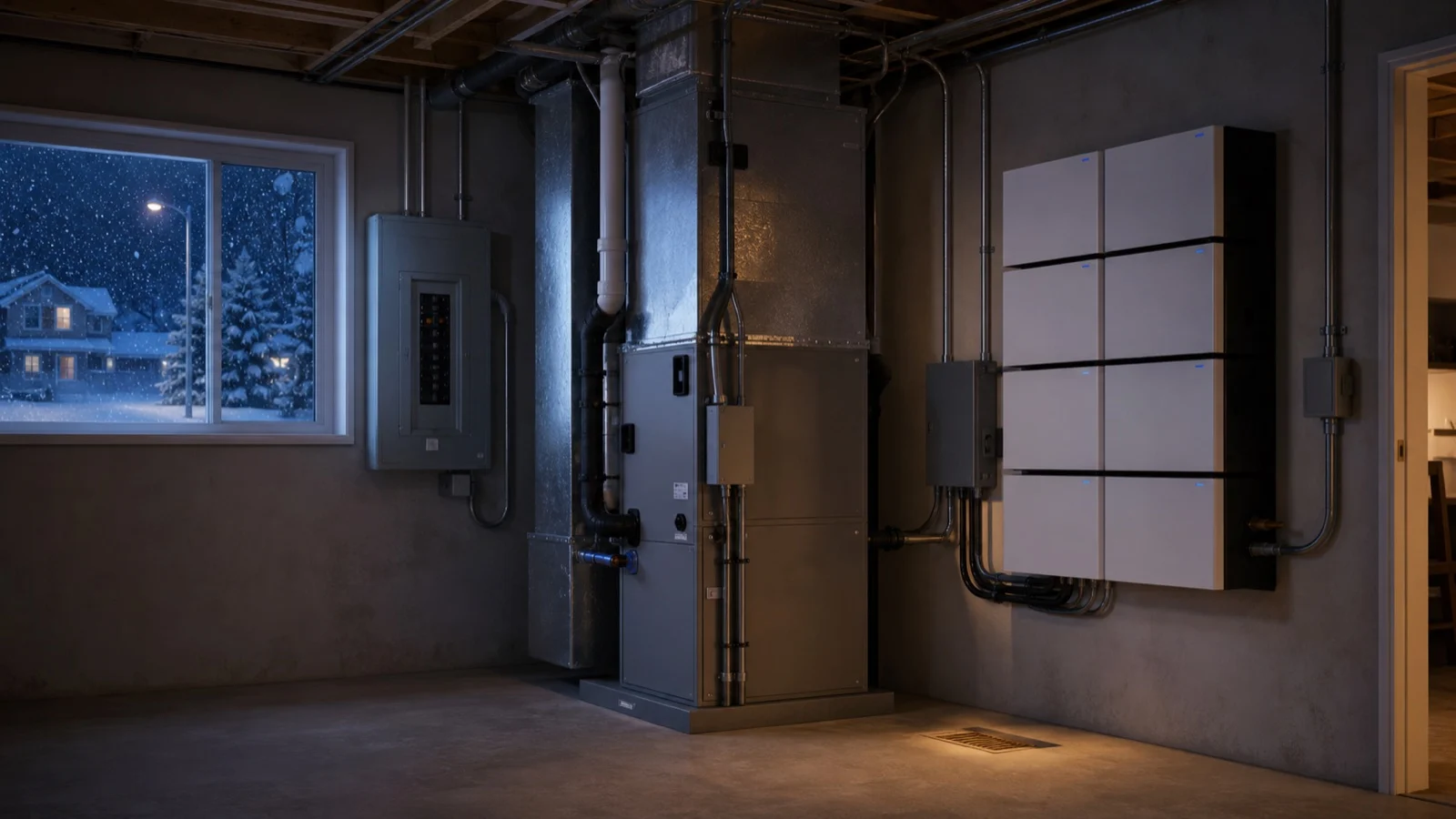
Electric heat creates a particularly difficult backup-power problem. A refrigerator or gas-furnace blower may need hundreds of watts; a central electric furnace can demand tens of thousands. That difference determines whether a portable generator is useful, whether a home battery lasts through the night, and whether powering the furnace is realistic at all.
Quick answer: Most central electric furnaces require a large 240-volt generator or whole-home battery system, not an ordinary portable power station. A 10kW electric furnace may need a generator in roughly the 12–14kW class before other household loads are added, while a 15kW furnace may push the requirement toward 18–20kW. Use the equipment nameplate and a professional load calculation—never furnace size alone—to select and connect backup power.
The first step is identifying what kind of electric heating equipment you actually have. An electric resistance furnace, heat pump, and gas furnace with an electric blower can all move warm air through ducts, but their electrical demands are radically different.
Why an Electric Furnace Is So Difficult to Back Up
An electric furnace produces heat by passing electricity through resistance elements. The blower then moves air across those hot elements and through the ductwork. The design is mechanically straightforward, but generating heat directly from electricity requires a large continuous electrical load.
The U.S. Department of Energy explains that electric resistance furnaces convert almost all incoming electricity into heat at the equipment. That sounds efficient, but electricity can still be an expensive heating fuel, and duct losses occur after the heat is created.
Unlike a compressor motor, resistance heating elements do not normally create an enormous momentary startup surge. The problem is sustained demand. A furnace that activates 10kW of heat is asking the backup source to deliver approximately 10kW for as long as that stage remains energized, plus the blower and controls.
That makes an electric furnace different from many loads covered by the Home Power Matrix generator size calculator. You are not merely clearing a brief startup spike; you are carrying an extremely large load through every heating cycle.
First, Identify the Heating System You Have
Before using any sizing table, look at the equipment label, electrical panel, thermostat configuration, installation documents, and model number. If the answer remains unclear, ask an HVAC technician or electrician.
Central Electric Resistance Furnace
A central electric furnace uses heating-element banks inside an air handler. It is commonly supplied by one or more large 240-volt breakers and may be rated in staged increments such as 5kW, 10kW, 15kW, or 20kW. This is the primary system discussed in this guide.
Heat Pump With Auxiliary Electric Heat
A heat pump moves heat rather than creating all of it through resistance. The compressor and air handler can require considerably less electricity than a resistance furnace, but auxiliary or emergency heat strips may add 5kW, 10kW, or more when they activate.
The Department of Energy reports that modern heat pumps can reduce heating electricity use by as much as 75% compared with electric resistance furnaces and baseboards. However, that advantage can shrink abruptly during backup operation if the system calls for resistance heat. Our sizing plan must account for the actual compressor, blower, defrost behavior, and installed heat-strip package—not just the thermostat’s ordinary reading. See the DOE heat-pump overview for the efficiency distinction.
Gas, Oil, or Propane Furnace
A combustion furnace still needs electricity for its blower, ignition, controls, and safety devices, but it does not create its heat with a 10–20kW resistance bank. Its backup-power requirement is usually much smaller. Do not apply an electric-furnace generator table to a gas furnace.
Electric Baseboard or Wall Heat
Baseboard and wall heaters are separate branch-circuit loads rather than one central furnace. Backing up every heater may still require enormous capacity, but a professionally designed plan might energize only one occupied zone. That is a different strategy from attempting to run whole-house central heat.
How Many Watts Does an Electric Furnace Use?
The furnace nameplate and installation documents are the authoritative sources. Look for kilowatts, volts, amps, minimum circuit ampacity, and the size of each heating kit or stage.
Use these conversions when the label provides only some of the information:
Watts = volts × amps
Kilowatts = watts ÷ 1,000
For example, a 240-volt heating stage drawing 41.7 amps consumes approximately 10,000 watts, or 10kW. The blower, controls, and any other loads must be added separately.
The following table illustrates why nameplate capacity matters. Generator ranges are rough planning classes for the furnace alone, not purchase recommendations. They include modest operating headroom but cannot account for blower startup, generator derating, fuel type, simultaneous household loads, or manufacturer requirements.
| Electric heat rating | Approx. current at 240V | Energy used per full-output hour | Rough generator class before other loads |
|---|---|---|---|
| 5kW | 20.8A | 5kWh | Approximately 7–8kW |
| 10kW | 41.7A | 10kWh | Approximately 12–14kW |
| 15kW | 62.5A | 15kWh | Approximately 18–20kW |
| 20kW | 83.3A | 20kWh | Approximately 24–26kW |
Some furnaces stage their elements instead of energizing the entire heat kit at once. That can reduce demand during mild weather, but backup power must be designed around the stages the system can actually call during cold conditions. Do not assume the furnace will remain in its lowest stage during an emergency.
What Size Generator Runs an Electric Furnace?
A generator must satisfy four requirements:
- Voltage: Most central electric furnaces require 240-volt service.
- Continuous output: The generator must carry the active heating elements, blower, controls, and every other energized circuit.
- Motor starting capability: The blower may briefly demand more power when starting.
- Safe connection: A hardwired furnace cannot simply be treated like a lamp with an extension cord.
A 10kW furnace does not automatically pair with a generator advertised as “10,000 starting watts.” Starting watts are a temporary peak rating. The furnace’s resistance elements create a continuous load, so the generator’s running-watt rating is the relevant number.
Generator output can also change with fuel and operating conditions. A tri-fuel model may provide less power on natural gas than gasoline, and elevation or high temperature can reduce available output. Add the refrigerator, well pump, lighting, or other essential circuits, and the required generator can grow quickly. Our guide to choosing a home generator walks through those broader decisions.
For many 15–20kW electric furnaces, a permanently installed standby generator is more realistic than a portable unit. That does not mean every standby generator is large enough. The installer still needs the furnace’s connected load, the rest of the backup panel, fuel availability, and local electrical requirements.
Can a Portable Power Station Run an Electric Furnace?
Usually not. Most portable power stations fail one or more of the key tests: sufficient continuous wattage, native 120/240-volt output, enough stored energy, or an approved way to serve the hardwired furnace circuit.
Large home-oriented battery systems demonstrate the gap. According to Anker’s published specifications, the SOLIX F3800 provides 6,000W of 120/240-volt output and stores 3.84kWh in its base configuration. The Anker SOLIX F3800 on Amazon is a legitimate high-output backup platform, but one base unit still cannot supply a 10–20kW resistance furnace.
EcoFlow lists the DELTA Pro Ultra at 7,200W of 120/240-volt output with 6kWh of storage in a one-battery configuration. Homeowners can compare current EcoFlow DELTA Pro Ultra configurations on Amazon, but its impressive specifications do not override the furnace nameplate: a standard single-inverter configuration remains below a 10kW heating load.
Affiliate disclosure: Home Power Matrix may earn a commission from qualifying Amazon purchases at no additional cost to you. Product configurations change; verify current manufacturer specifications and compatibility before purchasing.
These systems can still be valuable. They may support a heat pump operating without auxiliary strips, a smaller heating stage where the equipment and controls permit it, or selected household loads while another safe heat source protects occupants. Larger systems can also combine inverters and expansion batteries, but that moves the project from “portable power station” into professionally designed home backup.
Our comparison of portable power stations and generators explains why inverter output and stored energy solve different problems.
How Long Would a Home Battery Run Electric Heat?
Battery runtime begins with a simple energy calculation:
Runtime in hours = usable battery kWh ÷ heating load in kW
The table below shows theoretical runtime at uninterrupted full output. Real runtime will be shorter because of inverter losses, battery reserves, cold-temperature performance, blower consumption, aging, and other connected loads. A battery system also needs enough inverter output to serve the furnace; energy capacity alone does not establish compatibility.
| Nominal battery storage | At a 5kW load | At a 10kW load | At a 15kW load |
|---|---|---|---|
| 3.84kWh | 46 minutes | 23 minutes | 15 minutes |
| 6kWh | 72 minutes | 36 minutes | 24 minutes |
| 13.5kWh | 2.7 hours | 1.35 hours | 54 minutes |
| 27kWh | 5.4 hours | 2.7 hours | 1.8 hours |
Heating does cycle, so elapsed clock time may be longer than the full-output figures. But the table reveals the core problem: resistance heat can consume an entire ordinary home battery in only a few cumulative heating hours. Use the battery runtime calculator with your actual heating stage and usable storage, then apply the additional losses described in Battery Runtime Explained.
This is also why solar cannot be treated as instant rescue. Winter days are shorter, storms reduce production, snow can cover panels, and the array may generate far less power than the furnace consumes. Solar plus substantial storage can support a carefully designed system, but ordinary grid-tied panels shut down during outages unless compatible islanding equipment is installed. Our guide to using solar panels during an outage explains that limitation.
Where Electric-Heat Backup Matters Most
Electric heat is a national issue, but the risk looks different across regions. The U.S. Energy Information Administration reported that electricity was the main space-heating fuel for 42% of U.S. households in 2024.
Southeast
Electric heating is especially common across the South, where heat pumps and electric furnaces fit generally milder winters. The backup challenge still matters during hurricanes, ice storms, and unusual cold snaps. A heat pump may be practical to support until auxiliary resistance strips activate, so homeowners need to know both loads.
Mid-Atlantic and Northeast
Electric heating serves a smaller share of homes in many northeastern states, but cold weather and high electricity prices make resistance heat especially painful. EIA data for March 2026 placed average residential electricity prices at 23.49 cents per kWh in New Jersey and 20.92 cents in Pennsylvania. At those statewide averages, a 15kW furnace costs roughly $3.52 or $3.14 for each cumulative hour at full output before blower use.
That is relevant in places ranging from northern New Jersey to Pennsylvania’s Poconos, where sustained freezing weather raises both heating cost and outage stakes. It is an example, not a geographic limit: the same calculation applies anywhere after substituting the local utility rate.
Pacific Northwest
Historically abundant hydroelectric power helped make electric heating common in the Pacific Northwest. The EIA’s Washington profile reports that three in five Washington households use electricity as their primary heating source. Winter wind and ice outages can therefore leave a large number of households confronting the same furnace, baseboard, or heat-pump backup question.
Cold-Climate Heat-Pump Markets
Cold-climate heat pumps are expanding in New England, the Upper Midwest, and other northern markets. They can be far easier to back up than pure resistance furnaces—but only when the backup design prevents unexpected auxiliary-strip demand and still respects defrost and manufacturer requirements. Never disable safety controls or alter heat-strip operation without qualified HVAC guidance.
Safe Ways to Connect Backup Power
An electric furnace is normally a hardwired 240-volt load. Safe backup typically involves a listed transfer switch, an approved interlock arrangement where permitted, a critical-loads panel, or an integrated home energy system designed for the equipment.
The Electrical Safety Foundation International warns that a transfer switch must isolate utility and generator power to prevent deadly backfeed, and it recommends qualified-electrician installation. Never connect a generator to a receptacle to energize household wiring.
If a fuel-powered generator is part of the plan, carbon monoxide safety is nonnegotiable. The U.S. Consumer Product Safety Commission says to operate portable generators outdoors at least 20 feet from the home with exhaust directed away. Maintain battery-backed alarms on every level and outside sleeping areas; a straightforward model such as the First Alert CO400 battery-operated carbon-monoxide alarm can remain active when utility power is unavailable.
Power quality also matters for variable-speed blowers, thermostats, communicating HVAC systems, and inverter-driven heat pumps. Review generator total harmonic distortion and follow the HVAC manufacturer’s power requirements before connecting sensitive equipment.
When Powering the Furnace Is Not Practical
The smartest outage plan may be to stop trying to reproduce normal whole-house heating. Prioritize people, plumbing, and one safely occupied area.
- Reduce heat loss: Close blinds and curtains, block obvious drafts without obstructing required ventilation, and isolate unused rooms.
- Protect plumbing: Know where the main water shutoff is, insulate vulnerable pipes, and follow local guidance for freeze protection.
- Use lower-power personal warmth: Layer clothing and bedding. When the manufacturer permits safe use, a heated blanket consumes dramatically less energy than a resistance furnace; the Sunbeam Royal Luxe heated blanket is one specific example with adjustable heat and automatic shutoff. Inspect it before use, keep it flat as directed, and never use damaged heated bedding.
- Choose one safe zone: If using a listed electric space heater, plug it directly into an appropriate wall outlet or adequately rated backup source, keep clearance from combustibles, and never leave it unattended.
- Set an exit threshold: Decide in advance when indoor temperature, medical needs, road conditions, or expected outage duration mean relocating.
Never heat the house with a gas oven, charcoal grill, camp stove, or indoor generator. The Ready.gov outage guidance emphasizes keeping combustion equipment outdoors and at least 20 feet from building openings.
Add these decisions to a larger household outage plan. A technically impressive battery is not a complete winter strategy if no one knows which circuits to shed, when to shut off water, or when to leave.
Electric Furnace Backup Planning Checklist
- Confirm whether the system is an electric furnace, heat pump, baseboard system, or combustion furnace.
- Photograph the equipment nameplate and every associated breaker.
- Record heating-kit kilowatts, voltage, amperage, blower specifications, and staging.
- List every additional circuit expected to run during the outage.
- Compare the total with continuous—not merely starting—generator output.
- Account for reduced generator output on alternate fuels and at elevation.
- Calculate battery runtime from usable kWh and realistic heating stages.
- Have a qualified electrician design the transfer and connection equipment.
- Test the complete system under supervision before winter weather.
- Prepare a lower-energy heating and relocation plan in case backup power is insufficient.
Frequently Asked Questions
Can a portable generator run an electric furnace?
Some large portable generators can run smaller electric furnaces or limited heating stages, but many central electric furnaces require more continuous output than a portable generator provides. The generator must supply 240 volts, carry the active heating elements and blower, and connect through approved transfer equipment.
What size generator do I need for a 10kW electric furnace?
A 10kW electric furnace may require a generator in roughly the 12–14kW running-output class for the furnace alone. The final size must include the blower, controls, generator derating, fuel type, and every other backed-up circuit. Use the equipment nameplate and a professional load calculation.
Can a portable power station run electric heat?
A portable power station may run a small heater, one baseboard zone, or certain heat pumps when its voltage, continuous output, and connection method are compatible. Most ordinary power stations cannot run a 10–20kW central electric resistance furnace, and their batteries would drain quickly even if inverter output were sufficient.
How long will a battery run an electric furnace?
Divide usable battery capacity in kilowatt-hours by the active furnace load in kilowatts, then reduce the result for losses and reserve capacity. A 13.5kWh battery theoretically supports a continuous 10kW load for 1.35 hours before losses, although furnace cycling may extend elapsed clock time.
Is an electric furnace the same as a heat pump?
No. An electric furnace generates heat with resistance elements, while a heat pump moves heat using a refrigeration cycle. Many heat-pump systems also contain auxiliary resistance strips, which can sharply increase electrical demand during cold weather, defrost, or emergency-heat operation.
Can solar panels run an electric furnace during an outage?
Only a properly designed solar-plus-storage system with islanding capability, sufficient inverter output, and substantial battery capacity can support an electric furnace during an outage. Ordinary grid-tied solar shuts down when the grid fails, and winter solar production may be far below a resistance furnace’s demand.