

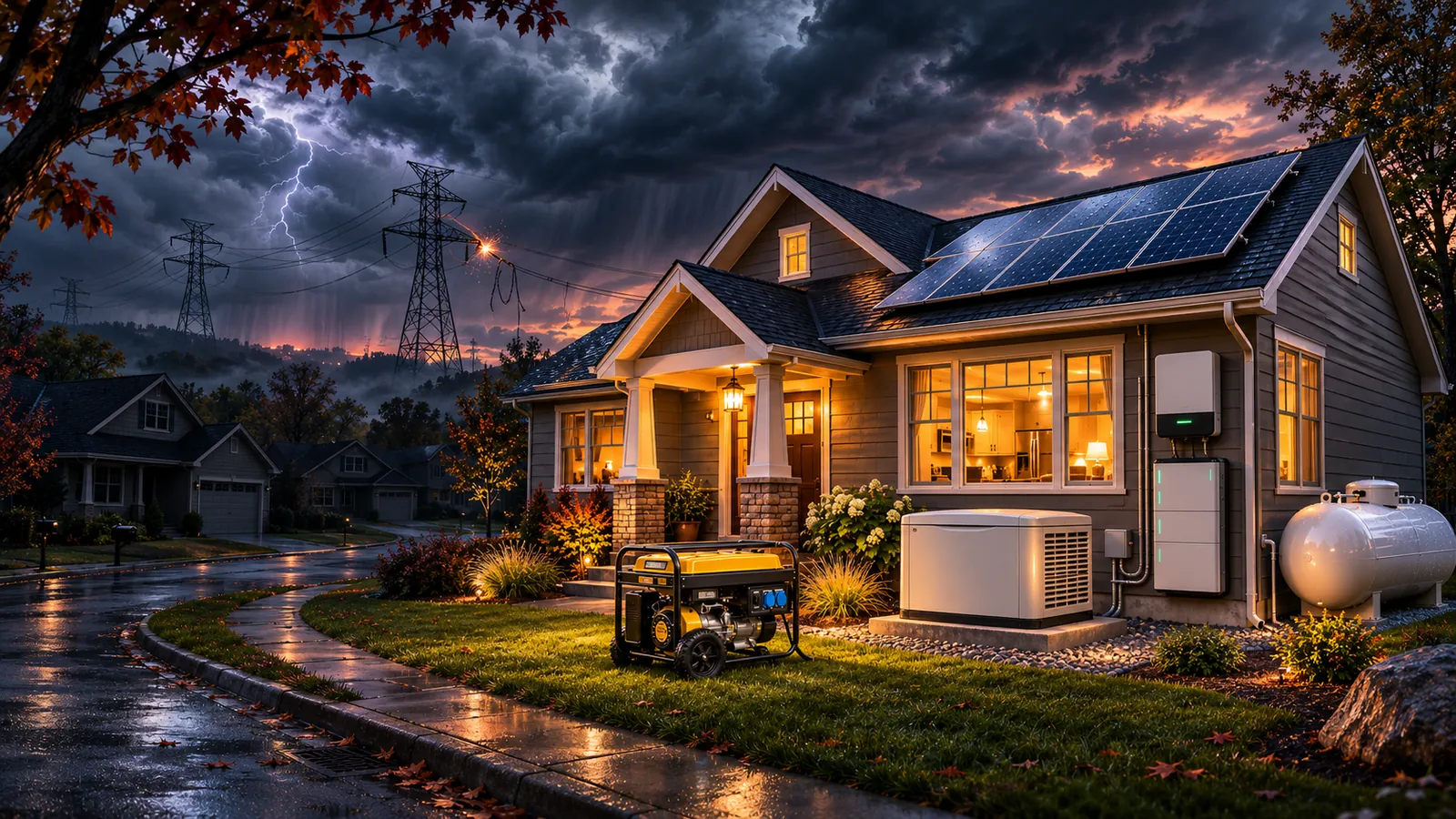
On November 12, 2026, a major Microsoft 365 outage disrupted email, communications, and business operations around the world. The following day, the Federal Aviation Administration ordered a nationwide ground stop after a telecommunications failure temporarily affected departing flights across the United States.
The incidents were not shown to be connected, and neither has been established as a cyberattack. Nevertheless, their timing raised a question extending beyond email and air travel: What happens when the infrastructure we depend on suddenly stops working?
For homeowners, few disruptions are more consequential than losing electricity. A power outage can disable refrigeration, heating and cooling systems, well pumps, communications equipment, and essential medical devices. If an outage continues for several days, even ordinary household tasks become difficult.
Quick answer: Gasoline generators are an accessible starting point for emergency electricity. Propane offers long-term stored fuel, natural gas can support extended operation while pipeline service remains available, and diesel is an option for larger sustained loads. Dual-fuel and tri-fuel generators provide flexibility, while properly configured solar and battery systems can reduce reliance on combustion fuel. The right choice depends on your essential electrical loads, fuel availability, and safe connection options.
You do not need to anticipate a nationwide blackout to benefit from backup power. A severe winter storm, damaged transformer, equipment failure, or localized electrical emergency can create exactly the same need. This guide compares the major energy options, shows how quickly generator fuel can be consumed, and explains how to prepare for outages lasting a day, three days, or longer.
Why Americans Are Concerned About the Power Grid in 2026
The November technology disruptions demonstrated how quickly an infrastructure problem can affect people across the country, even without a malicious attack. Reuters reported on the November 12 Microsoft outage, which affected Outlook, Teams, and other services. Subsequent reporting identified a software defect and cascading server problems rather than evidence of an attack.
On November 13, the FAA experienced instability in its telecommunications network and issued a nationwide ground stop. In its official explanation of the incident, the agency described disruptions affecting communications and radar feeds at multiple air traffic control facilities. Officials did not identify a coordinated cyberattack connecting the two incidents.
Neither event was a failure of the electrical grid. However, both showed how closely modern services depend on interconnected infrastructure—and why homeowners may be concerned about their own ability to cope with disruptions.
Are cyberattacks against the electric grid a real threat?
Yes. Cybersecurity threats to electrical infrastructure are a legitimate concern, although high-profile technology outages do not establish that an electrical attack is imminent. The U.S. Department of Energy’s Office of Cybersecurity, Energy Security, and Emergency Response works to protect energy systems against cyberattacks, physical threats, and other emergencies.
Modern electrical networks depend on industrial control systems, communications links, and complex software. Cybersecurity matters, but it is only one category of risk. Extreme weather, equipment failures, fuel shortages, transmission constraints, and physical damage can interrupt service without any cyberattack.
What NERC’s winter reliability assessment says
On November 18, 2026, the North American Electric Reliability Corporation (NERC) published its 2026–2027 Winter Reliability Assessment. The organization reported improvements in the overall winter reliability outlook, including additional generating resources, delayed retirements, and better cold-weather generator performance. It also highlighted ongoing challenges from rising electricity demand, volatile weather, and natural gas fuel constraints.
NERC did not predict an imminent nationwide grid collapse. Its findings describe a system with improvements and continuing vulnerabilities, especially under severe conditions. That is the sensible context for individual preparedness: the goal is not to predict the next outage, but to reduce its effect on your household.
For a related look at growing electricity demand, see our guide to AI data centers, electricity bills, and grid outage risks.
Gasoline, Propane, Natural Gas, Diesel, and Solar Compared
The first question in backup-power planning is not necessarily which generator to buy. It is which energy source will remain available during the kind of outage you are preparing for. A generator with an enormous electrical output is not very helpful if it runs out of gasoline and local stations cannot operate their pumps. A natural gas generator may run for days, but only while the gas network can deliver enough fuel.
| Energy source | Primary advantage | Main limitation | Best fit |
|---|---|---|---|
| Gasoline | Common, accessible generator equipment | Fuel ages and must be replenished | Affordable portable backup |
| Propane | Excellent long-term storage properties | Runtime limited by tank supply and vaporization capacity | Stored emergency reserves |
| Natural gas | No routine portable refueling while pipeline service works | Dependent on gas delivery and pressure | Extended home backup |
| Diesel | Heavy-duty equipment options for sustained loads | Costs, maintenance, storage, and cold-weather care | Larger backup systems |
| Dual-fuel generator | Gasoline or propane flexibility | Output varies by fuel | Homes wanting a second fuel option |
| Tri-fuel generator | Gasoline, propane, or natural gas | More connection and supply considerations | Homes with access to multiple fuels |
| Solar + battery | Stored electricity without generator exhaust | Limited capacity and weather-dependent recharging | Quiet backup and reduced fuel dependence |
No single source is universally best. A suburban home with a natural gas connection has different options from a rural property with a propane tank, private well, and long driveway vulnerable to winter storms.
Gasoline Generators: Affordable Electricity With a Fuel Storage Problem
Gasoline-powered generators are among the most accessible ways to generate electricity independently of the utility grid. Portable models range from compact inverter generators that can support a refrigerator and electronics to larger open-frame machines that can power selected household circuits.
Their advantages include widely available equipment, relatively low upfront costs, and familiar operation. Their weakness is dependence on a fuel that deteriorates during storage and may become difficult to replenish during a widespread emergency.
Exposure to oxygen, moisture, and temperature changes can degrade gasoline over time. Ethanol-blended fuel introduces additional storage concerns. Fuel stabilizers may slow degradation when used as directed, but they do not restore gasoline that has already spoiled.
There is another limitation during a regional blackout: gas stations generally depend on electricity to operate their pumps. Some have backup generation, but others may be unable to sell fuel. Deliveries and electronic payments can also be disrupted.
How much gasoline should you plan for?
Start with your generator’s manufacturer-published fuel consumption at a load similar to the one you expect to run. For example, if a generator uses approximately 0.5 gallons per hour and you operate it for six hours per day, that is about three gallons per day or nine gallons over three days. This is an example, not a universal fuel-consumption figure.
Use our Fuel Runtime Calculator to estimate your own needs. Store gasoline only in approved containers and quantities permitted by applicable rules. Our fuel storage safety guide covers containers, location, ventilation, and storage precautions.
Propane Generators: A Strong Option for Long-Term Fuel Storage
Propane is appealing for households that want fuel available when an emergency occurs without constantly rotating gasoline. Properly stored propane does not chemically deteriorate the way gasoline does, making it suitable for long-term emergency reserves.
Depending on the generator, propane can come from portable cylinders or larger stationary tanks. Homeowners who already rely on propane for heating, cooking, or other appliances may be able to factor generator demand into an existing supply arrangement, provided the system is properly sized.
The main limitation is how much fuel is available. A standard 20-pound cylinder may run a small generator for a useful period but should not be assumed to provide multi-day backup for a large generator operating substantial loads. Larger stationary tanks can make longer operation practical, but delivery and installation still matter.
Will propane work in freezing temperatures?
It can, but cold weather affects propane’s ability to vaporize and supply a generator at the required rate. Tank size, remaining liquid level, outdoor temperature, and generator demand all matter. A small cylinder may struggle to deliver sufficient vapor to a large generator during freezing weather even if liquid propane remains inside.
Before depending on propane for winter outages, confirm the expected withdrawal rate and tank arrangement with the generator manufacturer and your propane supplier. This is especially important when the same tank supplies home heating.
Natural Gas Generators: Long Runtime Without Portable Fuel Containers
For households with an existing natural gas connection, a compatible generator can be an exceptionally convenient backup option. Rather than repeatedly filling gasoline cans or replacing propane cylinders, it receives fuel through a professionally installed gas connection.
Natural gas can support extended operation as long as the pipeline network delivers sufficient gas and pressure. That may be particularly attractive for maintaining refrigeration, selected heating equipment, pumps, and essential electrical circuits during a multi-day outage.
Will natural gas still work if the electricity goes out?
Often, yes—but not always. The gas distribution network is separate from a home’s electrical service, so many local electricity outages do not automatically interrupt gas delivery. However, severe weather, damaged infrastructure, upstream supply disruptions, or low pressure can limit availability. A natural gas generator is not fully independent of external utilities.
What is required to connect a natural gas generator?
The generator must be specifically designed or manufacturer-approved for natural gas operation. A qualified professional should confirm meter and pipe capacity, regulation, pressure, and the needs of other gas appliances. House wiring also requires an approved transfer arrangement. A natural gas connection by itself does not create a safe whole-home backup system.
Diesel Generators: Heavy-Duty Backup for Larger Loads
Diesel generators are common in commercial facilities, farms, and larger emergency power applications, but they can also be useful for residential properties with substantial electrical needs or an existing diesel fuel supply.
They are available in designs suited to sustained operation and demanding loads. The drawbacks can include higher initial costs, noise, weight, exhaust, and more involved maintenance. Stored diesel can deteriorate or become contaminated, especially when water enters the storage system. Winter operation may require appropriate cold-weather fuel and manufacturer-approved precautions.
For a household that primarily needs refrigeration, communications, lighting, and a gas or oil furnace blower, a smaller gasoline, propane, or multi-fuel generator may be more economical. Diesel becomes more attractive when the power requirements justify it.
Dual-Fuel vs. Tri-Fuel Generators: Why Fuel Flexibility Matters
Dual-fuel generators typically run on gasoline or propane. Tri-fuel generators add natural gas compatibility, giving homeowners three approved choices. That flexibility can be valuable when a preferred fuel is unavailable during a widespread emergency.
A homeowner might normally use natural gas, keep propane for an alternative, and rely on gasoline only if needed. But all three options require prior planning: a tri-fuel label does not mean a home’s natural gas service has adequate capacity or that stored propane will last for days.
Real-world example: Champion 201121 running watts by fuel
The Champion 201121 tri-fuel generator illustrates why fuel selection affects electrical sizing. Its published ratings are:
| Fuel | Running watts | Starting watts |
|---|---|---|
| Gasoline | 8,000W | 10,000W |
| Propane | 7,200W | 9,000W |
| Natural gas | 7,000W | 8,750W |
It provides 1,000 fewer continuous watts on natural gas than on gasoline. That difference can determine whether a generator will run a large well pump, central air conditioner, or several appliances simultaneously. The output rating that matters is the one for the fuel you plan to use.
Starting watts matter too. A motor may need a brief surge above its normal running demand. Our starting watts vs. running watts guide explains the math, and the Generator Size Calculator helps estimate the required capacity.
For model comparison, you can browse tri-fuel generators on Amazon. Compare gasoline, propane, and natural gas output separately, along with the generator’s voltage, outlets, noise, fuel consumption, and manufacturer-approved connections.
How Much Generator Fuel Do You Need for 24 Hours, 72 Hours, or a Week?
Generator wattage determines the electrical load equipment can handle. Fuel capacity and consumption determine how long it can run. These are different specifications, and both matter.
For the Champion 201121, the manufacturer advertises approximately 12.5 hours of gasoline runtime at 50% load from its 8.5-gallon tank. That works out to about 0.68 gallons per hour under the manufacturer’s stated conditions. On propane, Champion advertises approximately five hours at 50% propane-rated load with a 20-pound cylinder.
Extending these published test rates gives the following illustrative consumption estimates:
| Generator operation | Gasoline at stated half load | Propane at stated half load |
|---|---|---|
| 8 hours | 5.4 gallons | 32 pounds |
| 24 hours | 16.3 gallons | 96 pounds |
| 72 hours | 49.0 gallons | 288 pounds |
These are calculations from two different manufacturer test conditions, not a direct fuel-efficiency comparison or a recommendation to store those quantities. Half load is approximately 4,000W on gasoline and 3,600W on propane for this generator. Consumption changes with load, weather, maintenance, and operating conditions. Always plan from your own generator’s specifications.
The larger lesson is that running a substantial generator continuously for several days can consume a great deal of fuel. An effective backup plan often reduces demand, staggers loads, or combines generation with battery storage rather than operating everything around the clock.
Planning for a 24-hour outage
For a short outage, a portable generator and adequate fuel may be enough to maintain refrigeration, essential heating or cooling, communications, lighting, and health-related equipment. A private well or sump pump may create substantial additional demand, especially when its motor starts. Avoid treating every high-watt appliance as an essential load.
Planning for a 72-hour outage
Over three days, fuel conservation becomes more important. Separate equipment that needs automatic power whenever it cycles, such as a refrigerator or sump pump, from equipment that can operate on a schedule. A suitably sized battery can supply selected loads between generator runs. Do not turn off backup power to safety-critical devices simply to save fuel.
Planning for a seven-day outage
A week-long outage adds fuel logistics, oil changes, maintenance, noise, weather exposure, and equipment reliability to the planning problem. A natural gas supply or properly sized stationary propane tank may simplify extended operation. Solar charging can reduce fuel demand when the system is capable of operating during a grid outage. It is also worth considering what happens if a primary generator fails.
Estimate your own fuel requirements with our Fuel Runtime Calculator, using the manufacturer rating closest to your expected load.
Solar and Battery Storage: Electricity Without Combustion Fuel
Fuel-powered generators produce electricity as long as compatible fuel is available, but their operation depends on consuming that supply. Solar panels produce electricity from sunlight, and batteries store electricity for later use. A properly designed combination can reduce fuel deliveries and offer quiet backup for suitable loads.
According to the U.S. Department of Energy’s guidance on solar and resilience, solar-plus-storage can support local electricity needs during outages when the system includes the necessary backup capabilities.
Will normal rooftop solar work during a blackout?
Not necessarily. Many conventional grid-tied solar systems automatically stop exporting electricity when utility service fails, preventing dangerous backfeeding onto utility lines. Outage-capable operation typically requires compatible inverter, isolation, control, and often battery equipment. A house with solar panels is not automatically a house with backup power.
For system details, read our guide to using solar panels during an outage.
How long can a portable battery power essential equipment?
Battery systems have two separate limits: inverter output in watts and stored energy in watt-hours. A power station might be powerful enough to start an appliance but store too little energy to operate it all night.
For example, a 2,000Wh battery with 85% usable AC energy would deliver around 1,700Wh. At a continuous 200W load, that is roughly 8.5 hours of operation under those assumptions. Actual output varies with inverter efficiency, battery condition, temperature, and the load’s cycling behavior.
Our 2,000-watt portable power station guide and Battery Runtime Calculator can help with those distinctions.
Combining a Generator, Battery, and Solar Panels for Longer Outages
One of the most flexible approaches to home backup is a hybrid system. Instead of running a combustion generator for every small load, a battery handles appropriate equipment while a generator supplies substantial loads or recharges storage. Solar panels can also replenish the battery during daylight when sufficient sunlight is available.
| Outage period | Possible power approach | Main consideration |
|---|---|---|
| Daytime | Solar generation, battery charging, and generator support if needed | Weather, panel output, and compatible charging hardware |
| Evening | Battery supports selected lights, electronics, and refrigeration | Usable stored energy and inverter rating |
| Overnight | Quiet battery operation instead of continuous generator use | Enough energy for every required overnight load |
| Cloudy weather | Generator supplies electricity or recharges storage | Fuel availability and approved generator-to-battery compatibility |
Not every generator and power station can be connected or charged in the same way. Confirm voltage, charging input, power quality, isolation, and manufacturer requirements before combining equipment. The advantage is flexibility—not an automatic promise of unlimited electricity.
For a complete system-design discussion, read our Solar + Battery + Generator Home Backup System Guide.
The Most Important Electrical Loads to Back Up First
You may not need whole-home power to make an outage manageable. Prioritizing essential circuits can substantially reduce equipment size and fuel consumption.
- Refrigerator and freezer: Preserve food and temperature-sensitive supplies, accounting for compressor starting demand.
- Gas or oil furnace: Supply the blower, burner controls, ignition, and other electrical components.
- Sump pump: Reduce flooding risk when storms and outages occur together.
- Well pump: Maintain water access for properties without municipal water.
- Lighting and communications: Support essential lights, phones, a radio, and internet equipment when service remains available.
- Medical equipment: Follow equipment-specific backup requirements and an individualized emergency plan.
A gas or oil furnace may need far less electricity than electric heating
A gas or oil furnace obtains most of its heating energy from combustion fuel, while electricity runs its blower, burner, controls, or pumps. Depending on the model, a smaller generator or suitable battery station may be sufficient to keep the heating system operating.
Electrical connections, neutral and grounding arrangements, controls, voltage, and motor starting requirements still matter. Review our guide to running a gas or oil furnace during a power outage rather than improvising a connection to household wiring. For broader prioritization, see the essential circuits worth backing up first.
Five Steps to Prepare Your Home Before the Power Goes Out
1. Calculate your essential electrical demand
Identify the equipment that must operate during an outage, add its realistic running load, and check the surge demand of compressors and motors. Our Generator Size Calculator is a starting point; equipment labels and manufacturer documentation should take priority over generic estimates.
2. Choose a dependable backup energy source
Match fuel or battery storage to the outage duration you want to cover. Gasoline may be the least expensive starting point. Propane provides stored fuel with long shelf life. Natural gas reduces refueling while service remains available. A multi-fuel generator, battery, or solar charging may add useful redundancy.
3. Arrange a safe electrical connection
A qualified electrician can install appropriate transfer equipment or a listed generator inlet arrangement that prevents electricity from feeding utility lines. Individual appliances may also be supplied directly from generator outlets with manufacturer-approved, properly rated cords and safe placement. Never backfeed your home through an ordinary wall outlet.
4. Build a fuel and maintenance plan
Calculate expected fuel consumption, confirm approved storage practices, and think through what happens if local suppliers close. Follow the generator’s service schedule for oil, filters, batteries, and fuel-system care. Stationary systems also need routine inspection and transfer-system testing.
5. Test the complete system
A generator that starts in the driveway may still fail to start a well pump or furnace blower. Test the approved connection and realistic loads before an emergency, including motor starts. Document safe operating instructions so other adults in the household can use the backup system correctly.
Generator Safety: The Rules That Matter Most
Combustion generators produce exhaust containing deadly carbon monoxide. The U.S. Consumer Product Safety Commission advises using portable generators outdoors only, at least 20 feet from the home or other buildings, with the exhaust directed away from windows, doors, and vents.
Never operate a portable gasoline, propane, natural gas, or diesel generator in a house, basement, garage, shed, or other enclosed or partially enclosed area—even with doors open. Keep working carbon monoxide alarms inside the home, including models with battery backup that remain operational during outages.
Follow manufacturer instructions for weather protection, placement, grounding, refueling, and electrical connections. Shut down and allow gasoline equipment to cool before refueling. Generator CO-shutoff features provide extra protection but do not replace safe placement and functioning indoor alarms.
For useful safety equipment, compare carbon monoxide alarms with battery backup on Amazon. If you’re still estimating appliance consumption, a P3 Kill A Watt monitor can help measure ordinary plug-in appliance use, although a typical meter may miss brief motor starting peaks.
Preparing for Grid Outages Without Predicting a Disaster
The November 2026 technology disruptions remind us how dependent everyday life has become on infrastructure operating outside our control. They do not demonstrate that the nation’s electricity grid is about to fail, but they do illustrate the value of redundancy and contingency planning.
Gasoline can supply inexpensive emergency electricity. Propane offers long-term fuel storage. Natural gas can support extended operation when pipeline service remains reliable. Diesel can serve heavier loads, while solar and battery storage reduce dependence on combustion fuel.
The strongest backup plan is not necessarily the biggest or most expensive system. It is the one that matches your essential loads, has a dependable energy supply, and has been installed and tested before an emergency.
Start with the Home Power Matrix Generator Size Calculator to estimate the electrical capacity you need, then use the Fuel Runtime Calculator to see how long your backup supply could last.
Frequently Asked Questions
Could a cyberattack shut down the U.S. power grid?
Cyberattacks can threaten electrical infrastructure, and federal agencies actively work to reduce the risks. The potential consequences depend on the targeted systems and circumstances. The November 2026 Microsoft and FAA failures have not been established as a coordinated attack or as evidence that a nationwide blackout is imminent.
What is the best generator fuel for a prolonged power outage?
It depends on fuel availability and electrical demand. Natural gas can support long runs if pipeline service continues. Propane offers long-term stored reserves. Diesel can suit larger systems. Gasoline is accessible but needs storage management. Dual-fuel and tri-fuel generators provide additional flexibility.
Will natural gas work if the power grid goes down?
Often, yes, because natural gas distribution is separate from a home’s electrical service. However, pipeline failures, severe weather, supply interruptions, or insufficient pressure can still disrupt fuel delivery.
How long will a 20-pound propane tank run a generator?
Runtime depends on the generator and load. Champion rates its 201121 tri-fuel generator for approximately five hours at half of its propane-rated output with a 20-pound cylinder. Smaller generators or lighter loads may run longer.
Is a dual-fuel or tri-fuel generator better for preparedness?
Tri-fuel equipment gives homes with natural gas access a third fuel option. Dual-fuel generators may be more economical when natural gas is unavailable. Either option requires correctly sized supplies and safe connections.
Can solar panels power a home when the grid is down?
Yes, if the solar installation is designed for backup operation. Many ordinary grid-tied systems shut down during outages. Outage-capable configurations use suitable equipment to isolate from the utility grid and serve local loads.
Is a generator cheaper than a home battery?
Portable combustion generators generally cost less upfront for substantial electrical output. Batteries provide quiet operation without exhaust or routine refueling, but runtime is limited by stored energy. Compare total costs over the intended backup duration, including fuel, maintenance, and installation.
How much fuel is needed for three days without power?
Multiply a generator’s expected hourly fuel consumption at your planned load by its planned daily operating hours and the number of days. For example, 0.5 gallons per hour for six hours daily equals approximately nine gallons over three days. Follow safe storage limits and use your generator’s actual consumption data.
Can a generator operate continuously for several days?
Some models support extended operation, subject to the manufacturer’s service intervals, duty cycle, fuel supply, and operating conditions. Oil changes, inspections, and safe refueling may require shutdowns.
What is the most affordable way to prepare for a grid outage?
Begin with the few electrical loads you truly need. A smaller generator or portable battery may keep refrigeration, communications, lights, and a compatible gas or oil heating system functioning without the cost of whole-home backup.
Affiliate disclosure: Some product links are affiliate links. As an Amazon Associate, Home Power Matrix may earn from qualifying purchases at no additional cost to you.