

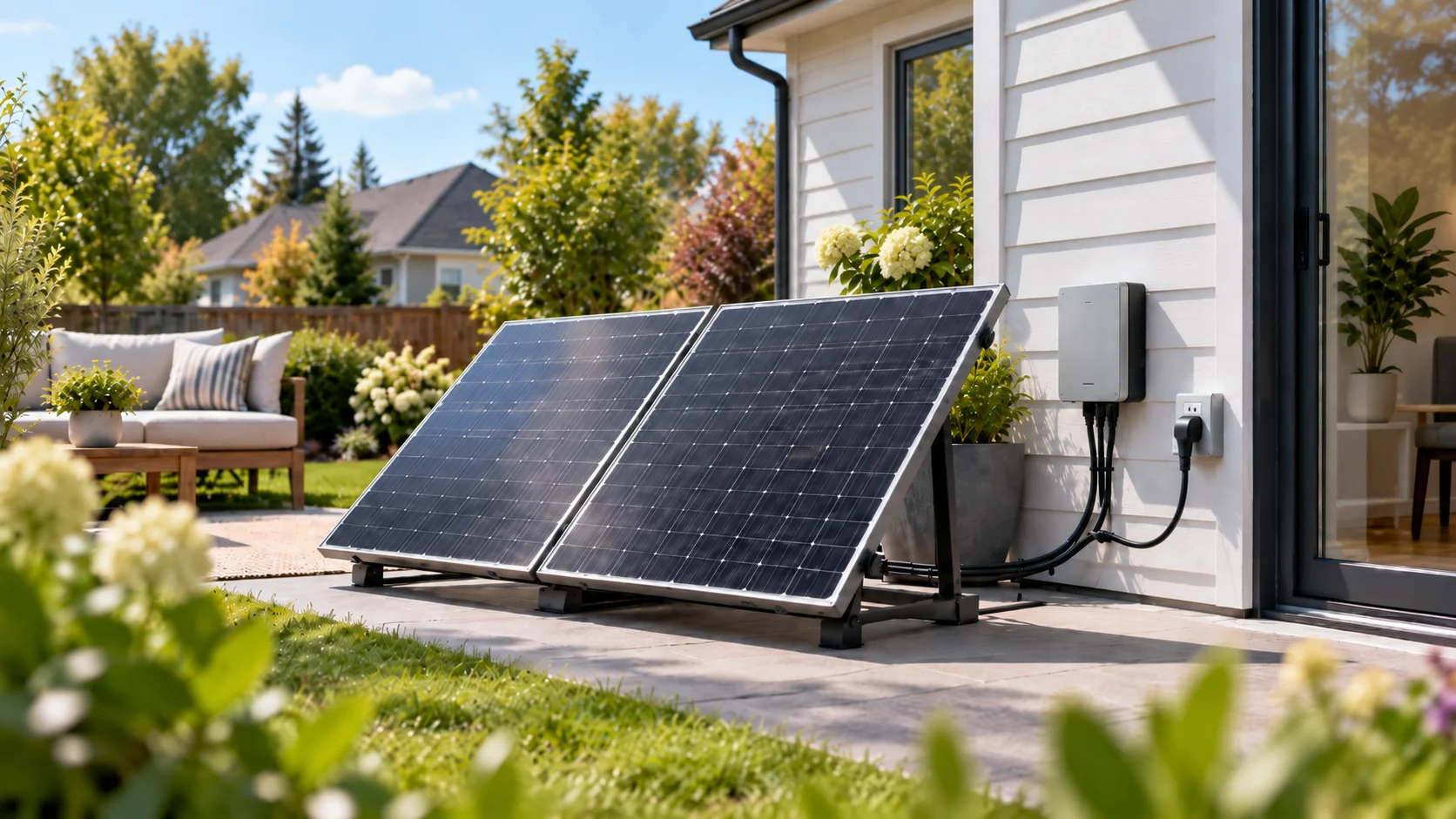
Plug-in solar could make residential solar dramatically easier for homeowners and renters who do not want, cannot afford, or simply cannot install a traditional rooftop solar array.
Instead of permanently wiring a large solar system into a home, a qualifying plug-in solar system uses a small photovoltaic array, inverter, and safety controls designed to supply electricity to the home’s electrical system through an approved receptacle.
The concept is already well established in parts of Europe. In the United States, however, the legal and electrical framework is being written almost in real time. Utah created the first dedicated state pathway in 2025, and several more states enacted plug-in solar legislation during 2026.
Quick answer: Plug-in solar panels, sometimes called balcony solar, are small grid-connected photovoltaic systems designed to offset electricity your home would otherwise buy from the utility. They are not the same as portable solar panels used with a power station, and a normal grid-connected plug-in solar system should not be expected to provide backup electricity during a power outage. State laws, product certification, electrical-code requirements, utility rules, and system design all matter.
This guide explains how plug-in solar works, where dedicated plug-in solar laws currently exist, what is happening in Pennsylvania, why anti-islanding protection matters, and what homeowners should verify before buying equipment.
Last reviewed: September 7, 2026.
What Is Plug-In Solar?
A plug-in solar system is a small photovoltaic system designed to generate electricity and supply that electricity to a building without the conventional permanent interconnection associated with a large rooftop solar installation.
Depending on the product and state requirements, a system may include:
- One or more solar panels
- A microinverter or other inverter that converts DC solar electricity into household AC electricity
- Anti-islanding protection
- Overcurrent and electrical safety controls
- Monitoring equipment
- Mounting hardware
- A cord and approved connection to the building’s electrical system
You may see several names for the same general category:
- Plug-in solar
- Balcony solar
- Plug-and-play solar
- Portable solar generation device
- Portable-scale solar
- Plug-in photovoltaic system
“Balcony solar” has become the most recognizable nickname because these systems can make solar accessible to apartment and condominium residents who do not control a rooftop.
The panels do not literally have to live on a balcony. Depending on the system, property, mounting requirements, and local rules, a small array could potentially be placed on a patio, deck, yard, fence, balcony, or appropriate ground-mounted structure.
How Does Plug-In Solar Power Your House?
The easiest way to understand plug-in solar is to think about your home’s existing electrical demand.
Suppose your refrigerator, internet equipment, computers, lights, and other daytime loads are currently using 800 watts.
Without solar, approximately 800 watts must come from the utility.
Now suppose a compliant plug-in solar system is producing 500 watts.
That solar production can help serve the loads already operating inside the house. Instead of purchasing the entire 800 watts from the grid, the home may need to draw only roughly 300 watts from the utility at that moment.
The exact electrical behavior depends on system design, metering, utility requirements, and whether the system incorporates export control.
But the basic economic idea is simple:
Generate electricity at the home and use it instead of purchasing the same electricity from the grid.
This makes daytime household demand especially important.
A home that already uses several hundred watts throughout the day has somewhere for the solar electricity to go.
Measure your daytime electrical load first
Before sizing a small solar system, it can be useful to understand how much electricity your ordinary plug-connected appliances are actually consuming.
Affiliate disclosure: Home Power Matrix may earn a commission from qualifying purchases made through links on this page. This does not affect the price you pay.
A plug-in electricity monitor such as the P3 Kill A Watt electricity monitor on Amazon can measure the power consumption of ordinary 120-volt appliances.
You might discover that your refrigerator, networking equipment, computers, televisions, chargers, and standby electronics create a substantial daytime base load even when nobody is deliberately using much electricity.
That matters because a small solar array is generally most valuable when its output can immediately offset electricity you would otherwise purchase.
Do not use a plug-in watt meter to investigate permanently wired equipment, open an electrical panel, or measure circuits it was not designed to test.
Does Plug-In Solar Work During a Power Outage?
This is one of the most important distinctions in the entire article:
A normal grid-connected plug-in solar system should not be assumed to provide backup electricity when the utility grid fails.
It sounds strange at first.
If the sun is shining and the solar panels are producing electricity, why should the system stop working?
The answer is electrical safety.
Utility workers repairing damaged power lines need to be able to treat a de-energized line as de-energized. A grid-connected solar system that continued energizing connected wiring could potentially create a dangerous condition.
Qualifying plug-in solar systems therefore use anti-islanding or related protection intended to prevent the system from energizing the grid during an outage.
Utah’s plug-in solar law, for example, requires qualifying equipment to include a feature that prevents the system from energizing the building’s electrical system during a power outage. New Hampshire’s law similarly requires anti-islanding and rapid-shutdown safeguards.
This is the same fundamental reason ordinary grid-tied solar panels usually do not power a home during an outage unless the system includes equipment specifically designed for backup operation.
If outage protection is your main goal, look instead at:
- Portable power stations
- Home battery systems
- Solar generators
- Solar plus battery storage
- Generators
- Properly designed whole-home solar and battery systems capable of isolating from the utility grid
Our guide to home battery backup systems explains how larger batteries can store electricity for use when the grid goes down.
Plug-In Solar vs. Portable Solar Panels: They Are Not the Same Thing
This terminology gets confusing fast because both products can be described as “portable solar.”
A folding solar panel connected to a portable power station is not the same thing as a plug-in photovoltaic system feeding electricity into a home’s electrical wiring.
| System | Where the electricity goes | Typical purpose | Grid interconnection? |
|---|---|---|---|
| Plug-in solar | Home electrical system | Reduce electricity purchased from utility | Yes, directly or functionally connected to the building electrical system |
| Portable solar panel + power station | Battery/power station | Recharge stored backup power | No conventional grid interconnection |
| Traditional rooftop or ground solar | Home electrical system and potentially grid | Large-scale household electricity production | Normally yes |
| Solar + outage-capable battery | Battery and isolated household loads during outage | Electricity savings plus backup power | Designed with controlled grid isolation |
If your goal is simply to recharge a portable power station during an outage, conventional portable panels remain a useful option.
Examples include the Renogy portable solar panel on Amazon, the Jackery SolarSaga 200W panel on Amazon, and the Anker SOLIX PS200 portable solar panel on Amazon.
These are examples of portable panels intended for compatible battery and power-station charging. They are not recommendations to plug a solar panel directly into a household receptacle.
If you are comparing solar charging with stored backup power, our guide to what a 2,000-watt portable power station can run explains the difference between inverter output and battery capacity.
Where Is Plug-In Solar Legal in 2026?
The U.S. legal landscape is changing extremely quickly.
There is not one federal statute that creates a universal plug-in solar pathway for every household in the country. States have instead begun creating their own definitions, exemptions, safety standards, utility requirements, and output limits.
That means “legal” needs some context.
A state with a dedicated plug-in solar law may exempt qualifying equipment from conventional utility interconnection procedures.
A state without such a law is not automatically declaring every possible plug-in photovoltaic device criminal contraband. It may simply mean that existing electrical, utility, permitting, and interconnection requirements still apply.
As of September 7, 2026, the most important state developments include:
| State | Status | Maximum output | Law / bill | Key point |
|---|---|---|---|---|
| Utah | ✅ Dedicated pathway in effect | 1,200W | HB 340 | First state to create a dedicated plug-in solar pathway; qualifying systems are exempt from standard interconnection requirements. |
| Maine | ✅ Dedicated pathway in effect | Up to 1,200W | LD 1730 / Public Law Ch. 644 | Signed April 6, 2026; establishes an exception for qualifying plug-in photovoltaic systems used to offset on-site consumption. |
| Maryland | ✅ Dedicated pathway in effect | 1,200W | HB 1532 | Effective July 1, 2026; qualifying residential systems are exempt from normal interconnection and net-metering requirements, subject to notification and safety provisions. |
| Vermont | ✅ Dedicated pathway in effect | 1,200W | S.202 / Act 149 | Signed June 16, 2026 and effective July 1, 2026. |
| New Hampshire | ✅ Dedicated pathway enacted and largely in effect | 1,200W AC inverter output | SB 540 / Chapter 262 | Signed July 2, 2026. Most provisions became effective July 2, 2026, with additional code-related provisions handled separately. |
| Colorado | ✅ Law in effect / phased provisions | Up to 1,920W under the state framework | HB 26-1007 | Signed May 7, 2026 and effective August 12, 2026; additional HOA-related provisions begin January 1, 2027. |
| Connecticut | 🟡 Enacted, effective soon | 1,200W | HB 5340 / Public Act 26-127 | Portable-solar provisions take effect October 1, 2026. |
| Virginia | 🟡 Enacted, future effective date | 1,200W | HB 395 / Chapter 1052 | Approved April 22, 2026; primary small portable solar provisions take effect January 1, 2027. |
| New Jersey | 🟡 Signed, future effective date | 1,200W | S2368 / A4836 | Garden State Balcony Solar Act signed September 1, 2026; main provisions take effect six months after enactment. |
| California | 🔵 Legislation passed, not yet an active pathway | Proposed 1,200W class | SB 868 | Legislation moved through the legislature in 2026; homeowners should verify final gubernatorial action before relying on the proposed exemptions. |
| New York | 🔵 Passed legislature | Proposed 1,200W | S.8512C / A.9111C, SUNNY Act | Passed both legislative chambers; final state action should be checked before treating the proposed exemptions as law. |
| Pennsylvania | 🔵 Legislation pending | Proposed 1,200W | HB 1971 | Would establish a dedicated plug-in solar pathway, but remains in the House Energy Committee as of this update. |
The safest way to read this table is:
- ✅ In effect: The state has enacted a dedicated plug-in solar framework that is currently operative, at least in substantial part.
- 🟡 Enacted / future effective date: The law has passed but important provisions are not yet effective.
- 🔵 Pending or incomplete: Legislation exists, but homeowners should not treat the proposed exemptions as current law.
For states not listed above, we did not identify a dedicated statewide plug-in solar pathway currently in effect during this review.
That does not automatically mean a system is universally prohibited.
It means homeowners need to check existing state law, utility interconnection rules, electrical-code requirements, local permitting, product certification, lease restrictions, and HOA requirements before installation.
Is Plug-In Solar Legal in Pennsylvania?
For Pennsylvania homeowners, the answer as of September 2026 is straightforward:
Pennsylvania does not yet have the simplified statewide plug-in solar framework proposed in HB 1971.
House Bill 1971 would create a new category called a “portable solar generation system.”
Under the current bill text, a qualifying system would:
- Be limited to no more than 1,200 watts supplied back to the utility grid
- Connect directly to a building’s electrical system through a standard electrical outlet
- Be intended primarily to offset on-site electricity consumption
- Be certified by Underwriters Laboratories or another nationally recognized testing laboratory
The bill would exempt qualifying systems from:
- Traditional utility interconnection applications
- Interconnection agreements
- Utility inspection or technical interconnection review
- Interconnection and administrative fees
- Prior utility approval
There is an important economic limitation.
The proposed Pennsylvania law says electricity exported by one of these qualifying systems would not be credited or compensated through the normal utility arrangement.
In other words, the goal is primarily:
Generate electricity and use it at your own home.
The bill was introduced in October 2025 and referred to the Pennsylvania House Energy Committee on October 28, 2025. As of September 7, 2026, the Pennsylvania General Assembly’s official bill history shows no later legislative action.
Until that changes, Pennsylvania homeowners should not assume the exemptions proposed in HB 1971 already exist.
Why UL 3700 Matters
One of the biggest developments in U.S. plug-in solar happened outside a state legislature.
In January 2026, UL Solutions introduced a dedicated testing and certification framework built around UL 3700, the Outline of Investigation for Interactive Plug-In Photovoltaic Equipment and Systems.
UL’s framework addresses the specific safety issues created when electricity-producing equipment connects to a building through a receptacle.
Those issues can include:
- Reverse current
- Branch-circuit loading
- Electric shock
- Overcurrent protection
- GFCI interaction
- Improper energization during an outage
- Power control
- Labeling and installation requirements
UL also notes an important regulatory wrinkle: the 2026 National Electrical Code does not generally recognize plug-in photovoltaic modules in the same manner as conventional photovoltaic installations.
UL 3700 is an attempt to create a safety framework specifically for this emerging product category.
For homeowners, there is a simple lesson:
Do not assume that a product is safe or approved for feeding electricity into your home’s electrical wiring merely because the manufacturer describes it as “plug-in,” “balcony solar,” or “plug-and-play.”
The certification of the complete system matters.
So does the exact installation method permitted by your jurisdiction.
What Is Backfeeding?
The word “backfeeding” gets thrown around constantly in generator and solar discussions, sometimes without much precision.
In a grid-connected solar installation, electricity generated at the home can flow into household circuits and potentially toward the utility grid.
That flow is not inherently dangerous when it occurs through a properly engineered and approved system.
The danger comes from uncontrolled or improperly protected energization.
That is particularly serious during an outage.
A generator should never be connected to a home by improvising a connection through an ordinary receptacle. The same principle applies to solar equipment that was never designed, certified, or approved for that method of interconnection.
Plug-in solar systems are attempting to solve this problem through purpose-built hardware, anti-islanding protection, power controls, appropriate connection requirements, and dedicated certification standards.
That is very different from buying a generic grid-tie inverter online and plugging it into a wall because a YouTube video says it works.
Can Plug-In Solar Export Electricity to the Grid?
Potentially, depending on system architecture, metering, utility rules, and power-control equipment.
However, many of the new state laws are intentionally designed around systems whose primary purpose is offsetting electricity consumed on-site, not participating as miniature conventional net-metered solar installations.
Pennsylvania’s proposed HB 1971 makes that especially clear. The bill says qualifying systems would not receive compensation for electricity exported to the grid.
Utah also separates qualifying portable solar devices from its conventional net-metering framework.
Some plug-in solar designs can use current monitoring or a power control system to regulate output so production better follows household consumption.
The practical objective is not necessarily to produce as much electricity as physically possible.
It is to produce electricity that your home can actually use.
Could Plug-In Solar Lower Your Electric Bill?
Yes.
How much depends on:
- System wattage
- Panel orientation
- Solar exposure
- Season
- Shading
- Local electricity rates
- Inverter and system losses
- How much of the solar electricity your home actually consumes
Consider a simplified example.
Suppose an 800-watt array produces the equivalent of three full-power hours per day on average.
Theoretical daily production would be:
800W × 3 hours = 2,400Wh, or 2.4kWh per day
If roughly 80% ultimately becomes useful electricity offsetting household consumption:
2.4kWh × 0.80 = 1.92kWh per day
Across 365 days:
1.92 × 365 = approximately 701kWh per year
At an electricity price of $0.20 per kWh:
701 × $0.20 = approximately $140 per year
That is an illustration, not a promised savings figure.
A shaded panel in a poor orientation may produce substantially less. A favorable location with high electricity prices can make the economics more attractive.
Plug-in solar should therefore not be evaluated only by asking:
“Can it eliminate my electric bill?”
A better question is:
“How much grid electricity can this relatively small investment keep me from buying over the life of the system?”
That becomes particularly interesting for renters, condo owners, and homeowners who would never spend tens of thousands of dollars on a permanent solar installation.
What About Time-of-Use Electricity Rates?
Plug-in solar becomes even more interesting where electricity prices vary by time of day.
If your utility charges more during periods when your panels are producing substantial electricity, each kilowatt-hour you avoid purchasing during that period may be more valuable.
Battery storage can take the concept further.
Instead of merely consuming solar electricity while the sun is shining, a compatible battery system can store electricity for later use.
That is a different system architecture from a basic grid-interactive plug-in array, but it highlights why small-scale solar and batteries are increasingly overlapping.
For larger battery-storage options, see our guide to home battery backup systems and major brands.
If you already know your battery capacity and appliance load, the Home Power Matrix Battery Runtime Calculator can estimate how long stored electricity may last.
Why Backyard and Ground-Level Solar Could Be Interesting
Plug-in solar is often discussed as a renter or apartment technology.
Homeowners with yards may have an entirely different reason to care.
Traditional rooftop solar is not ideal for every property.
Possible limitations include:
- Roof age
- Roof orientation
- Tree shading
- Complex roof geometry
- Future reroofing costs
- HOA restrictions
- Installation expense
A small ground-level or patio array can potentially be easier to access, inspect, clean, reposition, or remove.
It also avoids putting the equipment on the roof.
That does not mean a backyard array is automatically simple.
Solar panels create significant wind loads. Mounting must be appropriate for the product and location. Snow, vegetation, children, pets, drainage, electrical routing, and local building requirements still matter.
A solar panel leaning against patio furniture is not an engineered mounting system.
Do Solar Panels Lose Power When They Get Hot?
Yes.
Solar panels generally produce less electrical power as cell temperature increases.
That does not mean homeowners should automatically install sprinklers or continuously spray water over their panels.
Water-cooling systems can create their own complications, including:
- Mineral deposits
- Water consumption
- Additional maintenance
- Pumps and plumbing
- Freeze concerns
- Potential compatibility issues with the solar equipment
For ordinary residential systems, good placement, airflow, appropriate mounting, and manufacturer-approved installation methods are much more straightforward places to start.
Ground-mounted panels can have an advantage here because airflow around the rear of the panel may be less restricted than in some installation configurations.
Advantages and Disadvantages of Plug-In Solar
| Advantages | Disadvantages |
|---|---|
| Potentially much cheaper than conventional whole-home solar | U.S. laws and standards are still developing |
| Could expand solar access to renters and condo residents | Not every state has a simplified legal pathway |
| Small systems can offset ordinary daytime electricity use | Standard grid-connected systems generally do not provide outage backup |
| May avoid a large rooftop installation | Certified U.S. product selection is still emerging |
| Potentially portable when you move | Output is small compared with a full residential array |
| Can work on balconies, patios, or other suitable locations | Shade and poor orientation can significantly reduce generation |
| Potentially simpler utility process under new state laws | Landlord, HOA, mounting, electrical, and local safety requirements may still apply |
| May reduce grid electricity purchases | Exported electricity may receive no compensation |
What Should You Check Before Buying Plug-In Solar?
Do not start with the largest wattage advertised on Amazon.
Start with the boring stuff that prevents expensive mistakes.
Before buying, verify:
- Your state’s current law. Plug-in solar legislation is changing rapidly.
- Your utility’s requirements. Some states eliminate prior utility approval while others do not.
- Product certification. Check the certification required by your state’s law and local electrical authority.
- The complete system listing. A product containing one UL-listed component does not necessarily mean the complete plug-in photovoltaic system has been certified for this application.
- Maximum permitted output. Several state laws use a 1,200W maximum, but requirements vary.
- Anti-islanding protection. The system must not improperly energize connected wiring during an outage.
- Receptacle and branch-circuit requirements. Follow the exact installation instructions and applicable electrical rules.
- Meter compatibility. Do not assume every utility meter behaves identically with small distributed generation.
- Export rules. Determine whether the system can export electricity and whether exported power receives any compensation.
- Mounting requirements. Solar panels need to remain secure in wind and severe weather.
- Landlord or HOA requirements. State protections vary.
- Your daytime base load. A small solar system is generally most economical when your home can use the electricity it produces.
Be especially skeptical of listings that make broad claims such as “legal in all 50 states,” “works with every outlet,” or “no electrician ever required.”
This market is moving too quickly for those claims to be treated casually.
Is Plug-In Solar Worth It?
For some households, yes.
Someone planning a large permanent 10kW rooftop array probably is not going to replace that project with two small balcony panels.
That is not really the market plug-in solar is disrupting.
The more interesting users are people who currently have little or no access to conventional solar:
- Renters
- Apartment residents
- Condo owners
- Homeowners with unsuitable roofs
- People who do not want a major permanent installation
- Households looking for a relatively inexpensive way to offset part of their electricity bill
For those users, plug-in solar fills a gap between two existing extremes.
At one end, you buy every kilowatt-hour from the utility.
At the other, you spend thousands or tens of thousands of dollars on a permanent solar installation.
Plug-in solar creates another option in between.
Plug-In Solar Is Not a Complete Backup-Power Plan
Plug-in solar can reduce your reliance on grid electricity while the grid is operating.
That is useful.
But energy independence and outage resilience require a broader plan.
If you are preparing for grid failures, severe weather, growing electricity demand, or other disruptions, consider how solar fits with:
- Battery storage
- Portable power stations
- Generators
- Essential-load planning
- Solar recharging
- Fuel storage
- Load management
Our guide to how AI data centers could affect electricity bills and grid reliability explains why demand growth is becoming part of the home-energy conversation.
For actual emergency planning, start with Outage Planning 101 and identify which appliances genuinely need electricity when the grid fails.
The goal does not have to be complete off-grid independence.
It can simply be reducing the amount of electricity you have to buy while making sure an ordinary outage does not become a household emergency.
Frequently Asked Questions
What are plug-in solar panels?
Plug-in solar panels are part of small photovoltaic systems designed to supply solar electricity to a building through an approved electrical connection, potentially including a receptacle. They are sometimes called balcony solar or plug-and-play solar systems.
Can I plug a normal solar panel directly into a wall outlet?
No. An ordinary solar panel should not be plugged directly into a household outlet. A compliant plug-in photovoltaic system requires appropriate conversion equipment, safety controls, anti-islanding protection, certification, and an installation method permitted by the applicable state and local rules.
Does plug-in solar work during a power outage?
A normal grid-connected plug-in solar system should not be expected to provide backup power during an outage. Qualifying systems generally include anti-islanding protection that prevents them from energizing the building or grid when utility power fails. Outage backup requires equipment specifically designed to operate safely while isolated from the grid.
Is plug-in solar the same as a portable solar panel?
No. A portable solar panel used to charge a power station sends electricity into a battery system. Plug-in solar feeds electricity into a building’s electrical system to offset grid consumption.
Is plug-in solar legal in every state?
No universal federal plug-in solar pathway currently applies in every state. Several states have enacted dedicated laws, while others have pending legislation or continue to rely on existing electrical and utility interconnection requirements.
Which states have plug-in solar laws?
As of September 7, 2026, Utah, Maine, Maryland, Vermont, New Hampshire, and Colorado have dedicated plug-in solar frameworks substantially in effect. Connecticut, Virginia, and New Jersey have also enacted laws with important provisions taking effect later in 2026 or 2027. Other states have legislation pending or awaiting additional action.
Is plug-in solar legal in Pennsylvania?
Pennsylvania does not yet have the simplified statewide framework proposed in HB 1971. The bill would create a dedicated category for qualifying systems up to 1,200 watts, but as of September 7, 2026 it remains in the Pennsylvania House Energy Committee.
Can plug-in solar lower my electric bill?
Yes. A properly installed system can produce electricity that offsets electricity your home would otherwise purchase from the utility. Savings depend on system size, sunlight, orientation, shading, electricity rates, system losses, and how much of the generated electricity your home consumes.
Can plug-in solar send electricity back to the grid?
The answer depends on system design and local rules. Some systems can technically export power, while others use controls to limit export. Several state laws focus on on-site consumption and do not provide compensation for excess electricity sent to the grid.
What is UL 3700?
UL 3700 is an Outline of Investigation developed for interactive plug-in photovoltaic equipment and systems. It addresses safety considerations specific to solar equipment designed to connect to a building through a receptacle.
Can renters use balcony solar?
Potentially. One of the main attractions of plug-in solar is expanding solar access to renters and apartment residents. State law, lease terms, landlord restrictions, mounting requirements, building rules, and product certification still need to be checked.
Can a 1,200-watt plug-in solar system power an entire house?
No. A 1,200-watt system can offset smaller household loads, but major appliances such as central air conditioners, electric dryers, ranges, water heaters, and electric heating systems can consume several thousand watts individually.