

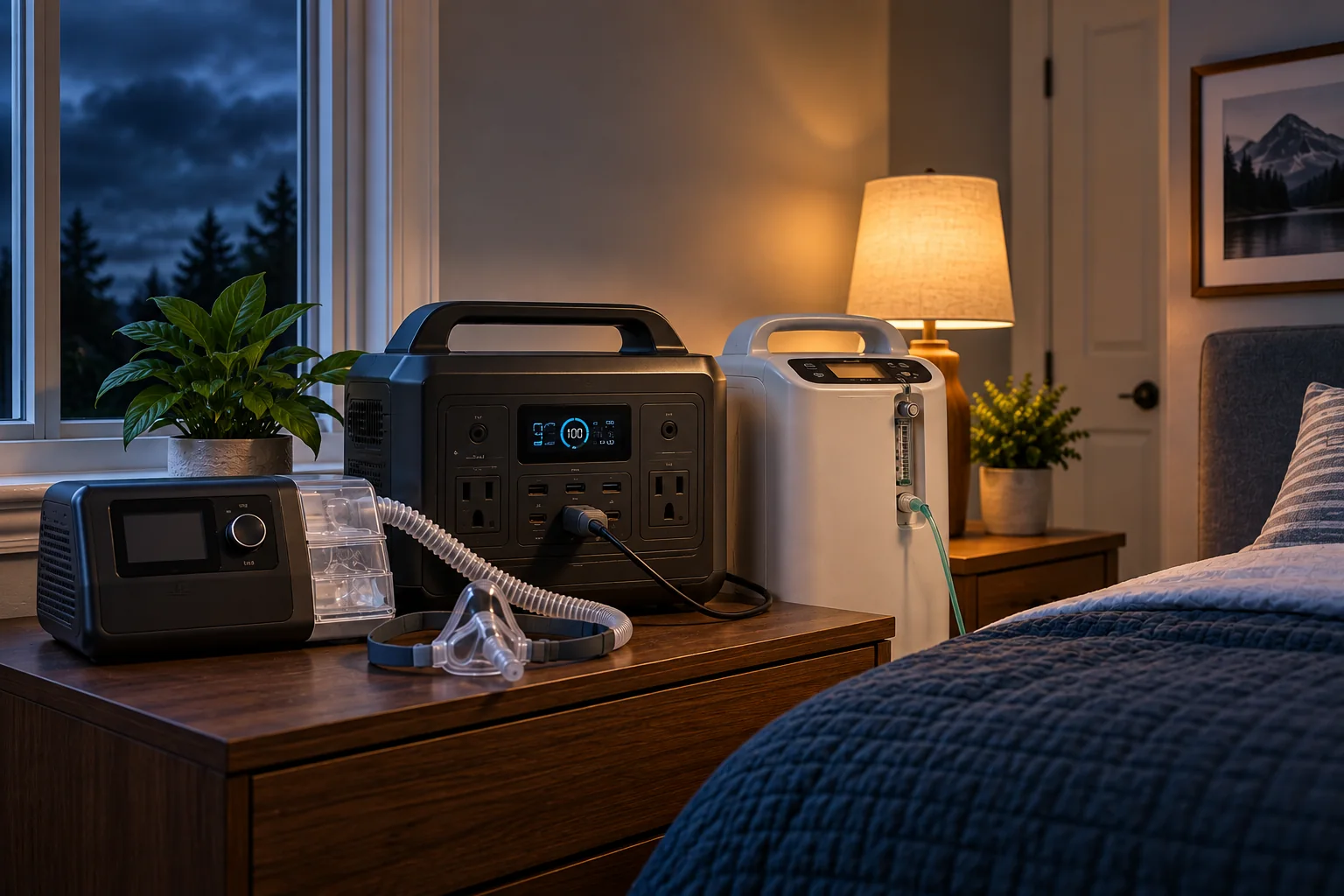
A power outage is inconvenient when it shuts off the television or leaves you charging a phone from the car. It becomes a very different problem when the equipment losing power helps you breathe.
CPAP and BiPAP machines, oxygen concentrators, nebulizers, ventilators, and other electrically powered medical devices can turn backup electricity from a convenience into an essential part of emergency planning. Modern batteries, portable power stations, generators, UPS systems, and manufacturer-specific backup accessories provide several ways to keep critical equipment operating, but the right solution depends heavily on the device.
A CPAP machine that operates only overnight presents a very different backup-power problem from a stationary oxygen concentrator that may run for many hours or continuously.
Quick answer: A CPAP machine can often be backed up overnight with a relatively modest battery or portable power station, although heated humidification and heated tubing can substantially increase energy use. A stationary oxygen concentrator generally requires much more stored energy and may need a larger battery system, generator, or another manufacturer-approved contingency during an extended outage. Always verify power requirements and compatibility using the documentation for your exact medical device.
This guide explains how much backup power CPAP and oxygen equipment can require, how to calculate battery runtime, when a UPS or portable power station makes sense, how generators and solar fit into a longer outage plan, and why medical backup power should always include a second plan behind the first one.
Why Medical Equipment Needs a Backup Power Plan
A power outage does not have to last for days to create a serious problem for someone who depends on electrically powered medical equipment. Severe storms, utility failures, hurricanes, wildfires, vehicle accidents, equipment failures, and planned shutoffs can interrupt service with little warning.
The Centers for Disease Control and Prevention recommends that people who rely on home medical equipment create an emergency power plan and identify backup or alternative power sources.
The U.S. Food and Drug Administration similarly recommends checking the instructions for your medical device or contacting its manufacturer or distributor to determine whether the equipment can safely operate from batteries or a generator.
That distinction matters. A battery having a 120V outlet does not automatically mean every medical device should be connected to it. Voltage, waveform, grounding, power-supply requirements, manufacturer-approved adapters, battery behavior, and other electrical requirements may matter.
If a device is required to sustain life, backup electricity should also be only one layer of the emergency plan. FDA guidance advises people who depend on life-sustaining medical equipment to know how to obtain emergency help if the equipment cannot continue operating.
The objective is redundancy:
- If utility power fails, another source is ready.
- If the first backup runs out or fails, another option exists.
- If electrical backup cannot be maintained, you already know what medical contingency comes next.
Our guide to building a power-outage plan before the lights go out covers the broader household side of outage preparation.
CPAP vs. Oxygen Concentrator: The Backup-Power Problem Is Very Different
CPAP machines and oxygen concentrators are both associated with respiratory care, but their electrical requirements can be dramatically different.
A CPAP machine uses a blower to maintain prescribed airway pressure while a person sleeps. Depending on the machine, pressure, humidifier settings, heated tubing, mask leak, and other accessories, energy consumption may be modest enough that a portable battery can provide one or more nights of operation.
An oxygen concentrator continuously separates oxygen from room air and delivers oxygen at the prescribed flow or dose. A stationary concentrator may operate for many hours or continuously and can consume hundreds of watts while doing it.
For example, Philips lists an average power consumption of approximately 350 watts for its EverFlo stationary oxygen concentrator.
At an average 350W load:
| Operating time | Energy required before losses |
|---|---|
| 2 hours | 700Wh |
| 4 hours | 1,400Wh |
| 8 hours | 2,800Wh |
| 12 hours | 4,200Wh |
| 24 hours | 8,400Wh |
Those figures do not account for inverter losses, battery reserve, or changing equipment demand. They simply demonstrate the scale of the problem.
A roughly 1,000Wh portable power station that could potentially provide several nights of service for a modest CPAP load would provide only a fraction of a day for a continuously operating 350W oxygen concentrator.
The correct question is therefore not simply:
“Will a portable power station run medical equipment?”
It is:
“Will this power source safely operate my exact device, at my settings, for the amount of time I need?”
How Much Power Does a CPAP Machine Use?
There is no single universal CPAP wattage.
Power consumption varies with the machine, therapy pressure, humidifier settings, heated tubing, operating mode, mask leak, and whether the device is being powered through AC or an approved DC converter.
Manufacturer documentation illustrates why generic internet wattage charts should be treated only as rough planning tools. ResMed provides battery and power-converter information for compatible CPAP equipment, including model-specific accessories rather than one universal power solution.
Heated humidifiers and heated tubing can change the calculation
One of the biggest differences between minimal CPAP operation and normal comfortable operation is heating.
A blower moving air requires electricity, but heating water in a humidifier and maintaining temperature in heated tubing can substantially increase energy consumption.
During an extended outage, some users may be able to increase battery runtime by disabling optional heating features if their medical provider and device instructions allow it.
Do not change prescribed therapy settings simply to conserve electricity. Humidity and comfort functions are different from therapeutic pressure, oxygen, or other prescribed settings.
How to Calculate CPAP Battery Runtime
Backup power becomes much easier to understand when you separate power from energy.
Watts describe how much power the device is consuming at a particular time.
Watt-hours describe how much energy is stored in a battery or consumed over time.
The basic calculation is:
Device watts × operating hours = watt-hours consumed
Suppose, purely as a planning example, that a CPAP averages 40 watts during the night.
For eight hours:
40W × 8 hours = 320Wh
For ten hours:
40W × 10 hours = 400Wh
That does not mean a 320Wh battery is automatically sufficient for eight hours. Battery and inverter systems are not perfectly efficient, advertised battery capacity is not always entirely available as AC output, temperature can affect performance, and designing a medical backup plan around reaching exactly 0% capacity is unnecessarily aggressive.
If the same CPAP instead averages 70W because of its machine, settings, humidifier, or heated tubing:
70W × 8 hours = 560Wh
That is why the actual equipment matters.
Once you know your device’s approximate demand, use the Home Power Matrix Battery Runtime Calculator to compare different battery capacities and loads.
For a deeper explanation of usable capacity, inverter losses, battery aging, and why advertised watt-hours do not translate perfectly into runtime, see how battery runtime actually works.
What Size Portable Power Station Do You Need for a CPAP?
For overnight CPAP backup, battery capacity is often one of the most important specifications once you have confirmed that the power source is compatible with the machine.
A useful way to think about power stations is in broad capacity classes:
| Nominal battery capacity | How to think about it for CPAP backup |
|---|---|
| 200–300Wh | Compact emergency or travel class; runtime may be limited, especially when heating features are used |
| Around 500Wh | Greater overnight flexibility and capacity for small additional loads |
| Around 1,000Wh | Potential for multiple nights depending on actual CPAP consumption and settings |
| 2,000Wh+ | Long-duration backup or capacity shared among several essential loads |
These are capacity categories, not guaranteed CPAP runtimes.
A 1,000Wh battery running a 30W average load presents a completely different problem from the same battery powering an 80W average load.
Popular roughly 1kWh LiFePO4 power stations include the Jackery Explorer 1000 v2 and EcoFlow DELTA 2. They provide much more capacity than a small dedicated CPAP battery while remaining portable enough for home emergency use.
You can view the Jackery Explorer 1000 v2 on Amazon or the EcoFlow DELTA 2 on Amazon.
Before buying any power station specifically for medical-device use, verify compatibility with the device manufacturer and confirm that its usable runtime provides adequate reserve.
Our guide to what a 2,000-watt portable power station can actually run also explains the important difference between inverter output and battery capacity.
Dedicated CPAP Batteries vs. Portable Power Stations
A dedicated CPAP battery and a general-purpose portable power station solve related but different problems.
A dedicated CPAP battery may be smaller, lighter, designed specifically around compatible CPAP machines, and easier to travel with. Manufacturer-approved batteries and power accessories can also remove much of the uncertainty surrounding voltage and compatibility.
A portable power station usually provides greater capacity and can also power lights, communications equipment, phones, chargers, and other emergency loads. Larger models can often recharge from solar panels, generators, or vehicle power during longer outages.
In many cases, the strongest strategy is not choosing one or the other.
It may be:
Dedicated battery for immediate backup + larger power station for extended runtime.
If you are shopping specifically for a battery designed around CPAP use rather than general emergency power, you can browse CPAP backup batteries on Amazon.
Compatibility varies by machine, so verify the exact CPAP model before purchasing.
Can a UPS Run a CPAP Machine?
A UPS, or uninterruptible power supply, is designed to keep connected electronics operating when utility power suddenly fails.
Its biggest advantage is automatic switchover.
If the power disappears at 2:17 a.m., a suitable UPS can prevent the need to wake up, find a flashlight, locate a battery, and reconnect the CPAP in the dark.
The limitation is usually runtime.
Many computer-oriented UPS units are designed primarily to provide minutes rather than an entire night of operation. A larger unit may provide substantially longer runtime under a small CPAP load, but its actual capacity still has to be compared with the device.
A pure-sine-wave UPS such as the CyberPower CP1500PFCLCD on Amazon is one example of the category. Its suitability and runtime still depend on the exact connected equipment.
A UPS can therefore make an excellent first layer even when it is not the entire backup strategy:
Grid power → UPS or battery → CPAP
For an extended outage, a larger power station, generator, or another approved backup source can take over before the smaller UPS battery is depleted.
Backup Power for a Stationary Oxygen Concentrator
Oxygen concentrators deserve a more conservative approach because both their electrical requirements and medical role can make backup planning substantially more demanding.
A stationary concentrator may consume several hundred watts continuously. Unlike a CPAP machine that may primarily operate during sleep, oxygen may be prescribed for much longer periods.
This changes battery sizing dramatically.
Consider a hypothetical 350W continuous load and a nominal 3,000Wh battery.
Even before accounting for conversion losses:
3,000Wh ÷ 350W = about 8.6 hours
Actual runtime would normally be lower.
This is why long-duration oxygen-concentrator backup may require some combination of:
- A large portable power station
- Expandable battery storage
- A permanently installed home battery
- A generator
- Solar charging
- Manufacturer-approved portable oxygen equipment
- Stored oxygen or another emergency option prescribed by the provider
- Relocation to a location with reliable electricity
Do not reduce prescribed oxygen settings simply to extend battery runtime unless instructed to do so by the appropriate healthcare professional.
For larger storage options, see our guide to home battery backup systems.
Portable Oxygen Concentrators Have Different Backup Options
Portable oxygen concentrators frequently contain internal or removable rechargeable batteries, giving them an inherent advantage during short outages.
Some models also support:
- Additional battery packs
- External battery chargers
- Vehicle charging
- AC adapters
- DC adapters
However, these accessories are normally model-specific.
Battery runtime can also change substantially according to prescribed oxygen setting and operating mode. A manufacturer’s advertised maximum runtime may represent a particular test condition and should not automatically be assumed to be the runtime available at your prescribed setting.
If a portable oxygen concentrator is part of your outage strategy, verify:
- Battery runtime at your prescribed setting
- How many charged batteries you have available
- How long each battery takes to recharge
- Whether batteries can charge while the concentrator operates
- Whether vehicle charging is supported
- Whether the manufacturer permits operation from an inverter, UPS, generator, or portable power station
- What contingency your oxygen supplier recommends if electrical power cannot be maintained
Extra device-specific batteries and approved accessories can be valuable, but this is a category where compatibility matters more than bargain hunting.
Can You Run an Oxygen Concentrator From a Portable Power Station?
Potentially, yes—but two separate requirements must be satisfied.
First, the power station must provide enough output.
Its inverter needs to support the concentrator’s electrical demand while meeting its voltage, waveform, and other requirements.
Second, the battery must contain enough energy.
A power station with a 2,000W inverter might have far more than enough output for a 350W concentrator but still contain only 1,000Wh of stored energy.
Under idealized conditions:
1,000Wh ÷ 350W = about 2.9 hours
Actual usable runtime would generally be shorter.
This distinction between watts and watt-hours is one of the most important concepts in medical backup planning.
A giant inverter rating does not create additional battery capacity.
For more on output limits, surge ratings, and continuous capacity, see our guide to starting watts vs. running watts.
Measure Your Real Medical-Device Power Consumption
Manufacturer specifications should come first, but real-world measurements can also be useful for compatible plug-in equipment.
A plug-in electricity monitor can show how much energy a 120V device consumes over an entire night rather than forcing you to estimate runtime from one instantaneous wattage figure.
For example, if a CPAP consumes 310Wh during eight hours of actual operation, you now have a much stronger basis for selecting battery capacity.
The P3 Kill A Watt electricity monitor on Amazon is one familiar example.
However, measurement has limits.
- Use plug-in monitors only with equipment for which their use is appropriate.
- Do not defeat grounding or other safety features.
- A single night’s consumption may not represent every set of conditions.
- Consumer meters may not perfectly capture very brief electrical transients.
A useful hierarchy is:
- Read the medical-device documentation.
- Verify manufacturer backup-power guidance.
- Measure actual energy consumption when appropriate and safe.
- Add reserve instead of sizing the battery to theoretical perfection.
AC vs. DC Power Can Affect Battery Runtime
Portable power stations normally store electricity internally as DC power.
When you use a normal 120V AC outlet, the power station’s inverter converts the battery’s DC electricity into AC. The medical device’s external power supply may then convert that AC back into DC.
Each conversion introduces some loss.
Certain medical devices have manufacturer-approved DC adapters that allow them to operate directly from a suitable DC source. When specifically supported by the manufacturer, this can reduce conversion losses and potentially increase runtime.
ResMed, for example, offers model-specific DC/DC converters for several of its CPAP products.
This does not mean an arbitrary third-party cable with the correct-looking connector is safe.
Use manufacturer-approved or manufacturer-specified charging and power equipment when required.
Readers looking for a specific adapter can browse CPAP DC power adapters on Amazon, but verify voltage, connector, polarity, wattage, and exact machine compatibility before purchasing.
Does a CPAP Need Pure Sine Wave Power?
There is no responsible universal answer for every CPAP machine ever manufactured.
Some equipment and accessories may have specific requirements regarding inverter waveform. Manufacturer documentation should determine what is acceptable for your particular machine.
Pure sine wave output more closely resembles normal utility AC than modified sine wave output, and many modern portable power stations already use pure sine wave inverters.
That makes pure sine wave a sensible feature to look for in a general-purpose medical backup power station, but the phrase itself is not a substitute for checking the device manual.
Power quality can also matter when generators are used with sensitive electronics. Our guide to generator total harmonic distortion and power quality explains what THD means and why inverter generators and battery systems are often considered for sensitive loads.
Should You Use a Generator for Medical Equipment?
A portable generator can provide far longer runtime than a standalone battery as long as fuel remains available.
For households with high-energy medical equipment or outages lasting multiple days, a generator can therefore become an important second or third layer of the backup plan.
However, generators introduce additional risks.
Portable generators produce carbon monoxide, a colorless and odorless gas that can cause severe illness or death.
The CDC warns that portable generators must be operated outdoors. CDC guidance recommends keeping generators at least 20 feet from the home and away from doors, windows, and other openings.
Never run a portable generator:
- Inside a home
- Inside a garage
- Inside a basement
- Inside a shed
- Near an open door or window
Battery-powered or battery-backup carbon-monoxide alarms are especially important when generators or other combustion equipment are part of the outage plan.
You can view battery-powered Kidde carbon-monoxide alarms on Amazon.
The generator itself also needs to have sufficient capacity for the medical equipment and every other load operating at the same time.
Our generator size calculator can help estimate overall household demand, while our guide to essential circuits worth backing up first explains why medical equipment should generally be prioritized over discretionary loads.
Generator + Battery Can Be Better Than Running the Generator All Night
A generator and portable power station do not necessarily compete with one another.
They can complement each other.
One useful extended-outage strategy is:
Generator → recharge battery → battery quietly powers medical equipment
The generator can operate safely outside during the day to recharge the battery and support larger household loads.
At night, the battery can power smaller equipment indoors without engine noise, exhaust, or continuously consuming generator fuel.
It also creates redundancy. If the generator needs fuel, maintenance, or temporary shutdown, stored battery energy provides a buffer.
Our full portable power station vs. generator comparison covers the strengths and limitations of both technologies.
Solar Can Extend Medical-Device Battery Backup
Portable solar panels can add another layer to an extended-outage system by replenishing compatible batteries without fuel.
They can be especially useful with relatively low-demand equipment such as CPAP machines.
If a CPAP consumes several hundred watt-hours overnight, a sufficiently sized solar array under favorable conditions may be able to replace much or all of that energy during the following day.
Higher-demand medical equipment changes the equation.
A stationary oxygen concentrator consuming several kilowatt-hours per day cannot realistically be supported indefinitely by one small portable solar panel.
Solar output depends on:
- Panel wattage
- Available sunlight
- Season
- Cloud cover
- Shade
- Panel orientation
- Temperature
- Charge-controller limits
- Battery charging limits
Think of solar as a way to extend and replenish stored energy, not as unlimited electricity.
You can browse portable solar panels for power stations on Amazon.
For medically important equipment, do not build the entire emergency plan around the assumption that tomorrow will provide perfect sunshine.
Build Medical Backup Power in Layers
The strongest medical-power plan does not depend on one battery.
A useful layered arrangement may look like this:
Layer 1: Immediate backup
An internal battery, dedicated medical-device battery, or suitable UPS keeps equipment operating when utility power initially fails.
Layer 2: Extended battery backup
A larger portable power station provides additional stored energy for hours or potentially days, depending on the equipment.
Layer 3: Recharging
Solar panels, a safely operated generator, vehicle charging, or restored utility power recharge the battery system.
Layer 4: Medical contingency
You already know whom to call, where to go, and what provider-approved alternative will be used if backup electricity cannot be maintained.
That is much more resilient than buying the largest battery you can afford and hoping the outage ends before its display reaches zero.
What Else Belongs in a Medical Power-Outage Kit?
Electricity is only one part of the system.
Depending on the medical equipment and household, a practical outage kit may include:
- Compatible spare medical-device batteries
- Manufacturer-approved AC and DC adapters
- A portable power station
- A suitable UPS
- Flashlights or battery-powered lanterns
- Battery-powered carbon-monoxide alarms
- Approved extension cords if a generator is part of the plan
- Device manuals
- Emergency contact information
- Spare cannulas, masks, tubing, filters, or other consumable supplies as appropriate
- A written record of important device settings
CDC’s emergency power checklist similarly recommends backup batteries, power banks, adapters, emergency lighting, carbon-monoxide detectors, and generator planning.
Prepare and charge equipment before severe weather arrives instead of beginning the process after the lights go out.
Make a Written Medical-Device Power Plan
For every electrically powered medical device in the household, record:
- Manufacturer and exact model
- Normal source of power
- Voltage and electrical requirements
- Typical measured energy consumption, if appropriate and available
- Internal battery runtime
- Approved external batteries or accessories
- Portable power-station capacity
- Estimated backup runtime
- How the battery will be recharged
- Medical-equipment supplier contact information
- Healthcare-provider contact information
- Utility and emergency contact information
- The plan if backup electricity cannot be maintained
Keep a paper copy somewhere accessible.
A beautifully organized emergency plan trapped inside a dead smartphone has certain logistical shortcomings.
FDA even provides a printable power-outage planning booklet for home medical devices.
FDA guidance also notes that some medical equipment can reset when power is interrupted, so check the device after electricity returns and make sure settings have not unexpectedly changed.
Test the Backup System Before You Actually Need It
The worst time to discover that a cable does not fit, the battery shuts down unexpectedly, or a concentrator consumes more power than you expected is during an actual blackout.
Following manufacturer or equipment-provider guidance as appropriate, test the backup configuration ahead of time.
Confirm that:
- The medical device operates normally from the backup source.
- The required cables and adapters are available.
- You know how much battery capacity is consumed during realistic use.
- Automatic switchover works if you depend on it.
- You know how and where the battery will be recharged.
- Everyone who may need to operate the system understands the plan.
Recharge stored batteries periodically and follow manufacturer storage recommendations.
Lithium-ion and LiFePO4 batteries slowly discharge in storage, and battery capacity also changes with age, temperature, charge state, and use.
An emergency battery purchased several years ago and never tested is not a dependable backup plan.
It is a mystery box with an LCD screen.
Frequently Asked Questions
Can a portable power station run a CPAP machine?
Many portable power stations can operate compatible CPAP machines, but runtime depends on the CPAP’s actual energy consumption, battery capacity, conversion losses, humidifier and heated-tube use, and other settings. Verify compatibility with the CPAP manufacturer before relying on a power station for backup.
What size battery do I need to run a CPAP for eight hours?
Calculate the CPAP’s average wattage or measured energy consumption and multiply it by eight hours. A device averaging 40W would theoretically consume about 320Wh in eight hours, but additional capacity should be allowed for conversion losses and reserve. Actual CPAP consumption varies by machine and configuration.
Will a 500Wh power station run a CPAP overnight?
It may. A low-demand CPAP configuration could potentially operate overnight from a 500Wh battery, while greater consumption from humidification, heated tubing, pressure settings, or other factors can reduce runtime. Use the power requirements of your own equipment instead of assuming a fixed runtime.
How long will a 1,000Wh power station run an oxygen concentrator?
Runtime depends on the concentrator’s electrical demand and the battery’s usable capacity. A hypothetical 350W continuous load would theoretically consume 1,000Wh in less than three hours even before real-world conversion losses are considered.
Can an oxygen concentrator run on a generator?
Some oxygen concentrators can operate from an appropriate generator, but the manufacturer or medical-equipment provider should confirm compatibility and electrical requirements for the specific model. Portable generators must always be operated safely outdoors because of carbon-monoxide risk.
Can solar panels power a CPAP machine?
Solar panels can recharge a compatible battery or portable power station that later powers a CPAP. Because solar output varies throughout the day and CPAP equipment is typically used overnight, battery storage normally provides the stable source of power while solar replenishes it during daylight.
Should I turn off my CPAP humidifier during a power outage?
Heated humidification and heated tubing can increase electricity consumption. Disabling optional heating features may extend battery runtime on some systems when permitted by the device instructions and medical guidance. Do not alter prescribed therapeutic settings solely to conserve electricity.
Can I plug medical equipment into any portable power station?
No. Verify voltage, output type, battery capacity, waveform requirements, approved accessories, and manufacturer guidance for the exact medical device before relying on a portable power station.
Is a UPS better than a portable power station for CPAP backup?
A UPS offers automatic switchover when utility power fails, while a portable power station typically provides much greater stored energy. Some households may benefit from using both: immediate UPS protection followed by a larger battery during an extended outage.
How should I calculate backup battery runtime?
A basic estimate starts with battery watt-hours divided by the device’s average watts, then adjusts downward for inverter losses, reserve capacity, and other real-world conditions. The Home Power Matrix Battery Runtime Calculator can help compare different loads and battery sizes.
The Medical Backup-Power Rule Worth Remembering
Do not start by shopping for a battery. Start with the medical device. Determine exactly what it requires, how much energy it consumes, how many hours you need to cover, and which backup sources the manufacturer permits. Then build enough capacity—and enough redundancy—that one depleted battery does not become the entire emergency plan.
For a CPAP user, that might mean a dedicated battery combined with a larger portable power station capable of covering several nights.
For someone relying on a stationary oxygen concentrator, it may mean a substantially larger battery system backed by a generator, solar charging, approved alternative equipment, and a clear medical contingency if the outage continues beyond the available stored energy.
The equipment and numbers will be different for every household.
The principle remains the same:
Know the load. Calculate the runtime. Verify compatibility. Leave reserve. Have another plan behind the first one.